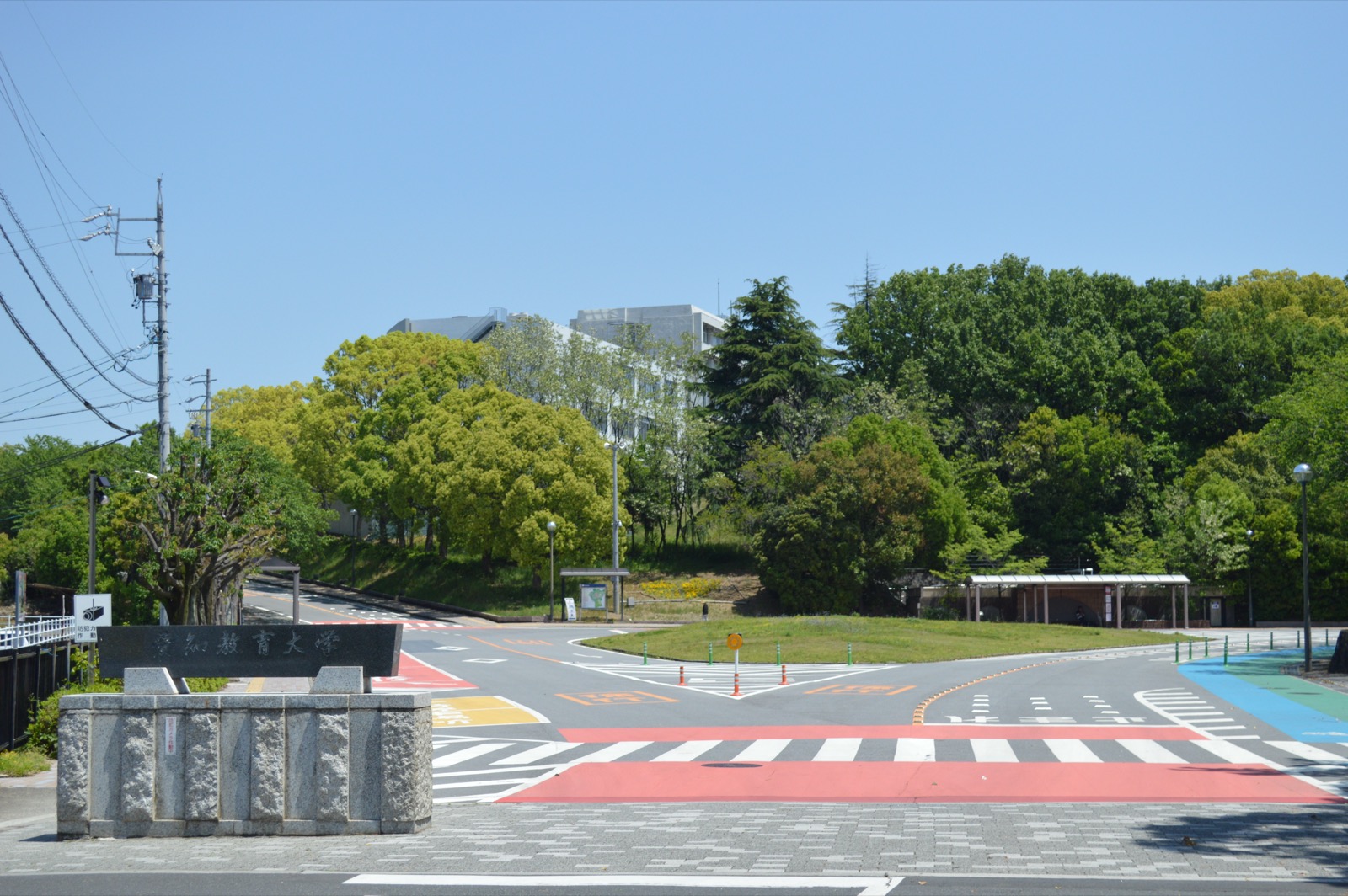
Aichi Kyoiku Daigaku
愛知教育大学
ClosedAll applications for April 2027 entry have closed · new deadlines appear here when next year's guidelines come out
- Exam location
- Campus in Japan ›
- Japanese requirement
- Take the EJU (no minimum score) ›
- First-year fees
- from ¥872,460 ›
Compare with other universities →
Fees and conditions can change over time. Always check the school's guidelines before you apply.
Fees and conditions can change over time.
About the school
A national university founded in 1949. It has 3,954 students, including 21 international students (undergraduate 0 · graduate 21). There are 192 faculty members.
History · 5
- 1873
- Aichi Prefectural Training School opened. It was the origin of Aichi Kyoiku Daigaku.
- 1949
- Aichi First Normal School, Aichi Second Normal School, and Aichi Youth Normal School are integrated, and Aichi Gakugei University is established as a new national university with one Faculty of Arts and Sciences.
- 1966
- Name changed to Aichi University of Education and Faculty of Education
- 1987
- A part of the capacity of the teacher training course (approximately 40%) was transferred and a general science course was established.
- 2004
- Aichi University of Education, a national university corporation, was established in accordance with the enforcement of the National University Corporation Law.
大学改革支援・学位授与機構「大学基本情報」2026(R8) (7-A) 学生数 · 大学改革支援・学位授与機構「大学基本情報」2026(R8) (11) 国費留学生,私費留学生,留学生以外の外国人学生 · 大学改革支援・学位授与機構「大学基本情報」2026(R8) (7-B) 教員数(本務者)
Admission requirements and dates
Aichi Kyoiku Daigaku admits international students through 1 route.Based on the guidelines for April 2027 entry
EJUThe exam Japanese universities use for international student admission · June and November · also held outside Japan = Examination for Japanese University Admission · JLPTJapanese-Language Proficiency Test · N1 is the highest, then N2 = Japanese-Language Proficiency Test
Comprehensive selection (for international students)
Official name: 総合型選抜
This is a selection for international students at national universities aiming to train teachers. This program is open to those who do not have a permanent residence permit in Japan and can promise to enroll if they pass the exam, and those living abroad can also apply by mail.
Applications for this year have closed — below are the remaining dates for those who applied
9/4~9/17 Application · 10/24 Exam
- Apply 9/4~9/17
- →
- Exam 10/24
- →
- Results 11/13
- →
- Enroll ~12/47 days left
Applications must be completed by registering online (from 9:00 a.m. on September 4, 2026 to 5:00 p.m. on September 16, 2026), paying the examination fee (until 11:59 p.m. on September 16, 2026), and mailing application documents (must arrive from September 11 to 5:00 p.m. on September 17). Enrollment procedures must be completed by 16:00 on Friday, December 4, 2026. Instructions on how to pay tuition fees are provided in the admission procedure guidelines.
EJU subjects · Take the Examination for Japanese University Admission for International Students (EJU) for either liberal arts or science majors. Science consists of 4 subjects in 3 subjects: Japanese, science (2 subjects from physics, chemistry, and biology), and mathematics (course 1 or course 2). The humanities include three subjects: Japanese, general subjects, and mathematics (course 1 or course 2). Japanese language subjects do not include writing. Test language is Japanese or English
Valid sittings · Either the November 2025 implementation (November of the previous year) or the June 2026 implementation (June of the current year). Depending on the implementation status of EJU 2026, the requirements may be relaxed, and in that case, it will be announced on the university website.
Other requirements · A foreigner who does not have a permanent residence permit in Japan. Persons who have completed a 12-year course in school education in a foreign country (including those expected to complete by March 31, 2027) or equivalent persons designated by the Minister of Education, Culture, Sports, Science and Technology; holders of International Baccalaureate, Abitur, Baccalaureate, GCE A-level, International A-level, European Baccalaureate qualifications; persons who have completed a 12-year course at an educational facility accredited by an international evaluation organization. Those who have a status of residence that does not hinder university admission, and who can guarantee that they will enroll if they are successful.
Good to know before applying
- This applies to foreigners who do not have a permanent residence permit in Japan. A residence status that does not hinder university admission is required.
- Applicants are those who can guarantee that they will enroll if they pass. In principle, those who pass the comprehensive selection cannot decline admission, but if it is unavoidable, please submit a "request to decline admission" with reasons by Friday, December 4, 2026, and receive permission from the university president.
- Application documents must be submitted by mail and must arrive by 5:00 pm on Thursday, September 17, 2026 (simplified registered express delivery). If applying from outside Japan, send by a traceable method such as EMS. Even if you live in a foreign country, please use the address of an acquaintance in Japan as your contact information.
- The letter of recommendation is prepared by the principal or supervisor of the high school from which the student graduated (or is expected to graduate). Items from Japanese language schools are not accepted.
- The minimum standard score is 1/3 of each allocated score and 1/2 of the total score, and if it does not meet, it will be rejected.
- When accepting foreign students, we conduct strict examinations based on security export control regulations. If you fall under the regulations, you may not be able to receive the education you desire or conduct your research.
- Even if you fail, you can take the general selection test by taking the 2027 University Entrance Common Test (separate entrance examination fee required).
- If you decline admission after completing the admission procedures, the paid admission fee will not be refunded for any reason. Application documents received will not be returned.
愛知教育大学 総合型選抜
Fees
- First-year fees
- ¥872,460
- Application fee
- ¥17,000
- Admission fee is ¥282,000, miscellaneous fees at the time of enrollment are ¥54,660 (includes 4 years of accident insurance premiums, education and research expenses, university events, employment, extracurricular activities, welfare support expenses only at the time of enrollment), tuition fees are ¥267,900 for the first semester and ¥267,900 for the second semester (¥535,800 per year).
- The total of ¥872,460 for the first year is calculated by adding the admission fee of ¥282,000 + miscellaneous admission fees of ¥54,660 + tuition fees of ¥267,900 for the first semester and ¥267,900 for the second semester (the first year's total is not stated in the guidelines).
- Admission fees and various fees are paid at the time of admission procedures, and instructions on how to pay tuition fees will be given in the admission procedure guidelines.
- If the payment amount is revised at the time of admission or while enrolled, the new amount will be applied from the time of the revision.
- All undergraduate students are required to have a laptop computer for teaching materials.
Places and fees by department 2
| Department | Places | First-year fees (¥) | |
|---|---|---|---|
| Kyouikugakubu | |||
| Gakkou kyouinyousei katei ( youji kyouiku senkou , gimukyouiku senkou , koutougakkou kyouiku senkou , tokubetsu shien kyouiku senkou , yougo kyouiku senkou ) | A few people for each major/specialty (April 2027, admission to 1st year) | ¥872,460 | |
| Kyouiku shien senmonshoku yousei katei ( shinri koosu, fukushi koosu, kyouiku gabanansukoosu ) | Some students for each course (April 2027, admission to 1st year) | ¥872,460 | |
Places are the total across all international student admissions. Fees are for 2027 entry.
For 2027 entry · from the school's guidelines
Documents to prepare
Admission application form, address sheet, application documents checklist (printed from the application site), personal records, letter of recommendation (principal or supervisor of the high school you are expected to graduate from/not applicable to Japanese language schools), high school graduation (completion) certificate or proof of expected graduation Original documents (copies of graduation certificates are not accepted), Japanese EJU results confirmation (held in November 2025 or June 2026), high school transcript, copy of residence card (front and back), or if you are living overseas, a copy of your passport. For music majors, a music practical skill content notification, and for health and physical education majors, a medical certificate with "stress electrocardiogram findings". For foreign language certificates, attach Japanese translation.
Graduate outcomes
How these are counted
Undergraduate graduates only (excluding graduate school graduates). Employed people include self-employed people and indefinite-term workers (Number of graduates by status from NIAD "Basic University Information")
- Employment results for international students alone cannot be found in official materials.
- Of the 894 undergraduate graduates, 646 found employment and 57 went on to further education (April 2025 to March 2026, NIAD "Basic University Information" number of graduates by status).
- Obtaining a teaching license is required for graduation in the school teacher training program at a teacher training university.
University Portraits · figures for all students (not international students only)
Reviews from students
No reviews yet. If you attend or attended this school, please write the first one.
Write a review
Scholarships
- International Exchange Center supports enrolled international students (international student tutor system, awareness and recruitment of private scholarships for international students)
- There is a page with information on admission fee/tuition fee exemptions, deferrals, and scholarships, and it says that Japan Student Services Organization scholarships (grants/loans) are ``excluding international students.'' It is not stated whether foreign students are eligible for tuition fee exemption under the new higher education study support system.
Student life support
- The student dormitory is a self-governing dormitory located on the university campus (32 rooms each in buildings A and B for men and buildings C to F for women, all single rooms, 14 m2).
- Applicants who wish to enter the dormitory should apply according to the admission procedure guidelines provided to successful applicants.
- The dormitory fee is ¥23,850 per month (dormitory fee ¥15,000 + common area fee ¥1,000 + utilities ¥6,200 + repair reserve ¥500 + internet fee ¥1,000 + neighborhood association fee ¥150), and ¥28,200 is required at the time of moving into the dormitory.
- Meals are self-cooked.
- Each expense may increase in the future, and we plan to increase the boarding fee from 2028.
Getting there
- Aichi Kyoiku Daigaku Campus
- Approximately 20 minutes by bus from the north exit of Chiryu Station on the Meitetsu Nagoya Main Line (approximately 25 minutes from Nisshin Station on the Meitetsu Toyota Line, approximately 35 minutes from the north exit of JR Kariya Station) and get off at Aichi Kyoiku Daimae. · Faculty of Education
愛知県刈谷市井ケ谷町広沢1
SALLAE compiled this from the school's admission guidelines and official sources (such as University Portraits).
Photo: Asturio Cantabrio · CC BY-SA 4.0 · Wikimedia Commons
This information is compiled from official sources and is not updated daily. Please confirm with the official contact before signing or applying.