Aichi Kotonoha Gakuin
Aichi Kotonoha Gakuin
- Progression
- University or similar 100% ›
- Dormitory fee
- From ¥25,000 per month ›
- AM & PM classes
- Decided by the school ›
Compare side by side with other schools →
Tuition and conditions may change depending on the intake. If you contact us, we will check with the school and give you accurate details.
Nearby schools comparedBy distance · no ads or paid placement
- Aichi Kotonoha GakuinThis schoolTuition/yr¥830,000Progression100%IntakesApr · Oct
- NW International Academy9.4km›Tuition/yr¥840,000Progression—IntakesApr · Jul
- JP Education10.5km›Tuition/yr¥840,000Progression—IntakesApr · Oct
- Nagoya YWCA Gakuin Japanese Language School11.3km›Tuition/yr¥758,000Progression—IntakesApr · Oct
— means SALLAE has not yet found the data.
About the school
The school offers only two courses, 2-year and 1 year 6 months university-prep, and its educational goal is progression to university or vocational school. In its FY2025 report published on its website, all 68 completers went on to university or similar. It is in Iwakura, Aichi, a 6-minute walk from Daisanji Station on the Meitetsu Inuyama Line, and about 19 minutes by train to Nagoya Station with no transfer. Students are split into morning and afternoon classes by Japanese ability and take four 45-minute periods a day. There is a school dormitory at ¥25,000 per month (6 months paid in advance at move-in).
Published data and school website
Tuition
If you saw a lower amount elsewhere, it may not include the admission fee and application fee
Median 1-year tuition in other areas — Kyoto ¥911,000(7 schools) · Kanagawa ¥880,000(8 schools) · Okinawa ¥858,000(6 schools) · Tokyo ¥840,600(56 schools) · Fukuoka ¥835,000(12 schools) · Hyogo ¥825,500(7 schools) · Osaka ¥814,000(27 schools) · Shizuoka ¥790,000(9 schools) · Chiba ¥745,333(10 schools) · Aichi ¥740,667(5 schools)
Total by intake
| Intake · length | Full course |
|---|---|
| 1 year 6 months | ¥1,150,000 |
| 2 years | ¥1,470,000 |
Cost details · Course tables · Notes
- Per term
- ¥160,000 3 months
- One-time fees
- ¥190,000Application fee · Admission fee
| Duration | Total |
|---|---|
| 1 year 6 months | ¥1,150,000 |
| 1 year 9 months | ¥1,310,000 |
| 2 years | ¥1,470,000 |
★"Per term" and "One-time at start" were calculated by SALLAE from each course's total. The courses this school actually offers are 1 year 6 months onward — all amounts in the table are values calculated by SALLAE.
Calculated by SALLAE · verified 2026-09-16
Whether it is refundable
- Admission fee
- Once paid, the admission fee is not refunded for any reason.
- Withdrawal within 6 months of enrollment
- For withdrawal within 6 months after enrollment, tuition and miscellaneous fees are not settled or refunded.
- CoE issued but no visa applied for and student does not come to Japan
- Conditions: return the admission permit and Certificate of Eligibility. Refund: all payments except the admission fee (if not yet paid, please pay the admission fee).
- If you applied for an entry visa at a Japanese mission abroad but were refused and could not come to Japan
- Conditions: return the admission permit and submit proof from the overseas diplomatic mission that no visa was issued. Refund: all payments except the admission fee.
See refund policy in full · 7 more lines
- If you obtained a visa but declined enrollment before leaving your country
- Conditions: return the admission permit and confirm that the unused visa has expired. Refund: all payments except the admission fee.
- Student who obtained a visa and came to Japan but withdraws without a valid reason
- In principle, no payments are refunded.
- Not enrolling after arriving in Japan
- No payments are refunded.
- Bank transfer fee
- Remittance fees for refunds are borne by the applicant.
- Voluntary withdrawal during the study period, such as for progression
- If you withdraw voluntarily during the study period, for example to go on to further study, and unstudied terms remain, tuition is settled and refunded in units of 6 months (first or second half). Miscellaneous fees are not refunded.
- Classes canceled for unavoidable reasons such as natural disasters, accidents or infectious diseases
- Tuition for canceled classes cannot be refunded.
- Students expelled for violating laws or school rules
- Tuition is not refunded
Admission & dates
- Apr intake
- 2-year course · Apply Aug 1 to end of October · Classes 1560 hr
- Oct intake
- 1 year 6 months course · Apply Feb 1 to early May · Classes 1170 hr
- Japanese level
- Japanese ability of JLPT N5 or above
Japanese ability of JLPT N5 or above, or at least 150 hours of Japanese study / Selection method: a Japanese test equivalent to JLPT N5, and an interview
Deadline and capacity rules
Capacity 225. In principle, applicants must be at least 18 at enrollment, have completed 12 or more years of school education, be able to pay tuition and living costs in Japan, and be in good mental and physical health. 2027 academic year admission guidelines.
School website · Updated 2026-06-05
Classes
- Morning
- 09:00-12:20 4 periods of 45 minutes
- Afternoon
- 13:20-16:40 4 periods of 45 minutes
- AM/PM placement
- Morning or afternoon session is assigned by Japanese ability and posted every 3 months. You can't choose.
Materials · Subjects · Timetable · Details
- Materials
- Materials (including a laptop) are included in the miscellaneous fees, paid in one lump sum in the first year.
Class period times 4 hours a day, 20 hours a week (45-minute periods)
| Morning | Afternoon | |
|---|---|---|
| 1 | 09:00-09:45 | 13:20-14:05 |
| 2 | 09:50-10:35 | 14:10-14:55 |
| 3 | 10:45-11:30 | 15:05-15:50 |
| 4 | 11:35-12:20 | 15:55-16:40 |
JLPT exam fees are included in the miscellaneous fees: 3 times for the 2-year university-prep course, 2 times for the 1 year 6 months course.
School website · Updated 2026-06-05
Documents
- Preliminary survey forms 1 and 2
- Admission application formSchool's prescribed form
- Statement of reason for studying abroadOn the school's designated form) Translation into the applicant's native language and Japanese (a translation is required even if the form is filled in in English)
- Copy of passportIf the applicant has been to Japan before, copies of all pages are also required
- Diploma of final education in the home country, and academic transcriptOriginal) (a translation is required even if written in English). Submit the original (returned after Immigration review is finished)
- Proof of Japanese study history and ability: JLPT or other Japanese test pass certificate (original for JLPT, copy for others) or a certificate of at least 150 hours of Japanese study
- 6 photos (40mm tall × 30mm wide): taken within 3 months of the Immigration application date. Front-facing, upper body, no hat, plain background. Write the applicant's name and date of birth on the back. Preferably wear a white collared shirt.
- Copy of an ID card or family register
Financial supporter's documents · only if applicable · 6 application requirements
Submitted by the person paying the tuition (financial sponsor)
- Financial sponsorship statementSchool-designated form
- Copy of ID
- Documents proving the relationship between applicant and sponsor: family register transcript, birth certificate, residence certificate or other official certificate, or a certificate of kinshipRequired for Nepal
- (Employee) certificate of employment; (company director) certified copy of the corporate registry; (self-employed) business license
- Original bank balance certificate in the financial supporter's name, issued within 3 months of the application date
- Copy of bank passbookPast 1 year
Only if applicable
- Certificate of enrollment (if currently enrolled)
- Certificate of employment (if currently employed)
- Copy of an ID card or family register (showing your place of origin) (If you have no passport)
- Statement of how funds were accumulated (past 3 years) (A statement of how funds were accumulated is required only if there are very few transactions)
- Income certificates (past 3 years) / Documents proving the sponsor's family composition: family register transcript, birth certificate, residence certificate or other official certificate (for sponsors abroad)
- Income tax certificates (past 3 years) / Residence certificate showing all household members (for sponsors in Japan)
Application requirements
The applicant and the financial supporter must prepare the submitted documents themselves. All documents written in a language other than Japanese or English need a Japanese translation. Even if the final-education diploma and transcript are in English, submit a Japanese translation too. In principle, prepare each document issued within the last 3 months. Fill in documents with a black ballpoint pen in clear block-style handwriting. Correct mistakes with a double line, not correction fluid, and add a correction seal or signature. Use A4 paper for each document. Copies must be made at the original's size. Documents other than those above may be requested if necessary.
The application guidelines do not say how much the bank balance certificate must show. SALLAE is confirming this with the school.
School website · Updated 2026-06-05
Admission process
- Request an admission consultation — CONTACT US
- Application — Send the full set of required documents to the school's contact person by EMS or similar, and pay the exam fee. April intake: August to end of October; October intake: February to early May.
- Selection — A written Japanese test and an interview are held; depending on the period, the interview may be online. Late August to early November (April intake); March to mid-May (October intake).
- Document check — The school checks the documents sent and asks for corrections where needed. Missing or incomplete items must be submitted additionally. Until late November (April intake); until early June (October intake).
- Application for the Certificate of Eligibility — The school applies on your behalf to the Nagoya Regional Immigration Services Bureau for the Certificate of Eligibility. Around early December (April intake); mid-June (October intake).
- Issuance of the Certificate of Eligibility — When Immigration grants approval, the Certificate of Eligibility is issued. Around late February (April intake); late August (October intake).
- Tuition payment — The school notifies you of the result. Pay the admission fee, tuition and other costs within 2 weeks of notification.
- Documents sent — After payment is confirmed, the Certificate of Eligibility, admission permit and other documents are sent by EMS, within 3 business days of the tuition due date.
- Visa application — Apply for a visa at the Japanese embassy or consulate in your country. Around mid-March (April intake); mid-September (October intake).
- Entry into Japan — Book a flight for the entry date designated in advance, and tell the school your entry date and arrival flight. Early April (April intake); early October (October intake).
School website · Updated 2026-06-05
Graduate outcomes
| FY2025 | Admitted |
|---|---|
| Employment | 7 students |
| Graduates | 68 students |
68 course completers, 68 meeting the criteria (100.0%) / 2-year progression course 41, 3, 40; 1-year 6-month course 27, 4, 29 (a, b, c) · b. Changes of status of residence approved: 2-year progression course 3, 1-year 6-month progression course 4 · School website · Updated 2026-06-01
Reviews
If you study here or used to, tell others what the classes, teachers and daily life were like. It helps anyone deciding on this school.
Write the first reviewUniversity prep
- Open campuses and progression fairs — Encourages students to attend open campuses and progression fairs according to their skills, and supports progression to university or vocational school.
- Team progression counseling — Teachers consult as a team and support progression to vocational school or university. Student-life and career guidance help students set goals.
- Interview and resume coaching — An interview with a teacher on the recruitment page says career guidance included interview practice and help writing resumes.
School website · Confirmed 2026-09-26
Daily-life support
- Airport pickup — Free if your arrival date is one the school designates; ¥20,000 per person on other dates. Only for arrivals at Chubu Centrair International Airport.
- National Health Insurance — International students staying in Japan must join National Health Insurance. National Pension premiums of about ¥15,000 per year are required.
- Accident insurance, health checkup — Accident insurance and health checkup fees are included in the miscellaneous fees paid in the first year.
- Dorm, part-time work, visa — The school reportedly supports problems students face, such as dormitory, part-time work and visa issues (teacher recruitment page).
School website · Updated 2026-06-05
Students
152 enrolled (2025) · Capacity 150 National median: 180 students
Based on 152 students enrolled in 2025.
Public data from the Association for the Promotion of Japanese Language Education (Nisshinkyo) · verified 2026-09-20
School life
- A wide range of school events through the year (New Year calligraphy, karuta, Setsubun, etc.)
- Various field trips (famous sites and historic places, factory tours, etc.)
- Also through taking part in local festivals and events, and cultural exchange with local residents and companies
On campus
- All rooms
- Heating and air conditioning — Heating and air conditioning in every room
School website · 2026-06-11 updated
Access
- Transit
- Meitetsu Inuyama Line, Daisenji Station, 6 min walk
- Nearby
- Nagoya Station to Daisanji Station: about 19 minutes by train. Chubu Centrair International Airport Station to Daisanji Station: about 60 minutes by train. The Gojo River, a famous cherry-blossom spot, is in Iwakura.
- Dormitory
- Available¥25,000 per month · Dorm fee (¥25,000 per month) / total initial cost ¥240,000 (including 6 months of dorm fees) / utilities at actual cost · Based on school website
School website · 2026-06-11 updated
Dorm — Room entry fee ¥40,000, dormitory deposit ¥50,000 and 6 months of dorm fees ¥150,000 (¥25,000 per month) are paid in advance at move-in (no installments). Rent starts from the 7th month. Utilities at actual cost.
School website · Updated 2026-06-05
SALLAE has organized the school website and published data in English.
The update date is the day that material was last revised.
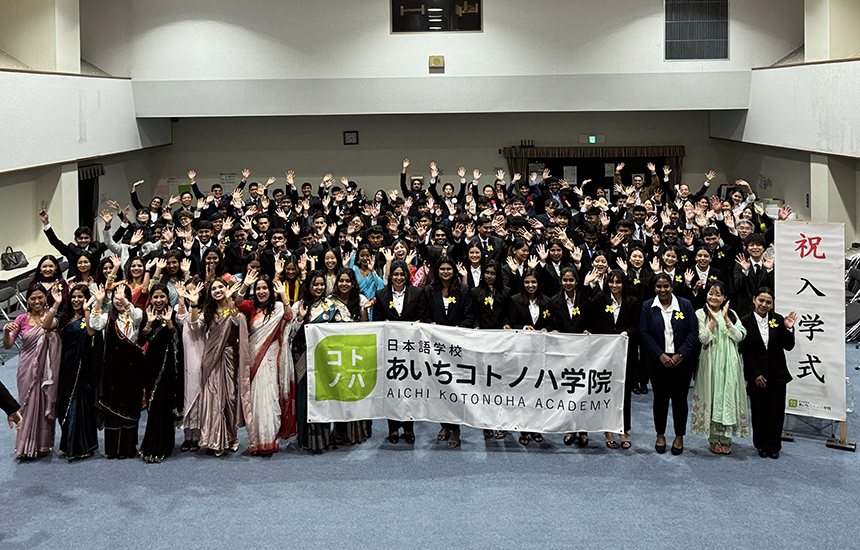
Photos are materials published by the school.
This information is compiled from official sources and is not updated daily. Please confirm with the official contact before signing or applying.