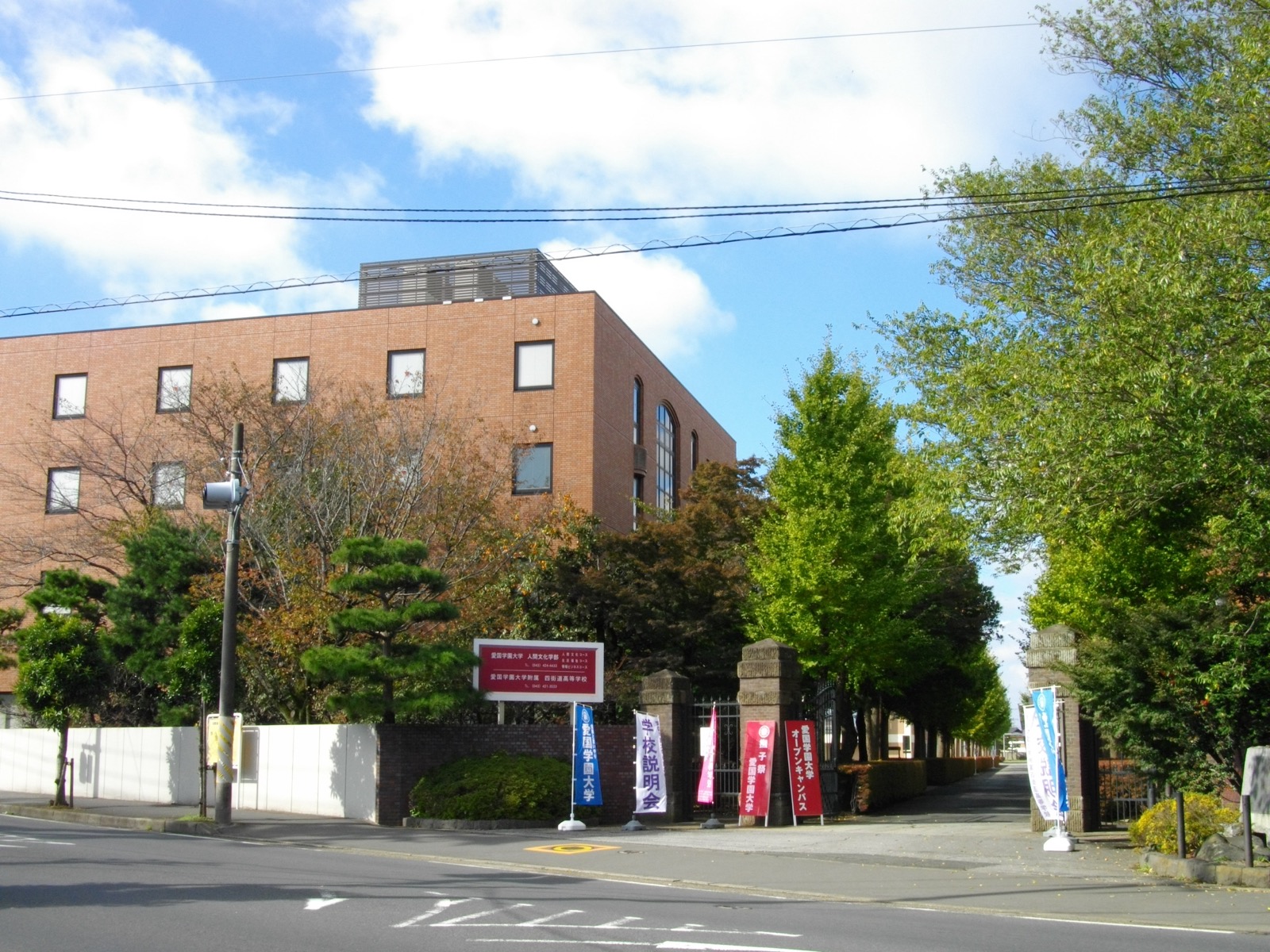
Aikoku Gakuen Daigaku
愛国学園大学
Opening soonApplications open 12/15 · Foreign student selection Japanese proficiency evaluation type (I to IV)
- Exam location
- Campus in Japan ›
- Japanese requirement
- EJU Japanese 260+ (out of 450) ›
- First-year fees
- from ¥920,000 ›
Compare with other universities →
Fees and conditions can change over time. Always check the school's guidelines before you apply.
Fees and conditions can change over time.
About the school
A private university founded in 1998. It has 53 students. There are 18 faculty members.
History · 4
- 1938
- Aikoku Gakuen is established and Aikoku Girls' Commercial School is opened.
- 1998
- On the 60th anniversary of Aikoku Gakuen, Aikoku Gakuen University opens in Yotsukaido City, Chiba Prefecture as the Faculty of Human Culture.
- 2021
- Starting in 2021, we will open four majors: “Psychology/Lifestyle,” “Business,” “Community Coexistence,” and “Understanding Japan.”
- 2025
- Curriculum will be reorganized in 2025
大学ポートレート(私学版) 愛国学園大学 学生情報 · 大学ポートレート(私学版) 愛国学園大学 教員情報 · 愛国学園大学 理事長挨拶(沿革)
Admission requirements and dates
Aikoku Gakuen Daigaku admits international students through 2 routes.Pick your situation below to see only the routes that fit · Based on the guidelines for April 2027 entry
EJUThe exam Japanese universities use for international student admission · June and November · also held outside Japan = Examination for Japanese University Admission · JLPTJapanese-Language Proficiency Test · N1 is the highest, then N2 = Japanese-Language Proficiency Test
International student admission: Japanese language assessment
Official name: 外国人
This is an entrance exam that shows your Japanese language proficiency based on your Japanese language test score (either JLPT N1, EJU Japanese 260 points or higher, or TOPJ Advanced C or higher). If you do not live in Japan, choose this type. The selection process will be decided through an interview and document review, and you can also choose to have an online interview.
Applications open 12/15 · in 18 days
Application 9/17~10/1(I) ... 2/25(IV) · Exam 10/17·12/12·1/23·3/13
EJU subjects · Japanese for the EJU (EJU) (including writing points)
General admission for international students
Official name: 外国人
This type does not include Japanese language test scores as a condition, and is determined by an interview, written test (written expression), and document review. Those who do not live in Japan should choose the Japanese language proficiency evaluation type.
Applications open 12/15 · in 18 days
Application 9/17~10/1(I) ... 2/25(IV) · Exam 10/17·12/12·1/23·3/13
Good to know before applying
- Women's universities that specify "female" in the application qualifications (4-year Faculty of Humanities, Department of Humanities only)
- The condition is to have a status of residence that does not interfere with university admission. Permanent residents of Japan are excluded from the scope.
- Those who do not reside in Japan should choose the Japanese language proficiency evaluation type (generally for residents of Japan)
- Interviews (including oral examinations) can be conducted face-to-face or online. If you wish, please inquire before applying.
- In principle, the entrance examination fee (¥28,000) is not refundable once paid. Submitted application documents will not be returned.
- If you request to withdraw your enrollment by March 31, 2027, the first year's payment, excluding the enrollment fee, will be refunded (recipients will be responsible for the transfer fees for the refund). However, if it is a single application, it cannot be declined.
- International students must notify their guarantor (parents/relatives living in Japan, parents/relatives who do not live in Japan, acquaintances living in Japan, etc.) who are living independently and a contact person living in Japan who can be contacted by the time of enrollment.
- If you are unable to graduate or complete your studies at the educational institution/facility you are currently enrolled in, your acceptance may be revoked.
- This material does not apply to foreign-born/returnee special selection, transfer selection, comprehensive type, school recommendation type, general, common test use, and working adult special selection. Only the international student selection (Japanese proficiency evaluation type/general) is listed as a path for international students to enter the first year.
· checked 2026-11-13
Fees
- First-year fees
- ¥920,000 ~ ¥1,170,000
- Application fee
- ¥28,000
- First year payment amount: Entrance fee ¥250,000, tuition fee ¥650,000, facility equipment fee ¥210,000, experiment and training fee ¥54,000, master's association fee ¥3,000, alumni association fee ¥3,000, totaling ¥1,170,000 (one-time payment).
- For international students, the tuition fee may be reduced to ¥400,000 per year due to a reduction/exemption review after enrollment, in which case the first year's payment will be ¥920,000.
- It is also possible to pay in two installments for the first and second semesters (tuition fee, facility equipment fee, experiment training fee).
- According to the educational corporation's public page (amounts from 2025 onwards), the amount to be paid from the second year onward is ¥920,000 for Japanese students and ¥670,000 for international students (if exemption measures are applied).
- The entrance examination fee is ¥28,000.
- Note that the total column for the two-part division (first term) in the entrance exam summary table is printed as ¥731,000, but the item in that line (250,000 + 325,000 + 105,000 + 27,000 + 3,000 + ¥3,000) ) is ¥713,000 (calculated value), and the amount after subtracting ¥457,000 from the lump sum total of ¥1,170,000 (calculated value) is also ¥713,000, which does not match the printed ¥731,000.
- Since it is not stated which is correct, neither amount is used as the previous period total.
Places and fees by department 1
| Department | Places | First-year fees (¥) | |
|---|---|---|---|
| Ningen bunka gakubu | |||
| Department of Human Culture | The admission capacity for the Faculty of Humanities and Culture is 100 students. Only a few people are selected for international students (terms I to IV) | ¥1,170,000after reduction 920,000 | |
Places are the total across all international student admissions. Fees are for 2027 entry.
For 2027 entry · from the school's guidelines
Documents to prepare
- Application documents: Application confirmation form (Application form, 1 photo (4cm high x 3cm wide)) / Graduation certificate (certificate of expected graduation) and transcripts (copies accepted) of the last school attended in a foreign country / All Japanese language courses attended in Japan Graduation certificate (including certificate of expected graduation) from educational facilities, vocational schools, etc., transcript, attendance certificate (states attendance rate and period of enrollment up to the month before application) / Curriculum vitae (educational background and work history from elementary school to present, specified format) / Days Japanese Language Proficiency Test (JLPT) Pass/Fail Result Notification and Japanese Language Proficiency Certificate (for test takers only. Pass/fail notifications must be submitted regardless of pass/fail) / Copy of Japanese Language Proficiency Test (EJU) admission ticket (for test takers only) / Practical Japanese Practice Proficiency Test (TOPJ) result notification and certificate (for test takers only) / Expenses payment plan (specified format) / Passport (copy of page with name and date of birth) / Residence card (copy of both front and back) / Residence card (copy accepted).
- Those who do not reside in Japan do not need a residence card or residence certificate.
- If your foreign graduation certificate/transcript is written in a language other than Japanese, English, or Chinese, please translate it into Japanese or English and have it certified by a public institution.
Graduate outcomes
How these are counted
University portrait numbers. It does not match the number of graduates (9 students in 2025) on the school statistics page.
The employment rate for graduates in March 2025 is 100% for Japanese students and 87.5% for international students (as of the end of March 2025. 100% achieved within 6 months of graduation). On the school statistics page, there are 9 graduates (granted degrees) in 2025 (2025) and 5 people who found employment.
University Portraits · figures for all students (not international students only)
Reviews from students
No reviews yet. If you attend or attended this school, please write the first one.
Write a review
Scholarships
- Tuition fee reduction/exemption system for foreign students: After admission, a reduction/exemption examination will be conducted to determine whether or not the fee will be granted. If the exemption is applied when paying in two installments, the tuition fee for the second semester will be reduced and the tuition fee will be ¥400,000 per year (¥250,000 reduction from ¥650,000). The school corporation's public page states that exemptions will be decided based on the attendance status each year.
- For information on the academic support system for 2027, please contact Aikoku Gakuen University Admission Center.
Student life support
Information on student dormitories and housing for international students cannot be found on the confirmed entrance examination page, tuition fee page, or international student page.
Getting there
- Aikoku Gakuen Daigaku Campus
- Approximately 7 minutes' walk from the north exit of JR Yotsukaido Station ("10 minutes' walk from the nearest station" on the page for international students) · Faculty of Human Culture Department of Human Culture
千葉県四街道市四街道1532
SALLAE compiled this from the school's admission guidelines and official sources (such as University Portraits).
Photo: Abasaa · Public domain · Wikimedia Commons
This information is compiled from official sources and is not updated daily. Please confirm with the official contact before signing or applying.