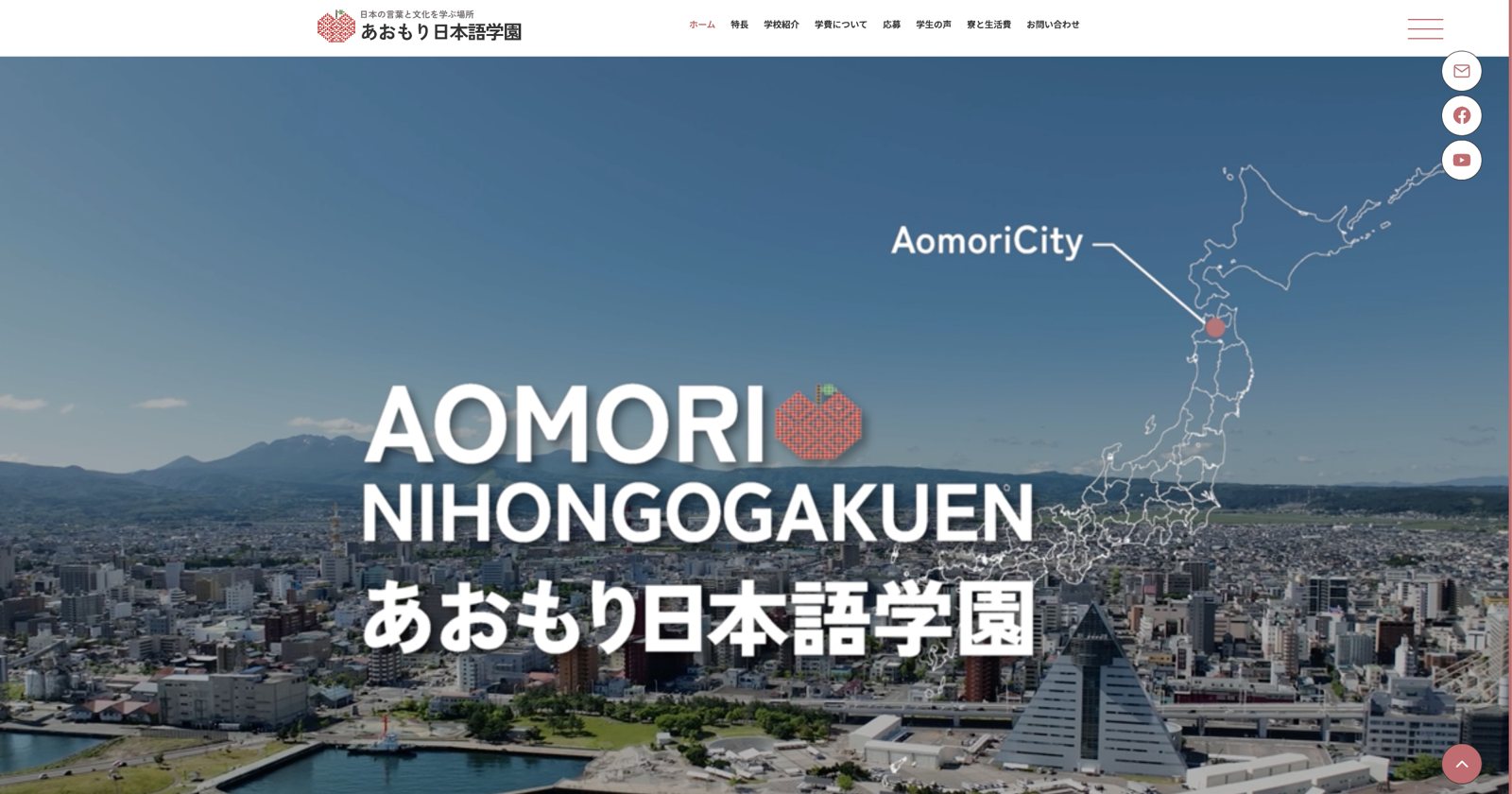
Aomori Japanese Language Academy
Aomori Japanese Language Academy
- Employment results
- Employment etc. 27% ›
- Tuition
- On the cheaper side nationwide ›
- Admission
- Once a year · April only ›
- Progression
- University or similar 68% · National median 86% ›
Compare side by side with other schools →
Tuition and conditions may change depending on the intake. If you contact us, we will check with the school and give you accurate details.
Nearby schools comparedBy distance · no ads or paid placement
- Aomori Japanese Language AcademyThis schoolTuition/yr¥750,000Progression68%IntakesApr
- Richinomori Japanese Language School Hakodate105.2km›Tuition/yr¥660,000Progression95%IntakesApr · Oct
- Cinq Perles Japanese Language Institute196.6km›Tuition/yr¥818,000Progression—IntakesApr · Oct
- Osaki City Osaki Japanese Language School249km›Tuition/yr¥880,000Progression—IntakesApr · Oct
— means SALLAE has not yet found the data.
About the school
A progression-centered school: its school rules state progression to universities and the like as the school's purpose, the 2027 intake's course name is "Vocational School and University Progression Course", and 15 of the 23 students who completed the course in FY2025 went on to universities, vocational schools and the like in Japan. It was the first Japanese language school in Aomori Prefecture to be MOJ-accredited (2021), is in central Aomori, and has a capacity of 80. As of May 2026 it had 48 students and 6 teachers, and it currently recruits only for the morning class of the 2-year course with April entry. It assumes students from non-kanji-character regions who only know hiragana and katakana, uses its own materials, and aims for JLPT N1 after 2 years. Dormitories cost ¥18,000–40,000 a month, and the women's dormitory is on the 3rd floor of the school building.
Published data and school website
Tuition
⚠ 1 year 6 months Japanese course varies by source — please confirm with the school. School website, 1 year 6 month course: ¥750,000 at entry, ¥350,000 in year 2, ¥1,100,000 in total. · Association for the Promotion of Japanese Language Education published data: ¥1,100,000. The 2-year course total (¥1,450,000) is the same in both sources. Only the 1 year 6 month course differs, and which figure applies and from when must be confirmed with the school.
If you saw a lower amount elsewhere, it may not include the admission fee and application fee
Median 1-year tuition in other areas — Kyoto ¥911,000(7 schools) · Kanagawa ¥880,000(8 schools) · Okinawa ¥858,000(6 schools) · Tokyo ¥840,600(56 schools) · Fukuoka ¥835,000(12 schools) · Hyogo ¥825,500(7 schools) · Osaka ¥814,000(27 schools) · Shizuoka ¥790,000(9 schools) · Chiba ¥745,333(10 schools) · Aichi ¥740,667(5 schools)
Total by intake
| Intake · length | Full course |
|---|---|
| October intake · 1 year 6 months | ¥1,100,000 |
| April intake · 2 years | ¥1,450,000 |
Cost details · course tables · notes · 3 items
- One-time fees
- ¥750,000Tuition covers tuition, materials, extracurricular activities, facilities and equipment, and health management. ¥700,000 · Application fee ¥20,000 · Admission fee ¥30,000
According to the school guide, fees are paid in one lump sum at enrollment. SALLAE will check with the school whether you can pay in installments.
| Intake · course | Extra 2nd-year costs | All |
|---|---|---|
| October · 1 year 6 months | ¥350,000 | ¥1,100,000 |
| April · 2 years | ¥700,000 | ¥1,450,000 |
Costs paid in addition for the second year. The application fee and admission fee are not charged again. In the second year there is no application fee or admission fee. 2-year course: ¥700,000 in August of the following year; 1.5-year course: ¥350,000.
FY2027 application guidelines: tuition includes materials, student activity fees and other costs. ¥700,000 per year (Article 20 of the school rules).
For FY2027 only the 2-year Japanese course (April intake) is offered. The 1 year 6 month course (October intake) appears in the tuition table and its appendix.
The application fee can be paid together with the admission fee and other tuition after the notice that the Certificate of Eligibility has been issued. If it is not issued, pay promptly after the notice.
School website · 2026-07-21 updated
Whether it is refundable
- Payment of admission fee and tuition
- (7) After transfer, submit a withdrawal-of-admission form; (8) after the documents are received, return the admission permit and CoE and send the withdrawal-of-admission form; everything except the application fee is refunded.
- If the visa application is withdrawn or the visa is not granted
- The admission fee and tuition other than the application fee are refunded. A withdrawal-of-admission form and documents proving the visa application was withdrawn or not granted are required.
- If you obtained a visa
- Tuition is refunded, except for the application fee, the admission fee, and costs of materials and facilities used to take in the student. Materials already purchased are sent by post.
- After entry (before enrolment)
- Tuition is refunded on condition that you submit a withdrawal-of-admission form and documents showing loss of status of residence and departure from Japan, and school staff confirm your departure.
See refund policy in detail · 2 more lines
- If you withdraw for personal reasons
- If you withdraw for personal reasons, the application fee, admission fee and tuition are not refunded, in principle.
- When you receive a refund
- Remittance fees for refunds of tuition and other fees are deducted from the refund.
Admission & dates
⚠ The application period varies by source — please confirm with the school. July 15 to August 15 of the year before enrollment (for April enrollment the following year). "Applications open for April 2027 enrollment!" · 2027 application guidelines: 2-year Japanese course, July 1 to September 10 of the year before enrollment. July 15 to August 15 of the year before enrollment (application page) / July 1 to September 10 of the year before enrollment (application guidelines)
- Apr intake
- 2-year course · Application July 1–Sep 10 of the year before entry · Classes: 1,600 hours (20 periods a week, 45 minutes per period). Extracurricular activities outside class hours total about 75 hours over 2 years.
- Japanese level
- JLPT N5 level or above
At application, a certificate of 150 or more hours of Japanese study and a certificate of passing JLPT N5 or an equivalent level. You must maintain at least N5-equivalent ability until you enter Japan.
Deadline and capacity rules
2-year Japanese course (half-day, morning), April intake, 40 students in total (20 students × 2 classes). One intake a year in April; in principle age 18 or over. Able to communicate in everyday English (CEFR A2).
School website · 2026-07-21 updated
Classes
- Morning
- 08:45-12:10 4 periods of 45 minutes
- Afternoon
- 13:00-16:25 4 periods of 45 minutes
- AM/PM placement
- 2-year Japanese course (half-day, morning), 8:45–12:10. Morning: 20 students × 2 classes = 40 students in total.
- Class size
- Max 20 students
- Class assignment
- Level-based 8 stages
Materials · Subjects · Timetable · Details
- Materials
- Taught with original materials teachers make to suit the students. The school also makes its own materials on the origin, meaning and stroke order of kanji, and supplementary materials for N4 to N1.
Part 1 (morning) 8:45–12:10, Part 2 (afternoon) 13:00–16:25 (4 periods each).5 days a week (Monday–Friday), 20 periods (45 minutes each).
| Part 1 (morning) | Part 2 (afternoon) | |
|---|---|---|
| Period 1 | 08:45-09:30 | 13:00-13:45 |
| Period 2 | 09:35-10:20 | 13:50-14:35 |
| Period 3 | 10:35-11:20 | 14:50-15:35 |
| Period 4 | 11:25-12:10 | 15:40-16:25 |
Four terms a year. A completion exam is given after each stage, graded in 4 levels: Excellent, Good, Pass and Fail. Classes are in Japanese only.
What each level covers · 8 stages
- Beginner I
- Beginner I: JLPT N5–N4, about 11 weeks, about 220 hours. Understand fixed sentences used in daily life, and their structure and meaning.
- Beginner II
- Beginner II: JLPT N4–N3, about 12 weeks, about 240 hours. Understand simply written texts and follow slow speech.
- Lower intermediate
- Pre-intermediate: JLPT N3, about 7 weeks, about 140 hours. Understand texts about social phenomena and everyday situations.
- Intermediate I
- Intermediate I: JLPT N3–N2, about 10 weeks, about 200 hours. Understand the main points of texts in a wide range of fields.
- Intermediate II
- Intermediate II: JLPT N2, about 10 weeks, about 200 hours. Understand the main points of explanatory texts and critiques, and write short essays.
- Upper intermediate
- Upper-intermediate: JLPT N2–N1, about 10 weeks, about 200 hours. Understand the main points of articles and editorials in various fields, and give presentations.
- Advanced I
- Advanced I: JLPT N1, about 10 weeks, about 200 hours. Understand newspaper articles, editorials and modern novels, and write summaries and essays suited to university entrance exams.
- Advanced II
- Advanced II: J.TEST Semi-B level, about 10 weeks, about 200 hours. Understand texts including academic fields and write papers with clear arguments.
School website · 2026-03-16 updated
Documents
- Admission application formPrescribed form
- Written pledgePrescribed form
- Letter of guaranteePrescribed form
- The page with your photo and personal details, and the pages showing travel history and past visas
- Copy of ID card or other identification
- 4 photos (4 cm tall × 3 cm wide). Color, no hat, no glasses, plain background, facing front, unretouched. Taken within 3 months, printed as a photo.
- Certificate of graduation from the last school attendedOriginal) or diploma (original
- Transcript (original) from the last school attended. All grades for every school year.
- Proof of Japanese study history (original): study level, 150 or more hours of study, certification of N5-or-above ability, and the institution's name, address, phone number, issuer's name and school seal or notarial seal.
- Any one of 10 kinds of certification, such as JLPT N5 or above, BJT or JLRT 300 points or above, or J.TEST Grade F or above (application guidelines, item 10).
Financial supporter's documents · only if applicable · 8 application requirements
Submitted by the person paying the tuition (financial sponsor)
- Financial sponsorship statementPrescribed form
- Documents issued by a public authority showing the expense sponsor's address and family registerResidence certificate, family register certificate, etc.
- Proof of the relationship between the sponsor and the applicant (original), issued by a public body. Not needed if the relationship can be shown by the documents showing the sponsor's address and family register.
- Copy of passport. For foreign nationals a copy of the residence card; for Japanese nationals a copy of the My Number card or driver's license.
- Certificate of employment (original), or the original of a business license or commercial register certificate (full record certificate)
- Salary payment certificateOriginal
- Public document proving annual income (original), for the past 1 year
- Public document proving annual tax paid (original), for the past 1 year
- Bank balance certificate in the expense sponsor's nameOriginal
- Documents showing how the expense sponsor accumulated the study funds (for example, a copy of a passbook in the sponsor's name), covering the past 1 year
- An explanation of how the funds for study costs were built up and a plan for paying expenses during your stay. Free format; write in more detail than the financial sponsorship statement.
Only if applicable
- Current students: certificate of expected graduation (original), certificate of enrollment (year of enrollment, major, current year), and transcript from the school of enrollment (original). (Current students)
- Certificate of employment (original): employer name, address, phone number, period of employment, job type and department, name of issuer, signature and company seal. (If the applicant is a company employee)
- Business license: a copy certified as a true copy of the original in your home country, or the original of a commercial register certificate (full record certificate) (If the sponsor is self-employed or runs a company)
- A notice of the scholarship award from the scholarship-paying body, and documents stating the scholarship conditions (If you receive a scholarship)
- For Nepalese students, a GPA of 2.7 or higher in Grades 11 and 12 (For Nepalese students)
Application requirements
Please prepare documents issued within 3 months of the planned application date. Documents not in Japanese need the translator's name and signature. Documents issued within 3 months before the Immigration Services Agency application date (for April intake, issued from September onward). If annual income and annual tax paid appear on the same document, that one document is enough. If there are 2 or more expense sponsors, documents are needed for each person. Required details: school name, address, name of the person in charge of issuing (the graduation certifier), and the school seal or notarial seal. The "purpose of studying Japanese" must be written by the applicant themselves. Applications that appear to use sample text or copy another person's writing will not be accepted. Other documents may be requested depending on the applicant's circumstances.
Grade standards are set for each country and announced on the website and when the application guidelines are requested. SALLAE is confirming this with the school.
School website · 2025-06-17 updated
Admission process
- Request an admission consultation — Contact by email or phone (017-742-6825). English, Chinese and Mongolian are available.
- Apply: please send the application documents by email. — Send the certificate of passing N5 or above, high school transcript and graduation certificate as PDFs, and the application form in Word format.
- Selection: document screening, then interview and academic assessment — The interview checks identity, educational and study history, motivation and ability to respond in English. The academic assessment covers reading kana and kanji, pronunciation, basic arithmetic and the like.
- Selection result notice; payment of the application fee — Selected students should pay the application fee.
- Preparing application documents; school document review — Send the application documents. The school will review them.
- Application to the Immigration Services Agency for the Certificate of Eligibility — The school submits the application form for the Certificate of Eligibility to the Immigration Services Agency
- Result of the status of residence decision — The Immigration Services Agency notifies the school of who has been granted status of residence.
- Pay the admission fee and tuition — "Before enrollment" as a payment period means within 2 weeks of the notice that the Certificate of Eligibility has been issued. Those granted the certificate pay the admission fee, tuition and other fees to the school.
- Re-interview. The Certificate of Eligibility (CoE) and admission permit are sent. — A re-interview is held before enrollment. If academic ability is lower than at selection, admission is cancelled and the CoE is returned to the Immigration Services Agency.
- Obtain a visa at a Japanese diplomatic mission abroad — Apply for a visa at a Japanese embassy (consulate general)
- Arrive in Japan and enrol — School staff will meet you.
- Placement test
- Classes are decided by academic level and so that, as far as possible, there are not many students of the same nationality. Skipping levels is not possible.
School website · 2026-07-21 updated
Graduate outcomes
| FY2025 | Admitted |
|---|---|
| Employment | 6 students |
| Graduates | 23 students |
Prepared June 10, 2026. 23 course completers, 22 meeting the criteria in total, 95.7% meeting the criteria. · Number approved for a change to a status of residence listed in the upper column of Schedule I-1 or I-2 of the Immigration Control Act: 2-year course 4, 1.5-year course 2. · School website · Updated 2026-06-10
Reviews
If you study here or used to, tell others what the classes, teachers and daily life were like. It helps anyone deciding on this school.
Write the first reviewUniversity prep
- Career guidance — The school understands students' aspirations and gives suitable career guidance. It tracks the status of decided career paths and keeps records as data.
- Information on destination schools is collected promptly — The school quickly gathers information on destinations, such as information sessions, open campuses, recommendation admission systems, exam formats and subjects, and tuition, and shares it with students.
- Entrance exam interview preparation — Advanced I (year 2, July–October): building N1-level ability and the writing and conversation skills that work in university entrance exams, plus entrance exam interview preparation.
Schedule to admission
- Beginner I
- Year 1, April and May, Beginner I · Orthography and pronunciation training · Learn how kanji are formed and stroke order · "Special program for the first month after enrollment" plus more: build enough language ability to handle part-time work after 1 month.
- Beginner II
- Year 1, June, July and August · Completion (N4 level)
- Lower intermediate
- Year 1, September, October and November · N3-level study
- JLPT N3
- Year 1, December · Pass JLPT N3 · Period to build skills in writing, conversation and kanji
- Intermediate I
- Year 1, January, February and March · Period to build skills in writing, conversation and kanji
- Intermediate II
- Year 2, April, May and June · N2-level study · Build reading skills
- Advanced I
- Year 2, July to October · Pass JLPT N2 · Build N1-level ability and the writing and conversation skills needed for university entrance exams · Entrance interview preparation
- EJU
- Year 2, November · EJU score of 270 or above
- Pass JLPT N1 and university admission
- Year 2, December · Pass JLPT N1 · University admission
- Advanced II
- Year 2, January, February and March · Build practical Japanese: polish the Japanese needed for university seminars, and strengthen writing and presentation skills · Pass J.TEST Semi-B level and BJT J1
School website · Confirmed 2026-09-26
Daily-life support
- Airport pickup — School staff will meet you on arrival in Japan. The school pays the cost. Staff can meet you as far as Haneda, Narita and Sendai airports.
- Accompaniment for procedures after arrival — Staff accompany students and help with procedures after arrival, such as residence registration and joining National Health Insurance.
- Life guidance staff — Each class has several teachers and a student life advisor, who help with administrative procedures, injury and illness, life counseling, and coordination with part-time employers. They also accompany students to the hospital.
- Native-language support — Support in your native language is also available if needed. English, Chinese and Mongolian are available.
- Daily-life orientation right after arrival — Right after arrival, the school runs its own program that teaches Japanese daily habits, rules and manners to help students adjust to life as an international student.
- Help finding a part-time job — The school provides part-time job information and interview practice. Homeroom teachers and students discuss financial sponsorship and part-time work.
- Regular meetings and regular dormitory visits — Regular meetings with students are used to understand how they live where they reside. Regular dormitory visit guidance is given.
- Health checkup — A health checkup is held once a year. Students must join National Health Insurance while enrolled, and are also guided on paying the premiums.
- Disaster prevention and emergency system — Fire evacuation drills are held. Procedures and evacuation sites for disasters are set and taught to students.
School website · Confirmed 2026-09-26
Scholarship
- Excellence award
- Students with excellent grades and good study attitude who set a good example are selected, honored and given a reward.
- Perfect attendance award
- A reward is given to students with no lateness or absences (100% attendance).
School website · Confirmed 2026-09-26
Students
35 enrolled (2025) · Capacity 80 National median: 180 students
Based on the 35 students enrolled in 2025.
Public data from the Association for the Promotion of Japanese Language Education (Nisshinkyo) · verified 2026-09-20
School life
For 1 year
- 4
- Entrance ceremony · Visit to the Hirosaki Castle Cherry Blossom Festival
- 5
- Oirase and Towada trip
- 7
- Tanabata: dress in a yukata and write your wishes on strips of paper.
- 8
- Aomori Nebuta Festival — students take part as haneto dancers · Calligraphy class: express the characters of your home country in calligraphy.
- 10
- Autumn foliage bus trip
- 12
- Christmas party
- 1
- New Year party
- 2
- February: Aomori is covered in snow. In 2024 it was a "snow hike".
- 3
- At graduation, students give presentations in front of people from inside and outside the school (3rd Presentation Contest, March 6, 2026). · Graduation ceremony
In 2024 a calligraphy exhibition was held at an outside gallery.
- Opportunities include introducing your home country at elementary schools, local international exchange events, discussions with junior and senior high school students, and taking part in a "Japanese cafe".
- After school, everyone cleans together, from the classroom to the toilets.
- Students prepare to give a presentation at an outside venue in front of people from inside and outside the school at graduation. The 3rd Presentation Contest was held on Mar 6, 2026.
On campus
- On campus
- Library and self-study room — The library can be used any time outside class hours.
- School and dormitory
- Wi-Fi — Both the school and the dormitories have Wi-Fi throughout.
- On campus
- Cafeteria — None. You can buy food and drinks and eat them during breaks.
- On campus
- Computers — None.
- Building
- Elevator — The school has no elevator, and other school facilities and the student dormitories are not sufficiently barrier-free.
Academic calendar
- Summer vacation
- About 20 days from early to mid-August, including weekends
- Autumn break
- About 7 days from late September to early October, including weekends
- Winter break
- About 20 days from late December to early January, including weekends
- Spring break
- About 20 days from late March to early April, including weekends
School website · Confirmed 2026-09-26
Access
- Transit
- 10 minutes by bus from the East Exit of JR Aomori Station Sakaemachi 2-chome bus stop
- Nearby
- The sea is a 10-minute walk from the school. A ski resort is 30 minutes from the school.
- Dormitory
- Available¥25,000 per month · Motomachi Akizuki Building ¥18,000–40,000 per month. The Sakaemachi Women's Dormitory is on the 3rd floor of the same building as the school, the Okuno Men's Dormitory is a 15-minute walk away, and the Motomachi Akizuki Building is a 20-minute walk. · Based on school website
School website · 2025-01-16 updated
Student dormitory — Sakaemachi Women's Dormitory and Okuno Men's Dormitory ¥25,000 per month (utilities included); Motomachi Akizuki Building ¥18,000–40,000 per month (utilities at actual cost).
School website · Confirmed 2026-09-26
SALLAE has organized the school website and published data in English.
The update date is the day that material was last revised.
Photos are materials published by the school.
This information is compiled from official sources and is not updated daily. Please confirm with the official contact before signing or applying.