Asia Japanese Language Institute
Asia Japanese Language Institute
- Tuition
- Low for Fukuoka ›
- Maximum age
- Up to age 27, depending on education ›
- Admission
- Twice a year · April and October ›
Compare side by side with other schools →
Tuition and conditions may change depending on the intake. If you contact us, we will check with the school and give you accurate details.
Nearby schools comparedBy distance · no ads or paid placement
- Asia Japanese Language InstituteThis schoolTuition/yr¥770,000Progression90%IntakesApr · Oct
- Nishi-Nihon International Education Institute3.4km›Tuition/yr¥843,000Progression91%IntakesJan · Apr · Jul · Oct
- Fukuoka Japanese Language School3.9km›Tuition/yr¥835,000Progression—IntakesJan · Apr · Jul · Oct
- Aso College of Foreign Languages, Tourism & Bridal4.7km›Tuition/yr¥750,000Progression—IntakesApr · Oct
— means SALLAE has not yet found the data.
About the school
The school focuses on progression. Two of its three regular courses (2 years for April intake and 1 year 6 months for October intake) are university-preparation courses, and of the 90 FY2024 graduates reported by the Association for the Promotion of Japanese Language Education, 73 progressed to vocational schools (65), universities (7) and a junior college (1). The school opened in 2001 with a capacity of 238, and is in Nagazumi, Minami-ku, Fukuoka, about 15 minutes by bus from Nishitetsu Takamiya Station. Many students are from Nepal, Vietnam and Taiwan, classes have 20 or fewer students, and there is also a 3-month short course (January, April, July and October intakes).
Published data and school website
Tuition
If you saw a lower amount elsewhere, it may not include the admission fee and application fee
Median 1-year tuition in other areas — Kyoto ¥911,000(7 schools) · Kanagawa ¥880,000(8 schools) · Okinawa ¥858,000(6 schools) · Tokyo ¥840,600(56 schools) · Fukuoka ¥835,000(12 schools) · Hyogo ¥825,500(7 schools) · Osaka ¥814,000(27 schools) · Shizuoka ¥790,000(9 schools) · Chiba ¥745,333(10 schools) · Aichi ¥740,667(5 schools)
Admission & dates
- Apr intake
- 2-year course · Apply for April intake: submit the student status application by November of the previous year · Classes 1,600 hr
- Apr intake
- 1-year course · Apply for April intake: submit the student status application by November of the previous year · Classes 800 hr
- Oct intake
- 1 year 6 months course · Apply for October intake: submit the student status application by May of the same year · Classes 1,200 hr
- Oct intake
- 1-year course · Apply for October intake: submit the student status application by May of the same year · Classes 800 hr
- Japanese level
- JLPT N5 level or above
JLPT Level 5 (N5) or above, or people recognized as having N5 ability or above after studying 150 or more hours in their own country or elsewhere. Basic academic ability in English and mathematics is also required
Deadline and capacity rules
Completion of 12 or more years of schooling. Aged 18 or over at application; for progression, age 23 or under for high-school graduates, 25 or under for junior-college graduates, and 27 or under for university graduates (no age limit for the general course). Ability to pay tuition and living costs is required
School website · Confirmed 2026-09-26
Classes
- Class size
- Max 20 students
Materials · Subjects · Timetable · Details
Each class is multinational with 20 or fewer students. Kanji vocabulary and JLPT preparation are done daily according to level. In the university-preparation course, EJU preparation classes start after the elementary level
School website · Confirmed 2026-09-26
Documents
- Application form (school's prescribed form)
- Résumé
- Statement of reason for study
- Japanese ability certificate or study certificate
- Written pledge
- Health certificate
- Original graduation certificate from your last school
- Original academic transcript from your last school
- 5 photos (4 cm tall × 3 cm wide), with your name written on the back
Sponsor documents
Submitted by the person paying the tuition (financial sponsor)
- Financial sponsorship statement
- Sponsor's certificate of employment
- Sponsor's income certificate
- Sponsor's tax payment certificate
- Financial sponsor's bank balance certificate
- Certificate of relationship between sponsor and applicant
It says only that, depending on the country, documents not in the list may be requested in addition; documents required by nationality and balance amount standards are not given. SALLAE is confirming this with the school.
School website · Confirmed 2026-09-26
Admission process
- Request an admission consultation — Display languages: Japanese, English, Simplified Chinese, Traditional Chinese, Vietnamese
- Prepare admission application documents — Please note that, depending on your country, documents other than those above may be requested.
- Selection method — Written exam and interview (partly in Japanese)
- Apply for student status of residence — The student-status application must be made by November of the previous year for April intake, and by May of the same year for October intake. Please apply with plenty of time to spare
- If you want to take the JLPT in July of year 1 — If you want to take the JLPT in July of year 1, send your photo and the exam fee before enrollment. Details will be given after admission is confirmed
- Placement test
- Classes are divided by Japanese ability, based on a placement test and interview at enrollment.
School website · Confirmed 2026-09-26
Short-term study
- Visa
- Temporary visitor(not a student visa)
- Duration
- 4 weeks – 3 months
- Open now?
- Rolling admissions, so availability varies from time to time — SALLAE will confirm with the school
Course without a student visa
- Other courses — If several people of similar ability apply together, a class tailored to your purpose can be created. Courses to build practical skills by Japanese level were offered in the past
- Japanese training for foreign trainees and companies — Consultations are accepted at any time
★Short-term courses are not listed in the published data — it counts only student-visa courses.
School website · Confirmed 2026-09-26
Graduate outcomes
| FY2024 | Admitted |
|---|---|
| University | 7 students |
| Vocational school | 65 students |
| Employment | 2 students |
| Graduates | 90 students |
Passing an exam
| Exam | Pass |
|---|---|
| JLPT N2 2024 | 6 students |
| JLPT N3 2024 | 33 students |
| JLPT N4 2024 | 5 students |
| JLPT N5 2024 | 1 student |
FY2024 JLPT: 135 examinees (N1: 4, N2: 30, N3: 94, N4: 6, N5: 1), 0 certified at N1. EJU Japanese: 5 took the June exam, 0 scored 219 or above
2024 school year: completers 90, meeting the standard 80 (88.8%). Progression 72, change of status of residence 2, proved by exam 42 · Per the FY2024 Report No. 44, those permitted to change status of residence: 1 from the 2-year university-preparation course and 1 from the 1.5-year university-preparation course · Public materials of the Association for the Promotion of Japanese Language Education · Confirmed 2026-09-26
Reviews
If you study here or used to, tell others what the classes, teachers and daily life were like. It helps anyone deciding on this school.
Write the first reviewUniversity prep
- Progression guidance — For deciding on a career path, the homeroom teacher takes the lead in choosing a school that suits each student.
- Appropriate advice on choosing a university — Advice on choosing a university is given considering language level and the student's wishes, with follow-up through the exam application procedures
- Exam prep class — EJU preparation classes begin once elementary-level study is finished. Students are strongly encouraged to take the June exam, whose results come out in late July
Schedule to admission
- Year 1
- June · EJU mock exam
- Year 1
- March · EJU registration
- Year 2
- April · EJU mock exam
- Year 2
- June · 1st EJU · JLPT mock exam
- Year 2
- August · Progression consultation fair · University open campuses
- Year 2
- September · EJU mock exam
- Year 2
- October · Progression consultation and exam period begins
- Year 2
- November · 2nd EJU · JLPT mock exam
- Year 2
- February · Decide next path
School website · Confirmed 2026-09-26
Daily-life support
- You can consult staff who speak English, Chinese, Vietnamese and Hindi — The school has staff who speak English, Chinese, Vietnamese and Hindi, so
- Counseling and advice on both daily life and studies — Teachers and office staff communicate with each student and give counseling and advice on both daily life and studies
- National Health Insurance — You can join Japan's National Health Insurance and use hospitals on the same terms as Japanese citizens. The school is also prepared to take quick and the best possible measures in case of illness or injury
- Part-time work — Students with a student visa may, in principle, work part-time up to 28 hours per week after notifying Immigration and obtaining permission. For short courses, it depends on the type of visa
- Traffic safety class, disaster prevention center and local disaster drills (annual events) — At the April and October intakes there is a traffic-safety class and a disaster-prevention center visit, and students also take part in community disaster drills
School website · Confirmed 2026-09-26
Students
171 students enrolled (2025) · Capacity 238 National median: 180 students
Based on 171 students enrolled in 2025.
Public data from the Association for the Promotion of Japanese Language Education (Nisshinkyo) · verified 2026-09-20
School life
For 1 year
- 4
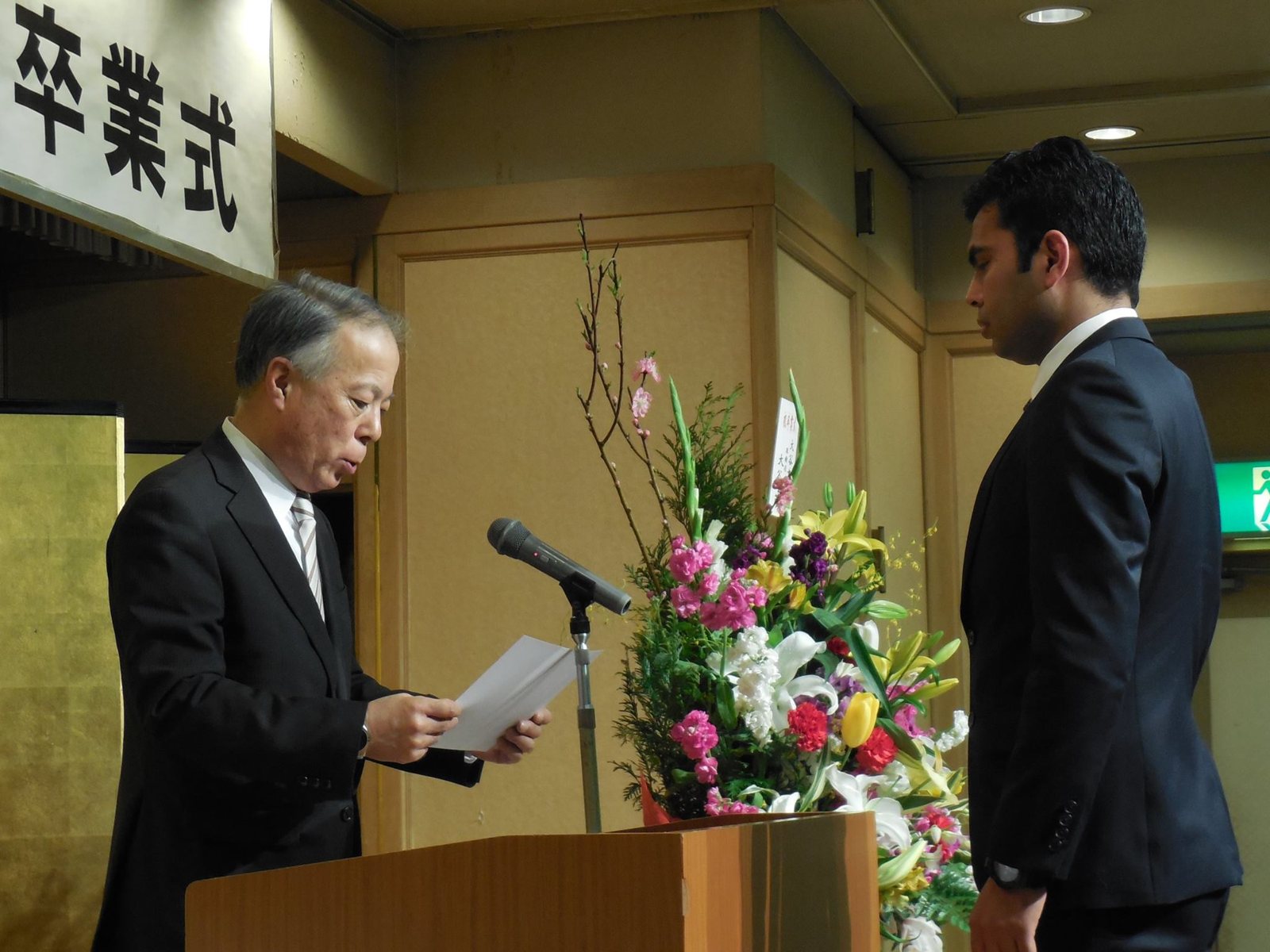
- 2-year course entrance ceremony · Traffic safety class · Disaster prevention center
- 5
- Hakata Dontaku · Welcome outing for new students
- 6
- EJU mock exam
- 7
- 1st JLPT · Tanabata · Hakata Gion Yamakasa · Nagasumi Festival
- 8
- Summer break · JLPT registration
- 9
- Final exams · Speech contest (April intake) · End of year 1, first half · Autumn break
- 10
- Start of year 1, second half · 1.5-year course entrance ceremony · Traffic safety class · Disaster prevention center
- 11
- Welcome outing for new students · Japanese culture experience · JLPT mock exam
- 12
- 2nd JLPT
- 1
- Winter break · New Year holidays
- 2
- Setsubun
- 3
- Final exams · Year 1 speech contest · End of year 1, second half · EJU registration
This is the year-1 schedule from the annual events table on the website · In year 2, the same seasonal events are joined by the EJU and progression schedule (the "schedule to acceptance" in progression and job support), a graduation excursion in February and the graduation ceremony in March · The event list above is compiled from photo captions on the website.
- Exchange with elementary school students
- Yukata experience
- Calligraphy experience
- Community disaster drill
- At Yusentei garden
- Marine World, Mitsui Greenland and the zoo (gallery photo caption)
- Nagazumi Festival
- Speech contest
Academic calendar
- Summer vacation
- Aug
- Autumn break
- Sep
- Winter break
- Jan
School website · Confirmed 2026-09-26
Access
- Nearby
- 15 minutes by bus from Nishitetsu Takamiya Station
- Dormitory
- Available¥18,000 per month · Student dormitory Villa Sarayama (2DK, apartment type). ¥135,000 for one person using a room, ¥90,000 for two sharing. Utilities and internet included · Based on school website
Public materials of the Association for the Promotion of Japanese Language Education · checked 2026-09-26
Dorm — Short-course student dormitory: single room, dormitory fee ¥135,000 plus ¥15,000 each for move-in fee, facility use fee and move-out maintenance fee, ¥180,000 in total; double room, dormitory fee ¥90,000, ¥135,000 in total. Even if admission is canceled, the ¥15,000 move-in fee is not refundable
School website · Confirmed 2026-09-26
SALLAE has organized the school website and published data in English.
The update date is the day that material was last revised.
Photos are materials published by the school.
This information is compiled from official sources and is not updated daily. Please confirm with the official contact before signing or applying.