Elite Japanese Language School
Elite Japanese Language School
- To station
- 3 min walk · Shin-Okubo Station
- Distance to dormitory
- 3 min walk ›
- Admission
- 4 times a year · choose your intake month ›
Compare side by side with other schools →
Tuition and conditions may change depending on the intake. If you contact us, we will check with the school and give you accurate details.
Nearby schools comparedBy distance · no ads or paid placement
- Elite Japanese Language SchoolThis schoolTuition/yr¥792,000Progression92%IntakesJan · Apr · Jul · Oct
- Tokyo Foreign Language College0.2km›Tuition/yr¥1,076,000Progression65%IntakesApr · Oct
- Tokyo World Japanese Language School0.3km›Tuition/yr¥877,000Installments OKProgression—IntakesJan · Apr · Jul · Oct
- ECC Japanese Language Institute Shinjuku Campus0.3km›Tuition/yr¥826,000Progression—IntakesApr · Oct
— means SALLAE has not yet found the data.
About the school
This school focuses on progression to university and graduate school — in the June 2025 report, 436 of 528 completers went on to university or similar, and every term it holds a 3-month graduate school preparation class and EJU mathematics, general subjects and English preparation classes, separate from the Japanese classes. A large school in Kabukicho, Shinjuku, opened in 1993, its main building is a 3-minute walk from JR Shin-Okubo Station, on the 12th floor of a Tokyo Metropolitan Government public facility building, and 569 of the 728 students enrolled in 2025 are from China. You can enter in January, April, July and October, and there is a dormitory near Okubo Station (1DK for 2–4 people, ¥50,000–¥60,000 a month, management fee separate).
Published data and school website
Tuition
⚠ Long-course tuition (first year) varies by source — please confirm with the school. School regulations Article 20 (in force June 2026), published total: application fee ¥22,000, admission fee ¥55,000, tuition and materials ¥660,000 (annual), facility and event fees ¥55,000 (annual) · Tuition page on the website (as of January 2026, tax included): application fee 22,000, admission fee 88,000, tuition 682,000, facility fee 17,600, equipment fee 22,000, materials fee 27,500, special activity fee 9,900 = ¥869,000. The table on the website is ¥77,000 higher. The school regulations came into force later, but their amounts may be old values — confirmation with the school is needed.
If you saw a lower amount elsewhere, it may not include the admission fee and application fee
Median 1-year tuition in other areas — Kyoto ¥911,000(7 schools) · Kanagawa ¥880,000(8 schools) · Okinawa ¥858,000(6 schools) · Tokyo ¥840,600(56 schools) · Fukuoka ¥835,000(12 schools) · Hyogo ¥825,500(7 schools) · Osaka ¥814,000(27 schools) · Shizuoka ¥790,000(9 schools) · Chiba ¥745,333(10 schools) · Aichi ¥740,667(5 schools)
Cost details · course tables · notes · 3 items
- One-time fees
- ¥792,000Tuition and materials (annual) ¥660,000 · Entrance examination fee ¥22,000 · Admission fee ¥55,000 · Equipment and events fee (annual) ¥55,000
According to the school guide, fees are paid in one lump sum at enrollment. SALLAE will check with the school whether you can pay in installments.
School regulations (in force Jun 1, 2026), Article 20: application fee ¥22,000, admission fee ¥55,000, tuition and materials ¥660,000 (annual), facility and event fees ¥55,000 (annual). Total for the general 2-year course ¥1,507,000.
Please pay the ¥22,000 application fee when you submit your documents.
Upper row: tax included; lower row (in parentheses): tax excluded (as of Jan 2026: consumption tax 10%)
Short-term 3 months costs ¥244,750 separately (admission fee ¥55,000 · tuition (3 months) ¥170,500 · facility fee ¥4,400 · equipment fee ¥5,500 · materials fee ¥6,875 · other (special activity fee) ¥2,475).
School website · 2026-06-01 updated
Whether it is refundable
- Application fee and admission fee
- Not refunded whether or not you enroll
- Before obtaining a visa, or if the visa is denied
- The amount after deducting the application fee, admission fee and transfer fee. Condition before obtaining a visa: return of the admission letter and the Certificate of Eligibility. Condition for visa denial: return of the admission letter and confirmation of the visa denial.
- After obtaining a visa and before coming to Japan, or after arriving in Japan and before classes start
- The amount after deducting the application fee, admission fee, transfer fee, administrative fee and cancellation fee (¥100,000).
- After arriving in Japan and after classes start (withdrawal midway)
- The amount obtained by taking 70% of tuition for terms not attended, excluding the first 6 months' tuition, and deducting the ¥22,000 administrative fee and the remittance fee. You must return home within 1 month after withdrawal.
See refund policy in full · 4 more lines
- Withdrawal midway from the 2nd year onward
- The amount after deducting the ¥22,000 administrative fee and the remittance fee from tuition and other fees for the term in which the withdrawal notice was submitted and later terms. You must return home within 1 month after withdrawal.
- Withdrawal to progress to another school, or withdrawal due to a change of status
- Under 1 year is treated the same as midway withdrawal. For 1 year or more, the ¥22,000 administrative fee and the remittance fee are deducted from tuition and other fees for the term of the withdrawal date and later terms.
- Students who transfer to another Japanese language institution, or whose average attendance rate during enrollment is below 80%
- No refund for students who transfer to another school or whose average attendance rate is below 80%. If you arrive late, tuition for classes you did not attend is also not refunded.
- Short-term course
- If you decline admission before the class start date, the amount after deducting the admission fee and transfer fee is refunded. There is no refund for withdrawal midway after classes start, or after arriving in Japan following visa issuance.
Admission & dates
⚠ The study period differs by source. Please confirm with the school. January term 1 year 3 months, April term 2 years, July term 1 year 9 months, October term 1 year 6 months · General 2-year course, study period 2 years. Intakes in April, July, October and January. Going by the periods in the admission guide, students finish in March of the second year whichever month they enter — confirmation with the school is needed.
- Jan intake
- 1 year 3 months course · Apply early July to early September
- Apr intake
- 2-year course · Apply early September to early November · Classes 1,600 class hours (45 min each)
- Jul intake
- 1 year 9 months course · Apply late December to mid-February
- Oct intake
- 1 year 6 months course · Apply early March to early May
- Japanese level
- Those with 150 or more hours of Japanese study, or Japanese ability equivalent to JLPT N5.
Deadline and capacity rules
Those who have completed 12 or more years of formal education, or have academic ability equivalent to high school graduation. Capacity is the total of Session 1 and Session 2 in Article 4 of the school regulations.
School website · Confirmed 2026-09-26
Classes
- Morning
- 09:00-12:20 4 periods of 45 minutes
- Afternoon
- 13:20-16:40 4 periods of 45 minutes
- Class assignment
- Level-based 12 levels
- Elective classes
- Comprehensive subjects · Math I and II · Physics · Writing · English: TOEFL and TOEIC preparation · EJU Japanese supplementary lessons · Guidance on writing a statement of purpose · Interview guidance · EJU preparation classes are 2 hours, once to 3 times a week: past exam problems and applied practice for essay writing, Mathematics I & II and physics.
Materials · Subjects · Timetable · Details
- Subject
- Hiragana and katakana practice · Grammar · Vocabulary · Listening · Kanji · Conversation · Writing · General Japanese · Reading · Group activities and presentations · Shadowing · EJU and JLPT (N2) preparation · Japanese society and culture · Discussion · Elementary covers grammar, vocabulary, listening, kanji, conversation and composition; from elementary-intermediate, comprehensive Japanese, reading, group activities and EJU and JLPT preparation; shadowing starts at intermediate.
A 3-month intensive graduate school preparation class opens every term. About 200 hours
| Mon | Tue | Wed | Thu | Fri | |
|---|---|---|---|---|---|
| Period 1 | Reading: introduction to research methods | Reading: introduction to research methods | Reading: introduction to research methods | Reading: introduction to research methods | Reading: introduction to research methods |
| Period 2 | Speech and debate | Presentation and interview preparation | Speech and debate | Presentation and interview preparation | Speech and debate |
| Period 3 | Writing logical texts | Preparing a research plan | Understanding and reading research papers | Grammar and expressions used in research papers | Preparing a research plan |
| Period 4 | Writing logical texts | Preparing a research plan | Understanding and reading research papers | Grammar and expressions used in research papers | Preparing a research plan |
Each level is 10 weeks, 20 hours a week (5 days). In fiscal 2023, total instruction was 1,600 unit hours, and the goal at completion is N1.
What each level covers · 8 stages
- Beginner I
- Learn about 162 kanji and about 930 vocabulary items. Build up basic sentence patterns and gain at least enough Japanese for minimal daily conversation. Goal: N5.
- Beginner II
- Learn about 164 kanji and about 885 vocabulary items. Gain the ability to communicate in somewhat more detail about one's surroundings. Goal: N4.
- Elementary-intermediate foundation
- About 550 kanji and 420 words. Gain the ability to express, bit by bit, familiar topics and one's own opinions about them. Goal: N4–N3.
- Lower intermediate
- About 600 kanji and about 1,000 words. Learn plain expressions for familiar topics and one's own opinions. Goal: N3.
- Intermediate foundation I and Intermediate foundation II
- About 550 kanji and about 1,300 words. Learn simple expressions for experiences, events, dreams, hopes and plans, and review grammar. Goal: N3.
- Intermediate I and Intermediate II
- About 800 kanji and about 2,000 words. How to handle most situations that arise in familiar matters, and how to describe experiences, dreams and plans. Goal: N2.
- Upper intermediate I
- About 1,200 kanji and about 3,500 words. Express opinions using complex language, including technical discussion in one's own field. Goal: N1.
- Upper-intermediate II, Advanced I and Advanced II
- About 2,000 kanji and 10,000 words. Covers the basics of honorific language used in real society, business conversation, polite expressions, current affairs and cultural background. Goal: N1.
School website · Confirmed 2026-09-26
Documents to prepare — student visa course
- Résumé
- Diploma from the highest level of education
- Transcript
- Certificate of Japanese study
- 8 photos3×4cm
- Copy of passport
- Other items the school deems necessary
Sponsor documents · Only if applicable
Submitted by the person paying the tuition (financial sponsor)
- Financial sponsorship statementGuarantor
- Documents proving the relationship between the applicant and the guarantor
- Balance certificate: ¥2,000,000 or more for language study of 1 year or less; ¥4,000,000 or more for language study of 1 year or more
- Sponsor's certificate of employment and income certificate
Only if applicable
- Certificate of enrollment (if enrolled in a university)
For short-term courses, submit 2 photos (3 × 4 cm) · Copy of passport · Other items the school deems necessary only.
School website · Confirmed 2026-09-26
Admission process
- Request an admission consultation — Inquiries: TEL 03-3232-0550, email info@eliteschooljapan.com
- Submit application documents — Please pay the ¥22,000 application fee when you submit your documents.
- In-school document screening
- Immigration Services Agency review
- Announcement of screening results
- Tuition payment
- Certificate of Eligibility and admission permit dispatched
- Visa issued at a Japanese diplomatic mission abroad — It takes 4–5 months from application to obtaining the visa.
- Admission
- Placement test
- By the time classes start, Japanese ability is assessed by exams and other means and classes are formed. The placement test includes a speaking test, and the new classes are announced.
School website · Confirmed 2026-09-26
Short-term study
- Visa
- Temporary visitor(not a student visa)
- Duration
- Up to 3 months
- Open now?
- Rolling admissions, so availability varies from time to time — SALLAE will confirm with the school
Course without a student visa
- Short-term course (3 months) — A preparation course leading to study abroad. Students practice the Japanese they have learned on extracurricular trips and get used to life in Japan and Tokyo through cross-cultural experiences and manga/anime materials.
- Students studying on a status of residence other than a student visa — Besides student visa holders, many students study Japanese while residing on work visas, dependent visas, spouse visas and so on. They study together with student visa holders (2022 blog).
★Short-term courses are not listed in the published data — it counts only student-visa courses.
School website · Confirmed 2026-09-26
Graduate outcomes
| FY2024 | Admitted |
|---|---|
| Employment | 18 students |
| Graduates | 528 students |
See 83 more schools
All schools accepted to so far
+32 more schools
See 11 more
+3 more schools
Prepared June 24, 2025. 528 course completers, 476 meeting the criteria (86.4%). Progression to university or similar 436, change of status of residence 18, tests 22 · Number approved for a change to a status of residence listed in the upper column of Schedule I-1 or I-2 of the Immigration Control Act (excluding Diplomat, Official and Technical Intern Training) · School website · Updated 2025-06-24
Reviews
If you study here or used to, tell others what the classes, teachers and daily life were like. It helps anyone deciding on this school.
Write the first reviewUniversity prep
- The "Career Guidance Department" manages progression status for the whole school — A full-time teacher manages overall progression status and provides progression information. Consultations are available in multiple languages, including English, Chinese, Korean and Mongolian.
- Progression guidance — Each class has one homeroom teacher who guides everyone's progression.
- Career guidance room — The career guidance room has materials on universities and vocational schools around Tokyo, past exam papers for universities and graduate schools, and computers, which you can freely view during breaks.
- Graduate school preparation class — A 3-month intensive graduate school preparation class opens every term. Students learn how to write logical texts, how to write a research plan and how to handle graduate school interviews.
- Graduate school progression course — Guidance on research plans and presentations, conversation and discussion with professors, reading specialized books and research methods, plus one-on-one individual guidance by a PhD holder.
- EJU preparation class and TOEIC preparation class — In addition to Japanese classes, the school offers EJU preparation classes (mathematics and general subjects) and TOEIC preparation classes.
- Career consultation and interview practice — Career consultations and interview practice are by reservation. Book through the QR code; morning-class students choose an afternoon slot and afternoon-class students choose a morning slot.
- Progression office LINE open chat — The progression chat shares links to open campus events, trial classes and the list of designated-school recommendations; the job-hunting chat shares job openings and consultation fair information.
- Career consultation event for international students — On Jul 30, 2024, a career consultation fair was held at Tokyo Fuji University, with 18 universities and graduate schools and 11 groups of vocational schools taking part. The Nov 1 progression fair had about 10 schools.
- Briefings held by students whose next schools are decided, on what to keep in mind when applying — Students whose next schools are decided gather students of the same nationality and hold many briefings on what to keep in mind when applying.
- Regarding exams and job hunting — Exam days and professor interview days for universities, graduate schools, vocational schools and companies are treated the same as attendance. As a rule, submit an official absence request and an exam admission ticket or similar at least 1 week in advance.
- Letter of recommendation — Cumulative attendance of 90% or more at the time of recommendation. You must have taken the previous term's final exam (or a make-up exam if unavoidable).
- Watch your completion timing!! — A student visa for a Japanese language school lasts up to 2 years, and many universities start in April, so you must decide where to go next by the end of March of your second year.
School website · Confirmed 2026-09-26
Daily-life support
- Airport pickup — I was relieved to see the teacher who came to meet me when I arrived at Narita Airport. When we reached the school, they had even prepared a warm boxed lunch.
- Guide to life in Japan — Explanations of the Immigration Control Act and everyday manners are given not only at enrollment but also at the start and end of each term. Teachers also teach garbage sorting, handling mail and so on.
- Orientation — At the enrollment orientation, a PowerPoint presentation covers grading, promotion criteria, school life rules and class rules.
- Native-language support — Support is available in the main students' native languages, and a support system in native languages and others is in place when needed, such as in emergencies.
- Health checkup — A health checkup is given once a year (Article 25 of the school regulations). On Jan 23, 2026, a checkup was held for students who enrolled in fiscal 2025.
- National Health Insurance — All eligible students are enrolled in National Health Insurance, and the school keeps track of their status.
- Part-time work guidance — Outside long breaks, up to 28 hours a week is permitted. A manageable part-time job is about 4 hours a day, 3–5 days a week.
- Finding housing — Rent through a school dormitory or a real-estate agent. Except for dormitories, most places need a guarantor, and a deposit and key money (4–6 months of rent) are paid at signing.
- Temporary return to home country — As a rule, temporary trips home during a term are not allowed. You can return home during long breaks and the May holidays, and must notify the school.
School website · 2026-04-28 updated
Scholarship
- MEXT scholarship (current students)
- Recommended by the school; those who are outstanding overall in attendance, grades and conduct. ¥360,000 per year
- MEXT scholarship (reserved at the school you progress to)
- Recommended by the school; those who are outstanding overall in attendance, grades and conduct. ¥360,000 per year
- MEXT scholarship (EJU results)
- Those with outstanding results on the Examination for Japanese University Admission for International Students (EJU). ¥360,000 per year
- Progression scholarship
- ¥200,000 OncePaid at graduation to students with 100% attendance who pass the University of Tokyo or its graduate school
- * ELITE scholarship
- ¥100,000 OnceThose who rank first in the country in various exams such as the EJU and the Japanese-Language Proficiency Test
- LSH Asia Scholarship (specified nonprofit organization)
- ¥100,000 OnceFrom Asia, understands the late Lee Su-hyun and can be recommended by the school. In fiscal 2022, a student of this school was chosen as an LSH Asia Scholar.
- Kyoritsu International Exchange Scholarship Foundation
- Recommended by the school; those who are outstanding overall in attendance, grades and conduct. ¥720,000 per year
- Excellence award (once every 3 months)
- ¥10,000 Once A few outstanding students with 100% attendance for 3 months who set an example for the school. Selected considering grades and class attitude. ¥10,000
- Perfect attendance award (once every 3 months)
- ¥5,000 Once Paid to all students with 100% attendance for 3 months and good conduct. No limit on the number of recipients. ¥5,000
- Local government and private organization scholarships
- Based on the Study in Japan scholarship pamphlet. Various.
School website · Confirmed 2026-09-26
Students
728 students enrolled (2025) · Capacity 1,000 National median: 180 students
Based on 728 students enrolled in 2025.
Public data from the Association for the Promotion of Japanese Language Education (Nisshinkyo) · verified 2026-09-20
School life
- In spring, students go every year alternately to Tokyo Disneyland and Tokyo DisneySea; in autumn, to a different place each year. In fiscal 2017 it was Kawagoe.
- On Tanabata, students wore yukata and took photos in the main building lobby. On an extracurricular trip to Toyosu, they had a barbecue.
- On Dec 12, 2025, as an off-campus experience, students did tea ceremony and whisked tea for each other in the seated "rurei" style, using chairs.
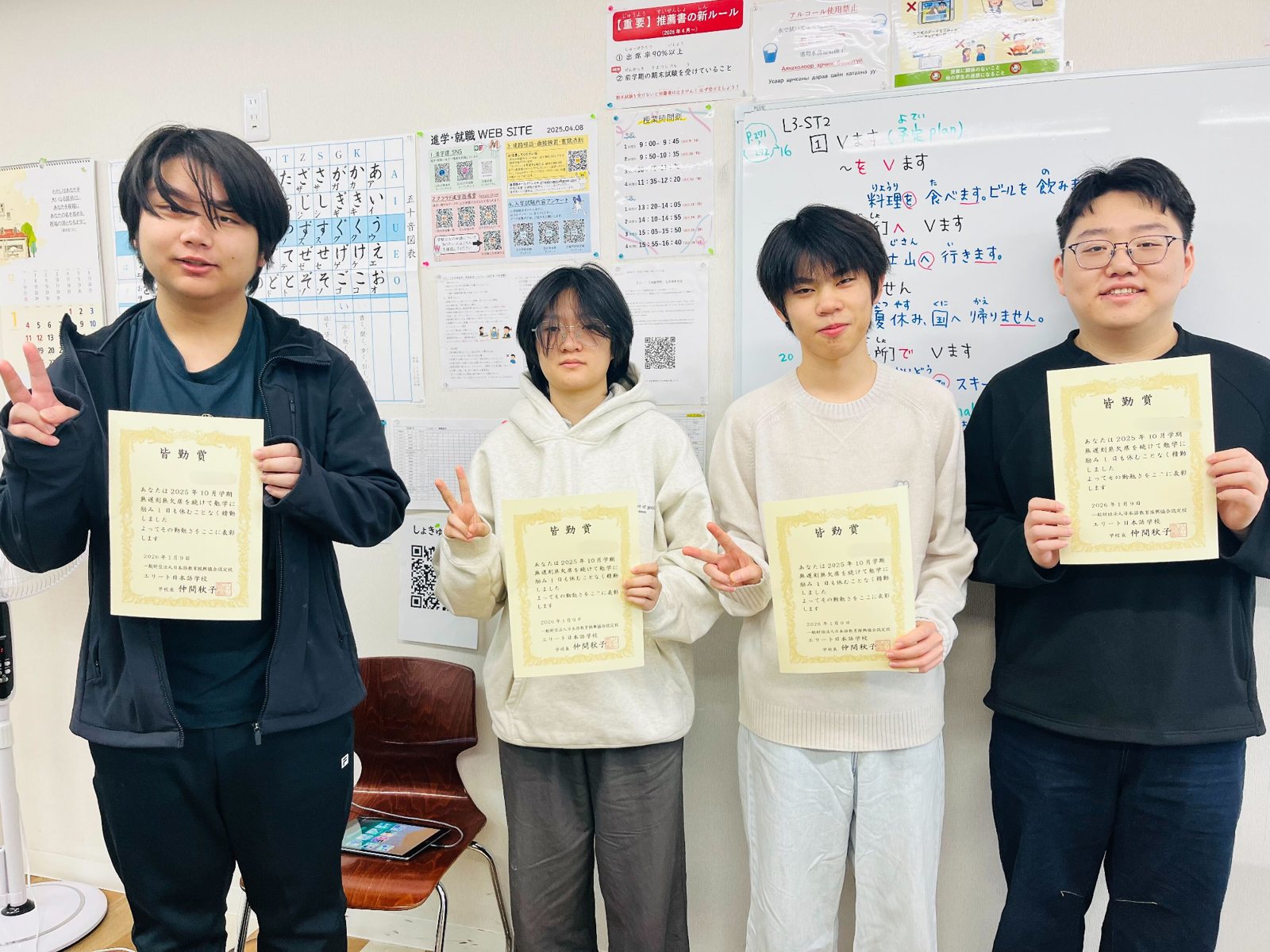
- Perfect-attendance and excellence awards ceremonies were held in each class (April 2026 term).
- 5 university students taking the Japanese teacher training course at Kanto Gakuin University visited and held a visitor session with the Elementary 2 level.
- Kanji study sessions are held for students unfamiliar with kanji. The school also introduces events such as exchange with outside university students, sports viewing and concerts, and traditional Japanese performing arts.
- On Dec 2, a disaster drill was held at Okubo Park, including walking through smoke, using a fire extinguisher and experiencing an intensity-7 earthquake (2022).
On campus
- Building 1 (main school)
- Tokyo Health Plaza Hygeia, 12th floor — 2-44-1 Kabukicho. In January 2022, the school moved to a large public facility owned by the Tokyo Metropolitan Government near Shinjuku Station.
- Building 2
- Shinjuku Building, 3rd floor — 2-42-17 Kabukicho
- Building 3
- 6th floor, Daiya Fugen Building, 1-1-19 Kita-Shinjuku — A branch, Building 3, is to be placed on the 6th floor of the Daiya Fugen Building, 1-1-19 Kita-Shinjuku, Shinjuku-ku, Tokyo (School Rules, Article 3)
- On campus
- Career guidance room — The progression guidance room holds materials on most universities and vocational schools around Tokyo, and has computers.
- Classroom
- Electronic whiteboard — In May 2023, 33 interactive whiteboards were purchased and placed in the classrooms.
2026–2027 academic calendar
- Saturdays and Sundays
- Weekly
- Spring break
- Mar 25–Apr 7
- Golden Week
- Apr 29–May 6
- Summer break
- Thu, Jun 25, 2026 – Tue, Jul 7, 2026
- Obon holiday
- Sat, Aug 8, 2026 – Sun, Aug 16, 2026
- Autumn closure
- Tue, Sep 29, 2026 – Mon, Oct 12, 2026
- Winter break
- Thu, Dec 24, 2026 – Wed, Jan 12, 2027
School website · Confirmed 2026-09-26
Access
- Transit
- JR Yamanote Line Shin-Okubo Station, 3 min walk
JR Sobu Line Okubo Station, 5 min walk
Seibu Shinjuku Line Seibu-Shinjuku Station, 3 min walk
Subway Oedo Line, Higashi-Shinjuku Station, 9 min walk - Nearby
- Building 1 (main school) is on the 12th floor of the Tokyo Metropolitan Health Plaza Hygeia at 2-44-1 Kabukicho, and Building 2 is on the 3rd floor of the Shinjuku Building at 2-42-17 Kabukicho. Distances are measured to the main school.
- Dormitory
- Available¥65,000–¥85,000 per month · Apartment (1DK): ¥60,000/month for 2 people, ¥50,000/month for 4 people, plus a management fee of ¥8,500/month. 3-minute walk from Okubo Station. · Based on school website
School website · Confirmed 2026-09-26
Dormitory — Move-in fee ¥30,000, facility fee ¥40,000, fire insurance ¥10,000. The room contract is renewed every 3 months, with 3 months' rent paid in advance. Water and utilities are included in the management fee.
School website · Confirmed 2026-09-26
SALLAE has organized the school website and published data in English.
The update date is the day that material was last revised.
Photos are materials published by the school.
This information is compiled from official sources and is not updated daily. Please confirm with the official contact before signing or applying.