Higashi-Shinjuku Japanese Language Institute
Higashi-Shinjuku Japanese Language Institute
- Course
- Further-study course only ›
- Tuition
- On the pricier side for Tokyo ›
- Admission
- 4 times a year · Jan, Apr, Jul, Oct ›
Compare side by side with other schools →
Tuition and conditions may change depending on the intake. If you contact us, we will check with the school and give you accurate details.
Nearby schools comparedBy distance · no ads or paid placement
- Higashi-Shinjuku Japanese Language InstituteThis schoolTuition/yr¥914,000Progression—IntakesJan · Apr · Jul · Oct
- Unitas Japanese Language School Tokyo Campus0.3km›Tuition/yr¥860,000Progression—IntakesJan · Apr · Jul · Oct
- Yu Language Academy0.5km›Tuition/yr¥870,000Progression—IntakesJan · Apr · Jul · Oct
- Kai Japanese School0.6km›Tuition/yr¥1,195,000Progression15%IntakesJan · Apr · Jul · Oct
— means SALLAE has not yet found the data.
About the school
A school where all 4 courses are academic-track, with EJU and JLPT preparation and interview and application guidance in the second year. Its last published results on its website (FY2019) were 49 students to vocational schools and 5 to universities, so most went on to vocational schools. It is 5 minutes on foot from Higashi-Shinjuku Station in Shinjuku-ku, Tokyo, with a capacity of 286; in May 2026 it had 173 international students and 23 teachers. Nepal is the most common home country among students (184 of 227 in 2025), and students generally live for the first year in designated student dormitories in Shinjuku-ku and elsewhere (¥35,000–¥65,000 a month per person).
Published data and school website
Tuition
If you saw a lower amount elsewhere, it may not include the admission fee and application fee
Median 1-year tuition in other areas — Kyoto ¥911,000(7 schools) · Kanagawa ¥880,000(8 schools) · Okinawa ¥858,000(6 schools) · Tokyo ¥840,600(56 schools) · Fukuoka ¥835,000(12 schools) · Hyogo ¥825,500(7 schools) · Osaka ¥814,000(27 schools) · Shizuoka ¥790,000(9 schools) · Chiba ¥745,333(10 schools) · Aichi ¥740,667(5 schools)
Total by intake
| Intake · length | Full course |
|---|---|
| January intake · 1 year 3 months | ¥1,104,500 |
| October intake · 1 year 6 months | ¥1,317,000 |
| July intake · 1 year 9 months | ¥1,507,500 |
| April intake · 2 years | ¥1,698,000 |
Cost details · course tables · notes · 5 items
- One-time fees
- ¥914,000Tuition (12 months) ¥636,000 · Admission screening fee ¥50,000 · Admission fee ¥80,000 · Materials (12 months) ¥66,000 · Facility usage fee (12 months) ¥60,000 · Activity fee, off-campus guidance fee and international student insurance ¥22,000
According to the school guide, fees are paid in one lump sum at enrollment. SALLAE will check with the school whether you can pay in installments.
| Intake · course | Extra 2nd-year costs | All |
|---|---|---|
| January · 1 year 3 months | ¥190,500 | ¥1,104,500 |
| October · 1 year 6 months | ¥403,000 | ¥1,317,000 |
| Jul · 1 year 9 months | ¥593,500 | ¥1,507,500 |
| April · 2 years | ¥784,000 | ¥1,698,000 |
Additional costs paid in the 2nd year — the application fee and admission fee are not charged again. 2nd-year items: tuition, materials and facility fees for the remaining period, plus extracurricular activities and international student insurance of ¥22,000 (¥0 for the 1-year 3-month course)
Revised fees apply from the July 2025 intake. Intakes are April, July, October and January, and the course length is set by the month of admission.
Admission screening fee (paid on the date the application is submitted): ¥50,000
Second-year fees are paid in the 9th month after enrollment: Jan 25 for April admission, Mar 25 for July admission, Jun 25 for October admission, Sep 25 for January admission
Translation fees for the documents submitted to the Immigration Bureau are paid separately.
The amount at enrollment plus the second-year amount matches the published course total (1 year 3 months ¥1,105,000 to 2 years ¥1,698,000) to the nearest ¥10,000.
School website · Updated 2026-02-20
Whether it is refundable
- If the CoE is not issued
- The admission screening fee is not refunded for any reason.
- If an enrolled student withdraws
- Withdrawal midway or voluntary withdrawal: tuition already paid is generally not refunded. If there are special circumstances and the principal approves a written statement of reasons, part may be refunded.
Admission & dates
- Apr intake
- 2-year course · Application September to November (approximate) · Classes 1608 hr
- Jul intake
- 1 year 9 months course · Application December to March (approximate) · Classes 1420 hr
- Oct intake
- 1 year 6 months course · Application Mar–Jun (approximate) · Classes 1228 hr
- Jan intake
- 1 year 3 months course · Application June to September (approximate) · Classes 1008 hr
- Japanese level
- JLPT N5–N4 or higher
For January admission, a JLPT N3 or higher pass is required. You must be able to submit the pass certificate.
Deadline and capacity rules
Intakes are April, July, October and January. Age 18 to 26. 12 years of school education in your home country; if 5 or more years have passed since your last education, a statement explaining the gap is required.
School website · Updated 2022-08-05
Classes
- Class assignment
- Level-based 3 stages
Materials · Subjects · Timetable · Details
- Subject
- Comprehensive Japanese · Reading · Grammar · Kanji · Vocabulary · Listening · Conversation · Writing · All 4 courses have the same subjects, such as integrated Japanese, for 20 hours a week. Classes that introduce Japanese culture, rules and events are also included.
Class hours by subject
| Subject | 2 years | 1 year 9 months | 1 year 6 months | 1 year 3 months |
|---|---|---|---|---|
| Beginner | 620 hours | 360 hours | 360 hours | 0 hours |
| Intermediate | 600 hours | 540 hours | 460 hours | 408 hours |
| Advanced | 388 hours | 520 hours | 408 hours | 600 hours |
The goal at completion is N1 in all 4 courses. Terms: Apr 1 – Jul 19, Aug 21 – Nov 30, Dec 1 – Mar 24. Classroom activities include peer learning.
What each level aims for · 3 levels
- Beginner
- N5–N4: pronunciation, characters, basic conversation, basic grammar
- Intermediate
- N3–N2: Japanese culture, reading and listening, composition, everyday conversation, grammar
- Advanced
- N1: Japanese culture, discussion, essays, specialist conversation, grammar
School website · Updated 2020-07-21
Documents
- Application form · enrollment application
- Diploma from the highest level of education
- Academic transcript from the highest level of educationFor all school years
- 8 photos4 cm × 3 cm, taken within the last 3 months
- Copy of passportAlso all pages showing past entry/exit records
- Certificate of completion of Japanese study
- JLPT or other certificatesJLPT pass certificate
- Written pledge
Financial supporter's documents · only if applicable · 4 application requirements
Submitted by the person paying the tuition (financial sponsor)
- Financial sponsorship statement
- Document proving the relationship between the person paying expenses and the applicantFamily register, birth certificate, etc.
- Bank deposit balance certificate from the expense payer's home country, copy of passbookDocument showing transaction history
- The sponsor's certificate of employment and income certificates for the past 3 years
Only if applicable
- Certificate of enrollment (if currently enrolled)
- Statement explaining the gap (Those who graduated from their last school 5 or more years ago)
- Business license and tax payment certificate (Business owner or sole proprietor)
Application requirements
The ¥50,000 admission screening fee is paid when the application documents are submitted. It is not refunded even if the Certificate of Eligibility is not issued. Translation fees for the documents submitted to the Immigration Bureau are paid separately. The financial sponsorship statement lists the monthly and annual amounts for tuition and living costs and how they will be paid, and states that a remittance certificate or a copy of the bankbook will be submitted at renewal. In the guarantor field of the pledge, write the address, name (signature), relationship to the student and occupation (workplace).
No additional documents by country or standards specific to Korean applicants are published. SALLAE is confirming this with the school.
School website · Updated 2022-08-05
Admission process
- Request an admission consultation — Contact by phone, e-mail or the inquiry form. Information is provided through the application guidelines and an interview (including online).
- Send the required documents and the screening fee — During the application period (approximate), send the required documents and the ¥50,000 screening fee. April admission: Sep–Nov; July admission: Dec–Mar; October admission: Mar–Jun; January admission: Jun–Sep.
- Screening of the applicant — Admission screening: checking Japanese test results, tax certificates and bankbooks (May 2026 periodic inspection report)
- Review of documents needed for the Certificate of Eligibility application — The ¥50,000 admission screening fee covers the review of the application form and the documents needed for the Certificate of Eligibility application, and is not refunded even if the Certificate of Eligibility is not issued.
School website · Updated 2022-08-05
Progression
| FY2019 | Admitted |
|---|---|
| University | 5 students |
| Vocational school | 49 students |
See 22 more schools
All schools accepted to so far
See 4 more schools
See 19 more schools
Progression results: FY2018 graduate school 1, university 19, vocational school 62; FY2017 graduate school 1, university 33, vocational school 66 · School website · Updated 2020-09-29
Reviews
If you study here or used to, tell others what the classes, teachers and daily life were like. It helps anyone deciding on this school.
Write the first reviewUniversity prep
- Preparation coaching for the EJU and the JLPT — EJU and JLPT preparation coaching is given as needed. The annual schedule includes mock exams in May, June, September, October and November.
- Coaching on interviews and application procedures for target schools — For second-year students, coaching is given on interviews and on the application procedures for their target schools.
- Career consultation — Career consultation begins in October (annual schedule)
- Progression information session — June 2019 progression information session
- Career guidance staff — Career guidance staff: 2 concurrent (periodic inspection report as of May 15, 2026)
School website · Updated 2022-08-05
Daily-life support
- Life guidance — Classes cover Japanese culture, rules and events, with a strong focus on guidance for daily life. Daily-life guidance staff: 5 full-time and 1 concurrent.
- Health checkup — A health checkup is held as early as possible after enrollment, and every year after that.
- Attendance guidance — Students whose monthly attendance rate falls below 80% are given guidance for improvement until it reaches 80% or higher.
- Checking period of stay and permitted outside activity — The school keeps track of each student's period of stay and whether they hold permission for activity other than that permitted by the status of residence, and advises accordingly. Students with permission are asked to report the name of the public or private organization where they work.
- Contact during breaks — School staff are at the school during students' summer vacation and can be reached if needed (notice of July 27, 2023).
The number of student-life staff, health checkups, attendance and residence checks are based on the periodic inspection report of May 2026.
School website · Updated 2026-05-25
Students
Enrolled 227 (2025) · Capacity 286 National median: 180 students
Based on 227 students enrolled in 2025.
Public data from the Association for the Promotion of Japanese Language Education (Nisshinkyo) · verified 2026-09-20
School life
For 1 year
- 1
- Jan intake entrance ceremony
- 2
- Opening ceremony for current students
- 3
- Graduates' speech contest · Graduation ceremony · Spring break · End-of-term exams for current students · Announcement of learning results, class changes
- 4
- Entrance ceremony for April intake · Opening ceremony for current students · New classes
- 5
- Mock exams preparing for the EJU and JLPT
- 6
- EJU month · End-of-term exams · JLPT mock exam
- 7
- Entrance ceremony for July intake · JLPT
- 8
- Summer vacation
- 9
- End-of-term exams · EJU mock exam
- 10
- Entrance ceremony for October intake · Career consultation begins · Japanese proficiency mock exam
- 11
- EJU month · JLPT mock exam
- 12
- JLPT month · End-of-term exams
This is the annual schedule from the curriculum page (posted in 2020).
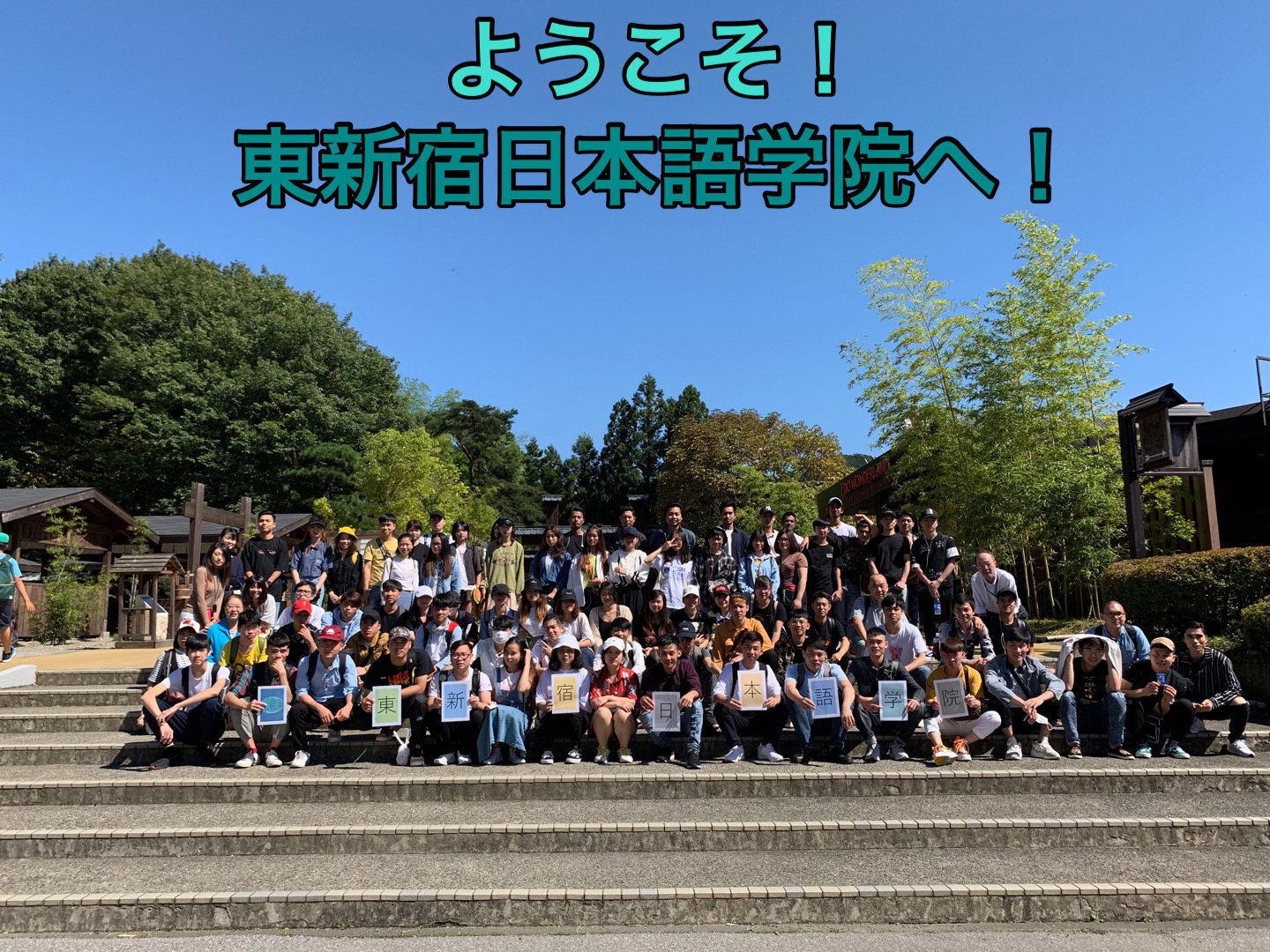
- Extracurricular activities: Nikko Edomura in May 2026, the ginkgo avenue at Meiji Jingu Gaien in November 2023, and Yushima Tenmangu and Kanda Shrine (yukata experience) in July 2023
- Tokyo Disneyland (2012, 2014) · Fuji-Q Highland (2013) · Kasai Rinkai Park (2014) · Tokyo DisneySea (2015) · Ueno Zoo (2016) · Mt. Takao (2017) · Nikko Edomura (2019)
2020–2021 annual schedule · Older material
- Summer vacation
- Jul 20–Aug 20 · The school's summer vacation runs from July 20 to August 16, 2026.
- Winter break
- Dec 23–Jan 5 · The school's winter vacation runs from December 26, 2025 to January 4, 2026.
- Spring break
- Mar 25 – Apr 3 · The school's spring vacation runs from March 21 to 31, 2025!
School website · Updated 2020-07-21
Access
- Transit
- Toei Subway Oedo Line / Tokyo Metro Fukutoshin Line Higashi-Shinjuku Station, 5 min walk Exit B3
- Nearby
- Turn right from exit B3, go straight about 200 m with the supermarket on your right, and the building is on your right. Job listings say 3 min walk from Higashi-Shinjuku Station and 12 min walk from Shin-Okubo Station.
- Dormitory
- Available¥35,000/month · Designated student dormitories: 4 in Shinjuku-ku and 3 elsewhere in Tokyo, dormitory fee (per month) ¥35,000–¥65,000 per person, in principle a 1-year stay · Per the school website
School website · Updated 2023-09-13
Student dormitory — Security deposit of 1 month's rent, futon fee ¥20,000, facility fee charged separately. Costs may change with economic fluctuations.
School website · Updated 2024-04-12
SALLAE has organized the school website and published data in English.
The update date is the day that material was last revised.
Photos are materials published by the school.
This information is compiled from official sources and is not updated daily. Please confirm with the official contact before signing or applying.