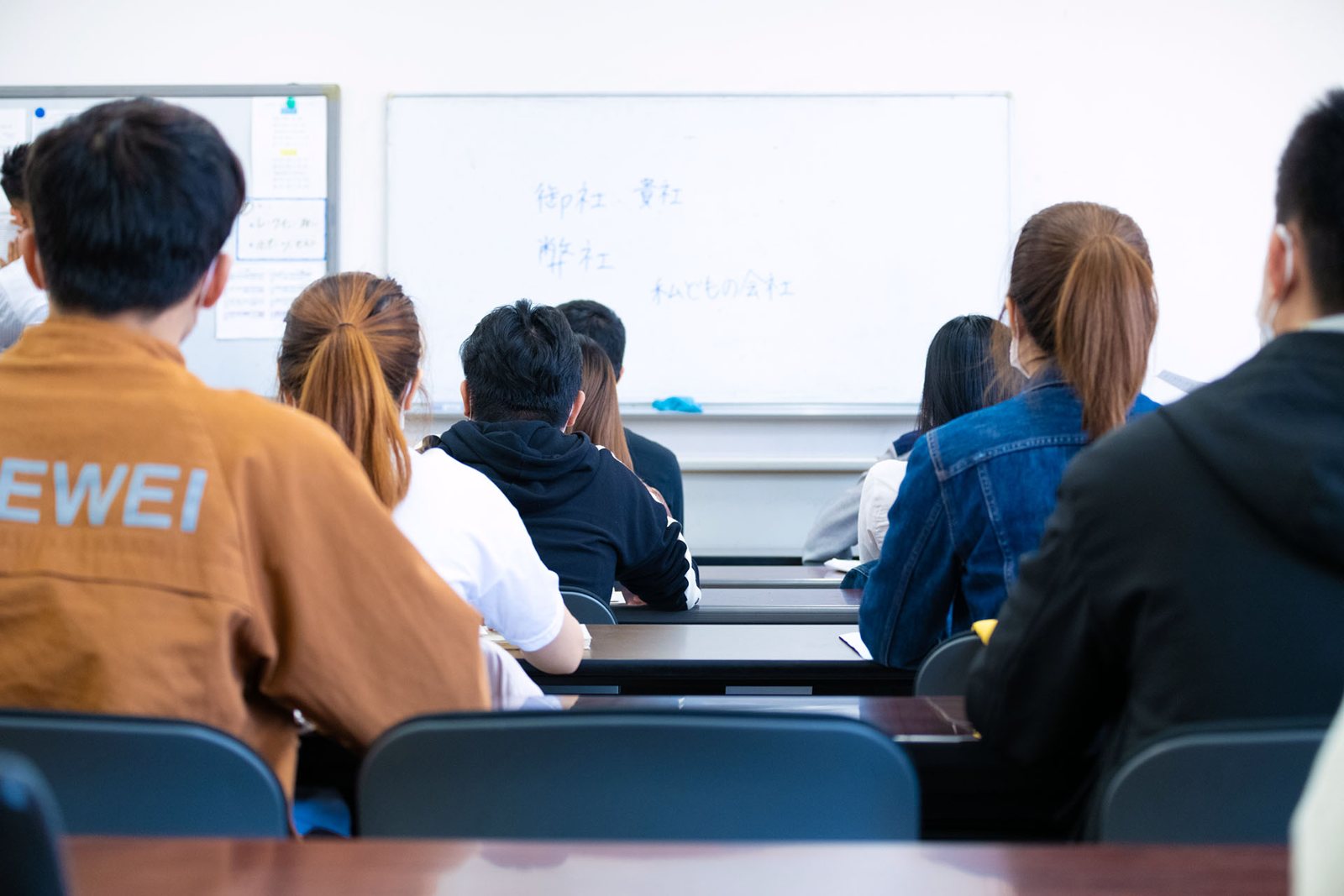
Hiroshima International Business College (vocational school)
Hiroshima International Business College (vocational school)
- Course
- Further-study course only ›
- Tuition
- On the cheaper side nationwide ›
- Admission
- Twice a year · April and October ›
Compare side by side with other schools →
Tuition and conditions may change depending on the intake. If you contact us, we will check with the school and give you accurate details.
Nearby schools comparedBy distance · no ads or paid placement
- Hiroshima International Business College (vocational school)This schoolTuition/yr¥660,000Progression—IntakesApr · Oct
- Anabuki International Mirai College, Japanese Language Department0.8km›Tuition/yr¥850,000Progression—IntakesApr · Oct
- Japanese College Fukuyama1.6km›Tuition/yr¥900,000Progression—IntakesApr · Oct
- Yakage Business College Japanese Language School25.8km›Tuition/yr¥690,000Progression—IntakesApr · Oct
— means SALLAE has not yet found the data.
About the school
A progression-focused Japanese Language Department offering only progression courses (2-year, 1 year 6 months and 1-year) for entering universities, graduate schools and vocational schools, with preparation for the EJU, JLPT, essays and interviews. In FY2025, 137 of the 153 students who completed the course progressed to universities etc. (including vocational schools). The department belongs to a vocational school in Fukuyama, Hiroshima Prefecture, 5 minutes on foot from JR Fukuyama Station, with a capacity of 260. Support includes airport pickup on arrival, a student dormitory with furniture and appliances, and daily-life support from staff who can handle Chinese, Vietnamese, Nepali and other languages.
Published data and school website
Tuition
If you saw a lower amount elsewhere, it may not include the admission fee and application fee
Median 1-year tuition in other areas — Kyoto ¥911,000(7 schools) · Kanagawa ¥880,000(8 schools) · Okinawa ¥858,000(6 schools) · Tokyo ¥840,600(56 schools) · Fukuoka ¥835,000(12 schools) · Hyogo ¥825,500(7 schools) · Osaka ¥814,000(27 schools) · Shizuoka ¥790,000(9 schools) · Chiba ¥745,333(10 schools) · Aichi ¥740,667(5 schools)
Admission & dates
- Apr intake
- 2-year course · Application 2-year course / 1-year course (April intake) → July–October of the previous year · Classes 1,600 class hours (1 class hour = 45 minutes)
- Apr intake
- 1-year course · Application 2-year course / 1-year course (April intake) → July–October of the previous year · Classes 800 class hours (1 class hour = 45 minutes)
- Oct intake
- 1 year 6 months course · Application 1.5-year course (October intake) → February–May of the same year · Classes 1,200 class hours (1 class hour = 45 minutes)
- Japanese level
- JLPT N5 level or above
At least 150 hours of Japanese study at a Japanese language institution or similar, and Japanese ability at JLPT Level 4 (N5) or higher (2021 admissions guide).
Deadline and capacity rules
Capacity: 2-year course 120, 1.5-year course 120, 1-year course 20. Application period Aug 1–Nov 30, 2026. Eligibility: 12 or more years of schooling completed, a clear purpose for study and career path, a guarantee of financial support, and no record of a denied Certificate of Eligibility.
School website · Confirmed 2026-09-26
Classes
Materials · Subjects · Timetable · Details
- Materials
- Elementary: Minna no Nihongo Elementary I and II, 2nd edition. After that: Nihongo So-matome N3 to N1, Shin Kanzen Master, and Nihon Ryugaku Shiken Taisaku Kijutsu Mondai Theme 100. Teacher-made materials are also used.
Class hours by subject
| Subject | 2 years | 1 year 6 months | 1 year |
|---|---|---|---|
| Beginner | 200 hours | — | — |
| Lower intermediate | 300 hr | 160 hours | — |
| Intermediate | 300 hr | 240 hours | 100 hours |
| Upper intermediate | 400 hours | 400 hours | 300 hr |
| Advanced | 400 hours | 400 hours | 400 hours |
Monday to Friday, 4 periods a day (45 minutes each). A placement test is given right after arrival in Japan; afterward, classes are reorganized based on confirmation tests, lesson tests and the like.
What each level aims for · 3 levels
- Elementary class
- Instruction continues until students can manage everyday conversation without trouble. Guideline: aim to pass JLPT N4.
- Intermediate class
- Aims at university entrance. Students are taught until they can express opinions accurately and communicate smoothly. Guideline: pass JLPT N2 or N3.
- Advanced class
- Aims at graduate school and university entrance. Students are taught until they can write short essays and give speeches. Guideline: aim to pass JLPT N1.
School website · Confirmed 2026-09-26
Documents
- Application form: filled in by the applicant personally; no one may write it for them. Write your name in the Latin alphabet above the name.
- Resume: filled in by the applicant personally; no one may write it for them. Write your name in the Latin alphabet above the name.
- Copy of passport: copy of all pages with entries. Have it obtained by the time of application.
- Statement of reasons for applying and plans after graduation: filled in in detail by the applicant personally; no one may write it for them. Applicants aged 25 or over must explain in particular detail how they came to apply.
- Certificate of Japanese study: filled in by the teacher or person in charge and stamped with approval by the school principal. At least 150 hours of Japanese study are required by the time of application.
- 5 photos (4 cm tall x 3 cm wide): taken within 6 months before application, with name and country written on the back; attach one to the application form.
- Original high school graduation certificate or diploma
- Original graduation certificate or diploma proving your last level of education
- Academic transcript: from high school, and from university if you graduated from one; must show grades for each year.
- Notarized family relationship certificate, copy of family register, copy of ID
Financial supporter's documents · only if applicable · 4 application requirements
Submitted by the person paying the tuition (financial sponsor)
- Statement of financial support: filled in by the sponsor personally in their native language. Writing on behalf of another person is not accepted.
- Documents proving the relationship to the applicant: notarized proof of kinship, birth certificate, etc.; for non-relatives, letters or photos.
- Certificate of employment: if the sponsor is a company owner or director, also a copy of the company's registration certificate.
- Income certificate: only certificates showing income for the past 3 or more years are accepted
- Tax payment certificate: issued by the tax office and covering at least the past 3 years of tax payments.
- Bank balance certificate: from a bank that can send money overseas, on the bank's official form, stating its address, phone and fax numbers.
- Copy of the bankbook supporting the bank balance certificate
- Statement of how funds were built up: an explanation, with monthly income and expenses, of how the funds were saved.
Only if applicable
- Results of an internationally recognized Japanese test such as JLPT, J-TEST or NAT-TEST, clearly stated (If you have taken a Japanese language test)
- Statement of reasons for non-issuance and statement of reasons for reapplication (including materials that can dispel the reason for non-issuance) (If you applied in the past and were denied)
- Certificate of enrollment (if currently enrolled)
- Certificate of return to study from the school (If you come to Japan while on leave)
- Elementary school enrollment certificate (If you entered elementary school at age 5 or under, or age 8 or over)
- Statement explaining any gap period (If you did not apply to this school right after your last graduation and there is a gap of 1 year or more)
- Statement explaining whether you could attend both at the same time (If you attended a Japanese language school while enrolled in high school or university, or while employed)
- Certificate of employment: stating the period of employment and duties (Only those with work experience)
- Certificate of reinstatement: stating the year and month of return to work (If you will return to work after graduating from this school)
- Certificate of dispatch and certificate of reinstatement: stating the dispatch period and the year and month of return to work (If you are dispatched by your employer)
- If you have visited Japan many times, materials explaining the reason (certificate, statement, etc.) (If you have visited Japan many times in the past)
- Documents proving that training history (stating the training content, period, allowance and contact details of the host organization) (If you have been to Japan for technical training)
- Tax payment certificate or annual income certificate (the tax payment certificate must be issued by the tax office) (If you pay tuition and living costs yourself)
- Bank balance certificate in your own name: from a bank that can send money overseas, on the bank's official form, stating its address, phone and fax numbers. (If you pay tuition and living costs yourself)
- Statement of financial support: must be filled in by the sponsor personally. Writing on behalf of another person is not accepted. (If the financial sponsor lives in Japan)
- Certificate of employment: company owners and directors, a copy of the company's registration certificate; self-employed, a copy of the business license. (If the financial sponsor lives in Japan)
- Income certificate: tax payment certificate and tax assessment certificate for resident tax or income tax showing total income, or a copy of the withholding slip or final tax return (copy). (If the financial sponsor lives in Japan)
- Bank deposit balance certificate: from a bank that can send money overseas, on the bank's official form, stating its address, phone and fax numbers. (If the financial sponsor lives in Japan)
- Seal registration certificate (If the financial sponsor lives in Japan)
- Documents proving the relationship to the applicant: for non-relatives, letters or photos. (If the financial sponsor lives in Japan)
- Certificate of residence listing all members of the same household (the Residence Card if the sponsor is a foreign resident of Japan) (If the financial sponsor lives in Japan)
- Statement of financial support: filled in, signed and sealed by the person in charge. If funds are sent from a company in your home country, the person in charge writes it in their native language. Writing on behalf of another person is not accepted. (If a company or public-interest organization is the sponsor)
- Copy of company registration certificate (If a company or public-interest organization is the sponsor)
- Profit and loss statement (if expenses are paid by a company or an organization such as a public-interest corporation)
- Documents proving the joint-venture relationship or business transactions (If a joint-venture company or business partner is sending an employee to study in Japan)
- Bank balance certificate: from a bank that can send money overseas, on the bank's official form, stating its address, phone and fax numbers. (If a company or public-interest organization is the sponsor)
Application requirements
The sponsor documents listed assume funds are sent from the applicant's home country. Documents differ for sponsors living in Japan and for companies or organizations. Application documents for April entry must be prepared after August of the previous year; for October entry, after February of the same year. Attach a Japanese translation to every document not written in Japanese, including the translator's name and contact details. During screening, the Immigration Services Bureau may request documents other than those above; if so, submit them promptly.
Only the procedures for Mainland China (CDGDC) and Vietnam (VN-NARIC) are listed for graduation verification. The admissions guide does not say what to submit from Korea (family relationship documents, graduation verification, etc.). SALLAE is confirming this with the school.
School website · Confirmed 2026-09-26
Admission process
- Request an admission consultation — You can consult about admission preparation and procedures in Korean.
- On-site interview — Depending on the region, applicants may be asked to travel to a designated place. Depending on the region and schedule, an interview may be difficult.
- Pass the interview
- In-school document screening — Application forms are available as Excel/PDF in English, Vietnamese and Chinese. An application screening fee of ¥20,000 is required with the documents. Send documents by the end of November of the previous year for April entry, and by the end of May for October entry.
- Admission permit issued
- Immigration Services Agency review — It takes about 2 months after applying to the Immigration Bureau for the Certificate of Eligibility to be issued.
- Issuance of the Certificate of Eligibility — Once the Certificate of Eligibility is issued, the school sends an invoice for tuition and other fees. If you withdraw after it is issued, the ¥20,000 application screening fee and ¥100,000 admission fee are not refundable.
- Tuition payment — When the invoice arrives, transfer the payment promptly to the school's designated account. After payment is confirmed, the original Certificate of Eligibility and admission permit are sent.
- Entry procedures at the consulate (re-examination by the consulate) — When the certificate and permit arrive, complete entry procedures at the relevant consulate. If you do not pass the entry screening, tuition and fees other than the document screening fee and admission fee are refunded.
- Enter Japan and enrol — Please let the school know once your arrival in Japan is decided. The school will meet you at the airport.
- Placement test
- Admission screening is by online interview (2026 periodic inspection). A placement test is given right after arrival in Japan, before classes begin.
School website · Confirmed 2026-09-26
Graduate outcomes
| FY2025 | Admitted |
|---|---|
| Employment | 3 students |
| Graduates | 153 students |
All schools accepted to so far
See 20 more schools
FY2025: 153 course completers; 150 students meeting the criteria in total (95.5%); progression to universities etc.: 71, 49 and 17. · Granted a change to a status of residence in the upper column of Table 1-1 or 1-2 of the Immigration Control Act: Progression 2-year course 2 · 1.5-year course 1 · School website · Updated 2026-06-10
Reviews
If you study here or used to, tell others what the classes, teachers and daily life were like. It helps anyone deciding on this school.
Write the first reviewUniversity prep
- Progression guidance — Preparation for the EJU, JLPT, essays and interviews, aiming at admission to the student's chosen university. The whole school, not just the homeroom teacher, supports progression to further education.
- Career interview — Career interviews are held in April of the 2nd year and around September, before the second-term classes start (after summer break). After that, individual consultations are available at any time for changes of plans.
- Provision of the information needed for career guidance — Information on study-abroad fairs and on universities and vocational schools is posted on social media. For schools you are interested in, visit their websites and request materials if needed.
- Career plans managed by the whole department — Homeroom teachers survey students' desired paths and report to the chief teacher and department head. The department head is responsible for career guidance and manages it jointly with General Affairs. Career guidance staff: 5 full-time (Reiwa 8, 2026).
School website · 2026-04-01 updated
Daily-life support
- Airport pickup — Please let the school know once your arrival in Japan is decided. The school will meet you at the airport.
- Part-time job introductions — Introductions to part-time job employers, and help with writing a resume and opening a new bank account. Part-time work up to 28 hours per week with permission for activities outside status of residence. Partnered with major part-time employers.
- Visa procedures handled on your behalf — Students whose status of residence is about to expire are approached in advance and given individual guidance. 5 application-agent staff (FY2023).
- Native-language consultation — Staff who can handle Chinese, Vietnamese, Nepali, English, German and Hindi are always on site.
- Guidance (booklet) — In the guidance session right after enrollment, a booklet in 6 languages covering garbage disposal, traffic rules, dormitory life, activities outside status of residence, insurance and visa renewal is handed out and explained through interpreting staff.
- Health checkup and escort to the hospital — Health checkups are held right after arrival in Japan and in the 2nd year. Staff accompany students to the hospital and interpret the doctor's explanation.
- Insurance — National Health Insurance (the state covers 70% of treatment costs) and the mutual-aid insurance of the Japanese language school cooperative (covers the 30% co-payment; dental and gynecology excluded)
- Disaster prevention education — On the day after the entrance ceremony, a fire evacuation drill is held with interpreting (dormitory residents also practice the dormitory evacuation route). The school has a disaster agreement with schools that can take in students in a disaster.
- Life guidance staff — The vice principal is responsible for student guidance, and the Student Support Division supports school life in general. Student guidance staff: 5 full-time and 1 concurrent (Reiwa 8, 2026).
- Food bank — The school has partnered with ZZB Co., Ltd. to start a food bank, providing food free of charge mainly to students.
School website · 2026-04-01 updated
Scholarship
- The school's own scholarship
- Amounts: ¥100,000, ¥50,000 and ¥30,000. Conditions: 100% attendance rate, excellent grades, study attitude, a recommendation from the homeroom teacher and participation in school activities, judged overall. Mainly for students in their 2nd year or later.
- Study incentive grant for international students
- Monthly ¥48,000 × 1 yearAmount: ¥48,000 per month, ¥576,000 per year, paid for 1 year. The school applies for the privately financed international student study incentive grant on students' behalf.
- LSH Asia Scholarship (specified nonprofit organization)
- ¥100,000 Once¥100,000 per year. The school also applies to the LSH Asia Scholarship Foundation and similar bodies.
- Other (essay contest, speech contest)
- Grand prize ¥50,000, participation prize ¥10,000. 1st-year students can also enter the contests.
School website · 2021-11-08 updated
Students
194 students enrolled (2025) · Capacity 260 National median: 180 students
Based on 194 students enrolled in 2025.
Public data from the Association for the Promotion of Japanese Language Education (Nisshinkyo) · verified 2026-09-20
School life
For 1 year
- 4
- Entrance ceremony for all departments (except the 1.5-year course of the Japanese Language Department) · New student guidance · Traffic safety class / bicycle training · Health checkup
- 5
- Traditional culture class · Field trip: Hiroshima and Miyajima · Cleanup activity (Midori-machi Park; the school's own volunteer project) · Fukuyama Rose Festival
- 6
- EJU, 1st sitting · Ohanashi Matsuri (storytelling festival) · Exchange event
- 7
- JLPT, 1st sitting · Career guidance · Etiquette course · Reading contest for foreigners
- 8
- Summer vacation · First semester exam (Japanese Language Department and International Culture and Communication Department)
- 9
- Kiku no Sekku (Chrysanthemum Festival) · Bingo region joint information fair on further education · Kiwanis Japanese essay contest for international students
- 10
- Entrance ceremony (Japanese course, 1.5-year) · New student guidance · Traffic safety class / bicycle training · Health checkup · International autumn festival
- 11
- EJU, 2nd sitting · Field trip (Japanese Language Department, 1st year) · Job-hunting information session
- 12
- 2nd Japanese-Language Proficiency Test · Sports day · Fukuyama Human Rights and Peace Festa: Human Rights Week commemorative gathering
- 1
- Winter break
- 2
- Graduation exam (2nd-year students of each department) · Hinamatsuri (Doll Festival) · Final exams (Japanese Language Dept., International Interpreting & Business Dept., Architectural CAD Dept.) · Lunar New Year holiday · Fukuyama City Japanese speech contest
- 3
- Graduation ceremony · Spring break
Only the Japanese Language Department's dates were copied from the school-wide annual events page (revised November 2021). Exams and make-up classes for other departments only are excluded.
- May (2nd-year field trip): visit to Peace Memorial Park and the Atomic Bomb Dome for peace studies, and to Itsukushima Shrine on Miyajima.
- July: take part in a story-reading contest, and in an international exchange event with local high school students through origami.
- September: take part in the traditional performing arts experience program 'Iaido'
- November (1st-year field trip): walk through the old streets of Tomonoura (Fukuyama) and visit its World Heritage site; orientation at a small zoo in Fukuyama.
- December: sports tournament (bowling) / March: take part in the international students' speech contest
- Students of the Japanese Language Department took part in the Tomonoura fireworks festival and ran a stall.
On campus
- 2F
- Staff room, 2F free space — A free space is also set up inside the 2nd-floor staff room for students who want to study on their own while talking directly with teachers.
- 3F
- Classrooms 301, 302, 303 and 305, library, 3F free space
- 4F
- Classrooms 401, 402, 403, 405 and 406, 4F free space
- 5F
- Classrooms 401, 402, 403, 405 and 406, 4F free space
- 6F
- Classrooms 601 and 603
- 7F
- Classroom 701, PC rooms 702 and 703 — The IT classrooms have 78 computers and 2 projectors (across 2 rooms), with one computer per student.
- 8F
- Classrooms 601 and 603
- All regular classrooms
- DVD recorder and monitor — A mobile projector can also be used when needed.
- Building
- Elevator — There is almost no step between classrooms and corridors, so wheelchair access is possible.
Academic calendar
- Summer vacation
- Aug
- Winter break
- Jan
- Lunar New Year holiday
- Feb
- Spring break
- Mar
School website · 2021-11-18 updated
Access
⚠ Whether living in the dormitory is required differs by source. Please confirm with the school. New students in the Japanese Language Department must live in the dormitory for 6 months, until they get used to life in Japan · Living in the dormitory is not compulsory; only students who wish to use it. Most new students currently live there. Please check with the school which is the current rule.
- Transit
- JR 5 min walk from Fukuyama Station
- Nearby
- About 1 min on foot from Hisamatsu-dori bus stop
- Dormitory
- Available¥28,000 per month · 1K rooms at Nishimachi Plaza, equipped with necessities (futon, appliances, tableware, etc.); a supermarket is near the dormitory · Based on school website
School website · 2023-03-30 updated
Dormitory — Besides the dormitory manager, a teacher in charge of student guidance also manages the dormitory in general (managing dormitory fees and guiding student life overall)
School website · 2021-11-08 updated
SALLAE has organized the school website and published data in English.
The update date is the day that material was last revised.
Photos are materials published by the school.
This information is compiled from official sources and is not updated daily. Please confirm with the official contact before signing or applying.