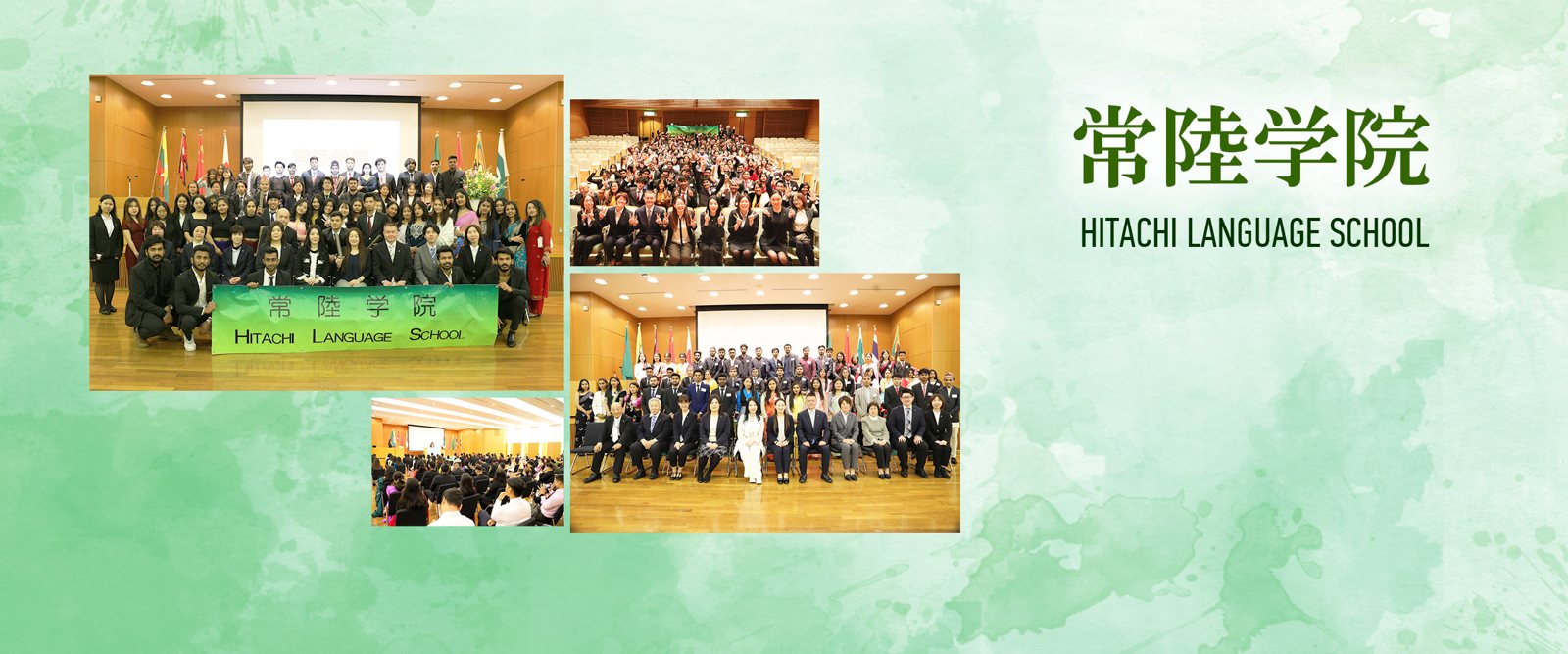
Hitachi Gakuin
Hitachi Gakuin
- Progression
- University or similar 98% ›
- Tuition
- On the cheaper side nationwide ›
- Admission
- 4 times a year · choose your intake month ›
Compare side by side with other schools →
Tuition and conditions may change depending on the intake. If you contact us, we will check with the school and give you accurate details.
Nearby schools comparedBy distance · no ads or paid placement
- Hitachi GakuinThis schoolTuition/yr¥715,000Progression98%IntakesJan · Apr · Jul · Oct
- Mirai Japanese Language School0.8km›Tuition/yr¥799,000Progression85%IntakesApr · Oct
- Ibaraki International Academy3.6km›Tuition/yr¥670,000Progression—IntakesApr · Jul · Oct
- Hitachi Sakura Japanese Language School32.7km›Tuition/yr¥771,000Progression—IntakesJan · Apr · Jul · Oct
— means SALLAE has not yet found the data.
About the school
A school that focuses on progression. In the FY2025 course completion report, 63 of the 64 students meeting the criteria progressed to Japanese universities, vocational schools and the like. It has progression courses for graduate school, university and vocational school, and EJU mathematics and integrated-subject preparation classes. The school is about 15 minutes by bus from Mito Station in Ibaraki Prefecture, with a capacity of 136; both morning and afternoon classes run 4 periods of 45 minutes. All students live in the school dormitory (in principle 4 per room), and of the 121 students enrolled in 2025, 110 were from Nepal and Sri Lanka.
Published data and school website
Tuition
If you saw a lower amount elsewhere, it may not include the admission fee and application fee
Median 1-year tuition in other areas — Kyoto ¥911,000(7 schools) · Kanagawa ¥880,000(8 schools) · Okinawa ¥858,000(6 schools) · Tokyo ¥840,600(56 schools) · Fukuoka ¥835,000(12 schools) · Hyogo ¥825,500(7 schools) · Osaka ¥814,000(27 schools) · Shizuoka ¥790,000(9 schools) · Chiba ¥745,333(10 schools) · Aichi ¥740,667(5 schools)
Total by intake
| Intake · length | Full course |
|---|---|
| 1 year 3 months | ¥878,000 |
| 1 year 6 months | ¥1,041,000 |
| 1 year 9 months | ¥1,204,000 |
| 2 years | ¥1,366,000 |
Cost details · Course tables · Notes
- Per term
- ¥162,667 3 months
- One-time fees
- ¥64,665Application fee · Admission fee
| Duration | Total |
|---|---|
| 1 year 3 months | ¥878,000 |
| 1 year 6 months | ¥1,040,667 |
| 1 year 9 months | ¥1,203,334 |
| 2 years | ¥1,366,001 |
★"Per term" and "One-time at start" were calculated by SALLAE from each course's total. The courses this school actually offers are 1 year 3 months onward — all amounts in the table are values calculated by SALLAE.
Calculated by SALLAE · verified 2026-09-16
Admission & dates
- Apr intake
- 2-year course · Application July to October (4 months)
- Jul intake
- 1 year 9 months course · Application November to February (4 months)
- Oct intake
- 1 year 6 months course · Application February to May (4 months)
- Jan intake
- 1 year 3 months course · Application May to August (4 months)
- Japanese level
- At least 200 hours of Japanese study
If your last education is high school (12 years of schooling), you must hold a certificate of JLPT Level 4 (N5) or higher, J-TEST (Grade F or higher) or NAT-TEST Level 4.
Deadline and capacity rules
There are 4 entry months a year (April, July, October and January), and every term graduates in March. If January entrants do not pass the graduation exam, the period can be extended up to 2 years at most.
School website · 2026-09-10 updated
Classes
- Morning
- 08:30-12:00 4 periods a day (45 min each), 20 periods a week
- Afternoon
- 13:00-16:30 4 periods a day (45 min each), 20 periods a week
- Elective classes
- Mathematics I · Mathematics II · Integrated subjects · English · EJU preparation classes other than Japanese (extra fee): Mathematics I, Mathematics II and Integrated Subjects. EJU preparation classes: Mathematics I and II, Integrated Subjects and English.
Materials · Subjects · Timetable · Details
- Materials
- Elementary: Minna no Nihongo and picture materials. Intermediate: Chukyu kara Manabu Nihongo. Advanced: Jokyu de Manabu Nihongo. Authentic materials such as newspapers and TV news are also widely used.
- Subject
- Reading · Listening comprehension · Conversation · Composition · Intermediate classes are organized by genre: reading, listening and conversation. Conversation classes are offered for elementary, intermediate and advanced levels.
Class hours 4 periods a day (45 minutes each), 20 periods a week, for a total of 760 hours of study a year.
| Morning | Afternoon | |
|---|---|---|
| Period 1 | 08:30-09:15 | 13:00-13:45 |
| Period 2 | 09:25-10:10 | 13:55-14:40 |
| Period 3 | 10:20-11:05 | 14:50-15:35 |
| Period 4 | 11:15-12:00 | 15:45-16:30 |
Each level takes 6 months as standard. A progression course (graduate school, university, vocational school) and a JLPT course (N1 and N2). Grades are assessed mainly by the homeroom teacher, plus 4 regular exams a year.
What each level covers · 4 stages
- Beginner
- 6 monthsBasic grammar and sentence patterns. 2,000 words of vocabulary and 500 kanji. Consolidating the four skills. Self-expression useful in daily life using simple sentence patterns and vocabulary. Passing the old JLPT level 3
- Intermediate
- 6 monthsSomewhat advanced grammar. 7,000 words and 1,000 kanji. Idioms and set phrases. Short essays. Pass JLPT N2.
- Advanced
- 6 monthsMore advanced grammar and sentence patterns. 2,000 kanji and 10,000 words. Reading complex, advanced texts. Logical writing. Pass JLPT N1.
- Further study
- 6 monthsClasses centered on past entrance exam questions. Distinctively Japanese expressions. Guidance on entrance exam essays. Interview coaching. Natural, persuasive expression.
School website · 2020-05-11 updated
Documents
- Admission application formphoto attached), résumé (on the academy's designated form), 4 sheets in total
- 6 photos3 cm × 4 cm, with name and date of birth written on the back
- Original diploma of last education and verification report
- Report card
- Certificate of Japanese study
- Copy of passport
- Copy of ID
- Copy of certified family registerSame address as on the résumé; if different, attach a separate explanation
- Handwritten statement of reasons for study
Financial supporter's documents · only if applicable · 6 application requirements
Submitted by the person paying the tuition (financial sponsor)
- Financial sponsorship statementUse the institute's designated form
- Notarized certificate of family relationshipOfficial documents showing the relationship between the applicant and the sponsor
- Sponsor's bank balance certificate¥3,000,000 or RMB 200,000 or more
- Sponsor's certificate of employment, income certificate and tax payment certificateShowing income for the past 3 years
- Business licenseIf the sponsor is self-employed
- Sponsor's family status listApplication form set
Only if applicable
- Certificate of enrolment and certificate of expected graduation (If you are currently enrolled)
- Pass certificate for the Japanese-Language Proficiency Test level 4, NAT-TEST level 4, JLCT level 4, or J-Test level F, etc. (for high school graduates)
- Proof of Japanese study hours (200 hours or more) (If you have a junior college or university education)
- Copy of the passport pages with visa and entry/exit stamps (If you have entered Japan before)
- Copy of passport, copy of both sides of Residence Card, copy of student ID of the school attended or certificate of employment (If you have relatives in Japan (parents, siblings, spouse, children, etc.))
- Sponsor's certificate of residence or certificate of alien registration record, family register copy, bank balance certificate (¥3,000,000 or more), certificate of employment, income certificate (withholding slip, etc.), tax payment certificate stating income, company registration copy and company brochure (If the financial sponsor lives in Japan)
Application requirements
At least 12 years of education from elementary school, with excellent grades and motivation to study (university, junior college, regular high school) Within 5 years of graduating from the last school attended Correspondence courses, night schools, self-study exams, adult education and vocational schools need separate review. The sponsor must be a direct-line relative only. Documents are valid only if issued within 3 months of the submission date Documents differ by nationality and by how costs are paid, so please always contact the office before applying.
For credential verification, only the China Ministry of Education verification report is listed; no standards for credentials from countries other than China are given. SALLAE is confirming this with the school.
School website · 2026-09-10 updated
Admission process
- Request an admission consultation — For enrollment procedures, please consult us first.
- Please mail to the application address — Mail the application form, resume and statement of financial support, together with the applicant's and sponsor's documents, to the application address (Hitachi Gakuin Office).
- Written test — The written exam is in Japanese. The school notifies students of the time and place through referring agencies and the like.
- Interview — A school representative holds an interview locally. The sponsor and parents must attend. The applicant brings a resume, original ID, diploma and original transcript; the sponsor brings original ID.
- Admission decision — Successful applicants pay the application screening fee of ¥20,000 at the interview.
- First-year tuition — First-year fees are the same for every entry month, and are due within 1 week of the date the Certificate of Eligibility is issued.
- Placement test
- Placement test and individual interview at enrollment
School website · 2026-09-10 updated
Short-term study
- Visa
- Working holiday(not a student visa)
- Duration
- 4 weeks – 3 months
- Open now?
- Rolling admissions, so availability varies from time to time — SALLAE will confirm with the school
Course without a student visa
- General short-term course (3 months) — A 3-month course. An auditing system allows short-term transfer for 1 to 3 months depending on Japanese level.
- Working holiday visa short-term course — Only the name appears in the course guide.
- For those on a dependent visa — Only the name appears in the course guide.
★Short-term courses are not listed in the published data — it counts only student-visa courses.
School website · 2020-05-11 updated
Graduate outcomes
| FY2025 | Admitted |
|---|---|
| Employment | 2 students |
FY2025: 64 students meeting the standard in total. Progression to university or similar: April 42, July 12, October 9, January 0 · Status of residence in the upper column of Table 1-1 or Table 2 of the Immigration Control Act · School website · Updated 2026-06-09
Reviews
If you study here or used to, tell others what the classes, teachers and daily life were like. It helps anyone deciding on this school.
Write the first reviewUniversity prep
- Progression orientation — First, through progression orientations held twice a year and similar sessions, students are guided on what to do to enter a Japanese university.
- Progression information session — On-campus progression briefings are held, and students also attend briefings held in the city. Regular progression briefings 2 to 3 times a year
- Individual counseling and interview coaching — Consultation, interview coaching and guidance on writing research plans from homeroom teachers and progression specialist teachers. Individual meetings during long breaks and proofreading of statements of purpose.
- Learn desired paths early — As vocational school entrance exams are getting earlier, the school learns each student's desired path through the placement test and individual interview at enrollment and handles it through regular surveys of career plans.
- Mock exams and last-minute intensive preparation — Regular mock exams and intensive last-minute preparation classes. The school handles EJU and JLPT applications for all students at once.
- Progression course: national and private graduate schools — How to contact graduate school professors, including email exchanges; how to write a research plan; interview practice, and so on.
- Progression course: national and private universities — 'Jokyu kara Manabu Nihongo', current-affairs exercises, and EJU preparation (explanations of past questions, mock exams). Classes in Mathematics I and II and Integrated Subjects are paid.
- Vocational school — 'Chukyu kara Manabu Nihongo', current affairs, writing and presenting essays, and interview practice
- Job-hunting support course — This course was set up to support students' job hunting as well.
- Specified Skilled Worker (i) exam preparation curriculum — A test-preparation curriculum designed specifically for passing the Specified Skilled Worker exam.
School website · Confirmed 2026-09-26
Daily-life support
- Part-time job introductions — Part-time job openings from various companies are posted regularly on the notice board. Joint part-time job briefings with staffing agencies and chain stores are held at the school.
- Part-time work information — With permission for activities outside status of residence, up to 28 hours per week, and up to 8 hours per day during long breaks. Work related to adult entertainment is prohibited. Students need a bank account and a mobile phone, and must understand Japanese manners.
- In the best cases, a part-time job is found within a month of arrival in Japan. — How easily you find a part-time job depends greatly on communication skills and spoken Japanese. In the best cases within a month of arrival; even at N4 it can take half a year.
- N4 — Cleaning, food factories, izakaya dishwashing, warehouse work, etc.
- N3 — Izakaya kitchens, stocking shelves at supermarkets, etc.
- N2 or higher — Izakaya and restaurant floor service, supermarket cashier, etc.
- Management of part-time work status (recorded interviews on workplace, working hours, hourly pay and monthly pay) — Before and after long breaks, the school asks about and records each student's workplace, working hours, hourly wage and monthly pay. For students who change or consider changing jobs, the school checks the shop they plan to interview at in advance.
- Multilingual staff — Hitachi Gakuin has staff who can handle multiple languages, including English, Chinese and Vietnamese.
- Report card on study and daily life attitude — Once or twice a year, a report card on study and daily life attitude is sent to parents, with attendance rate, in-school exam results, EJU and JLPT results and comments on study attitude, translated into each student's language.
- Orientation on study and daily life — At the pre-enrollment orientation, students are taught Japanese manners such as how to put out garbage and bicycle traffic rules. At the homeroom every Friday, neighbors' opinions and countermeasures are shared.
- Individual meetings; contact and dormitory guidance visits for unexcused absences — Students' worries and problems are handled in individual meetings. For unexcused absences, the school contacts the student the same day and makes guidance visits to the dormitory.
- Dorm equipment check and cleaning inspection — Staff regularly check dormitory facilities and cleanliness, and give careful guidance so students get used to life in Japan.
School website · 2025-08-29 updated
Scholarship
- Study incentive grant while attending a Japanese language school
- For privately financed international students aiming to enter graduate schools, universities, vocational schools and the like in Japan who excel in academics and character but have difficulty continuing their studies for financial reasons. Paid to those who pass in-school screening and the Ministry of Education screening.
- Study incentive grant after progressing to a vocational school or higher in Japan, based on EJU results
- Monthly ¥30,000 × 1 yearPaid for one year to students with excellent EJU results who newly enroll as regular students in a Japanese university undergraduate program, junior college or specialized course of a vocational school. ¥30,000 per month.
School website · 2026-09-10 updated
Students
121 enrolled (2025) · Capacity 136 National median: 180 students
Based on 121 students enrolled in 2025.
Public data from the Association for the Promotion of Japanese Language Education (Nisshinkyo) · verified 2026-09-20
School life
For 1 year
- 4
- Information session on further education for current students · Progression orientation · Cherry blossom viewing
- 5
- Entrance ceremony · First in-school mock exam for EJU preparation · City tour for new students
- Jun–Jul
- 1st EJU (Examination for Japanese University Admission for International Students) · 1st JLPT · Beach outing
- Aug–Sep
- Summer break · City tour for new students
- 10
- City tour for new students · Disaster drill
- 11
- Entrance ceremony · 2nd EJU · Evacuation drill
- 12
- 2nd JLPT · Bowling tournament · Winter break
- 1
- New Year's Day · City tour for new students · Daily-life orientation
- Feb–Mar
- Progression orientation · Excursion · Graduation ceremony · Spring break
This is the annual schedule on the school guide page (last updated December 2023). Breaks are listed by month only.
- Students with 100% attendance can enjoy boating and a barbecue at the Tamagawa International Group's marina.
- New students take a school-bus tour of Tokyo and go on excursions, and there are culture classes by class.
- Christmas party (2020) and Christmas party (2021), from the school news
- 2026 graduation trip
On campus
- Practice room and library — Free to use for practice or breaks.
- School building — The school's own building
Academic calendar
- Summer vacation
- Aug–Sep
- Winter break
- Dec
- New Year's Day
- New Year's Day
- Spring break
- Feb–Mar
School website · 2023-12-04 updated
Access
⚠ The monthly rent differs by source. Please confirm with the school. Association for the Promotion of Japanese Language Education, published materials: ¥20,000 (per month) · School website: rent ¥30,000 per month; monthly utilities (electricity, gas and water) at actual cost. The Chinese page (old version) says ¥15,000 per month — please check with the school before enrolling.
- Nearby
- No facilities that would disturb study. Supermarket and drugstore 6 min on foot, convenience store 8 min, post office 5 min, bank 18 min (about 9 min by bicycle).
- Dormitory
- Available ¥20,000 (per month) · Generally 4 people per room. Rent ¥30,000 per month (electricity, gas and water at actual cost). Commute to school: about 5 min · Based on school website
School website · 2023-12-04 updated
Dormitory — All students live in the dormitory. Shared kitchen, toilets and showers. Beds, refrigerator, microwave, air conditioner, rice cooker, cooking utensils, washing machine and so on. Dormitory fees are paid at the office by the 16th of each month.
School website · 2025-08-29 updated
SALLAE has organized the school website and published data in English.
The update date is the day that material was last revised.
Photos are materials published by the school.
This information is compiled from official sources and is not updated daily. Please confirm with the official contact before signing or applying.