Hitachi Sakura Japanese Language School
Hitachi Sakura Japanese Language School
- Dormitory fee
- From ¥20,000 per month ›
- Distance to dormitory
- 10 min walk ›
- Admission
- 4 times a year · choose your intake month ›
Compare side by side with other schools →
Tuition and conditions may change depending on the intake. If you contact us, we will check with the school and give you accurate details.
Nearby schools comparedBy distance · no ads or paid placement
- Hitachi Sakura Japanese Language SchoolThis schoolTuition/yr¥771,000Progression—IntakesJan · Apr · Jul · Oct
- Ibaraki International Academy29.3km›Tuition/yr¥670,000Progression—IntakesApr · Jul · Oct
- Mirai Japanese Language School32.3km›Tuition/yr¥799,000Progression85%IntakesApr · Oct
- Hitachi Gakuin32.6km›Tuition/yr¥715,000Progression98%IntakesJan · Apr · Jul · Oct
— means SALLAE has not yet found the data.
About the school
Four of the 5 courses are progression courses (2 years to 1 year 3 months), and the school emphasizes progression, with homeroom teachers handling career guidance until students are accepted. The website lists progression results to universities such as Hiroshima University (graduate school) and Teikyo University and to vocational schools in Ibaraki and Tokyo, and also introduces employment at care facilities. It opened in 2018 in Kashima-cho, Hitachi, Ibaraki Prefecture (18 minutes on foot from JR Hitachi Station) with a capacity of 100, and 37 students graduated in March 2026. Many enrolled students are from Nepal and Myanmar. For the first 6 months after enrollment, students must live in a school-designated dormitory (¥20,000 a month, utilities extra), and the school also offers airport pickup and introductions to part-time jobs.
Published data and school website
Tuition
If you saw a lower amount elsewhere, it may not include the admission fee and application fee
Median 1-year tuition in other areas — Kyoto ¥911,000(7 schools) · Kanagawa ¥880,000(8 schools) · Okinawa ¥858,000(6 schools) · Tokyo ¥840,600(56 schools) · Fukuoka ¥835,000(12 schools) · Hyogo ¥825,500(7 schools) · Osaka ¥814,000(27 schools) · Shizuoka ¥790,000(9 schools) · Chiba ¥745,333(10 schools) · Aichi ¥740,667(5 schools)
Admission & dates
- Apr intake
- 2-year course · Application Aug–Nov · Classes 1,600 hr
- Jul intake
- 1 year 9 months course · Application Feb–Mar · Classes 1,400 hr
- Oct intake
- 1 year 6 months course · Application May–Jun · Classes 1,200 hr
- Jan intake
- 1 year 3 months course · Application Aug–Sep · Classes 1,000 hr
- Apr intake
- 1-year course · Application Aug–Sep · Classes 800 hr
- Japanese level
- JLPT N5 level or above
1 year 9 months and 1 year 6 months: pass N5 or equivalent to A1. 1 year 3 months: pass N4 or equivalent to A2. General 1 year: pass N3 or equivalent to B1. 2-year course: able to read and write at an A1-equivalent level.
Deadline and capacity rules
April entry: Progression 2-year course (capacity 40) and General 1-year course (capacity 40). Progression 1 year 9 months (July), 1 year 6 months (October) and 1 year 3 months (January): capacity 20 each.
School website · Updated 2026-05-22
Classes
- Morning
- 09:00-12:30
- Afternoon
- 13:00-16:30
- AM/PM placement
- Depending on the course, students are assigned to morning or afternoon classes.
- Class assignment
- Level-based 8 stages
Materials · Subjects · Timetable · Details
- Subject
- Grammar · Reading · Listening comprehension · Conversation · Composition · Japanese society and culture · Exam preparation · In all 5 courses, the subjects are grammar, reading, listening, conversation, writing, Japanese society and test preparation.
Elementary 1 and 2, then Pre-intermediate, Intermediate 1, 2 and 3, Advanced 1 and 2. Entry level differs by course. Small classes. In principle closed on Saturdays, Sundays and public holidays.
School website · 2025-12-02 updated
Documents
- Application form (school's designated form / Japanese translation). Leave no blanks; write 'None' where there is nothing to enter.
- Resume (school's designated form / Japanese translation). List education and work history from elementary school to the present, with the addresses of schools and workplaces written in full.
- Statement of reasons for study (school's designated form / Japanese translation). Write specifically and in detail, in line with your education and work history.
- Diploma of last education, or a graduation certificate (original / Japanese translation)
- Transcript of last education (original / Japanese translation), covering grades from enrollment to graduation
- Japanese test / Japanese study certificate (original): proof of N5 level or higher, or a certificate of 150 hours or more from a Japanese language school in your country. If you have a test result, the study certificate is not needed.
- Passport (copy). If you have entered Japan before, also submit copies of the pages showing entries and exits.
- 10 photos: 4 cm tall x 3 cm wide, taken within 3 months, with name, nationality and date of birth written on the back
Financial supporter's documents · only if applicable · 3 application requirements
Submitted by the person paying the tuition (financial sponsor)
- Statement of financial support (school's designated form / Japanese translation). Sign by hand.
- Documents proving the relationship between the applicant and the sponsor (copy / birth certificate, notarized family relationship certificate, etc.). Those living in Japan need a family register copy and a certificate of residence (all household members).
- ID (copy / Residence Card, passport, etc.). If the sponsor is Japanese, a driver's license or similar.
- Deposit balance certificateoriginal / Japanese translation). The balance certificate must be in the name of the expense payer (checklist
- Copy of passbook / original transaction recordsJapanese translation). The checklist asks for a passbook copy or transaction records (for the past 1 year
- Certificate of employment (original / Japanese translation). Company employees: certificate of employment; self-employed: copy of business license; company directors: company registration copy, etc.
- Income certificate (original / Japanese translation). Past 1 year, showing income or earnings.
- Tax payment certificate (original / Japanese translation). Past 1 year.
- Sponsor's family list (original / Japanese translation). Prepared by the sponsor and signed by hand.
- Documents on scholarships
Only if applicable
- Certificate of enrollment and transcript (original / Japanese translation) (Current students)
- Statement dispelling the reasons for non-issuance, with supporting materials (If you have a history of visa refusal)
- Statement of how assets were built up (for the past 1 year). Include any land or livestock you own (if item 4 (passbook copy or transaction records) cannot be provided)
Application requirements
Applicants from Sri Lanka, China (mainland), Nepal, Bangladesh, Vietnam, Myanmar and Mongolia must submit additional documents separately. The table states for each document whether an "original" or a "Japanese translation" is needed. The May 2026 enrollment document checklist includes a statement explaining a past Certificate of Eligibility refusal and scholarship documents, but does not list a transcript, photos, the expense payer's ID or a family list
School website · 2025-11-21 updated
Admission process
- Request an admission consultation — Contact the school by email, phone or the website inquiry form.
- Submit application documents — Download the application documents as PDF or Excel and submit them.
- Document screening — Document screening and an interview exam at the school
- Application to the Immigration Services Agency for the Certificate of Eligibility — The school submits the application form for the Certificate of Eligibility to the Immigration Services Agency
- Notice that the Certificate of Eligibility has been issued — After the Immigration Services Agency issues the Certificate of Eligibility, the school contacts the applicant (or intermediary).
- Fee payment by bank transfer — The applicant remits the first-year fees to the school's bank account.
- Receive the Certificate of Eligibility — After payment is confirmed, the Certificate of Eligibility and related documents are mailed to the applicant (or intermediary).
- Visa application and issuance — Bring the Certificate of Eligibility and related documents to a Japanese embassy or consulate abroad and obtain the student visa.
- Arrive in Japan and enrol — The applicant enters Japan on the student visa and enrolls at the school.
- Placement test
- Whether students' abilities are assessed by exam or similar before classes begin and classes are organized appropriately
School website · Updated 2026-05-22
Progression
| FY2025 | Admitted |
|---|---|
| Graduates | 37 students |
All schools accepted to so far
37 students graduated at the 7th graduation ceremony on Mar 13, 2026. Career results are listed with "others" at the end · Special nursing homes (Ginsadai and Kanazawa Bentenen), the Akanekai social welfare corporation, Full House Company Ltd. and others · School website · Updated 2025-12-25
Reviews
If you study here or used to, tell others what the classes, teachers and daily life were like. It helps anyone deciding on this school.
Write the first reviewUniversity prep
- Career guidance is handled by homeroom teachers. — Progression to universities, graduate schools and vocational schools, and employment at Japanese companies. Career guidance is handled by homeroom teachers, who support students responsibly until they are accepted.
- The school's own test-preparation program — The school's own test-preparation program covers the JLPT and the EJU.
- The latest materials on progression are available for students to read — Whether up-to-date materials on further education are available for students to view
School website · 2026-01-19 updated
Daily-life support
- Airport pickup — On arrival, students are picked up at the airport and taken to the dormitory, and the school shows them to their room.
- Part-time job introductions — The school introduces part-time jobs at restaurants, welfare facilities, food factories, supermarkets, convenience stores and so on, and also provides guidance and support on part-time work.
- Support with procedures needed for daily life — The school helps with procedures such as National Health Insurance and opening a bank account.
- Food bank — Other living support: food bank program
- Orientation on life as an international student is held right after enrolment — Orientation right after enrollment and orientation on daily life are held (self-inspection and evaluation 10-3 and 10-4).
- Health checkup and insurance — Health checkups are held regularly. All eligible students are enrolled in National Health Insurance and also in international student insurance (self-inspection and evaluation).
- Disaster drill — The annual schedule includes disaster-prevention drills in May and November.
- Support for students on holidays and during long breaks — Support for students on holidays and during long breaks, and a system for consultation on traffic accidents and the like (self-inspection and evaluation 10-2 and 10-8, 5 points)
In the self-inspection and evaluation of March 31, 2025, items such as orientation, health checkups, holiday support and traffic accident consultation were rated 5 points.
School website · 2025-12-25 updated
Scholarship
- MEXT learning incentive for international students
- From JASSO (Japan Student Services Organization)
- Student rental housing support program
- From JASSO (Japan Student Services Organization)
- LSH Asia Scholarship (specified nonprofit organization)
- From the LSH Asia Scholarship Foundation, a specified nonprofit corporation
- Perfect attendance award
- From the Japanese language school: the Perfect Attendance Award and the Sakura Award, given to eligible students at graduation
- Sakura Award
- From the Japanese language school: the Perfect Attendance Award and the Sakura Award, given to eligible students at graduation
School website · 2025-12-25 updated
Students
87 enrolled (2025) · Capacity 100 National median: 180 students
Based on 87 students enrolled in 2025.
Public data from the Association for the Promotion of Japanese Language Education (Nisshinkyo) · verified 2026-09-20
School life
For 1 year
- 4
- Spring excursion (cherry-blossom viewing)
- 5
- Disaster drill
- 7
- Summer break (Jul 26–Aug 24)
- 8
- Summer break (Jul 26–Aug 24)
- 9
- Final exams
- 10
- Kimono dressing experience · Autumn break (Oct 1–9)
- 11
- Disaster drill
- 12
- Excursion · Winter break (Dec 20–Jan 6)
- 1
- Winter break (Dec 20–Jan 6)
- 2
- Final exams · Results presentation
- 3
- Spring break (from Mar 14) · Graduation ceremony
FY2025 annual schedule. Divided into first and second terms; June is shown as '-' (nothing planned).
- Spring excursion. Held when new students arrive, to deepen exchange and friendship across the whole school (April 17, 2026).
- Winter excursion on January 30, 2026: Ryujin Suspension Bridge, Fukuroda Falls and strawberry picking
- 7th sports day (June 12, 2026). Team competition.
- Results presentation at the Civic Center on February 10, 2026: speeches, slide presentations, songs and dances. Part-time employers and local residents also attended.
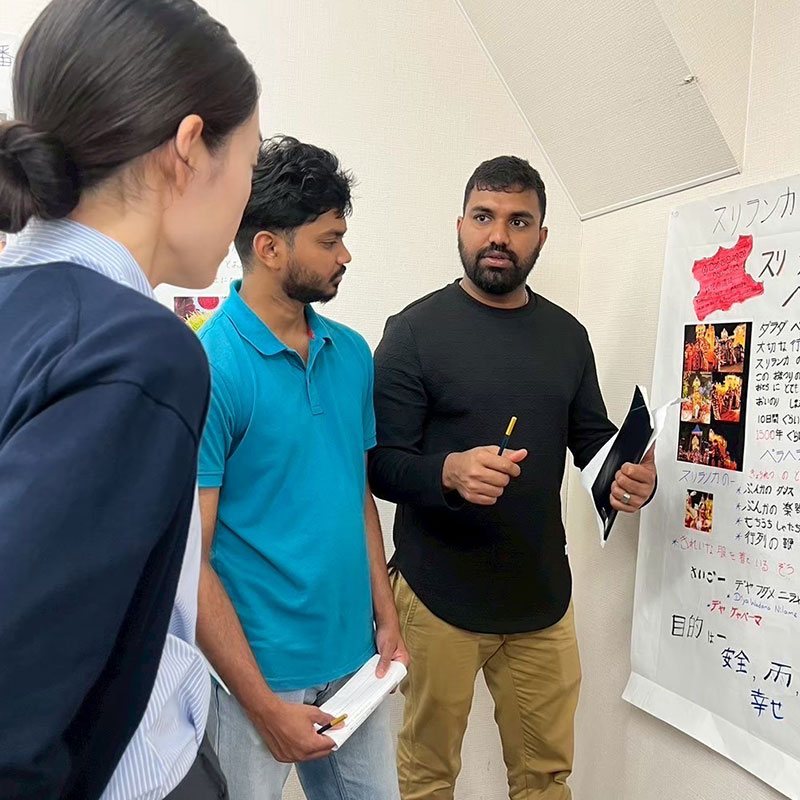
- As part of class activities, 'Visitor Sessions' are held in which local residents can also take part.
- Speech contest
- Calligraphy, tea ceremony, kimono dressing experience and Setsubun
- Hitachi International Culture Festival / International Talk: take part in radio calisthenics, the culture festival, and an easy-Japanese experience at the culture festival
- Graduation ceremony
On campus
- Self-study room — Whether a room is set aside for self-study outside class hours
- Books and media — Whether books and media suited to the educational content and number of students are provided and always available
2025–2026 academic calendar · Older data
- Saturdays, Sundays and public holidays
- · In principle, closed on Saturdays, Sundays and public holidays.
- Summer vacation
- Jul 26–Aug 24
- Autumn break
- Oct 1–9
- Winter break
- Dec 20–Jan 6
- Spring break
- From Mar 14
School website · 2025-12-02 updated
Access
- Transit
- 18 min walk from Hitachi Station (JR Joban Line)
- Nearby
- 15 min on foot from the central exit of Hitachi Station. The Taga Mountains lie to the west and the Pacific Ocean to the east, so summers are cool and winters mild. Kamine Park and Heiwa-dori are among Japan's 100 best cherry-blossom spots.
- Dormitory
- Available¥22,000 per month · Dormitory fee ¥20,000 per month (utilities paid individually). Nearest to Hitachi Station, about 10 min on foot to school. Air conditioner, refrigerator, washing machine, rice cooker. · Based on school website
School website · 2025-12-25 updated
Dormitory — For the first 6 months after enrollment, students live in a school-designated dormitory. All dormitories are within walking distance of the school. Dormitory fee ¥20,000 per month. The ¥20,000 dormitory entry fee and 1 year of dormitory fees are paid together with tuition.
School website · 2025-12-25 updated
SALLAE has organized the school website and published data in English.
The update date is the day that material was last revised.
Photos are materials published by the school.
This information is compiled from official sources and is not updated daily. Please confirm with the official contact before signing or applying.