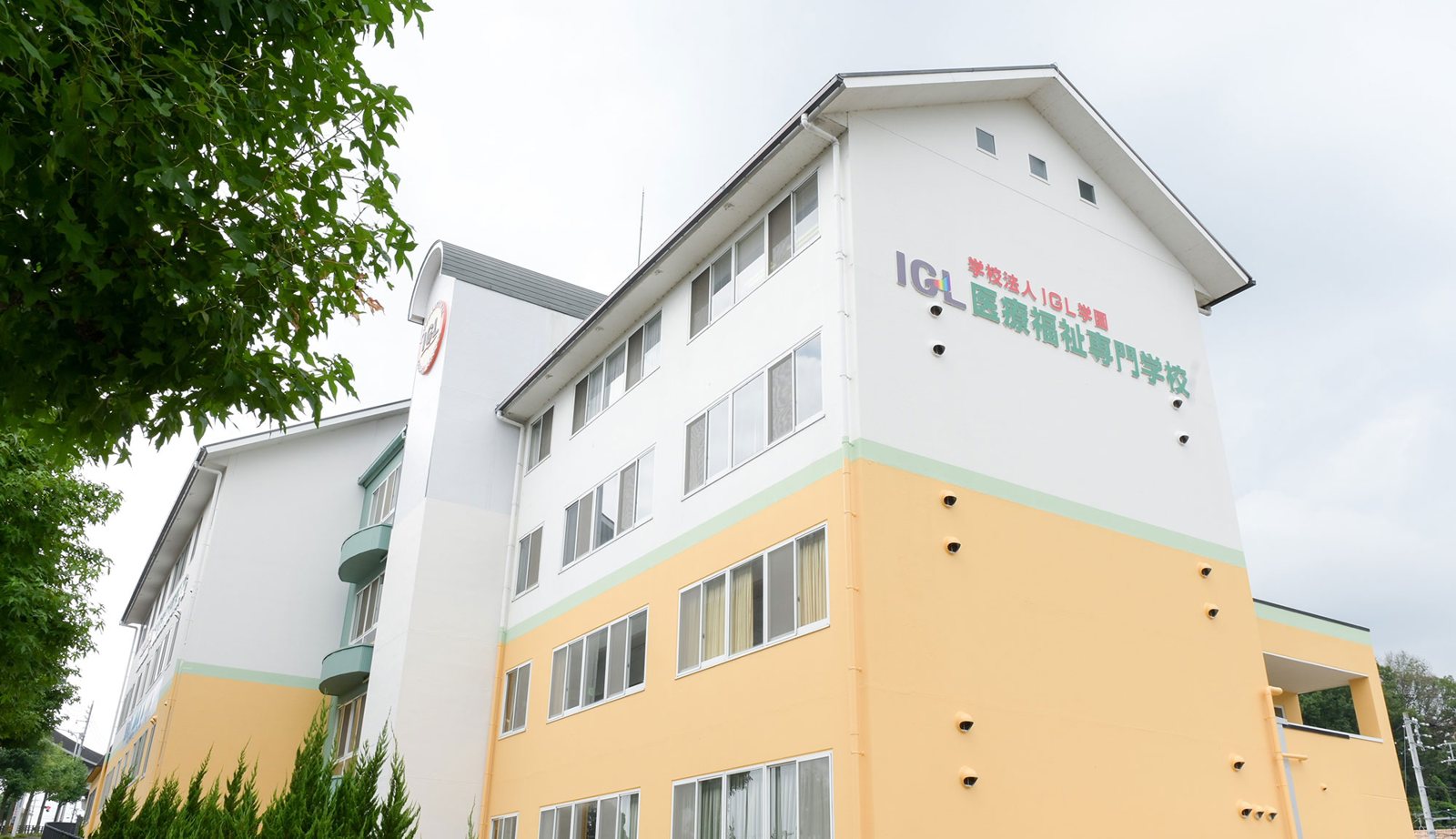
IGL College of Medical and Welfare
IGL College of Medical and Welfare
- Course
- Further-study course only ›
- Tuition
- On the cheaper side nationwide ›
- Age requirement
- Age 30 or under ›
Compare side by side with other schools →
Tuition and conditions may change depending on the intake. If you contact us, we will check with the school and give you accurate details.
Nearby schools comparedBy distance · no ads or paid placement
- IGL College of Medical and WelfareThis schoolTuition/yr¥735,000Progression91%IntakesApr · Oct
- Hiroshima YMCA College9km›Tuition/yr¥758,000Progression62%IntakesApr · Oct
- Trinity College Hiroshima Medical and Welfare College9.2km›Tuition/yr¥875,000Progression97%IntakesApr · Oct
- Hiroshima International College of Medical Welfare10.6km›Tuition/yr¥800,000Installments OKProgression94%IntakesApr · Oct
— means SALLAE has not yet found the data.
About the school
A progression-focused Japanese department for students aiming to go on to universities and vocational schools. There are only two courses, the 2-year Progression Course and the 1 year 6 months Progression Course, and the timetable includes JLPT preparation classes and EJU elective subjects (mathematics, integrated subjects, science). In the FY2025 Report No. 44, 118 students progressed to university or similar (109 completers, counted including students who left midway). The department is part of IGL Medical and Welfare College in Bantoh, Asaminami-ku, Hiroshima, with a capacity of 280. Every two months it holds exchange events with Japanese students from the care, dental hygiene, acupuncture and judo therapy departments. After graduation, students can move on to the college's professional courses with the examination fee and admission fee waived, and there are double-room dormitories (¥19,000–23,000 per month) and part-time job introductions for all first-year students.
Published data and school website
Tuition
If you saw a lower amount elsewhere, it may not include the admission fee and application fee
Median 1-year tuition in other areas — Kyoto ¥911,000(7 schools) · Kanagawa ¥880,000(8 schools) · Okinawa ¥858,000(6 schools) · Tokyo ¥840,600(56 schools) · Fukuoka ¥835,000(12 schools) · Hyogo ¥825,500(7 schools) · Osaka ¥814,000(27 schools) · Shizuoka ¥790,000(9 schools) · Chiba ¥745,333(10 schools) · Aichi ¥740,667(5 schools)
Total by intake
| Intake · length | Full course |
|---|---|
| 1 year 6 months | ¥1,042,000 |
| 2 years | ¥1,349,000 |
Cost details · course tables · notes · 3 items
- Per term
- ¥153,500 3 months
- One-time fees
- ¥121,000Application fee · Admission fee
| Duration | Total |
|---|---|
| 1 year 6 months | ¥1,042,000 |
| 1 year 9 months | ¥1,195,500 |
| 2 years | ¥1,349,000 |
★"Per term" and "One-time at start" were calculated by SALLAE from each course's total. The courses this school actually offers are 1 year 6 months onward — all amounts in the table are values calculated by SALLAE.
Calculated by SALLAE · verified 2026-09-16
Whether it is refundable
- Withdrawal at least 2 weeks before the "Certificate of Eligibility application" is submitted to Immigration
- The application fee is refundable. Admission fee and tuition: "–" (not yet paid).
- Withdrawal later than 2 weeks before the "Certificate of Eligibility application" is submitted to Immigration
- The application fee is not refundable. Admission fee and tuition: "–" (not yet paid).
- Certificate of Eligibility not issued
- The application fee is not refundable. Admission fee and tuition: "–" (not yet paid).
- Withdrawal after paying tuition and fees, such as the admission fee, and before classes begin
- The application fee and admission fee are not refundable. Tuition, materials and miscellaneous expenses are refundable (the Certificate of Eligibility and letter of admission must be returned).
See refund policy in detail · 2 more lines
- Visa not issued for reasons attributable to the applicant
- The application fee and admission fee are not refundable. Tuition, materials and miscellaneous expenses are refundable (the Certificate of Eligibility and letter of admission must be returned).
- After classes begin
- None of the application fee, admission fee, tuition, materials or miscellaneous expenses is refundable.
Admission & dates
- Apr intake
- 2-year course · Application Applications accepted mid-July to early August 2026 / interviews mid- to late August / results announced early to mid-September
- Oct intake
- 1 year 6 months course · Application Applications accepted mid-January to early February 2027 / interviews mid- to late February / results announced early to mid-March
- Japanese level
- JLPT N5 equivalent or higher
Deadline and capacity rules
April 2-year Progression Course and October 1 year 6 months Progression Course, total capacity 280. Recruitment ends when capacity is reached. Document screening, interview and Japanese (written test). Applicants must live outside Japan, have completed 12 years of schooling abroad, be 30 or younger at enrollment, and have no history of refusal at other schools
School website · 2026-06-12 updated
Classes
- Morning
- 09:20-12:30 Periods 1 and 2 (morning class). Generally Year 2 students attend the morning class
- Afternoon
- 13:20-16:30 Periods 3 and 4 (afternoon class). Generally first-year students attend the afternoon class
- AM/PM placement
- Morning or afternoon class is decided by the placement test at enrollment. Generally first-year students attend the afternoon class and second-year students the morning class
- Class assignment
- Level-based 10 levels
- Elective classes
- Mathematics · Integrated subjects · Science · Periods 5 and 6, 13:20–14:50: choose mathematics (Mon), integrated subjects (Wed) or science (Fri)
Materials · Subjects · Timetable · Details
- Materials
- The main textbook is "Dekiru Nihongo." The order is Challenge, study grammar, Let's say it, speak/read/listen/write, activity preparation, I can do it!!
- Subject
- Kanji writing practice · Main textbook (grammar, vocabulary, conversation, writing, activities) · Exam preparation (grammar, characters, vocabulary, listening, reading)
Timetable Monday to Friday (closed on Saturdays, Sundays, national holidays and days set by the school). Attendance is managed in 45-minute units.
| Mon | Tue | Wed | Thu | Fri | |
|---|---|---|---|---|---|
| Period 1 9:20–10:05 | Kanji writing practice | Kanji writing practice | Kanji writing practice | Kanji writing practice | Kanji writing practice |
| Period 2 10:05–10:50 | Main textbook: Grammar | Main textbook: Vocabulary | Main textbook: Grammar | Main textbook: Writing | Main textbook: Activities |
| Period 3 11:00–11:45 | Main textbook: Conversation | Exam preparation: Grammar | Main textbook: Conversation | Exam preparation: Characters and vocabulary | Main textbook: Activities |
| Period 4 11:45–12:30 | Exam preparation: Listening | Exam preparation: Grammar | Main textbook: Vocabulary | Exam preparation: Characters and vocabulary | Exam preparation: Reading |
| Periods 5 and 6 13:20–14:50 | Mathematics (elective) | Comprehensive subjects (elective) | Science (elective) |
The goals are JLPT N3 to N2 or higher and a score of 200 or more on the EJU. Attendance is managed in 45-minute units, and arriving late or leaving early by 10 minutes or more counts as an absence.
School website · Confirmed 2026-09-26
Documents
- Application form: use the school's form and fill it in completely without errors. Paste a photo in the designated space.
- Statement of reasons for study: use the school's form and state clearly your purpose for studying in Japan, your plans after graduation and so on.
- 4 photos (3 × 4 cm) taken within 3 months before applying. Write your name and date of birth on the back.
- Copy of passport or ID: the photo page and pages showing past entries to and exits from Japan. If you do not have a passport, a copy of an official ID.
- Copy of diploma or graduation certificate: the original diploma of your last school attended and a copy, or the original graduation certificate. Those expected to graduate from high school need a certificate of expected graduation.
- Academic transcript of the last school attended: submit the original and a copy.
- Documents proving Japanese ability equivalent to JLPT N5 or higher. If you cannot prove it at the time of application, a "Japanese study record certificate" prepared by a Japanese language institution and a "copy of the exam admission ticket"
- Copy of family register: submit a register showing the applicant's family composition.
- Translation certificate: submit one bearing the signature of the person who made the Japanese translation.
- Pre-entry tuberculosis screening: for countries subject to screening, a certificate of no active tuberculosis issued by a designated medical institution; for other countries, a medical certificate issued by a hospital or facility designated by the school.
- Confirmation form on personal information protection: use the school's form.
Financial supporter's documents · only if applicable · 2 application requirements
Submitted by the person paying the tuition (financial sponsor)
- Copy of ID: a copy of an official ID
- Financial sponsorship statement (school's designated form)
- Bank balance certificate: submit one that states the bank balance on the bank's official letterhead.
- Submit a copy of the passbook for the account named in certificate B-3.
- Documents proving how the assets were built up over the past 1 year: submit a transaction statement, passbook or similar.
- Documents proving the relationship between the applicant and the financial sponsor: submit a certificate of kinship, birth certificate or similar.
- Occupation certificate: certificate of employment (company employees and civil servants), business license (self-employed), etc.
- Income certificate: submit a certificate showing annual income for the past 1 year.
- Tax payment certificate or tax exemption certificate: a certificate showing taxes paid over the past 1 year. Not needed if the income certificate also records tax payments.
- Copy of family register (residence certificate): a register showing the financial sponsor's family composition. Not required if living in the same household as the applicant. For those living in Japan, a residence certificate listing all household members.
Only if applicable
- Certificate of employment: on the company's official letterhead, clearly stating the workplace's name, address, phone number, fax number, representative's name, job duties and period of employment. (If you are currently employed)
- Certificate of employment, etc. (For those who have stayed in Japan for technical intern training and have returned to their jobs after going home)
- Military service certificate (for those with military service)
- Certificate of enrollment or leave of absence (If currently enrolled or on leave of absence from a university or similar)
- Statement of current address (If your registered address differs from your current address)
- Statement of gap period (If there is a gap of 6 months or more in your history)
Application requirements
For all documents written in a language other than Japanese (including English), be sure to attach a Japanese translation. In addition, you may be asked to prepare and submit an explanatory statement as necessary.
Only the documents for applicants from China and Vietnam (such as academic credential verification) are listed individually. For documents required for other nationalities, SALLAE checks with the school. SALLAE is confirming this with the school.
School website · 2026-06-12 updated
Admission process
- Request an admission consultation — Consult in Korean about enrollment preparation and procedures.
- Entrance exam — Applicants take an entrance exam (interview and test). Selection is by document screening, interview and Japanese (written test). Mid to late August for April intake, mid to late February for October intake
- Announcement of results — The school notifies the sending agency of the results. Early to mid-September for April intake, early to mid-March for October intake
- Submit application documents — Applicants submit the required documents to the school. Late September to early November for April intake, late March to early May for October intake
- Submit the application for the Certificate of Eligibility — The school submits the "Certificate of Eligibility application" and related documents for the accepted students to the Hiroshima Regional Immigration Services Bureau. Late November for April intake, early June for October intake
- Certificate of Eligibility result notice — Late February (April intake) / late August (October intake). If approved, we send the study-abroad procedure guide, a tuition transfer request and a dormitory fee transfer request. If not approved, we send a notice of non-issuance and return documents that can be returned, such as the original diploma
- Tuition payment — Pay all fees in full: admission fee, tuition, materials and other expenses (including insurance). Early March for April intake, early September for October intake
- CoE sent — After payment is confirmed, the school sends the Certificate of Eligibility to the sending agency, and at that time returns returnable documents such as the original diploma.
- Visa application — The applicant or a representative completes the visa procedure at a Japanese diplomatic mission abroad. Mid-March for April intake, mid-September for October intake
- Entry into Japan — Arrive in Japan on the day the school specifies. Early April for April intake, early October for October intake
- Placement test
- A placement test at enrollment determines whether you are in the morning or afternoon class.
- After entry
- Contact, notices and explanations to students are given through Google Classroom or the bulletin board.
School website · 2026-06-12 updated
Short-term study
- Open now?
- Rolling admissions, so availability varies from time to time — SALLAE will confirm with the school
Course without a student visa
- Auditing program — People who need Japanese language education can, after completing the prescribed procedure, attend classes of the Japanese Language Department for a certain period for a fee.
★Short-term courses are not listed in the published data — it counts only student-visa courses.
School website · 2024-07-11 updated
Graduate outcomes
| FY2025 | Admitted |
|---|---|
| Employment | 10 students |
| Graduates | 109 students |
Passing an exam
| Exam | Pass |
|---|---|
| JLPT N2 2022 | 3 students |
| JLPT N2 2023 | 12 students |
| JLPT N2 2024 | 3 students |
| JLPT N3 2022 | 4 students |
| JLPT N3 2023 | 37 students |
| JLPT N3 2024 | 19 students |
For N2, 57 took the test and 18 passed (31.6%) in 2022–24 combined; for N3, 186 took it and 60 passed (32.3%).
All schools accepted to so far
+12 more schools
Prepared Jun 18, 2026. 109 course completers, 129 students meeting the standard (26 withdrawals), 95.6%. Progression 118, changes of status of residence 10, CEFR-framework A2-equivalent 1 · Number permitted to change status of residence: 2-year progression course (entered FY2024) 5; 1.5-year progression course (entered FY2024) 5. · School website · Updated 2026-06-18
Reviews
If you study here or used to, tell others what the classes, teachers and daily life were like. It helps anyone deciding on this school.
Write the first reviewUniversity prep
- On-campus further-study briefing — July: on-campus progression briefing
- Supports progression through cooperation agreements with universities — Cooperation agreements with private universities in the Chugoku and Shikoku regions, including Hiroshima Shudo University and Shikoku University. A comprehensive cooperation agreement with Hiroshima Jogakuin University was concluded on Feb 27, 2025 and renewed in 2026.
- Internal progression to IGL Medical and Welfare College "Professional Course" — After graduation, students can progress to the International Liberal Arts Communication, Nursing Care and Welfare, Dental Hygiene, Acupuncture and Moxibustion, and Judo Therapy departments. The entrance examination fee and admission fee are waived.
- Study plan totaling 3 years — A study plan totaling 3 years is also possible together with the International Liberal Arts Communication Department (daytime, 1 year; goals: JLPT N2 or higher and EJU score of 240 or higher)
- Excused absence request — Taking university entrance exams, open campus visits, and attending interviews and company briefings for job hunting count as attendance if a request for excused absence is approved.
School website · 2026-06-12 updated
Daily-life support
- Airport pickup — For students living in the student dormitory, school staff pick them up at Hiroshima Airport or Hiroshima Station and take them to the dorm. Students living in private housing cannot use the pickup service.
- Native-language support staff — Staff fluent in the native language and Japanese are assigned for students from China, Vietnam and Nepal to support their studies and daily life. Contact with guardians is also made in their native language when necessary.
- Government office and bank procedures after entry — Homeroom teachers and daily-life support staff help with procedures at government offices and banks after arrival, and also respond to and support students in cases of illness or accident.
- Part-time job introductions — All first-year students are introduced to part-time jobs of 28 hours a week, including many customer-service jobs. The IGL Group also offers part-time jobs while you study
- Insurance — Students are enrolled in comprehensive insurance for Japanese-language school students (covering injury treatment, illness treatment, liability and more). There is also an insurance system under which medical costs are effectively free.
- Tuition payment consultation — If you have difficulty paying fees for financial reasons, deferred or installment payment is allowed. Submit the request for installment or deferred tuition payment at least 20 days before the payment deadline
School website · Confirmed 2026-09-26
Scholarship
- MEXT learning incentive for international students
- Monthly ¥48,000 × 1 yearFor international students; chosen from first-year students with excellent attendance and grades. Selection is made at promotion to the second year (April). About ¥48,000 per month is paid for one year
- Kyoritsu International Exchange Foundation Scholarship (for privately financed international students)
- If you plan to enter the Nursing Care and Welfare Department and want to work in the IGL Group, please consult the school.
School website · Confirmed 2026-09-26
School life
For 1 year
- 4
- Entrance ceremony · Health checkup
- 5
- Kimono experience
- 6
- EJU (Examination for Japanese University Admission) · Ball games tournament
- 7
- Japanese-Language Proficiency Test (JLPT) · On-campus further-study briefing
- 8
- Summer vacation
- 10
- Entrance ceremony · Welcome dinner · Health checkup
- 11
- EJU (Examination for Japanese University Admission) · School festival
- 12
- JLPT · Winter break
- 2
- Field trip · In-school speech contest
- 3
- Graduation ceremony · Spring break
Some events are not held in order to prevent the spread of COVID-19.
- About 300 Japanese students study here. Exchange events are held once every two months, and
- There are also many off-campus exchanges, such as visits to nearby libraries, universities and tourist facilities.
- Each class has a homeroom teacher who advises each student on issues in student life, including studies, career path, finances and health.
On campus
- School building
- Library room — About 8,700 books, about 600 videos and DVDs, 30 magazines. Internet available on computers. Open Monday to Friday, 9 a.m. to 5 p.m.
- Entrance hall
- Unmanned convenience store service "Smart Self" (Poplar) — Cashless payment available; open on school days from 8:30 a.m. to 5:30 p.m.
- Multipurpose hall, 2nd floor
- Multipurpose hall — A place for student welfare, exchange and school events
- Whole campus
- Wi-Fi
2026–2027 academic calendar
- School anniversary
- May 4
- Spring break
- Apr 1 (Wed) – Apr 7 (Tue), 2026
- Summer vacation
- Aug 8–23, 2026
- Autumn break
- Sep 18 (Fri) – Oct 4 (Sun), 2026 · * For first-year students, from Sep 19 (Sat), 2026
- Winter break
- Dec 19 (Sat), 2026 – Jan 4 (Mon), 2027
- Spring break
- Mar 12 (Fri) – Mar 31 (Wed), 2027 · * For first-year students, from Mar 13 (Sat), 2027
School website · Confirmed 2026-09-26
Access
- Transit
- 7 min walk from Chorakuji Station (Astram Line)
8 min walk from Ban Station (Astram Line) - Nearby
- From Hiroshima Station and Yokogawa Station, take the JR Sanyo Main Line to Shin-Hakushima Station; on the JR Kabe Line, change to the Astram Line at Omachi Station. Get off at Chorakuji Station. Free school bus (apply in the survey after acceptance).
- Dormitory
- Available¥20,500–¥24,500 per month · 2 students per room. Dormitory fee per month per person: ¥19,000 for the women's dormitory, ¥23,000 for the men's dormitory. A separate dormitory operation fee of ¥1,500 is charged every month · Based on school website
School website · Confirmed 2026-09-26
Dormitory — The women's dormitory is a shared-living type (shared shower, toilet, washing machine and kitchen); the men's dormitory is a studio type (with shower, toilet and kitchen). 2 students per room in both. Six months of dormitory fees are paid at enrollment and every half year
School website · 2026-06-12 updated
SALLAE has organized the school website and published data in English.
The update date is the day that material was last revised.
Photos are materials published by the school.
This information is compiled from official sources and is not updated daily. Please confirm with the official contact before signing or applying.