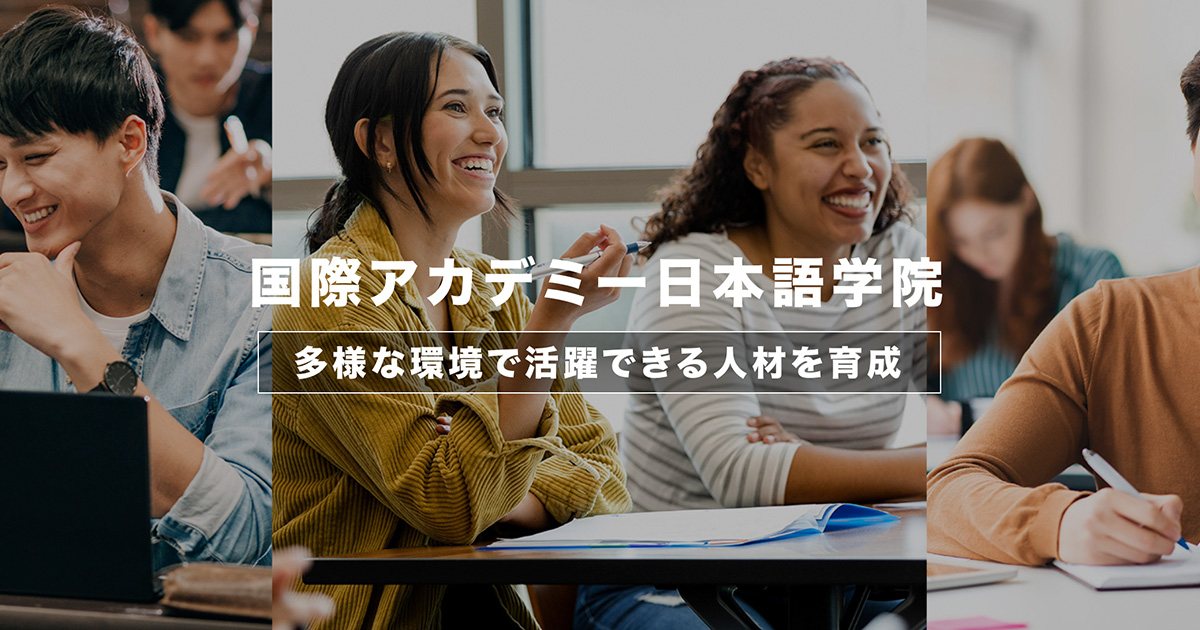
Kokusai Academy Japanese Language Institute
Kokusai Academy Japanese Language Institute
- Employment results
- Employment, etc. 17% ›
- Course
- Further-study course only ›
- Admission
- 4 times a year · choose your intake month ›
- Progression
- University or similar 73% · National median 86% ›
Compare side by side with other schools →
Tuition and conditions may change depending on the intake. If you contact us, we will check with the school and give you accurate details.
Nearby schools comparedBy distance · no ads or paid placement
- Kokusai Academy Japanese Language InstituteThis schoolTuition/yr¥798,000Progression73%IntakesJan · Apr · Jul · Oct
- Sunshine Language School0.5km›Tuition/yr¥949,000Progression—IntakesJan · Apr · Jul · Oct
- ISI College of Foreign Languages1km›Tuition/yr¥1,015,000Progression—IntakesJan · Apr · Jul · Oct
- Melos Language Academy1.3km›Tuition/yr¥904,000Progression—IntakesJan · Apr · Jul · Oct
— means SALLAE has not yet found the data.
About the school
The student-visa program offers only four progression courses for entering university, graduate school or vocational school (2 years, 1 year 9 months, 1 year 6 months, 1 year 3 months), and 85 of the 131 students who completed the course in fiscal 2025 progressed to university or similar. Guidance for the EJU, JLPT, individual university exams and interviews is given in all relevant classes. The school is a 6-minute walk from Exit C6 of Ikebukuro Station, has a capacity of 280 (125 international students in April 2026), accepts entry in January, April, July and October, and has 8 class levels from Beginner I to Advanced III. Study-abroad exam (general subjects and mathematics) and English preparation classes are offered to those who wish, and students who reach a certain level can be recommended for admission to a university.
Published data and school website
Tuition
⚠ Total costs by course vary by source — please check with the school. Published sources: International Academy Japanese Language Institute, Japanese Language Education Promotion Association school table (April 2024): China 142, Vietnam 40 (the tuition table shows totals by course). · School website: first year ¥798,000, plus second year: 1 year 3 months ¥182,000, 1 year 6 months ¥364,000, 1 year 9 months ¥546,000, 2 years ¥728,000. Depending on the course, the difference is ¥118,000–¥202,000. The website table shows amounts revised in April 2025, so the published figures may be earlier prices.
If you saw a lower amount elsewhere, it may not include the admission fee and application fee
Median 1-year tuition in other areas — Kyoto ¥911,000(7 schools) · Kanagawa ¥880,000(8 schools) · Okinawa ¥858,000(6 schools) · Tokyo ¥840,600(56 schools) · Fukuoka ¥835,000(12 schools) · Hyogo ¥825,500(7 schools) · Osaka ¥814,000(27 schools) · Shizuoka ¥790,000(9 schools) · Chiba ¥745,333(10 schools) · Aichi ¥740,667(5 schools)
Total by intake
| Intake · length | Full course |
|---|---|
| January intake · 1 year 3 months | ¥980,000 |
| October intake · 1 year 6 months | ¥1,162,000 |
| July intake · 1 year 9 months | ¥1,344,000 |
| April intake · 2 years | ¥1,526,000 |
Cost details · course tables · notes · 3 items
- One-time fees
- ¥798,000Tuition ¥648,000 · Application fee ¥20,000 · Admission fee ¥50,000 · Facility fee ¥40,000 · Materials ¥30,000 · Activity fee ¥10,000
According to the school guide, fees are paid in one lump sum at enrollment. SALLAE will check with the school whether you can pay in installments.
| Intake · course | Extra 2nd-year costs | All |
|---|---|---|
| January · 1 year 3 months | ¥182,000 | ¥980,000 |
| October · 1 year 6 months | ¥364,000 | ¥1,162,000 |
| Jul · 1 year 9 months | ¥546,000 | ¥1,344,000 |
| April · 2 years | ¥728,000 | ¥1,526,000 |
These are extra costs paid in the second year. The application fee and admission fee are not charged again. Year 2: for the 2-year course, one year's fees (tuition ¥648,000, facility fee ¥40,000, materials ¥30,000, activity fee ¥10,000). For other courses, fees for the remaining period
Fee table (from April 2025): first-year payment, 2-year progression course, total ¥798,000 (consumption tax included).
After the CoE is issued, the school sends a copy of the certificate and the tuition invoice. After the tuition payment is confirmed, the original and the entrance ceremony guide are sent.
Short-term course: admission fee ¥0. Total ¥49,000 for 1 month, ¥117,000 for 3 months, ¥204,000 for 6 months (textbooks at actual cost).
School website · Confirmed 2026-10-02
Whether it is refundable
- Short-term course
- Once paid, fees are not refunded under any circumstances.
Admission & dates
⚠ Application deadline to the school varies by source — please confirm with the school. April intake: Oct 15 of the year before enrollment; July intake: Feb 15; October intake: May 15; January intake: Aug 31 of the year before enrollment. · April: Nov 15 of the year before enrollment; July: Mar 15; October: May 15; January: Sep 15 of the year before enrollment. · April: Nov 15 of the year before enrollment; July: Feb 28; October: May 15; January: Aug 31 of the year before enrollment. The notice on the top page (Oct 15, 2026 for the April 2027 intake) matched the course guide table, so that value is used in the table. The July and January intakes need to be confirmed with the school.
- Jan intake
- 1 year 3 months course · Application Aug 31 of the year before enrollment · Classes 1,000 hr
- Apr intake
- 2-year course · Application Oct 15 of the year before enrollment · Classes 1,600 hr
- Jul intake
- 1 year 9 months course · Application Feb 15 · Classes 1,400 hr
- Oct intake
- 1 year 6 months course · Application May 15 · Classes 1,200 hr
- Japanese level
- JLPT pass certificate, J.TEST transcript, Japanese study certificate (150 hours or more required), etc.
If you enter on the first day of a term (the start date of classes), you can study from the very beginning of the beginner level (school FAQ).
Deadline and capacity rules
Completed the final school of a course equivalent to 12 years of school education in Japan abroad (or expected to), aims to progress to higher education, and passes the admission screening. As a rule, within 5 years of graduating from the last school attended.
School website · 2026-02-03 updated
Classes
- Morning
- 09:00-12:35
- Afternoon
- 13:00-16:35
- AM/PM placement
- Classes are decided by a level test.
- Class size
- Max 20 students
- Class assignment
- Level-based 8 stages
- Elective classes
- Study-abroad exam (general subjects) · Study-abroad exam (mathematics) · English · Classes open as soon as enough students wish to take part.
Materials · Subjects · Timetable · Details
- Materials
- Beginner: Daichi Japanese for Beginners I and Minna no Nihongo Beginner I Kanji. Intermediate: New Approach Intermediate Japanese and Nihongo Nama Chukei. Advanced: newspaper articles, magazines and authentic materials.
- Subject
- Conversation · Characters · Listening comprehension · Reading · Composition · Sentence patterns and expressions · Debate and speeches · Writing papers · Beginner: conversation, characters, listening, reading, composition. Intermediate and advanced: sentence patterns and expressions, reading (close reading), conversation, listening, composition. Advanced III: reading (long texts), debate, speeches, paper writing.
Class hours by subject
| Level | 2 years | 1 year 9 months | 1 year 6 months | 1 year 3 months |
|---|---|---|---|---|
| Beginner I | 200 hours | — | — | — |
| Beginner II | 200 hours | 200 hours | — | — |
| Intermediate 1 · Intermediate 2 | 400 hours | 400 hours | 400 hours | 400 hours |
| Intermediate III | 200 hours | 200 hours | 200 hours | 200 hours |
| Advanced 1·2 | 200 hours | 200 hours | 200 hours | 200 hours |
| Advanced 3 | 200 hours | 200 hours | 200 hours | — |
A level test is held every term and classes are reorganized. Classes are organized by level, with about 15 students per class.
Goals for each level · 6 levels
- Beginner I
- 3 monthsLearn basic grammar, conversation, and kana and kanji (220 characters), and be able to hold simple everyday conversations and do basic reading and writing. Equivalent to JLPT N5.
- Beginner II
- 3 monthsBasic everyday conversation, such as expressing your own intentions and making requests. 298 kanji, about 1,200 vocabulary words. Equivalent to N4.
- Intermediate I
- 3 monthsOrganize the sentence patterns and grammar learned at beginner level by function, building a base for more advanced conversation and expression. About 250 kanji, about 1,500 vocabulary words. Equivalent to N3.
- Intermediate II
- 3 monthsNatural conversation on general topics. Close-reading skills for newspapers, magazines and general books. About 250 kanji, about 2,000 vocabulary words. Equivalent to N3–N2.
- Intermediate III
- 3 monthsClose-reading skills for authentic materials, and the basics of fast reading for newspapers and magazines. About 250 kanji, about 2,000 vocabulary words. Equivalent to N2.
- Advanced I, II and III (3 months each)
- 9 monthsMaster advanced grammar (function words), kanji and vocabulary, and acquire Japanese suited to a wide range of situations. About 2,000 kanji, about 10,000 vocabulary words.
School website · 2026-02-03 updated
Documents to prepare — student visa course
- Application form (school's prescribed form)
- Résumé
- Written pledge
- Graduation certificate or certificate of the last school attended
- Transcript from last school attended
- JLPT pass certificate, J.TEST transcript, Japanese study certificate (150 hours or more required), etc.
- Documents on the family register: notarized proof of kinship, copy of family register, etc.For all family members
- Copy of IDBoth front and back sides are required
- 5 photos (3×4 cm)
Financial supporter's documents · only if applicable · 4 application requirements
Submitted by the person paying the tuition (financial sponsor)
- Financial sponsorship statement (school form)
- Documents proving the relationship between the applicant and the financial sponsor
- A bank balance of about ¥3,000,000 in Japanese yen
- Any one of the following: a copy of a bank passbook, documents showing income other than salary, or a document explaining how the assets were accumulated.
- Documents on the financial sponsor's occupation: for employees, a certificate of employment; for company directors and the self-employed, a corporate registry copy, a copy of the business license, etc.
Only if applicable
- Copy of the household register (hukou), family register copy, etc. (for all family members), income certificate, tax payment certificate, etc. (3 years each required) (Sponsor residing abroad)
- Residence certificate, and tax payment certificate stating income and earnings, etc. (3 years required) (Sponsor residing in Japan)
- The specific reason for taking on the study-abroad expenses (If the financial sponsor is not a relative of the applicant)
- Relationship to the applicant, name, nationality, date of birth, telephone number, name of workplace or school, whether they plan to live together, and foreign resident registration certificate number (Documents about relatives living in Japan)
Application requirements
Applicants who previously applied for a status of residence and were refused must declare it without fail. Additional documents may be requested besides the application documents. When correcting an entry, do not use correction fluid; draw two lines through it and stamp a correction seal. Submitted documents will not be returned, except for graduation certificates, JLPT pass certificates and the like.
The examples of family register documents (household register, notarized certificate of family relationships) and the copy of a fixed-deposit certificate in the Japanese-language application guidelines are examples for China. The Korean-language version (old edition) lists a family register copy (listing all family members) and a business registration certificate, but it does not state which documents should be submitted now. SALLAE is confirming this with the school.
Short courses do not require study-visa procedures, so there are no documents to prepare in advance. Please bring your passport or residence card.
School website · 2023-10-13 updated
Admission process
- Request an admission consultation — Contact the school, or the study-abroad agency handling your procedures, to get information on the interview date and procedures. TEL +81-3-5953-3400
- Admissions screening — The interview and written test are held with the applicant in the applicant's home country.
- Application — After passing the admission screening, prepare and send the required documents. The school applies to the Tokyo Regional Immigration Services Bureau on your behalf.
- Issuance of the Certificate of Eligibility — After the Certificate of Eligibility (CoE) is issued, the school sends the student or the study-abroad agency a copy of the certificate and the tuition invoice.
- Tuition payment — Once the tuition payment is confirmed, the school sends the original Certificate of Eligibility and the entrance ceremony guide.
- Obtain a student visa — Take the original certificate sent by the school, your passport, the admission letter and other documents to the Japanese embassy or consulate in your country and apply for the visa.
- Before coming to Japan — Students who do not plan to live with relatives or friends and would like help finding accommodation after arriving in Japan, or airport pick-up on the day of arrival, should contact the school in advance.
- Entrance ceremony and level test — Classes are decided by a level test held after the entrance ceremony.
- Placement test
- Judged by the placement test at entry, JLPT results, study status before coming to Japan, and desired career path. A level test is held every term and classes are reorganized.
- Application form
- Korean version is available
School website · 2026-02-03 updated
Short-term study
- Visa
- Temporary visitor(not a student visa)
- Admission
- RollingNo fixed intake months
- Open now?
- Rolling admissions, so availability varies from time to time — SALLAE will confirm with the school
Course without a student visa
- Short-term course — Open to anyone regardless of purpose, including people with a status of residence other than student and people on short-term stays. Applications are accepted in 1-month units, and enrollment is possible at any time.
★Short-term courses are not listed in the published data — it counts only student-visa courses.
School website · 2026-02-03 updated
Graduate outcomes
| FY2025 | Admitted |
|---|---|
| Employment | 20 students |
| Graduates | 131 students |
Passing an exam
| Exam | Pass |
|---|---|
| JLPT N1 2025 | 3 students |
| JLPT N2 2025 | 18 students |
| JLPT N3 2025 | 17 students |
| JLPT N1 2024 | 5 students |
| JLPT N2 2024 | 28 students |
| JLPT N3 2024 | 11 students |
| JLPT N1 2023 | 6 students |
| JLPT N2 2023 | 39 students |
| JLPT N3 2023 | 3 students |
JLPT results, fiscal 2025: N1 3 students, N2 18 students, N3 17 students.
All schools accepted to so far
Course completers 131, students meeting the standard 116 in total (88.5%), withdrawals 0 (prepared June 25, 2026). · Students granted a change of status of residence: 2-year progression course 10, 1 year 9 months course 2, 1 year 6 months course 8. · School website · 2026-07-01 updated
Reviews
If you study here or used to, tell others what the classes, teachers and daily life were like. It helps anyone deciding on this school.
Write the first reviewUniversity prep
- Given in all relevant classes — Guidance for progression to higher education, including the EJU, the JLPT, individual university entrance exams and interviews, is of course given in all relevant classes.
- Individual meetings with homeroom teacher — Individual interviews with the homeroom teacher are the basis of career guidance and are held regularly.
- On-campus progression briefing — Representatives of vocational schools and universities are invited to progression briefings at the school. Students are also guided to attend school briefings held by specialist agencies and career briefings outside the school.
- The latest materials on progression are available for students to read — Brochures and application guidelines for each vocational school and university can be browsed at the school.
School website · 2026-04-03 updated
Daily-life support
- Airport pickup — Students who do not plan to live with relatives or friends and would like help finding accommodation after arriving in Japan, or airport pick-up on the day of arrival, should contact the school in advance.
- Orientation by native-speaker staff — Orientation at entry is held on the day of the entrance ceremony, using materials in Chinese, Vietnamese, English and Mongolian. Students without materials in their language are given an explanation through an interpreter.
- Whether the school keeps in proper contact with parents or guardians — The school makes a point of informing parents of each student's study and living situation in their native language.
- National Health Insurance — All students enrol in National Health Insurance, and the school also introduces student insurance for international students and encourages enrolment.
- Health checkup — Take it as soon as possible after enrollment, then every year after that.
- Guidance to the nearest hospital or clinic — When medical treatment is needed, students are referred to medical facilities where their native language is spoken; in serious cases, a teacher or staff member accompanies the student to the hospital.
- Attendance guidance — For students whose attendance rate drops, the homeroom teacher gives guidance in class; if there is no improvement, the administrative office summons the student for guidance and the principal gives special guidance.
- Guidance on complying with the law — Guidance on complying with the law is given class by class at entry and before long holidays.
School website · 2026-06-20 updated
Scholarship
- Receives the Japan Student Services Organization (JASSO) scholarship and the MEXT Privately Financed International Student Scholarship every year
- We receive it every year.
- Advance reservation system for the Privately Financed International Student Scholarship
- The school also recommends students, as appropriate, for the advance reservation system for the Privately Financed International Student Scholarship, which is paid for the period after they progress to further study.
School website · 2026-06-20 updated
Students
182 enrolled (2024) · Capacity 180 National median: 180 students
Based on the 182 students enrolled in 2024.
Public data from the Association for the Promotion of Japanese Language Education (Nisshinkyo) · verified 2026-09-20
School life
For 1 year
- 4
- April intake entrance ceremony · placement test 1 · April term classes begin
- 6
- 1st EJU · Tuition deadline (July intake) · April term ends
- 7
- Entrance ceremony · JLPT 1st sitting · July term classes begin
- 9
- Tuition deadline (April and October intake) · July term ends
- 10
- Entrance ceremony · October term classes begin
- 11
- EJU 2nd sitting
- 12
- 2nd Japanese-Language Proficiency Test (JLPT) (tentative) · October term ends
- 1
- Entrance ceremony · January term classes begin
- 3
- School trip (planned) · Graduation ceremony · Tuition deadline (April 2026 intake) · January term ends
Total annual class hours 768 (764 for graduates); each term has 48 class days and 192 hours.
- Extracurricular activities to learn Japanese customs and culture are also held.
- As an all-school activity, visits to the Ikebukuro Disaster Prevention Center are arranged from time to time.
- The school supports the local neighborhood association, actively encourages students to join its events, and gives thorough guidance on commuting manners and how to put out garbage. The school is a member of the neighborhood association.
- According to the school news from 2010, activities included an Ikebukuro quiz rally, a day trip to Kamakura, a visit to Rikkyo University (about a 10-minute walk from the school), an exchange party with Japanese university students, a summer party, and career briefings by field.
On campus
- Main building
- Library room — The library is stocked with books, CD radio-cassette players and more, and is open before and after classes so students can use it as a self-study room.
- Main building
- Infirmary — The infirmary is there in case a student suddenly feels unwell.
- Classroom — Every classroom is equipped with air conditioning, ventilation and audio equipment.
- 3rd and 4th floors
- Classroom renovation (2013) — The floors were replaced with wood flooring and small classrooms were added, making it possible to run 12 classes across morning and afternoon.
- 3 buildings — The main building and all branch buildings meet the new earthquake-resistance standards,
2026–2027 academic calendar
- Spring break
- 3/27–4/12
- Summer vacation
- 8/1–8/16
- Winter break
- 12/18–1/11
- Break between terms
- Jun 24–Jul 5 · Sep 30–Oct 7 · These are days without classes on the annual schedule (including the entrance ceremony and spare days).
School website · 2026-04-03 updated
Access
- Transit
- 6 min walk from Ikebukuro Station (JR lines, Tobu Tojo Line, Seibu Ikebukuro Line, Tokyo Metro Marunouchi Line) Exit C6
- Nearby
- Ikebukuro Station, Exit C6, 6 min on foot
- Dormitory
- Available¥30,000 per month · Students who want help finding accommodation after arriving in Japan should contact the school in advance. The school partners with multiple real-estate agencies to widen students' choices. · Based on school website
School website · 2026-02-03 updated
Dormitory — Students who do not plan to live with relatives or friends and want help finding housing after arriving in Japan should contact the school in advance
School website · 2026-02-03 updated
SALLAE has organized the school website and published data in English.
The update date is the day that material was last revised.
Photos are materials published by the school.
This information is compiled from official sources and is not updated daily. Please confirm with the official contact before signing or applying.