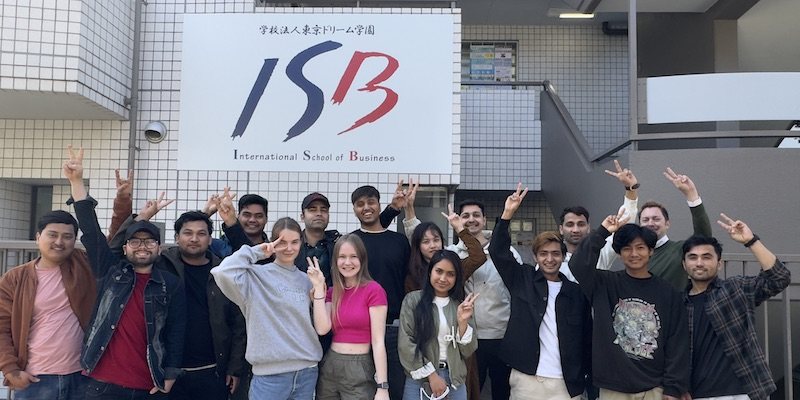
International School of Business (vocational school)
International School of Business (vocational school)
- Tuition
- On the cheaper side for Tokyo ›
- Admission
- Twice a year · April and October ›
- Japanese at entry
- From N5 ›
Compare side by side with other schools →
Tuition and conditions may change depending on the intake. If you contact us, we will check with the school and give you accurate details.
Nearby schools comparedBy distance · no ads or paid placement
- International School of Business (vocational school)This schoolTuition/yr¥750,000Progression—IntakesApr · Oct
- Sugamo Japanese Language Education Institute Tokyo Campus0.4km›Tuition/yr¥913,000Progression—IntakesApr · Oct
- Tokyo International Exchange Institute Ikebukuro Campus0.8km›Tuition/yr¥928,000Progression85%IntakesApr · Oct
- Melos Language Academy1.2km›Tuition/yr¥904,000Progression—IntakesJan · Apr · Jul · Oct
— means SALLAE has not yet found the data.
About the school
A Japanese department of a business college that also has an International Business Department and a General English Conversation Department. Its feature is that from the intermediate level students are divided into four career-path classes (university, graduate school, business, general). In the latest report on its website (prepared July 2022), all 45 completers went on to universities, vocational schools and the like. Classes are a morning class (8:45–12:55) or an afternoon class (13:05–17:15), 5 periods of 45 minutes each, about 850 hours a year. April-intake students can earn the "Senmonshi" title on completion. The Japanese department's application guidelines on the website are for April 2023 enrollment at the latest (first-year fees ¥750,000; applicants must be 18–25 and within 4 years of graduating from their last school), so please confirm the current requirements with the school. It is in Sugamo, Toshima-ku, Tokyo, an 8 min walk from JR Otsuka Station and Sugamo Station.
Published data and school website
Tuition
If you saw a lower amount elsewhere, it may not include the admission fee and application fee
Median 1-year tuition in other areas — Kyoto ¥911,000(7 schools) · Kanagawa ¥880,000(8 schools) · Okinawa ¥858,000(6 schools) · Tokyo ¥840,600(56 schools) · Fukuoka ¥835,000(12 schools) · Hyogo ¥825,500(7 schools) · Osaka ¥814,000(27 schools) · Shizuoka ¥790,000(9 schools) · Chiba ¥745,333(10 schools) · Aichi ¥740,667(5 schools)
Cost details, tables by course and notes · 2 items
- One-time fees
- ¥750,000Tuition (annual) ¥620,000 · Application fee ¥20,000 · Admission fee ¥80,000 · Materials (annual) ¥30,000
According to the school guide, fees are paid in one lump sum at enrollment. SALLAE will check with the school whether you can pay in installments.
Courses offered (April 2023 term)
The application fee is paid to the intermediary agency when applying. The balance is invoiced after the Certificate of Eligibility is issued and remitted to the ISB designated account. Overseas transfer fees are borne by the applicant.
School website · Checked 2026-09-29
Whether it is refundable
- Application fee
- Application fees already paid are not refunded under any circumstances, regardless of the visa result.
- If the Certificate of Eligibility was issued but the visa was refused at the overseas diplomatic mission
- Only tuition and materials fees are refunded. Show proof that the visa was refused (such as the "refused" stamp in the passport) and return the original Certificate of Eligibility and admission permit to ISB.
- If you withdraw for personal reasons
- If you apply in writing by Mar 31, 2023 (phone or other verbal contact is not valid), only tuition and materials fees are refunded. No refund can be made if the originals are not returned.
- Other
- As a rule, fees already paid are not refunded. Overseas transfer fees are borne by the applicant.
Admission & dates
- Apr intake
- · Application Applications accepted from October 2022, interviews held, and Immigration documents accepted after passing the interview (applications close once capacity is reached) · Classes About 850 hours/year
- Oct intake
- · Classes About 850 hours/year
- Japanese level
- JLPT N5 or higher, or an equivalent level
JLPT N5 or higher, or an equivalent level (university graduates can consult separately). At least 150 hours of Japanese study (based on the hours stated on the Japanese study certificate)
Deadline and capacity rules
Ages 18–25, with 12 years of school education or equivalent, within 4 years of graduating from the last school attended. Applications accepted, interview held, and immigration documents accepted after passing the interview.
School website · Checked 2026-09-29
Classes
- Morning
- 08:45-12:55
- Afternoon
- 13:05-17:15
- Elective classes
- English: focuses on university entrance exam preparation to raise ability. TOEFL and TOEIC preparation is also offered. · Mathematics: preparation for the Examination for Japanese University Admission for International Students (EJU), aiming for high scores. · Kanji: kanji classes for students from non-kanji regions. · Japanese culture: understand Japanese culture through manga, dramas, novels and more · Conversation
Materials · Subjects · Timetable · Details
- Subject
- Characters and vocabulary · Grammar · Reading · Listening comprehension · Conversation · Composition · Practice · Classes are organized into beginner, intermediate and advanced by a level check test and interview. From intermediate level, class content follows your career path (university, graduate school, business, general Japanese).
Morning: sample timetable (8:45–12:55) / afternoon class (13:05–17:15) Morning students 8:45–12:55 / afternoon students 13:05–17:15 (5 periods a day)
| Mon | Tue | Wed | Thu | Fri | |
|---|---|---|---|---|---|
| 08:45-09:30 | Characters and vocabulary | Characters and vocabulary | Characters and vocabulary | Characters and vocabulary | Characters and vocabulary |
| 09:35-10:20 | Grammar | Grammar | Grammar | Grammar | Grammar |
| 10:25-11:10 | Reading comprehension | Listening comprehension | Reading comprehension | Reading comprehension | Reading comprehension |
| 11:20-12:05 | Listening comprehension | Conversation | Composition | Listening comprehension | Listening comprehension |
| 12:10-12:55 | Presentation | Presentation | Presentation | Presentation | HR |
About 850 total class hours per year, 2 regular exams per term, summer break of about 1 month.
School website · Checked 2026-09-29
Documents
- Application formSchool's designated form
- Admission application formSchool's designated form
- Confirmation formSchool's designated form
- Résuméschool's designated form), statement of study purpose (résumé item No. 11
- Original diploma of the last school attended, transcript of the last school attended, and academic credential verification report of the last school attended
- Japanese study period certificate
- Japanese test pass certificateJLPT, J-Test, NAT, TOPJ), Japanese test score report (JLPT, J-Test, NAT, TOPJ
- Birth certificateRelationship between the applicant and the expense payer
- Copy of IDFront and back
- Copy of passport (if issued), and copy of the passport pages showing Japan entry and exit records
- 8 photos3×4cm
Sponsor documents · Only if applicable · 5 application requirements
Submitted by the person paying the tuition (financial sponsor)
- Financial sponsorship statementSchool's designated form
- Balance certificate¥2,400,000 or more
- Copy of bank passbookAll pages
- Sponsor's certificate of employment
- Sponsor's income certificateFor the past 3 years
- Explanation of the source of funds
- Copy of IDFront and back
Only if applicable
- Sponsor's certificate of employment (If you are currently employed)
Application requirements
Courses offered (April 2023 intake) * Documents issued in Japan must be within 3 months; documents issued abroad must also be within 3 months. Student documents that need a Japanese translation: résumé, statement of study purpose, original diploma, transcript, study period certificate, certificate of employment, birth certificate, copy of ID. Expense payer documents are not needed if the payer lives in Japan. If the expense payer lives in Japan: residence certificate, family register, tax certificate (most recent 3 years), balance certificate (¥3,000,000 or more), copy of passbook, certified copy of the corporate registry (if self-employed), copy of passport and residence card (for foreign nationals), copy of bank passbook (all pages). * If you have training experience in Japan, you must have carried out technology transfer for the same length of time as your training in Japan.
School website · Checked 2026-09-29
Admission process
- Request an admission consultation — The school exchanges documents through local intermediary agencies. Direct inquiries to the school are made by email or phone.
- Application — Application fee: pay the application fee to the intermediary agency when applying.
- Document screening and interview — Interview held; immigration documents are accepted after passing the interview.
- The school applies to the Immigration Services Agency — The school applies to the Immigration Services Agency
- Tuition remittance — Scans of the Certificate of Eligibility, the admission permit and the tuition invoice are sent through the local intermediary agency. After checking them, remit the balance to the ISB designated account.
- Certificate and admission permit mailed — All original documents, including the Certificate of Eligibility, are mailed to the local intermediary agency after the full balance is confirmed as received.
- Apply for a visa at the Japanese embassy, enter Japan — Apply for a visa at the Japanese embassy, receive the visa, fix the arrival date and flight, enter Japan, entrance ceremony.
School website · Checked 2026-09-29
Progression
| FY2021 | Admitted |
|---|---|
| Graduates | 45 students |
Prepared Jul 20, 2022: 45 course completers, 45 students meeting the standard (100.0%). Progression: Japanese course A 1 · B 31 · C 5 · D 8 · School website · Updated 2022-07-20
Reviews
If you study here or used to, tell others what the classes, teachers and daily life were like. It helps anyone deciding on this school.
Write the first reviewUniversity prep
- Classes by career path — From intermediate level, class content follows your career path (university, graduate school, business, general Japanese).
- Exam preparation — EJU mock exams (May, Oct), JLPT mock exams (Jun, Nov), summer intensive course in August.
- Internal progression briefing — Internal progression briefing
School website · Checked 2026-09-29
School life
For 1 year
- 4
- Entrance ceremony and orientation · Japanese level check test
- 5
- Golden Week · EJU mock exam · Academia
- 6
- Health checkup · EJU · JLPT mock exam · First-semester midterm exams
- 7
- JLPT · Variety experience classes
- 8
- Mt. Fuji climb (optional) · Summer intensive course · Summer break
- 9
- First-term final exams · Internal progression briefing
- 10
- October intake entrance ceremony + orientation · EJU mock exam · Sports day
- 11
- EJU · JLPT mock exam
- 12
- Second-semester midterm exams · Japanese culture experience · Winter break
- 1
- New Year's shrine visit
- 2
- Speech contest · Academia · Second-semester final exams
- 3
- Graduation ceremony
For the April and October 2023 intakes
- A sports day is held at the National Yoyogi Stadium Second Gymnasium (notices on the 2024 and 2025 website).
School website · Checked 2026-09-29
Access
- Transit
- 8 min walk from Otsuka Station (JR Yamanote Line)
8 min walk from Sugamo Station (JR Yamanote Line)
7 min walk from Sugamo Station (Toei Mita Line) Exit A3
7 min walk from Otsuka-Ekimae Station (Toden Arakawa Line) - Nearby
- Main building: 3-8-1 Sugamo, Toshima-ku / Annex (Building 2): 1-25-7 Kita-Otsuka, Toshima-ku
School website · 2024-07-10 updated
SALLAE has organized the school website and published data in English.
The update date is the day that material was last revised.
Photos are materials published by the school.
This information is compiled from official sources and is not updated daily. Please confirm with the official contact before signing or applying.