ISI Language School KyotoPopular
ISI Language School Kyoto
Popular · The school most often recommended by Korean study-abroad agents in Kyoto (5 of 13 agents) · Confirmed September 2026 · This counts the recommendation lists of study-abroad agents; it is not a SALLAE recommendation
- Course
- Further-study course only ›
- AM & PM classes
- Decided by the school ›
- Tuition
- On the high side for Kyoto ›
Compare side by side with other schools →
Tuition and conditions may change depending on the intake. If you contact us, we will check with the school and give you accurate details.
Nearby schools comparedBy distance · no ads or paid placement
- ISI Language School KyotoThis schoolTuition/yr¥1,015,000Progression—IntakesJan · Apr · Jul · Oct
- Kyoto International Academy1.6km›Tuition/yr¥911,000Progression99%IntakesApr · Jul · Oct
- Kyoto Language Academy1.7km›Tuition/yr¥861,000Progression—IntakesApr · Oct
- Kyoto Japanese Language School (Kyoto Japanese Language Education Center)2.2km›Tuition/yr¥879,000Progression—IntakesApr · Oct
— means SALLAE has not yet found the data.
About the school
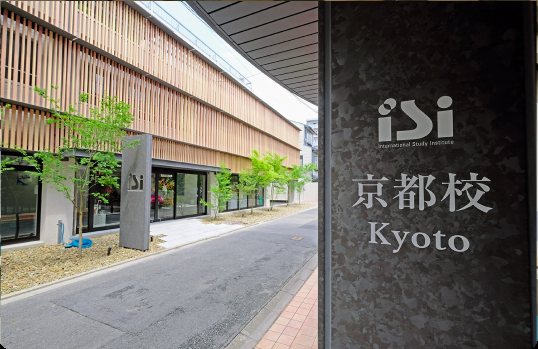
A university-preparation school: every course is a university-bound course (1 year 3 months to 2 years). In the 2025 report to the Immigration Services Agency, 320 of the students who completed or left their courses went on to universities and similar institutions. It is the Kyoto campus of the ISI Group (capacity 1,072, students from 56 countries and regions) and supports admission to Kansai universities through a special-track class, elective classes for graduate school and EJU preparation, and a career EXPO held three times a year. It stands in a quiet residential area 7 minutes on foot from JR Enmachi Station, and a dormitory exclusively for Kyoto campus students is a 13-minute walk away.
Published data and school website
Tuition
⚠ Admission fee if the Certificate of Eligibility is not issued varies by source — please confirm with the school. All fees paid except the admission screening fee and bank refund fees are refunded. · The admission screening fee and admission fee are not refunded for any reason. The school's two documents differ, so check with the school before applying.
If you saw a lower amount elsewhere, it may not include the admission fee and application fee
Median one-year fees in other regions — Kyoto ¥911,000(7 schools) · Kanagawa ¥880,000(8 schools) · Okinawa ¥858,000(6 schools) · Tokyo ¥840,600(56 schools) · Fukuoka ¥835,000(12 schools) · Hyogo ¥825,500(7 schools) · Osaka ¥814,000(27 schools) · Shizuoka ¥790,000(9 schools) · Chiba ¥745,333(10 schools) · Aichi ¥740,667(5 schools)
Cost details, tables by course and notes · 6 items
- One-time fees
- ¥1,015,000Tuition ¥720,000 · Admission examination fee ¥40,000 · Admission fee ¥100,000 · Materials ¥55,000 · Facility management fee ¥100,000
According to the school guide, fees are paid in one lump sum at enrollment. SALLAE will check with the school whether you can pay in installments.
FY2027 prices (for enrollment from April 2027) as listed in the 2026 application guidelines. Prices include tax; the examination fee is paid when you apply.
FY2027 Kyoto campus, 6 months: ¥577,500 (application ¥40,000 · admission ¥100,000 · tuition ¥360,000 · materials ¥27,500 · facilities ¥50,000)
FY2026 Kyoto campus, 1 year: ¥942,000 (application ¥33,000 · admission ¥77,000 · tuition ¥708,000 · materials ¥44,000 · facilities ¥80,000).
The facility operation and management fee includes student insurance.
Short-term prices are for 10 weeks (1 term) per the 2026 short-term application guidelines; from FY2027 it is ¥248,750.
External exam fees, transport costs, and transport for some extracurricular activities are not included in tuition.
Short-term 3 months is a separate ¥228,000 (admission fee ¥20,000 · tuition ¥177,000 · materials ¥11,000 · facility management fee ¥20,000).
School website · 2026-06-04 updated
Whether it is refundable
- If the Certificate of Eligibility is not issued
- If the Certificate of Eligibility is not issued, 100% of fees are refunded. The admission fee is not refunded, and a ¥6,000 refund handling fee applies.
- If the Japanese embassy refuses to issue a visa
- Tuition, materials and facility management fees are refunded in full — a document showing the refusal is required; the examination fee and admission fee are not refunded.
- Until the day before CoE issuance
- Cancellation before the Certificate of Eligibility is issued: 100% of fees refunded. The application fee and admission fee are not refunded, and a ¥6,000 handling fee applies.
- From CoE issuance until 15 days before the enrollment date
- From CoE issuance until 15 days before enrollment, fees are refunded minus 1 month's worth. Handling fee: ¥6,000.
See refund policy in detail · 5 more lines
- From 14 days before the enrolment date until the day before
- From 14 days before enrollment to the day before: refund of fees minus 3 months' worth. Handling fee: ¥6,000.
- Cancellation after enrolment (on or after the enrolment date): before entering Japan
- After the enrollment date but before entering Japan: refund minus 3 months' worth, or transfer to the next term. Handling fee: ¥6,000.
- Cancellation after enrolment: withdrawal midway
- Refunds are made per 2-term unit. Nothing is refunded for terms already started. Cancellation fee for terms not yet started: ¥0 if 6 or more months before, ¥36,000 if 3–6 months before, ¥90,000 if 1–3 months before, ¥126,000 if the previous month.
- Deferring enrolment
- Enrollment can be postponed only once. Re-enrolling within 1 year waives the admission fee.
- When you receive a refund
- Refunds are made within 40 days of completing the procedure. Remittance fees are borne by the student. Applies to withdrawals on or after April 1, 2027.
Admission & dates
- Apr intake
- 2-year course · Application End of October 2025 · Classes 20 class hours/week × 80 weeks = 1,600 class hours (45 min each).
- Jul intake
- 1 year 9 months course · Application End of February 2026 · Classes 20 class hours/week × 70 weeks = 1,400 class hours (45 min each).
- Oct intake
- 1 year 6 months course · Application End of May 2026 · Classes 20 class hours/week × 60 weeks = 1,200 class hours (45 min each).
- Jan intake
- 1 year 3 months course · Application End of August 2026 · Classes 20 class hours a week × 50 weeks = 1,000 class hours (1 class hour = 45 minutes).
- Japanese level
- About 150 hours of Japanese study, or Japanese ability equivalent to N5 (CEFR A1)
Students entering in January generally start from the N4 level, so they need beginner Japanese ability equivalent to JLPT N5.
Deadline and capacity rules
Applications close once capacity is reached. The Kyoto campus has intakes in April, July, October and January, and each course ends in March.
School website · 2026-06-04 updated
Classes
- Morning
- 8:50 ~ 12:00 Usually morning classes from Intermediate II to advanced
- Afternoon
- 13:00 ~ 16:10 Usually afternoon classes from beginner to Intermediate I
- AM/PM placement
- You cannot choose — it is decided by the placement test result. Usually beginner to intermediate I is in the afternoon and intermediate II onward in the morning, but it varies by term and class assignment.
- Class size
- Max 20 students
- Class assignment
- Level-based 8 stages
- Elective classes
- Graduate school preparation · EJU preparation (EJU Japanese) · JLPT preparation · Employment · Conversation · Elective classes are offered twice a week for 90 minutes each, for Intermediate II and above. Requests are collected every 3 months, and the class may not run depending on the number of applicants.
Materials · Subjects · Timetable · Details
- Materials
- ISI's original kanji textbook and commercial materials are used, with repeated vocabulary and kanji study on Monoxer.
- Subject
- Grammar · Conversation · Listening comprehension · Reading · Composition · Expression · Pronunciation · Article 9 of the school regulations sets the hours per subject for the basic course and the university-prep course. 1 class hour is 45 minutes.
Morning and afternoon classes Monday–Friday, 2 periods a day (90 min each).
| Morning | Afternoon | |
|---|---|---|
| Period 1 | 8:50~10:20 | 13:00~14:30 |
| Period 2 | 10:30~12:00 | 14:40~16:10 |
Class hours by subject
| Subject | 2 years | 1 year 9 months | 1 year 6 months | 1 year 3 months |
|---|---|---|---|---|
| Grammar | 500 hours | 440 hours | 380 hours | 310 hours |
| Conversation | 520 hours | 460 hours | 420 hours | 350 hours |
| Listening comprehension | 140 hours | 120 hours | 80 hours | 60 hours |
| Reading comprehension | 120 hours | 100 hours | 80 hours | 80 hours |
| Composition | 120 hours | 100 hours | 80 hours | 80 hours |
| Expression | 180 hours | 160 hours | 140 hours | 110 hours |
| Pronunciation | 20 hours | 20 hours | 20 hours | 10 hours |
8 levels from beginner to advanced. Each level is 200 class hours (20 class hours × 10 weeks). At the end of each term, 8 areas and an overall result are graded from A+ to D.
What each level covers · 8 stages
- Beginner I
- 3 months JLPT N5 · 150–200 kanji. Can follow simple instructions spoken slowly and can greet people and introduce themselves.
- Beginner II
- 3 months JLPT N4 · 300 kanji. Can read 3–4 paragraphs using basic kanji and convey everyday intentions and requests.
- Intermediate I
- 3 months JLPT N3 · EJU 220 points · 500 kanji. Can follow explanations of familiar topics and give a prepared speech.
- Intermediate II
- 3 months JLPT N2 · EJU 250 points · 800 kanji. Can pick out the main points of editorials and speeches and exchange opinions on social topics.
- Intermediate III
- 3 months JLPT N2 · EJU 280 points · 1,100 kanji. Can grasp the gist of news and editorials and give presentations on specialized topics of interest.
- Advanced I
- 3 months JLPT N2/N1 · EJU 300 points · 1,400 kanji. Can follow somewhat specialized explanations and adjust how they speak to the situation.
- Advanced II
- 3 months JLPT N1 · EJU 320 points · 1,700 kanji. Can follow specialized and abstract lectures and state logical opinions on social topics.
- Advanced III
- 3 months JLPT N1 · EJU 340 points · 2,000+ kanji. Can follow lectures and news at natural speed and give presentations and discuss social and specialized topics.
School website · 2026-08-18 updated
Documents to prepare — student visa course
- On the school's application form, write your name exactly as in your passport and the financial sponsor's occupation and workplace.
- Fill in the résumé, statement of study purpose and post-graduation plans on the school's designated forms. Education history from elementary school, the date of preparation and the applicant's signature are required.
- Health status declarationSchool-designated form
- 2 ID photos4 cm tall × 3 cm wide
- Copy of passport (all pages with Japan entry/exit records)
- Diploma or certificate from your last school [copy]
Financial supporter's documents · only if applicable · 8 application requirements
Submitted by the person paying the tuition (financial sponsor)
- The financial sponsorship form is on the school's designated form and signed by the sponsor in person. If the sponsor is neither the applicant nor a parent, describe how the sponsorship came about.
- Proof of income (annual income for the past year) or bank balance certificate (issued within 3 months, in the sponsor's name, balance matching the study period)
Only if applicable
- Certificate of enrolment or certificate of expected graduation [copy] ((Only if you are enrolled in your last school at the time of application))
- Those enrolled in or who left a university, junior college or vocational school must submit that school's certificate in addition to their high school diploma. (If currently enrolled in, on leave from, or having dropped out of a university, junior college or vocational school)
- JLPT pass certificate [copy] (If you passed the Japanese-Language Proficiency Test)
- Certificate of Japanese study (If you have attended a Japanese language school)
- Written explanation (if gaps in education or work history exceed 6 months)
- Residence card [copy of both sides] (If you hold a residence card)
- A payer living in Japan submits a residence certificate, bank balance and transaction statements, proof of employment, tax and tax payment certificates, and a residence card. (Sponsor residing in Japan)
Application requirements
Completed 12 or more years of schooling at enrollment. However, those 18 or older with a high school qualification are accepted even with fewer than 12 years. Under 55 as of April 1, 2026. Except for certificates, only original documents issued within 3 months of the Immigration application date are valid. If a document is in a language other than Japanese, be sure to attach a Japanese translation. Sign by hand in ballpoint pen yourself. If you have ever applied for a Certificate of Eligibility for study, work or other purposes, including withdrawn applications, tell the school at the time of application. Send originals by international courier such as FedEx, DHL, OCS or EMS, and let the school know the tracking number. Those who want to find a job in Japan must also submit separate documents needed for job-hunting support.
Apart from the mandatory documents, required documents and conditions differ by nationality or region and past immigration application history. SALLAE is confirming this with the school.
Short-term course: submit only the application form · Health declaration form · Copy of passport · ID photo (face photo) data · Copy of both sides of the residence card · Submit only the homestay application form.
School website · 2026-06-04 updated
Admission process
- Request an admission consultation — You receive individual counseling in your native language, and a staff member supports you in preparing, checking and submitting documents.
- Submit application documents; document screening, interview and payment of the entrance examination fee — Submit the application documents, take the document screening and interview, and pay the application fee by bank transfer, Flywire or WeChat Pay.
- After you are accepted, the school applies on your behalf to the Immigration Services Agency for the Certificate of Eligibility (CoE) — For April intake, the immigration application is filed in late November of the previous year, and obtaining the visa takes about 6 months. Campusmate-J becomes available after the acceptance notice.
- After the CoE is issued, the tuition invoice is provided via Campusmate-J. — For April intake, CoE issuance and tuition payment are in late February.
- Take an online level test — Classes are formed based on placement test results
- The school sends the CoE and admission permit
- Obtaining a visa and booking a flight — For April intake, the visa application is in early March. Register the e-ticket of your booked flight in Campusmate-J.
- Admission — Please arrange your entry to Japan so that you can move into the dormitory on the designated move-in date and time.
- Placement test
- Before enrollment, classes are formed using an online placement test and a questionnaire on Japanese study history and future plans.
- After entry
- After the acceptance notice, you receive guidance and documents through Campusmate-J, and after enrollment you can check attendance, grades and timetables. The LMS and Monoxer are used for study.
School website · 2026-07-19 updated
Short-term study
- Visa
- Temporary visitor or Working holiday(not a student visa)
- Duration
- 2 weeks – 6 months
- Open now?
- Rolling admissions, so availability varies from time to time — SALLAE will confirm with the school
Course without a student visa
- Short-term comprehensive Japanese course — From 2 weeks · 8 levels · about 20 students per class. Intakes in Jan/Apr/Jul/Oct, mid-term entry possible, deadline 30 days before, age 16 or older. Invitation letters are for stays of 8 weeks or more; preparation fee is extra.
- Private lessons — Lessons are available any time from a single lesson. Choose from everyday conversation, JLPT, business and exam prep; online is also available.
- Group programs — Consultation is available for educational institutions and companies from about 10 people. Japanese classes can be combined with cultural experiences and university visits, lasting from several days to several months.
★Short-term courses are not listed in the published data — it counts only student-visa courses.
School website · 2026-09-14 updated
Graduate outcomes
| FY2025 | Admitted |
|---|---|
| Employment | 85 students |
See 10 more schools
The Kyoto campus had 535 students meeting the criteria in fiscal 2025: 320 went on to universities and similar institutions, 85 changed their status of residence, and 130 showed proof of A2 level or above. · At the Kyoto campus in fiscal 2025, 85 of the 535 students meeting the criteria were approved for a change of status of residence. Fiscal 2024: 79; fiscal 2023: 46. · School website · 2026-06-11 updated
Reviews 2
External reviewAuto-translatedPersonal review · Naver blog · May 2024
The school orientation is done in your native language, lol (I was surprised it was written in Hangul haha)
I wondered if homework would pour in from the very first day of the term... but it was just reading to bring in and previewing kanji haha
The class I was assigned to was Intermediate Level 3, and I thought it'd be a Chinese-speaking class or a European class, but it was just all Europeans (...) Everyone talks in English. Turns out they had already enrolled last year and were taking the 2-year course, and maybe because it's the class right below Advanced, there were only a few new students. I thought Chinese people would be the best at Japanese, but the Italian and French kids are the best. East Asia, let's reflect;;
Our school has a system called elective classes. It's for the Thursday morning class (upper intermediate) every week, and instead of classes by level, you sign up by the subject you want to learn. It sounds impressive, but it's not;
There are a certification class, a job-hunting class, a study-abroad exam class, a graduate school prep class, and a conversation class, but except for the conversation class, all of them are for students aiming at jobs or further education, so kids like me who came to have fun all piled into the conversation class. But even though all the students are upper intermediate or above, they only teach things like greeting Japanese people and how to react in conversation T_T I wanted something like discussions.... No matter how much I suggested it, they wouldn't listen, so I gave up hope for next semester. That was when I got fed up with the school..
Still, the classroom was pretty... When I opened a Japan Post Bank account because of my part-time job, the school printed out the application form for me and told me about the post office, but it was really far away T_T
This was truly the only heartwarming moment while attending the school T_T My favorite teacher gave me a chocolate with a letter on the last day of class. I cried reading the letter they carefully wrote for each student… I kept my head down and dozed off right up to the last class… so I cried again from guilt 🥲
Most of the kids at our school took the JLPT, but I'm the only one who didn't haha. For Tanabata, the school also held its own event where we wrote wishes and hung them on bamboo.학교 OT는 자국어로 해 줍니다 꺄르륵 (한글 적혀 있어서 놀람ㅎ)
개강 첫날부터 숙제가 쏟아지나 했는데... 그냥 읽어 오기랑 한자 예습해 오기였음ㅎ
배정받은 반은 중급 3단계였는데, 중화권 반 유럽권 반일 줄 알았더니 그냥 유럽밭이었다(…) 다들 영어로 얘기함. 알고 보니 이미 작년에 입학해서 2년 과정 듣는 사람들이었고, 상급 바로 아랫반이라 그런지 신입생은 몇 명 없었음. 중국인들이 일본어 제일 잘할 줄 알았는데 이탈리아·프랑스 애들이 제일 잘함. 동아시아 반성하자;;
우리 학교엔 선택 수업이라는 제도가 있음. 매주 목요일 오전반(중상급) 대상인데, 레벨별 반이 아니라 배우고 싶은 과목별로 수강신청하는 방식이다. 들으면 기깔나 보이는데 아님;
자격증반, 취업반, 유학시험반, 대학원 준비반, 회화반이 있는데 회화반 빼고 전부 취업·진학 목표인 학생용이라 나처럼 놀러 온 애들은 회화반으로 몰렸음. 근데 수강생이 다 중상급 이상인데 일본인과 인사하기, 대화에서 리액션하기 이딴 것만 가르쳐 줌ㅠ 토론 같은 걸 원했는데.... 아무리 건의해도 안 들어줘서 다음 학기엔 기대를 버렸다. 학교에 정떨어진 계기..
그래도 교실은 예뻤어... 알바 때문에 유초은행 만들 땐 학교에서 신청서 직접 뽑아 주고 우체국도 알려 줬는데, 거기가 엄청 멀었음ㅠ
이거 정말 학교 다니면서 유일하게 맘이 따땃했던 순간ㅠㅠ 제일 좋아했던 쌤이 마지막 수업 날 편지 달린 초콜릿을 주셨어요. 학생마다 정성스레 써 주신 편지 읽고 눈물… 저 마지막 수업까지 고개 박고 졸았거든요… 죄책감에 또 눈물 🥲
우리 학교 애들은 JLPT 대부분 다 응시했는데 저만 안 봤어요ㅎ 칠석 때는 학교에서 자체 이벤트로 소원 적어 대나무에 다는 것도 해 줬어요.External reviewAuto-translatedPersonal review · Naver blog · Mar 2024
I attended ISI Language School in Kyoto and I'm proud to say it was a choice I don't regret at all! lol I made good connections with friends from all over the world and met great teachers, which helped my Japanese studies enormously.
Of course, I can't say every teacher was the best. For classes I was unhappy with, I shared opinions with my classmates and requested class improvements by email through our homeroom teacher, and I think the school actively took them on board and reflected them. The facilities were clean too.
When I was preparing for job hunting, my homeroom teacher and the career teachers went over everything carefully from my résumé to interview prep, and I got the result I wanted in the end. I can't say I'm 100% satisfied, but with language study, your own effort is what matters most in the end, and if you actively give the school feedback on what's lacking, it gets improved to some extent. By the way, I'm a student with absolutely no financial interest in this school lol
Korean friends in other classes at the same language school seem to have fewer tests and not much homework, but only our class has lots of homework, kanji and grammar J-tests, and even PPT presentations... ugh
The scope of the Monday grammar test is way, way too much, so I spent the weekend holed up at home just studying. Kanji eventually sticks somehow if you keep writing it, but grammar is truly hopeless... I can't understand it, can't memorize it, and can't say it out loud. This is a total!!! mess..!!!
Today there was a career guidance briefing at the language school. I started studying abroad in my mid-30s, so getting a job was a goal just as much as Japanese ability, and I was grateful they held the briefing at a fairly early point :)
They explained in great detail the stages and categories of job-hunting preparation, what to prepare, the interview stages, and even the validity period of the work visa, and just knowing there will be places and teachers' guides for job and career counseling going forward made me feel I could spend my language school life productively. I heard that hotel-industry job support is active in spring and autumn, so I could sketch out a plan too.
Still, I'm not leaving either Japanese or job prep up to the school, so in the end it's up to you!교토 ISI 어학교를 다녔는데 정말 후회 없는 선택이었다고 자부합니다! ㅋㅋ 세계 각국에서 온 친구들과 좋은 인연도 맺고, 좋은 선생님들을 만나서 일본어 공부에 굉장히 많은 도움이 됐어요.
물론 모든 선생님이 다 최고였다고는 못 해요. 불만 있는 수업은 같은 반 친구들이랑 의견 나누고 담임 선생님을 통해 메일로 수업 개선 요청을 했는데, 학교 측에서 적극적으로 수렴하고 반영해 줬다고 생각해요. 시설도 깨끗했고요.
취업 준비할 때도 담임 선생님이랑 취업 담당 선생님들이 이력서부터 면접 준비까지 꼼꼼히 봐 주셔서 끝까지 원하는 결과를 얻었어요. 100% 만족이라고는 못 하지만, 어학 공부는 결국 본인 노력이 제일 중요하고 부족한 건 학교에 적극적으로 의견 내면 어느 정도 개선돼요. 참고로 저는 이 학교랑 이익관계 전혀 없는 학생입니다 ㅋㅋ
같은 어학교 다니는 다른 반 한국인 친구들은 시험도 자주 없고 숙제도 많이 없는 것 같은데, 우리 반만 숙제도 많고 한자·문법 J테스트에 PPT 발표까지 ..하
월요일 문법 시험 범위가 많아도 너무 많아서 주말은 집에 처박혀 공부만 함. 한자는 계속 쓰다 보면 어찌저찌 외워지는데 문법은 진짜 노답.. 이해도 잘 안 되고 암기도 안 되고 말로도 안 나옴. 이것이 바로 총체적!!! 난국..!!!
오늘은 어학교 진로 가이던스 설명회가 있었어요. 30대 중반에 시작한 유학이라 일본어 실력만큼 취업도 목표였는데, 꽤 빠른 시점에 설명회를 열어 줘서 감사했어요 :)
취업 준비 단계랑 분류, 준비해야 할 것들, 면접 단계, 취업비자 유효기간까지 정말 상세하게 설명해 줬고, 앞으로 취업·진로 상담할 수 있는 곳과 선생님들 가이드가 있을 거라는 것만 알아도 어학교 생활을 유익하게 보낼 수 있겠다 싶었어요. 호텔 쪽은 봄·가을에 취업 지원이 활발하다고 해서 계획도 좀 그려졌고요.
그래도 일본어도 취업 준비도 학교에 맡기는 건 아니니까, 결국 자기 하기 나름!
External reviews are public posts that SALLAE collected and rewrote in the writer’s own voice. SALLAE keeps the original links.
University prep
- Individual guidance for students wishing to go on to further study — Homeroom teachers and the head office career center give individual support through application documents and interviews. The Kyoto campus also has career staff.
- Career interview — The homeroom teacher holds at least 4 individual progression meetings before graduation. First-year students get an explanation of the annual schedule at a career guidance session.
- Career Expo — The Kyoto campus holds a Career Expo for all students 3 times a year.
- Target school analysis tool — A target-school analysis tool compares past successful applicant data. Progression materials are also placed at the West Building library booth and the East Building career booth.
- Special progression course — Special courses are held on application documents, the statement of motivation, graduate school applications and interviews. Some courses invite graduate school professors.
- Special advanced class — A special advanced class for selected students moves faster than regular classes and is also offered at the Kyoto campus.
- Progression to group schools — For progression to WEWORLD Group schools, support is provided for preparing application documents and renewing visas.
- Employment — In the job-hunting elective, students learn résumé writing, interview practice and presentations.
- Support after progression — Support is provided after progression as needed.
Schedule to admission
- Career guidance and interviews
- From early after enrolment · Study plan tailored to your goal
- How to choose a destination school
- While enrolled · Further-study information sessions · School visits · Individual consultations
- Application preparation and exam preparation
- Application period · Writing a statement of purpose · Interview practice · Research plan guidance
- Decide on a path and prepare for enrolment
- After acceptance · Confirm enrollment procedures · Prepare for your new life
School website · 2026-07-28 updated
Daily-life support
- Homeroom teacher system — The homeroom teacher is the contact for questions about class, city hall procedures and feeling unwell.
- Public health nurse — Students can consult the group schools' school nurse online or in person, and the content is shared with the homeroom teacher.
- Health checkup — A tuberculosis screening is done on entry to Japan and a basic health checkup in the graduating year. Students are guided and accompanied to hospitals depending on results.
- Native-language support — Before enrollment, multinational staff handle consultations in your native language. For languages the Kyoto campus cannot cover, it works with other group departments.
- Orientation and life guidance — Students attend an orientation at enrollment, and life guidance is held regularly during study. At evacuation drills, traffic safety guidance is also given with the police.
- Part-time work — An information session is held for those who want part-time work, and work-related documents are checked at visa renewal.
- Residence procedures — All office staff are qualified to submit immigration applications on behalf of students
- Finding housing — Besides its directly managed dormitories, the school introduces partner dormitories and real-estate agencies.
- Insurance — Address on the residence card and enrollment in National Health Insurance are checked. All students are enrolled in insurance.
- Traffic accidents — Consultation on traffic accidents and a crisis management manual are in place, and initial disaster response is reviewed each term. Weather warnings are also announced on Teams.
- Airport pickup — One-way pickup from Kansai International Airport to a Kyoto student dormitory from ¥40,000, and to a homestay from ¥41,000.
School website · 2026-03-31 updated
Scholarship
- ISI Japanese Language School Principal's Award
- ¥50,000 Once For students who have been enrolled in the ISI Group for at least 1 year and have excellent grades and attendance. Awarded 4 times a year (Apr, Jul, Oct, Jan).
- Perfect attendance award
- ¥30,000 OnceFor students enrolled on a student visa with no lateness or absences for 1 year. Awarded 4 times a year.
- Learning incentive for international students
- ¥30,000 per month. For students who entered on a student visa, have 90% or higher attendance over 1 year, excellent grades and want to go on to further study.
- Learning incentive for international students
- ¥48,000 per month. For students who achieved excellent EJU results and are enrolled at a Japanese university or graduate school.
- Kyoritsu Maintenance Scholarship Fund
- ¥60,000 per month · student visa · from Asia incl. Korea · 100% attendance and excellent grades · school recommendation after 1 year of study
- LSH Asia Scholarship
- ¥20,000 per month · Asian student on a student visa enrolled 3+ months and staying 6+ more months · 90%+ attendance, excellent grades, school recommendation
- Nitori International Scholarship Foundation
- ¥50,000 per month. Conditions: planning to enroll at a Japanese university or graduate school, living in Japan, monthly reports, 2 exchange meetings a year, and part-time work.
- IHNO Scholarship
- ¥10,000–¥30,000 per month depending on part-time hours. For students who work part-time diligently on a student visa.
School website · 2026-08-18 updated
School life
For 1 year
- Spring
- Cherry blossom viewing · Pottery and ninja experiences · Excursions and walks
- Summer
- Excursion · Tanabata and Bon dance · ISI Further-Study Expo
- Autumn
- Halloween event · Tea ceremony, calligraphy and kimono dressing · Sports day, school festival and street-stall fair
- Winter
- Speech contest · Tea ceremony and calligraphy · Company seminar
* Event details may vary by campus and year.
- Maiko experience, kabuki viewing, kimono dressing, ikebana, Zen meditation, samurai experience, Japanese kite making, a bowling tournament and more.
- Ritsumeikan University information session
- At Tanabata, the school opens to local residents, with exchanges with university and high school students and visits to a nursery school.
- Students' average age is 27, from 56 countries and regions (as of April 2026).
- Up to 28 hours per week during school terms, and up to 8 hours per day during long school breaks.
On campus
- On campus
- Student lounge — Student lounge
- On campus
- Book area — Books can also be borrowed
- On campus
- Learning commons — A space suited to self-study and group study. The 1st floor of the East Building is also a self-study space.
- On campus
- Career guidance room — Rich information and materials on progression
- On campus
- Cafe — Delicious coffee and carefully chosen light meals
- On campus
- Open terrace
- On campus
- Japanese-style room — Used for special classes such as tea ceremony and kimono dressing
- On campus
- Prayer room — Prayer mats and hand and foot washing areas provided
- On campus
- Each classroom has a projector or TV monitor, an electronic whiteboard and a PC. — All classrooms
- On campus
- Wi-Fi and student PCs
2026–2027 academic calendar
- Saturdays and Sundays
- Saturdays and Sundays
- Public holidays
- Public holidays
- Spring break
- Mar 20–Apr 7, 2026
- Summer vacation
- Aug 8–16, 2026
- Autumn break
- Sep 19–Oct 6, 2026
- Winter break
- Dec 19, 2026–Jan 6, 2027
School website · 2026-07-29 updated
Access
- Transit
- 7 min walk from Enmachi Station (JR Sagano-Sanin Line)
15 min walk from Nijo Station (JR Sagano-Sanin Line)West exit
15 min walk from Nijo Station (Kyoto Municipal Subway Tozai Line) Exit 3 - Nearby
- From Enmachi Station it is a 7-minute walk per the campus page and a 6-minute walk per the school map. From Nijo Station it is a 15-minute walk, and 1 minute on foot from the Marutamachi Gosendori bus stop.
- Dormitory
- Available · Kyoto student dormitories: double rooms from ¥53,000 per month, single rooms ¥67,000–¥79,000 per month. Enmachi Dormitory is a 13-minute walk. · Per the school website
School website · 2026-07-29 updated
Dormitory — Kyoto student dormitory, per term: from ¥249,000 for a twin room, from ¥291,000 for a single room. Homestay for 4 weeks: ¥117,100 in FY2026, ¥121,000 in FY2027.
School website · 2026-08-07 updated
SALLAE has organized the school website and published data in English.
The update date is the day that material was last revised.
Photos are materials published by the school.
This information is compiled from official sources and is not updated daily. Please confirm with the official contact before signing or applying.