International University of Health and Welfare
国際医療福祉大学
Opening soonApplications open 12/16 · Special Selection for International Students (January)
- Exam location
- Campus in Japan ›
- Japanese requirement
- Take the EJU (no minimum score) ›
- First-year fees
- from ¥1,060,000 ›
Compare with other universities →
Fees and conditions can change over time. Always check the school's guidelines before you apply.
Fees and conditions can change over time.
About the school
A private university founded in 1995. It has 10,701 students. There are 1,214 faculty members. It has 5 campuses (Otawara, Narita, Tokyo Akasaka, Odawara, Okawa); which one you attend depends on your department.
History · 8
- 1995
- Opened "International University of Health and Welfare" in Otawara City, Tochigi Prefecture, as Japan's first university of medical welfare. The Faculty of Health Sciences was established
- 1997
- The Faculty of Medical Welfare was established at the Otawara Campus
- 2005
- The Faculty of Pharmacy was established at the Otawara Campus. The Okawa Campus opened in Okawa City, Fukuoka Prefecture
- 2006
- The Odawara Campus opened in Odawara City, Kanagawa Prefecture (Faculty of Health Sciences at Odawara)
- 2015
- The "International Student Preparatory Course" was opened at the Otawara Campus (to strengthen Japanese language education)
- 2016
- The Narita Campus opened in front of Kozunomori Station. The Faculty of Nursing at Narita and the Faculty of Health Sciences at Narita were launched
- 2017
- The Faculty of Medicine was opened at the Narita Campus. Of the first class of 140 students, 20 were international students
- 2018
- The Tokyo Akasaka Campus was opened, and the Faculty of Psychology and Health and Welfare Management at Akasaka was launched
大学ポートレート(私学版) 国際医療福祉大学 学生情報 · 大学ポートレート(私学版) 国際医療福祉大学 教員情報 · 国際医療福祉大学のあゆみ
Admission requirements and dates
International University of Health and Welfare admits international students through 3 routes.Pick your situation below to see only the routes that fit · Based on the guidelines for April 2027 entry
EJUThe exam Japanese universities use for international student admission · June and November · also held outside Japan = Examination for Japanese University Admission · JLPTJapanese-Language Proficiency Test · N1 is the highest, then N2 = Japanese-Language Proficiency Test
Apply with EJU scores (Nov · Jan)
Official name: 留学生特別選抜
People who took "Japanese" in the EJU are selected by documents, an essay and an interview. You can choose from all faculties and departments except the Faculty of Medicine.
Applications open 12/16 · in 19 days
Nov 14 exam · EJU from June 2025 to June 2026
- Apply 11/1~11/6
- →
- Exam 11/14
- →
- Results 12/14 days left
- →
- Enroll ~12/10
First-year student fees are paid within the enrollment procedure period. In principle they are paid in one lump sum, but you can also choose an installment method that splits tuition and the laboratory and practical training fee (practical training and literature costs) between the time of enrollment procedures and September after enrollment. The Educational Support Association annual fee of ¥45,000 is also required at enrollment
EJU subjects · You must take "Japanese" in the EJU. The score standard is not published. If you took subjects other than "Japanese", those scores are also used as a reference in the pass/fail decision
Valid sittings · One of June 2025, November 2025 or June 2026 (if you took it more than once, choose one sitting)
Other requirements · You need enough Japanese ability to take classes in Japanese (as a guide, JLPT N2 or higher, or equivalent Japanese ability)
Jan 31 exam · EJU up to November 2026 · residence status required
- Apply 12/16~1/7opens in 19 days
- →
- Exam 1/31
- →
- Results 2/13
- →
- Enroll ~2/19
First-year student fees are paid within the enrollment procedure period. In principle they are paid in one lump sum, but you can also choose an installment method that splits tuition and the laboratory and practical training fee (practical training and literature costs) between the time of enrollment procedures and September after enrollment. The Educational Support Association annual fee of ¥45,000 is also required at enrollment
EJU subjects · You must take "Japanese" in the EJU. The score standard is not published. If you took subjects other than "Japanese", those scores are also used as a reference in the pass/fail decision
Valid sittings · One of June 2025, November 2025, June 2026 or November 2026 (if you took it more than once, choose one sitting)
Other requirements · You need enough Japanese ability to take classes in Japanese (as a guide, JLPT N2 or higher, or equivalent Japanese ability)
Apply from a country without the EJU (JLPT N2)
Official name: 留学生特別選抜
This is the route for people living in countries where the EJU is not held, applying with a JLPT N2 or higher result. November exam only.
Applications for this year have closed — below are the remaining dates for those who applied
Nov 14 exam · documents by mail (must arrive by deadline)
- Apply 11/1~11/6
- →
- Exam 11/14
- →
- Results 12/14 days left
- →
- Enroll ~12/10
First-year student fees are paid within the enrollment procedure period. In principle they are paid in one lump sum, but you can also choose an installment method that splits tuition and the laboratory and practical training fee (practical training and literature costs) between the time of enrollment procedures and September after enrollment. The Educational Support Association annual fee of ¥45,000 is also required at enrollment
Special selection for international students (Medicine)
Official name: 医学部
This is a selection only for the Faculty of Medicine, using written tests in English, Mathematics and Science, an essay and an interview (20 places). You can choose Japanese or English as the language of the exam questions.
Applications for this year have closed — below are the remaining dates for those who applied
2nd session · applications Nov 2 to 9 · results Dec 14
- Apply 11/2~11/9
- →
- Exam 1 11/21
- →
- Exam 2 12/58 days left
- →
- Results 12/14
1st session · applications in August (already closed)
- Apply 8/12~8/20
- →
- Exam 1 9/1
- →
- Exam 2 9/12
- →
- Results 9/24
Good to know before applying
- By the time you enroll you need a "Student" residence status (or another status that allows study at a university). Submit documents proving your residence status to the admissions office of the campus you will attend by March 19, 2027 (must arrive by then); if you cannot obtain it by 5:00 pm on March 31, 2027, you are treated as having declined enrollment. You cannot study on "Temporary Visitor" status
- People who live outside Japan and do not have a Japanese residence status, or who have "Temporary Visitor" status, must apply to the exam held in November. You cannot apply to the January exam
- You must have taken the EJU between June 2025 and November 2026 and must have taken "Japanese". For the November exam, scores from November 2026 cannot be used (they can be used for the January exam)
- If you mail application documents from overseas, you must contact the admissions office of the campus you want by the first day of the application period, and send the documents so they arrive by the deadline. Arranging documents from your home country can take about a month
- You must have completed 12 or more years of regular school education abroad (including those expected to complete it by March 31, 2027). You are eligible if you have spent 3 years or less in total in Japanese schools. Foreign schools in Japan are treated the same as Japanese schools
- You apply to the admissions office of the campus (faculty) you want, and once an application is accepted, no changes to its contents (faculty and department, exam category, exam site) are allowed at all. The exam sites, by faculty, are the Otawara, Narita, Tokyo, Odawara and Okawa campuses
- In addition to the amounts in the table, the Educational Support Association annual fee of ¥45,000 (every year) is required. Some faculties also have a reserve fund of ¥50,000 per year for "Overseas Health and Welfare Conditions", and textbook costs, clinical training costs and national exam preparation costs are charged separately. The admission fee is not refunded for any reason
- Tuition reduction is a system you apply for and go through screening; if your grades within your department fall in the bottom 10% for 2 years in a row after enrollment, the reduction is canceled from the following academic year. If your residence status is not "Student", you are not eligible
- The Faculty of Medicine's special selection for international students is a separate selection. You must confirm your application eligibility in advance before applying (details in the "2027 Academic Year Application Guidelines, Faculty of Medicine, Department of Medicine")
国際医療福祉大学 2027年度学生募集要項
Fees
- First-year fees
- ¥1,060,000 ~ ¥1,750,000
- Paid at enrollment
- from ¥695,000
- Application fee
- ¥30,000
- Examination fee ¥30,000 (¥35,000 for the Faculty of Pharmacy, the Faculty of Pharmacy at Narita and the Faculty of Pharmacy at Fukuoka).
- First-year fees are ¥1,060,000 to ¥1,750,000 depending on the department.
- The admission fee is ¥200,000 (Health and Welfare, Akasaka) or ¥300,000.
- If you choose the installment method, the payment at enrollment procedures starts from ¥695,000 (plus the Educational Support Association annual fee of ¥45,000 separately).
- After the tuition reduction (50%), the first year starts from ¥710,000
Places and fees by department 27
| Department | Places | First-year fees (¥) | |
|---|---|---|---|
| Faculty of Health Sciences | |||
| Department of Nursing | A few students per session | ¥1,680,000after reduction 1,230,000 | |
| Department of Physical Therapy | A few students per session | ¥1,600,000after reduction 1,150,000 | |
| Department of Occupational Therapy | A few students per session | ¥1,600,000after reduction 1,150,000 | |
| Department of Speech-Language-Hearing Sciences | A few students per session | ¥1,600,000after reduction 1,150,000 | |
| Department of Orthoptics and Visual Sciences | A few students per session | ¥1,600,000after reduction 1,150,000 | |
| Department of Radiological Sciences and Information Science | A few students per session | ¥1,610,000after reduction 1,160,000 | |
| Department of Medical Laboratory Sciences | A few students per session | ¥1,610,000after reduction 1,160,000 | |
| Faculty of Health and Welfare | |||
| Department of Health and Welfare Management | A few students per session | ¥1,060,000after reduction 710,000 | |
| Faculty of Pharmacy | |||
| Department of Pharmacy | A few students per session | ¥1,750,000after reduction 1,200,000 | |
| Faculty of Nursing at Narita | |||
| Department of Nursing | A few students per session | ¥1,610,000after reduction 1,160,000 | |
| Faculty of Health Sciences at Narita | |||
| Department of Physical Therapy | A few students per session | ¥1,600,000after reduction 1,150,000 | |
| Department of Occupational Therapy | A few students per session | ¥1,600,000after reduction 1,150,000 | |
| Department of Speech-Language-Hearing Sciences | A few students per session | ¥1,600,000after reduction 1,150,000 | |
| Department of Medical Laboratory Sciences | A few students per session | ¥1,610,000after reduction 1,160,000 | |
| Department of Radiological Sciences and Information Science | A few students per session | ¥1,610,000after reduction 1,160,000 | |
| Faculty of Pharmacy at Narita | |||
| Department of Pharmacy | A few students per session | ¥1,750,000after reduction 1,200,000 | |
| Faculty of Psychology and Health and Welfare Management at Akasaka | |||
| Department of Psychology | A few students per session | ¥1,060,000after reduction 710,000 | |
| Department of Health Care Management | A few students per session | ¥1,060,000after reduction 710,000 | |
| Faculty of Health Sciences at Odawara | |||
| Department of Nursing | A few students per session | ¥1,610,000after reduction 1,160,000 | |
| Department of Physical Therapy | A few students per session | ¥1,600,000after reduction 1,150,000 | |
| Department of Occupational Therapy | A few students per session | ¥1,600,000after reduction 1,150,000 | |
| Faculty of Health Sciences at Fukuoka | |||
| Department of Nursing | A few students per session | ¥1,410,000after reduction 960,000 | |
| Department of Physical Therapy | A few students per session | ¥1,450,000after reduction 1,000,000 | |
| Department of Occupational Therapy | A few students per session | ¥1,450,000after reduction 1,000,000 | |
| Department of Medical Laboratory Sciences | A few students per session | ¥1,450,000after reduction 1,000,000 | |
| Faculty of Pharmacy at Fukuoka | |||
| Department of Pharmacy | A few students per session | ¥1,750,000after reduction 1,200,000 | |
| Faculty of Medicine | |||
| Department of Medicine | 20 | ||
Places are the total across all international student admissions. Fees are for 2027 entry.
For 2027 entry · from the school's guidelines
Documents to prepare
Application form (web), graduation (or expected graduation) certificate and transcript from your high school, statement of reasons for applying, activity record report, copy of EJU admission ticket, documents proving ability to pay expenses (original bank balance certificate), copy of passport. Only if applicable: health condition questionnaire, university transcripts and graduation certificate, language qualification certificates, Japanese language school grades and attendance certificate, documents proving residence status
Graduate outcomes
How these are counted
Figures for undergraduate graduates and graduate school completers combined
Of the 252 international students who have graduated so far, 156 found jobs at medical institutions and the like in Japan, and 38 international students went on to graduate school (as of May 2026). National exam pass record for international students: nurses 38 (52 took the exam), physical therapists 43 (44), doctors 69 (71), and others
University Portraits · figures for all students (not international students only)
Reviews from students
No reviews yet. If you attend or attended this school, please write the first one.
Write a review
Scholarships
- Tuition reduction for privately financed international students: 50% of tuition (if the person paying your costs has an annual income of ¥5 million or less) or 20% (¥8 million or less). The condition is part-time work at campuses, affiliated hospitals or facilities designated by the university (20 or more hours per week for 50%, 10 or more hours per week for 20%). Screening takes place after enrollment (around June every year), and it cannot be combined with the Special Scholarship Student system
- Special Scholarship Student scholarshippeople who completed enrollment procedures in the Special Selection for International Students (November) can take the Special Scholarship Student special selection as a challenge exam while keeping their right to enroll (examination fee ¥10,000).
Each year it pays an amount equal to 100% (S), 50% (A) or 30% (B) of tuition - If you move up to this university from the International Student Preparatory Course, the admission fee is waived (except for the Faculty of Medicine). If you go on to this university's graduate school after finishing an undergraduate degree, the graduate school admission fee is waived
- Scholarships for international studentsthe JASSO Honors Scholarship for Privately Financed International Students, the Rotary Yoneyama Memorial Scholarship (designated schools only at the Otawara, Narita and Odawara campuses), the Ashigin International Exchange Foundation scholarship, and others.
There is also partial support for medical costs (the Educational Support Association fee is separately required) - Otawara City International Student Scholarship (only for residents of Otawara City): pays undergraduate students ¥60,000 per year, a total of ¥240,000 over 4 years (¥360,000 over 6 years for the Faculty of Pharmacy), with no repayment. A free city bus pass is also provided
- If you choose the Care Welfare major (capacity 40) of the Medical Welfare course in the Department of Health and Welfare Management, Faculty of Health and Welfare, part of your tuition is waived. You can also use the study support scholarship (a loan of ¥300,000 per year for up to 4 years; repayment is waived if you work 3 years as a certified care worker at a designated facility) and the Tochigi Prefecture certified care worker study fund loan system
Student life support
- Student dormitories are only at the Otawara, Narita and Okawa campuses.
- Dormitory fees: Otawara "Wakakusa Dormitory" ¥15,000 per month; Narita "Kozunomori Heights" rent ¥46,000 plus common service fee ¥6,000; Okawa "Canna Heights" ¥41,500 per month.
- Residents are chosen from among admitted students, considering commuting circumstances, financial situation and so on.
- The Tokyo Akasaka and Odawara campuses have no student dormitory
Getting there
- Otawara Campus
- JR Tohoku Shinkansen and Tohoku Main Line, Nasushiobara Station (about 20 minutes by school bus) · Faculties of Health Sciences, Health and Welfare, and Pharmacy
栃木県大田原市北金丸2600-1 - Narita Campus
- Keisei Main Line, Kozunomori Station, 1 min walk · Faculties of Medicine, Nursing at Narita, Health Sciences at Narita and Pharmacy at Narita
千葉県成田市公津の杜4-3 - Tokyo Akasaka Campus
- Tokyo Metro Ginza Line and Marunouchi Line, Akasaka-mitsuke Station (Exit A), 3 min walk · Faculty of Psychology and Health and Welfare Management at Akasaka
東京都港区赤坂4-1-26 - Odawara Campus
- JR Odawara Station, West Exit, 3 min walk · Faculty of Health Sciences at Odawara
神奈川県小田原市城山1-2-25 - Okawa Campus
- About 20 minutes by Nishitetsu Bus from Nishitetsu Yanagawa Station, get off at "Kokusai Iryo Fukushi Daigaku-mae" · Faculties of Health Sciences at Fukuoka and Pharmacy at Fukuoka
福岡県大川市榎津137-1
SALLAE compiled this from the school's admission guidelines and official sources (such as University Portraits).
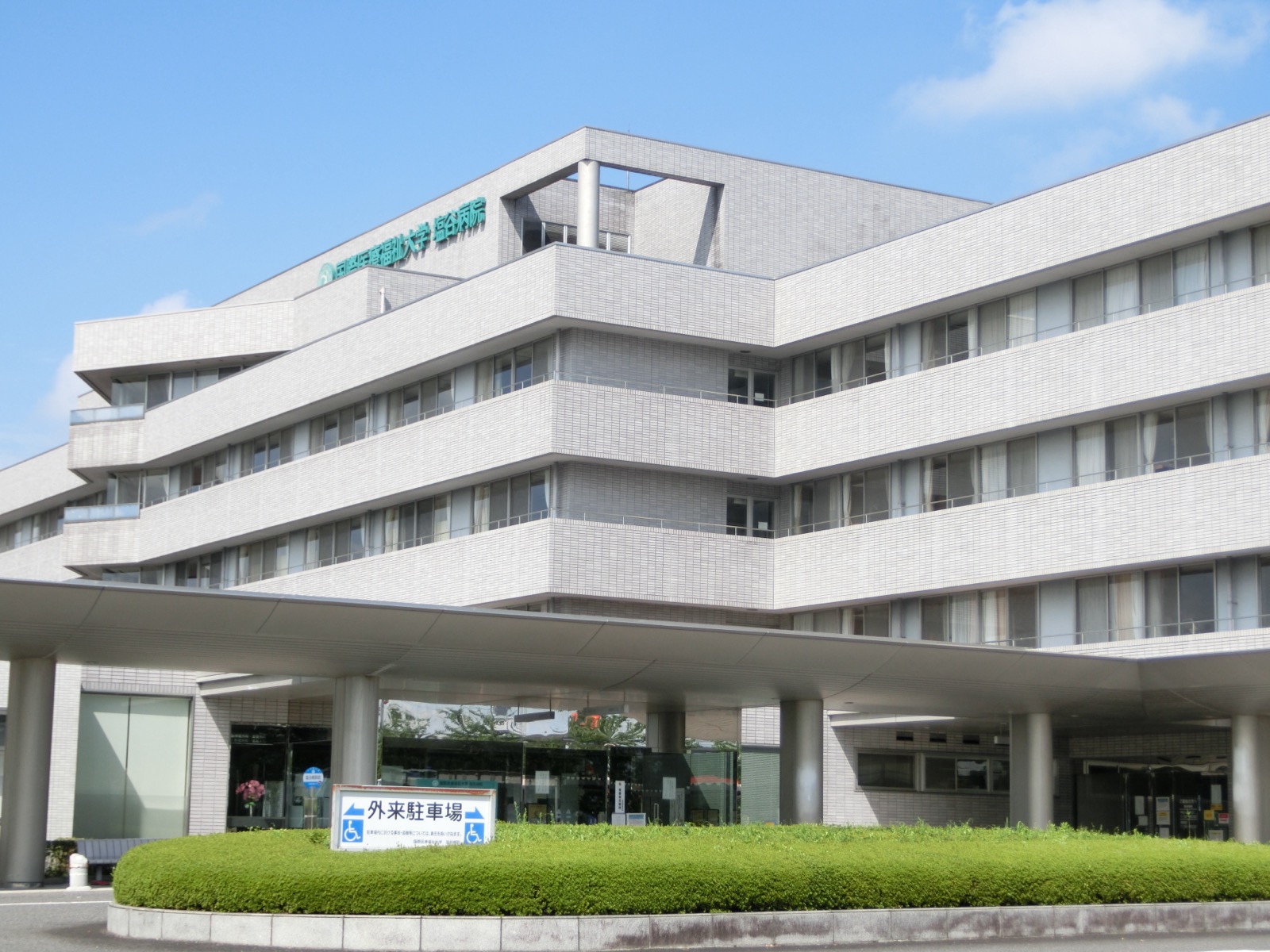
Photo: Abasaa · Public domain · Wikimedia Commons
This information is compiled from official sources and is not updated daily. Please confirm with the official contact before signing or applying.