KCP International Japanese Language SchoolPopular
KCP International Japanese Language School
Popular · Of 13 study-abroad agencies in Korea, 10 include this school on their recommendation lists · Checked September 2026 · This is a count of agencies' recommendation lists, not a SALLAE recommendation
- Course
- Further-study course only ›
- University referrals
- 17 schools accept recommendation letters ›
- AM & PM classes
- Decided by the school ›
Compare side by side with other schools →
Tuition and conditions may change depending on the intake. If you contact us, we will check with the school and give you accurate details.
Nearby schools comparedBy distance · no ads or paid placement
- KCP International Japanese Language SchoolThis schoolTuition/yr¥878,000Progression—IntakesJan · Apr · Jul · Oct
- Tokyo International Japanese Language Institute0.5km›Tuition/yr¥780,000Progression—IntakesJan · Apr · Jul · Oct
- Shinjuku Gyoen Gakuin0.5km›Tuition/yr¥873,000Progression84%IntakesJan · Apr · Jul · Oct
- Tokyo Kogakuin Japanese Language School1km›Tuition/yr¥660,000Progression—IntakesApr · Oct
— means SALLAE has not yet found the data.
About the school
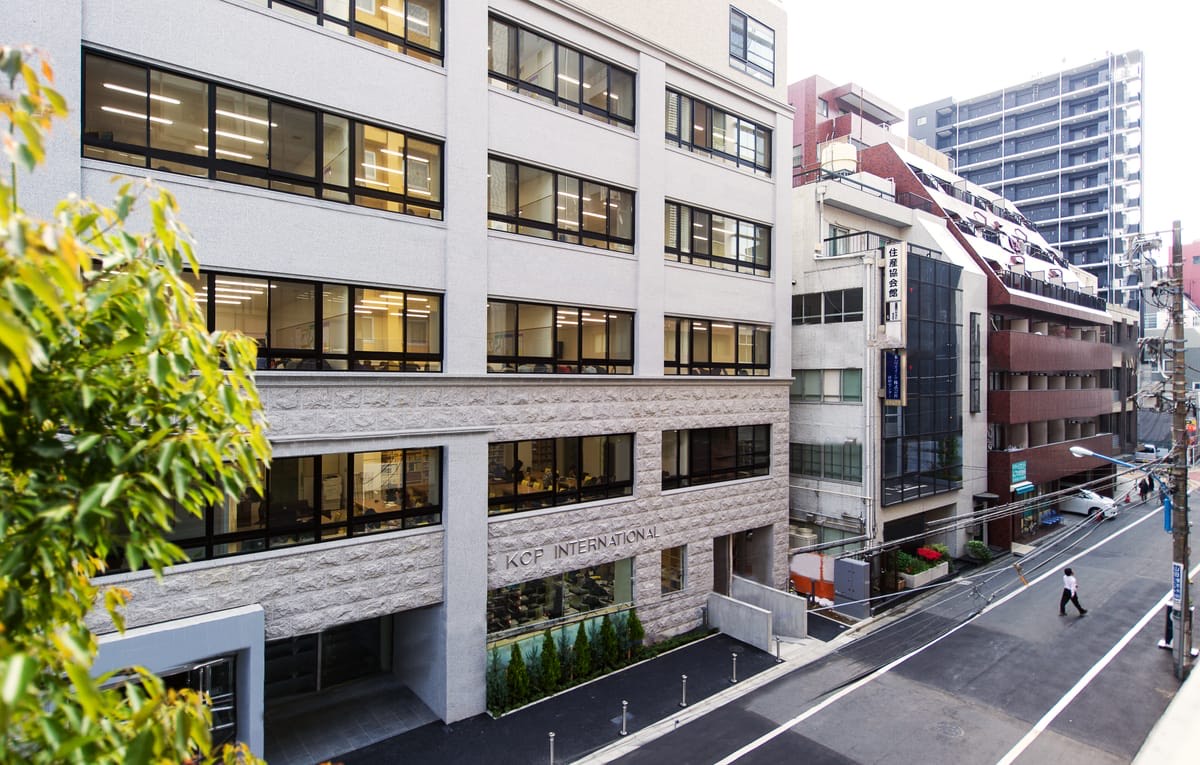
A Japanese language school in Shinjuku that has been running for over 40 years since 1983. It is strong in progression to universities and graduate schools, especially art universities, and its 7-story dedicated building has an art room, a library and even a Japanese garden. It is a MEXT-accredited institution and has a Korean office in Jongno, Seoul, so you can consult in Korean before leaving Korea.
Published data and school website
Tuition
If you saw a lower amount elsewhere, it may not include the admission fee and application fee
Median 1-year tuition in other areas — Kyoto ¥911,000(7 schools) · Kanagawa ¥880,000(8 schools) · Okinawa ¥858,000(6 schools) · Tokyo ¥840,600(56 schools) · Fukuoka ¥835,000(12 schools) · Hyogo ¥825,500(7 schools) · Osaka ¥814,000(27 schools) · Shizuoka ¥790,000(9 schools) · Chiba ¥745,333(10 schools) · Aichi ¥740,667(5 schools)
Total by intake
| Intake · length | Full course |
|---|---|
| January intake · 1 year 3 months | ¥1,061,000 |
| October intake · 1 year 6 months | ¥1,244,000 |
| July intake · 1 year 9 months | ¥1,427,000 |
| April intake · 2 years | ¥1,610,000 |
Cost details, tables by course and notes · 2 items
- Per term
- ¥183,000 3 months · Based on tuition
- One-time fees
- ¥878,000 1 year of tuition ¥732,000 · Admission screening fee ¥20,000 · Admission fee ¥70,000 · Facility fee ¥56,000
According to the school guide, one year's fees are paid in one lump sum at enrollment. SALLAE will check with the school whether you can pay in installments.
| Intake · course | Extra 2nd-year costs | All |
|---|---|---|
| January · 1 year 3 months | ¥183,000 | ¥1,061,000 |
| October · 1 year 6 months | ¥366,000 | ¥1,244,000 |
| Jul · 1 year 9 months | ¥549,000 | ¥1,427,000 |
| April · 2 years | ¥732,000 | ¥1,610,000 |
Extra cost paid in the 2nd year — the application fee and admission fee are not charged again. per term 183,000 yen each.
Materials and insurance fees are separate. Money once paid is not refunded under any circumstances.
EJU prep course is a paid option (¥36,000 for 3 months) — free for art courses.
Short-term 3 months is a separate ¥232,000 (admission fee ¥35,000 · facility fee ¥14,000 · tuition ¥183,000).
School guide · Updated 2026-02-01
Admission & dates
- Jan intake
- 1 year 3 months course · Classes 950 hours
- Apr intake
- 2-year course · Classes 1,520 hours + Japanese culture and society 80 hours
- Jul intake
- 1 year 9 months course · Classes 1,330 hours
- Oct intake
- 1 year 6 months course · Classes 1,140 hours
- Japanese level
- JLPT N5 level or above
For the January intake, you need A2 level or above (equivalent to passing JLPT N4) and about 300 hours of study history. Designated tests such as JFT-Basic and NAT-TEST are also accepted.
Deadline and capacity rules
The university-preparatory course starts only in April (2 years) and October (1 year 6 months); it has more Japanese hours and adds foundation subjects — the 2-year course is 1,680 hours of Japanese + 80 hours of Japanese society + 240 hours of foundation subjects, and the 1-year-6-month course is 1,220 hours of Japanese + 60 hours of Japanese society + 220 hours of foundation subjects. The school does not publish the application deadline on its website — SALLAE will check.
Published by MEXT · Confirmed 2026-09-20
Classes
- Morning
- 9:00 ~ 12:15 Intermediate classes run 09:00–12:15, with four 45-minute periods.
- Afternoon
- 13:30 ~ 16:45 13:30–17:00 (beginner). Session 2 is 4 periods of 45 min, 5 days a week.
- AM/PM placement
- However, you cannot choose morning or afternoon classes.
- Class assignment
- Level-based 8 stages
- Elective classes
- EJU Japanese · Mathematics I/II · Physics, chemistry, biology · Integrated subjects · JLPT (N1·N2) · TOEIC · * Available subjects and instruction differ by level.
Materials · Subjects · Timetable · Details
- Subject
- Characters, notation, kanji and vocabulary · Listening · Reading · Integrated study · Writing / composition · Reading-based essay · Japanese society · Midterm / final tasks · University preparation (subjects only in the university preparation course)
Intermediate class 09:00 ~ 12:15
| Mon | Tue | Wed | Thu | Fri | |
|---|---|---|---|---|---|
| 09:00 | Kanji and vocabulary | Listening comprehension | Kanji and vocabulary | Kanji and vocabulary | Kanji and vocabulary |
| 09:45 | Listening comprehension | Integrated learning | Reading | Integrated learning | Listening comprehension |
| 10:45 | Reading-based short essays | Integrated learning | Integrated learning | Integrated learning | Reading |
| 11:30 | Reading-based short essays | Elective 1 | Elective 2 | JLPT prep | Reading |
Beginner class 13:30 ~ 17:45
| Mon | Tue | Wed | Thu | Fri | |
|---|---|---|---|---|---|
| 13:30 | Kanji | Listening comprehension | Kanji and composition | Listening comprehension | Kanji |
| 14:15 | Integrated learning | Integrated learning | Integrated learning | Integrated learning | Integrated learning |
| 15:15 | Integrated learning | Integrated learning | Integrated learning | Integrated learning | Integrated learning |
| 16:00 | Integrated learning | Integrated learning | Integrated learning | Integrated learning | Progression preparation |
| 17:00 | Japanese for progression | — | Japanese for progression | — | Japanese for progression |
The timetable changes each term. Advanced-study Japanese runs 17:00–17:45 on Mon, Wed and Fri and is an elective in the university preparation course.
School website · 2026-08-28 updated
Documents to prepare — student visa course
- 6 photos3.0 × 4.0cm
- Application form · RésuméSchool form
- Basic certificate (detailed) · Family relationship certificate (detailed) — based on yourself
- Graduation certificate from your last school — if you are enrolled in, on leave from or removed from university, a high school graduation certificate + a university certificate of enrollment (leave or removal); if you are due to graduate from high school, a middle school graduation certificate + certificate of expected graduation
- Copy of passportPhoto page · Entry/exit page
Financial supporter's documents · only if applicable · 4 application requirements
- From the July 2026 term High school student record · residence registration extract (for those who passed the qualification exam, the junior high school record)
Submitted by the person paying the tuition (financial sponsor)
- Financial sponsorship statementSchool form
- Bank balance certificate — at least KRW 40,000,000, in the financial supporter's nameCan also be in the applicant's name
- Family relationship certificate (detailed) — parent-based for a parent or sibling; parent-based + grandparent-based for a parent's sibling
- Income certificate or withholding tax slip for employment income
- Copy of employment certificate or business registration certificate
Only if applicable
- Employment certificate or career history certificate (if you have work experience)
- Proof of Japanese study — JLPT certificate, transcript or course attendance certificate (if you have one)
- Spouse's consent form (if married)
- Military service certificate (if you have completed military service or are currently serving)
- Certificate of entry and exit records (if you have been to Japan)
- Copies of family members' residence cards · student ID (if family members are in Japan)
- Financial supporter's income, tax, balance and employment documents in Japan (if the financial supporter lives in Japan)
Application requirements
Documents must have been issued within 3 months. The financial supporter must be a parent, a sibling, or a close relative on the paternal or maternal side. If you support yourself, you need at least 3 years of work experience. If a sibling is in Japan on a student visa, or if the financial supporter lives in Japan, you need to consult the school first.
Short-term courses require only 6 photos · Application form and résumé · A copy of the passport.
School guide · Updated 2018-07-24
Admission process
- Request an admission consultation — Consult in Korean and prepare the documents together
- Submit the application form and required documents, then go through screening.
- After you are accepted, you apply for a visa and prepare before coming to Japan.
- Complete enrollment procedures, take the placement test, attend orientation, and travel to Japan.
- Placement test
- After admission is confirmed, you take an online placement test. An interview may also be held, so please prepare your internet connection and equipment.
- After entry
- Use "Go KCP" to check class schedules and materials and to submit homework and assignments. How to use it is explained at the orientation after enrollment.
- Application form
- Korean version is available
School website · 2026-08-28 updated
Progression
See 5 more schools
All schools accepted to so far
See 30 more schools
See 22 more schools
See 15 more schools
By-year figures are based on the school's official website announcements. "All" means the main schools the school publicly lists as admissions · School website · Updated 2026-08-28
Reviews 16
Auto-translatedStudent · Sep 2026
I spent every season of 2025 at this school. It was convenient since it's in central Shinjuku, and the teachers are all kind. I was born and raised in Korea and had almost no contact with foreigners, so I liked being able to mingle with people of many nationalities here. In particular, the Chinese friends were more innocent and fun than I expected, so I hung out with them a lot.
I entered the intermediate class and graduated from the advanced class. The classes have a curriculum that's useful for people going into jobs or university. The classes aren't extremely tough, and they do assign homework, but not that much. Because of that, people who don't work hard keep repeating a level and stay stuck in the same place.
I'm not in the university-prep class, but there seemed to be quite a lot of courses that people going on to further study need. I recommend it to anyone considering university or graduate school.25년 한 해의 모든 계절을 이 학교에서 보냈습니다. 신주쿠 도심에 있어서 편했고, 선생님들도 다 친절하세요. 한국에서 나고자라 외국인들과의 교류가 거의 없다시피했는데 여기서 다양한 국적의 사람들과 어울려서 좋았습니다. 특히 중국친구들이 생각보다 순수하고 재밌어서 많이 어울려다녔어요.
중급반으로 들어가 고급반으로 졸업했습니다. 수업은 취업/대학에 들어가는 사람들에게 유용한 커리큘럼으로 되어있어요. 수업이 엄청 빡센편은 아니고, 숙제도 내주긴하는데 그다지 많지않습니다. 때문에 열심히 하지 않는사람은 계속 유급하고 그자리에 머무르더라구요.
제가 진학반은 아니지만 진학하는사람에게 필요한 코스들이 꽤 많은거같아보였어요. 대학교/대학원 진학 고민하시는분들에게는 추천합니다.External reviewAuto-translatedPersonal review · WaniKani community · Jul 2025
Once classes started, classroom time alone is over 23 hours a week;; The pace also feels incredibly fast. Since it's a beginner class, it wasn't easy for students to talk to each other in Japanese, but the overall atmosphere of the school was friendly.
수업 시작하니까 일주일 교실 시간만 23 hr 넘음;; 진도도 체감상 엄청 빠름. 초급반이라 학생들끼리 일본어로 대화하는 건 쉽지 않았는데, 학교 분위기는 전반적으로 친근한 편이었어요.
External reviewAuto-translatedPersonal review · Go Overseas · May 2025
I attended for 6 months, and my Japanese improved far more than it did over several years of studying on my own. I had to do homework and review after class every day, but it wasn't more than I could handle. The best part was that classes were conducted only in Japanese, so you naturally end up using Japanese all the time.
6개월 다녔는데, 몇 년 동안 혼자 공부했을 때보다 일본어가 훨씬 많이 늘었습니다. 매일 수업 뒤에 숙제랑 복습은 해야 했지만 감당 못 할 정도는 아니었어요. 수업이 일본어로만 진행돼서 자연스럽게 계속 일본어를 쓰게 되는 환경이 제일 좋았습니다.
External reviewAuto-translatedPersonal review · Reddit · Feb 2025
It's seriously intense lol. Tests 2-3 times a week, vocabulary and kanji homework every day, even a short essay every week... if you fall behind, it's hard to keep up. Still, I had enough free time on weekends to go out with friends, and making friends wasn't hard!
진짜 빡세요 ㅋㅋ 일주일에 시험 2~3번, 매일 단어·한자 숙제, 매주 짧은 작문까지... 밀리면 따라가기 힘들어요. 그래도 주말엔 친구들이랑 놀러 다닐 여유는 있었고 친구 사귀는 건 어렵지 않았어요!
External reviewAuto-translatedPersonal review · Go Overseas · Nov 2024
When I first came to Japan I could hardly speak Japanese, but after attending for about 2 years, I definitely gained a solid foundation and confidence. The program is strict and intensive, so I think this school suits people who want to learn Japanese seriously rather than those who just want to try it out casually.
처음 일본 왔을 땐 일본어로 거의 말을 못 했는데, 약 2년 다니면서 기본기랑 자신감이 확실히 생겼습니다. 과정이 엄격하고 강도가 높은 편이라, 가볍게 체험하려는 분보다는 일본어를 진지하게 배우려는 분께 맞는 학교라고 생각합니다.
External reviewAuto-translatedPersonal review · Go Overseas · Nov 2024
I'm writing this review later, but I actually attended in the summer of 2019. Even though it was a short course, my conversation skills improved quite a lot. From the textbooks to the lessons, there was a high proportion of Japanese, so it helped me take things in directly in Japanese instead of translating into English in my head. On the other hand, you have to set aside study time separately after class.
후기는 나중에 쓰는 건데 실제로 다닌 건 2019년 여름이야. 짧은 과정이었는데도 회화가 꽤 늘었어. 교재부터 수업까지 일본어 비중이 높아서 영어로 번역해서 생각하는 대신 일본어로 바로 받아들이는 데 도움이 됐고. 대신 수업 끝나고 공부 시간은 따로 챙겨야 해.
External reviewAuto-translatedPersonal review · Go Overseas · Nov 2024
More than the class content, what I remember most are the people I met at school and the process of adjusting to life in Japan. I made lasting bonds with my friends and teachers, and since the school helped me when I first started living in Japan, adjusting was much easier 😊
수업 내용보다도 학교에서 만난 사람들, 그리고 일본 생활에 적응해 가는 과정이 제일 기억에 남아요. 친구들, 선생님들과 오래갈 인연을 만들었고, 처음 일본 생활할 때 학교 도움을 받아서 적응이 훨씬 수월했어요 😊
External reviewAuto-translatedPersonal review · Reddit · Dec 2023
I'm currently attending KCP. The classes are pretty intense, but I can feel my Japanese improving quickly because of it. You can't just sit there; you have to put in a proper amount of study, but I'm quite satisfied with the school and the class environment.
지금 KCP 다니는 중. 수업 꽤 빡센데 그만큼 일본어가 빨리 느는 게 느껴짐. 그냥 앉아만 있으면 안 되고 공부량 제대로 가져가야 하지만, 학교랑 수업 환경엔 만족도 꽤 높음.
External reviews are public posts that SALLAE collected and rewrote in the writer’s own voice. SALLAE keeps the original links.
University prep
- Weekly "career guidance" hour — There is a weekly "career guidance" hour, and you prepare step by step from choosing target schools through applying, taking exams, passing and deciding where to enroll.
- Individual consultation and coaching — For interviews and oral exams, individual coaching is given according to a plan.
- Graduate school — The school guides you in choosing a research theme, finding a laboratory, meeting professors and writing a research plan.
- University preparation course — Students with fewer than 12 years of primary and secondary education in their home country can also take university entrance exams after completing this course.
- Designated-school recommendations: 18 — Hosei University · Toyo University · Shibaura Institute of Technology · Kwansei Gakuin University · Takushoku University · Showa Women's University · Shobi University · Ferris University · Tokyo Polytechnic University · Musashino University · Teikyo University · Komazawa Women's University · Tokyo University of Information Sciences · Yokohama College of Commerce · Meikai University · Bunka Gakuen University · Tama University · Kansai University of International Studies · Designated-school recommendations change depending on each year's situation, and the school runs an internal selection based on grades, attendance rate, personal evaluation and other factors.
Schedule to admission
- Year 1
- April–December · Foundation-building period · Strengthening basic Japanese · EJU / JLPT preparation · Improving listening, reading and vocabulary
- Year 2, first half (building applied skills)
- December–September · Drawing up an exam schedule · Gathering information on Japanese universities · June: 1st EJU · Applying to private universities
- Year 2, second half (final sprint)
- September–March · Private university exams · November: 2nd EJU · Applying to national universities · Secondary exam preparation
School website · 2026-08-28 updated
Scholarship
- KCP Kyosei Scholarship
- ¥50,000 Once KCP Kyosei Scholarship: (new students) ¥30,000–¥50,000, about 10 students a year; (current students) recruited twice a year, ¥50,000, about 20 students a year
- Study incentive allowance
- Monthly ¥50,000 × 1 yearMEXT Honors Scholarship for Privately-Financed International Students: ¥48,000 per month, about 12 students a year (varies by year)
- Kyoritsu International Exchange Scholarship Foundation
- Monthly ¥60,000 × 1 year 1–2 students
- Takayama International Education Foundation scholarship
- Monthly ¥50,000 × 1 year2 students
School guide · Checked 2026-09-11
Students
Enrolled 295 (2020) · Capacity 760 National median: 180 students
Based on 295 students enrolled in 2020 — Old materials.
Public data from the Association for the Promotion of Japanese Language Education (Nisshinkyo) · verified 2026-09-20
School life
For 1 year
- Apr
- Cherry blossom viewing
- May
- Dragon Boat Festival · Midterm exams · Extracurricular class
- Jun
- Crime prevention seminar · University and graduate school progression fair · 1st EJU · Final exams
- Jul
- Tanabata · 1st JLPT · Extracurricular class
- Aug
- Midterm exams · Summer vacation · Vocational school progression fair
- Sep
- Evacuation drill · Final exams
- Oct
- Health checkup · Extracurricular class
- Nov
- 2nd EJU · Midterm exams
- Dec
- 2nd JLPT · Final exams
- Jan
- Extracurricular classes
- Feb
- Setsubun · Midterm exams · Graduation certification exam
- Mar
- Hinamatsuri · Graduation ceremony · Final exams
Events include barbecues, sports days, Kotoba Day, bus trips and short excursions, and vary by term.
Clubs
- Drama club — Improve your Japanese expression with original KCP plays!
- Koto club — Enjoy music while learning a traditional instrument.
- Newspaper club — Work together on everything from interviewing to writing articles and design.
- Manga and anime club — Talk passionately about your favorite works in Japanese.
- Tea ceremony club — Practice making tea and learn Japanese culture and manners.
- Reading club — Split into upper-intermediate and beginner groups to enjoy books at your level.
On campus
- School building
- 7 floors above ground, 1 basement floor
- Basement level 1
- Art room — Fully equipped facilities for students going on to art programs.
- 2nd floor
- Library room — The library holds about 5,000 books and has up to 100 self-study seats. Listening materials and computers can also be borrowed.
- 6F
- Auditorium — Used for ceremonies, information sessions on further study and other purposes.
- 7F
- Japanese-style room — Used for club activities such as tea ceremony and koto.
- Japanese garden
- Japanese garden — A garden planted with flowers and plants for all 12 months of the year. There are also a schoolyard and bicycle parking.
2026–2027 academic calendar
- Spring break
- Mar 27–Apr 6 · * Apr 29 is a make-up class day
- Golden Week
- May 1–6
- Summer vacation
- Jun 20–Jul 5
- Obon
- Aug 15–23
- Silver Week
- Sep 19–23
- Autumn break
- Sep 26–Oct 7
- Winter break
- Dec 22–Jan 11, 2027
School website · 2026-08-28 updated
Access
- Transit
- Tokyo Metro Marunouchi Line Shinjuku-gyoenmae Station on foot 5 min Exit 2
Tokyo Metro Marunouchi Line, Yotsuya-sanchome Station, 12 min walk Exit 2
Tokyo Metro Fukutoshin Line Shinjuku-sanchome Station on foot 13 min Exit C4
Toei Shinjuku Line, Akebonobashi Station, 11 min walk Exit C4 - Nearby
- Nearby: Hanazono Hospital, a post office, Yotsuya Ward Community Center and Shinjuku Gyoen.
- Dormitory
- Available¥76,000 a month
School website · 2026-08-28 updated
Japanese language institution certified by MEXT Certification no. 20251130049 · Certified 2025.10.31 →
SALLAE has organized the school website and published data in English.
The update date is the day that material was last revised.
Photos are materials published by the school.
This information is compiled from official sources and is not updated daily. Please confirm with the official contact before signing or applying.