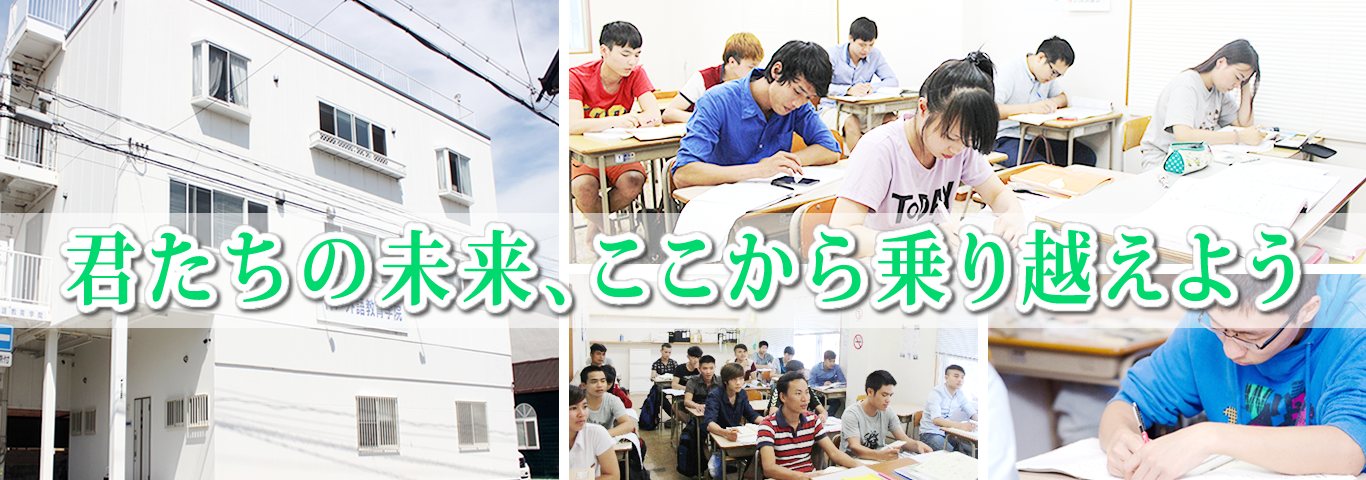
Kobe Foreign Language Education Institute
Kobe Foreign Language Education Institute
- Progression
- University etc. 94% ›
- To station
- 3 minutes on foot · Kosoku-Nagata Station
- Admission
- 4 times a year · choose your intake month ›
Compare side by side with other schools →
Tuition and conditions may change depending on the intake. If you contact us, we will check with the school and give you accurate details.
Nearby schools comparedBy distance · no ads or paid placement
- Kobe Foreign Language Education InstituteThis schoolTuition/yr¥781,000Progression94%IntakesJan · Apr · Jul · Oct
- International Language Academy0.3km›Tuition/yr¥898,000Progression—IntakesJan · Apr · Jul · Oct
- KIJ Language Institute1.4km›Tuition/yr¥863,000Progression89%IntakesJan · Apr · Jul · Oct
- Budo no Ki Japanese Education Center2.7km›Tuition/yr¥775,000Progression—IntakesApr · Oct
— means SALLAE has not yet found the data.
About the school
The school reports that 219 of 240 students who completed in fiscal 2025 went on to universities, graduate schools, vocational schools and other schools (Report No. 44), and it focuses on progression to further study. All four courses (2 years, 1 year 9 months, 1 year 6 months and 1 year 3 months) are progression courses. It opened in 2009 in Nagata-ku, Kobe, 3 minutes on foot from Kosoku-Nagata Station on the Hanshin Expressway line and Nagata Station on the subway. There is a student dormitory near the school (3-person rooms from ¥18,000 per month), and about three-quarters of the 2025 enrolled students are from Bangladesh and Nepal.
Published data and school website
Tuition
If you saw a lower amount elsewhere, it may not include the admission fee and application fee
Median 1-year tuition in other areas — Kyoto ¥911,000(7 schools) · Kanagawa ¥880,000(8 schools) · Okinawa ¥858,000(6 schools) · Tokyo ¥840,600(56 schools) · Fukuoka ¥835,000(12 schools) · Hyogo ¥825,500(7 schools) · Osaka ¥814,000(27 schools) · Shizuoka ¥790,000(9 schools) · Chiba ¥745,333(10 schools) · Aichi ¥740,667(5 schools)
Total by intake
| Intake · length | Full course |
|---|---|
| 1 year 3 months | ¥951,000 |
| 1 year 6 months | ¥1,121,000 |
| 1 year 9 months | ¥1,292,000 |
| 2 years | ¥1,462,000 |
Cost details · Course tables · Notes
- Per term
- ¥170,333 3 months
- One-time fees
- ¥99,335Application fee · Admission fee
| Duration | Total |
|---|---|
| 1 year 3 months | ¥951,000 |
| 1 year 6 months | ¥1,121,333 |
| 1 year 9 months | ¥1,291,666 |
| 2 years | ¥1,461,999 |
★"Per term" and "One-time at start" were calculated by SALLAE from each course's total. The courses this school actually offers are 1 year 3 months onward — all amounts in the table are values calculated by SALLAE.
Calculated by SALLAE · verified 2026-09-16
Whether it is refundable
- As a rule
- Fees once paid cannot be refunded in principle, and the application fee is not refunded for any reason. Exceptions are refunded within three months according to the refund rules.
- If the visa is not issued at the embassy or consulate
- If the visa is not issued, fees are refunded except the application fee and admission fee, only if the refusal notice and the admission permit are submitted to the school.
- If permitted by Immigration but you do not enroll for personal reasons
- Before entering Japan, fees are refunded except the application fee and admission fee, only if the Certificate of Eligibility and admission permit are returned (only when there is a valid reason).
- After entry
- After entering Japan, refer to the school's refund rules (the admission guide PDF says "no refund for any reason").
Admission & dates
- Apr intake
- 2-year course · Application April intake: application period September–November, results announced late February
- Jul intake
- 1 year 9 months course · Application July intake: application period January–March, results announced mid-May (late May in the admission guide PDF)
- Oct intake
- 1 year 6 months course · Application October intake: application period March–May, results announced late August
- Jan intake
- 1 year 3 months course · Application January intake: application period June–September, results announced early November (late November in the admission guide PDF)
- Japanese level
- JLPT N5 level or above
At least 150 hours of Japanese study at a Japanese language institution or similar, and JLPT N5 or higher, J-TEST Grade F or higher, or an equivalent level
Deadline and capacity rules
All courses are for progression to further study. The 2-year and 1-year 9-month courses start at beginner level; the 1-year 6-month and 1-year 3-month courses start at intermediate level. Applicants must have completed 12 or more years of school education abroad and have no criminal record in their home country.
School website · 2026-01-26 updated
Classes
- Morning
- 09:00-12:25 Morning 9:00–12:20, afternoon 13:10–16:30 (4 periods of 45 min), 5 days a week (Mon–Fri)
- Afternoon
- 13:10-16:35 Morning 9:00–12:20, afternoon 13:10–16:30 (4 periods of 45 min), 5 days a week (Mon–Fri)
- AM/PM placement
- The old Chinese-language admission guide states that morning or afternoon is decided by class, and that classes are decided by interview and exam.
- Class assignment
- Level-based 3 stages
Materials · Subjects · Timetable · Details
- Materials
- Students learn the four skills based on comprehensive textbooks. What textbooks of various levels cannot cover is handled with the school's own materials.
- Subject
- Integrated · Reading · Kanji and vocabulary · Writing · Grammar · Progression guidance · Exam preparation · Society and cultural experiences
4 terms a year. Mornings 9:00–12:25, afternoons 13:10–16:35, 4 periods each (Mon–Fri). Classes are formed regardless of nationality.
What each level aims for · 3 levels
- Beginner
- Starting from natural pronunciation practice, students build the minimum communication ability needed in daily life.
- Intermediate
- Japanese ability to handle general topics from familiar subjects to social issues. Students add somewhat advanced grammar and vocabulary and build JLPT N2-level ability.
- Advanced
- Comprehensive Japanese ability to handle lectures at universities and graduate schools. Study with an eye on the next school or workplace builds JLPT N1-level ability.
School website · 2026-09-18 updated
Documents
- Admission application formDesignated form
- Written pledgeHas fields for the student's signature and the sponsor's signature
- Diploma from the highest level of education
- Academic transcript from the highest level of education
- Japanese study certificate (150 hours or more) and JLPT certificate
- Color copy of family registerBirth registration
- Color copy of passportCopy of ID
- 8 photos4*3cm
Financial supporter's documents · only if applicable · 4 application requirements
Submitted by the person paying the tuition (financial sponsor)
- Financial sponsorship statementDesignated form
- Bank savings certificate (equivalent to ¥3 million or more, time deposit of 3 months or longer) and color copy of bankbook
- Certificate of employment
- Income certificatePast 3 years
- Tax payment certificatePast 3 years
- Color copy of ID
- Certificate of family relationship
Only if applicable
- If the financial supporter lives in Japan, the required documents differ. Please contact the school office. (Sponsor residing in Japan)
- Bank balance certificate, income certificate and scholarship certificate in your own name (stating amount and period) (old Chinese-language admission guide, when the student pays the costs)
Application requirements
How to fill in the forms and notes on certificates are given on a separate sheet when you apply. If the original is in a language other than Japanese or English, attach a Japanese or English translation. If a forged or altered document is found among the submitted documents, admission may be canceled. After application, documents are not returned except important originals such as the graduation certificate and the JLPT certificate.
Required documents differ by country and region, so please contact the school for details. SALLAE is confirming this with the school.
School website · 2026-01-26 updated
Admission process
- Request an admission consultation — Fill in the inquiry form in Japanese, English, Chinese or Vietnamese. You can also contact the school by email.
- Pre-arrival questionnaire — The preliminary questionnaire can be downloaded in Excel for Japanese, English and Chinese, and in Word for Vietnamese.
- On-site interview — The first step in the admission procedure is the "local interview".
- School document screening — Submit the application form (designated format), a pledge and documents, and the school screens the documents.
- Admission permit issued; document screening at Immigration — After admission is granted, the Immigration Services Agency screens the documents and issues the Certificate of Eligibility.
- Remit fees — After the result notice and fee invoice, remit the fees; after payment is confirmed, the Certificate of Eligibility is sent (2016 admission guide).
- Visa application, issuance and arrival procedures — Enter Japan after the visa is screened at the local Japanese consulate.
- Placement test
- Classes are organized by the school's own test, created with reference to the JLPT.
School website · 2026-01-17 updated
Graduate outcomes
| FY2025 | Admitted |
|---|---|
| Employment | 2 students |
| Graduates | 240 students |
All schools accepted to so far
+3 more schools
Prepared June 15, 2026: course completers 240, persons meeting the standard 232 (96.7%), progression 148/64/6/1, status change 1/0/0/1 · Persons permitted to change status of residence in the Item 44 report: 2-year course 1, 1 year 3 months course 1 · School website · Updated Jun 15, 2026
Reviews
If you study here or used to, tell others what the classes, teachers and daily life were like. It helps anyone deciding on this school.
Write the first reviewUniversity prep
- Regular career interviews — After arriving in Japan, students meet regularly with their progression teachers and decide on their target schools and departments.
- Two teachers give progression guidance to each student — Two teachers (one non-Japanese and one Japanese) give progression guidance to each student.
- Progression information session — An in-school information session on further study is held once a year. The school also joins nationwide information sessions several times a year.
- Score analysis of successful applicants (EJU, JLPT and others) for each school — The school collects progression data, such as the scores (EJU, JLPT, TOEIC, TOEFL) of students who took the exams of each university and graduate school in past years, and analyzes which universities and graduate schools students can enter.
- EJU and JLPT preparation — EJU (Japanese, mathematics) coaching and JLPT preparation courses (reservation required)
- Guidance on preparing application documents — The school guides students in filling in and preparing their application documents.
- Guidance on short essays and research plans — Students practice writing short essays in class. For graduate school applicants, the school guides them on writing research plans and interview manners, and helps them contact professors.
- Extensive collection of past exam questions — The school keeps this year's and past brochures and application guidelines of universities, graduate schools and vocational schools, along with past in-school exam and short-essay questions for universities and graduate schools.
- One-on-one interview practice — Students do mock interviews with teachers many times, and are coached to leave a good impression on interviewers in the real interview.
- Open campus visits — Students join open campuses and bus tours of universities and vocational schools together (school notices 2024–2025).
School website · 2026-09-18 updated
Daily-life support
- Airport pickup — One week before arrival, notify the school of your name, a copy of your flight ticket and your arrival time. The school meets students at the airport when they arrive on the date the school specifies.
- Visa procedure assistance, bank account opening and accompaniment for resident registration — Its "comprehensive support" lists airport pickup, visa procedure assistance, bank account opening and accompaniment for resident registration.
- Multilingual consultation — Staff who are former international students support daily life in multiple languages. Japanese, Chinese, Nepali, Hindi and English are covered, and staff also take consultations on personal worries.
- Two-person team — Each class is run by a two-person team: one homeroom teacher and one office staff member in charge.
- Reliable health support — Regular health checkups are held, and health management is supported through first aid for illness and injury, health consultations, and referrals to specialists and hospitals.
- Orientation and life guidance — At orientation, social rules and daily habits are taught in your native language or a common language. Guidance from the police station and health center is also given regularly.
- Part-time work — Under Japanese law, part-time work is limited to 28 hours a week (40 hours a week during long breaks). An application form for permission to engage in activities outside the status of residence can be downloaded.
- Disaster prevention — Evacuation methods for disasters such as fire, earthquake and typhoon are set out, and evacuation drills are held regularly. Water and other supplies are stored in preparation for earthquakes.
School website · 2026-01-17 updated
Scholarship
- JASSO Study Incentive Grant
- Monthly ¥30,000 × 1 year¥30,000 per month (¥360,000 in total). For students recommended by the school, with excellent grades, special contributions to the school, who are role models and take an active part in activities.
- Outstanding graduate award
- For those who go on to a prestigious university, recommended by the homeroom teacher (¥30,000 once, per the 2016 admission guide)
- Diligence award
- For excellent attendance, no unexcused absence and role-model students (¥10,000 once, per the 2016 admission guide; attendance of 99% or more and no absences)
- JLPT N1 and N2 scholarship
- The January 2026 admission guide gives only the name "JLPT N1 and N2 scholarship".
- Scholarship for entering a national or public university undergraduate program
- Only the name appears on the Chinese-language version of the website (2024), with no amount given.
School website · 2024-05-31 updated
Students
478 enrolled (2025) · Capacity 516 National median: 180 students
Based on 478 enrolled students in 2025.
Public data from the Association for the Promotion of Japanese Language Education (Nisshinkyo) · verified 2026-09-20
School life
For 1 year
- 4
- Spring term starts · April students enroll, spring entrance ceremony · New student welcome party · Cherry blossom viewing · Special life-safety guidance
- 5
- Health checkup · EJU mock test (held at the academy)
- 6
- 1st EJU · Field trip
- 7
- July students enroll · JLPT · In-school career consultation · Progression briefing for international students
- 8
- Summer vacation (summer intensive course)
- 9
- End-of-term exams · Individual career consultation · Exam season begins
- 10
- Autumn term starts · October students enroll, autumn entrance ceremony
- 11
- Field study · 2nd EJU
- 12
- JLPT · Winter break
- 1
- January students enroll · Japanese cultural experience activities
- 2
- Speech contest · Graduation exam
- 3
- Final exams · Graduation ceremony · Spring break
- The school regularly holds cultural activities in school, such as speech contests, karaoke contests, New Year calligraphy and Tanabata.
- The school holds Japanese culture classes and gatherings such as Tango no Sekku, Tanabata, Halloween, Setsubun and Christmas.
- At New Year, students visit Nagata Shrine for hatsumode.
- Visits to nearby museums, art museums, zoos, aquariums, disaster-prevention centers, and shrines and temples.
- Soccer match
- Students enter the speech contest at the University of Marketing and Distribution Sciences almost every year; in 2023, more than 10 students took part and won the grand prize.
- Students take part once or twice a year in events with local residents. Information about student volunteering is actively shared with current students.
- To increase students' motivation to study, the school has an award system for students who are role models in character, academic ability and attendance rate.
On campus
- Classroom
- Air conditioning and large monitors — Every classroom has air conditioning. This year, large monitors were installed in all classrooms and laptops for teachers' classes were provided (fiscal 2024 self-assessment).
- On campus
- Self-study room — The school provides a room where students can study on their own outside class hours.
- Building
- Barrier-free — The school is not yet barrier-free for wheelchair users and others, and is considering making it barrier-free.
Academic calendar
- Public holidays
- Public holidays (listed in each term's "Break" column)
- Golden Week
- Term 1: Apr 1–Jun 30
- Summer and autumn break
- Term 2: Jul 1–Sep 30 · August: summer vacation (summer intensive course)
- Christmas break
- Term 3: Oct 1–Dec 31
- Winter and spring break
- Term 4: Jan 1–Mar 31 · December: winter vacation; March: spring vacation
School website · 2026-01-17 updated
Access
- Transit
- Hanshin: about 14 minutes from Hanshin Sannomiya Station to Kosoku-Nagata Station Kosoku-Nagata Station, 3 min walk
Subway: about 8 minutes from Shin-Kobe Station to Nagata Station Nagata Station, 3 min walk - Nearby
- Rokubancho, Nagata-ku, Kobe, Hyogo. From Kansai International Airport to Kobe-Sannomiya takes about 60 minutes by limousine bus; the school is a 3-minute walk from Nagata Station on the subway (2 minutes in the admission guide PDF).
- Dormitory
- Available¥25,000 per month · Student dormitory near the school. Monthly rent: ¥18,000 for a 3-person room, ¥25,000 for a 2-person room, ¥40,000 for a single room. · Based on school website
School website · 2024-02-21 updated
Dormitory — Dormitory fees are paid every six months. Entrance fee ¥30,000, fire insurance and other costs ¥20,000, deposit ¥10,000; the total for the first six months is ¥168,000 for a 3-person room, ¥210,000 for a 2-person room and ¥300,000 for a single room.
School website · 2026-01-17 updated
SALLAE has organized the school website and published data in English.
The update date is the day that material was last revised.
Photos are materials published by the school.
This information is compiled from official sources and is not updated daily. Please confirm with the official contact before signing or applying.