KIJ Language Institute Tokyo Campus
KIJ Language Institute Tokyo Campus
- Course
- Further-study course only ›
- AM & PM classes
- Decided by the school ›
- Admission
- 4 times a year · Jan, Apr, Jul, Oct ›
Compare side by side with other schools →
Tuition and conditions may change depending on the intake. If you contact us, we will check with the school and give you accurate details.
Nearby schools comparedBy distance · no ads or paid placement
- KIJ Language Institute Tokyo CampusThis schoolTuition/yr¥863,000Progression90%IntakesJan · Apr · Jul · Oct
- Labo Japanese Language Education Training Center0.6km›Tuition/yr¥732,000Progression—IntakesJan · Apr · Jul · Oct
- Mitsufuku Japanese Language Institute0.8km›Tuition/yr¥910,000Progression—IntakesApr · Oct
- Sekimonkai Japanese Language School Nippori Campus (Arai Gakuen)0.8km›Tuition/yr¥915,000Progression76%IntakesJan · Apr · Jul · Oct
— means SALLAE has not yet found the data.
About the school
All four courses are progression courses (2 years, 1 year 9 months, 1 year 6 months, 1 year 3 months), and the principal also describes it as a school specializing in progression to higher education. Of the 78 completers in FY2025, 70 progressed to universities and other institutions. It is a school with a capacity of 190, located in Sendagi, Bunkyo-ku, Tokyo, a 7-minute walk from JR Nishi-Nippori Station, opened in 2020 by moving a branch of the Kobe KIJ Language Academy to Tokyo. Many students come from China (110 of 154 in 2025); at enrollment, a class placement test puts students in 5 level-based classes, and they take 4 periods a day in a morning or afternoon class set by the school.
Published data and school website
Tuition
⚠ Total costs by course vary by source — please check with the school. School website: first year ¥862,640 (application fee 30,000, admission fee 60,000). Second-year totals ¥772,640 / ¥580,410 / ¥388,120 / ¥190,860 · Association for the Promotion of Japanese Language Education published data: 2 years 1,555,900; 1 year 9 months 1,187,840; 1 year 6 months 1,371,890; 1 year 3 months ¥996,330. Application fee ¥20,000, admission fee ¥50,000. The published sheet is from July 2025, so its year differs from the website (revised June 2026). The Tokyo campus tuition in the published sheet (2 years 1,320,000; 1 year 3 months ¥825,000 and so on) matches the tuition in this table, but the application fee, admission fee and other costs differ. The published sheet lists the 1-year 6-month course as higher than the 1-year 9-month course, so the amounts for the two courses may be swapped.
If you saw a lower amount elsewhere, it may not include the admission fee and application fee
Median 1-year tuition in other areas — Kyoto ¥911,000(7 schools) · Kanagawa ¥880,000(8 schools) · Okinawa ¥858,000(6 schools) · Tokyo ¥840,600(56 schools) · Fukuoka ¥835,000(12 schools) · Hyogo ¥825,500(7 schools) · Osaka ¥814,000(27 schools) · Shizuoka ¥790,000(9 schools) · Chiba ¥745,333(10 schools) · Aichi ¥740,667(5 schools)
Total by intake
| Intake · length | Full course |
|---|---|
| January intake · 1 year 3 months | ¥1,053,500 |
| October intake · 1 year 6 months | ¥1,250,760 |
| July intake · 1 year 9 months | ¥1,443,050 |
| April intake · 2 years | ¥1,635,280 |
Cost details, tables by course and notes · 4 items
- One-time fees
- ¥862,640Tuition ¥660,000 · Application screening fee ¥30,000 · Admission fee ¥60,000 · Facility fee ¥40,000 · Materials ¥30,000 · Extracurricular activity fee ¥15,000 · Insurance ¥22,640 · Health management fee ¥5,000
According to the school guide, fees are paid in one lump sum at enrollment. SALLAE will check with the school whether you can pay in installments.
| Intake · course | Extra 2nd-year costs | All |
|---|---|---|
| January · 1 year 3 months | ¥190,860 | ¥1,053,500 |
| October · 1 year 6 months | ¥388,120 | ¥1,250,760 |
| Jul · 1 year 9 months | ¥580,410 | ¥1,443,050 |
| April · 2 years | ¥772,640 | ¥1,635,280 |
Extra costs paid in the second year. The application fee and admission fee are not charged again. In the second year, the amount for the remaining period until graduation is paid at the school office or by bank transfer 10 months after enrollment. The health management fee is "—" for the 1 year 3 months course only
First-year payments for all courses (1 year)
Tuition (tax included)
After the Certificate of Eligibility is issued, pay the tuition within 2 weeks of the date the school notifies you.
First-year payments for all courses (1 year), total ¥862,640
School website · 2026-06-20 updated
Whether it is refundable
- If the Certificate of Eligibility is not issued
- All payments are refunded except the application fee.
- If the Certificate of Eligibility was issued but you did not apply for an entry visa and did not come to Japan
- All payments are refunded except the application fee and admission fee. However, the admission permit and the Certificate of Eligibility must be returned.
- If the Japanese embassy refuses to issue a visa
- All payments are refunded except the application fee and admission fee. However, the admission permit must be returned and a certificate of visa non-issuance submitted.
- If you obtained an entry visa but declined enrollment before coming to Japan
- Only when it can be confirmed that the entry visa was unused and has expired, all payments are refunded except the application fee and admission fee. The admission permit must be returned.
See refund policy in detail · 2 more lines
- If a student who obtained an entry visa, came to Japan and enrolled withdraws midway
- The application fee and admission fee are not refunded. Tuition and other fees are also not refunded in principle. Only when the principal judges that there are unavoidable circumstances, tuition from the next term is refunded.
- When you receive a refund
- If a refund is sent by bank transfer, the remittance fee is deducted from the amount sent.
Admission & dates
- Apr intake
- 2-year course · Application Document submission period: Sep 1 to mid-October of the previous year. Application to Immigration: late November of the previous year. Results: late February to early March. · Classes 1,520 hours
- Jul intake
- 1 year 9 months course · Application Document submission period: Dec 1 of the previous year to mid-January. Application to Immigration: late February. Results: late May to early June. · Classes 1,330 hours
- Oct intake
- 1 year 6 months course · Application Document submission period: Mar 1 to mid-April. Application to Immigration: late May. Results: late August to early September. · Classes 1,140 hours
- Jan intake
- 1 year 3 months course · Application Document submission period: Jun 1 to mid-July of the previous year. Application to Immigration: late August of the previous year. Results: late November to early December of the previous year. · Classes 950 hours
- Japanese level
- 2-year advanced-study course: JLPT N5 / CEFR A1 level, 150 or more hours of Japanese study
1-year 3-month course: JLPT N4 / CEFR A2 level, 300 or more hours. 1 year 9 months: 180 or more hours. 1 year 6 months: 200 or more hours.
Deadline and capacity rules
Four intakes a year. 12 or more years of school education abroad (self-study and correspondence education are not counted). Enrolled as of Apr 1, 2026: 2-year 111, 1 year 9 months 19, 1 year 6 months 20, 1 year 3 months 0.
School website · 2026-09-24 updated
Classes
- Morning
- 09:00-12:25
- Afternoon
- 13:00-16:25
- AM/PM placement
- The school assigns either session 1 (4 hours in the morning) or session 2 (4 hours in the afternoon). Requests for class time or class selection are not accepted.
- Class assignment
- Level-based 5 stages
Materials · Subjects · Timetable · Details
- Materials
- The school makes an effort to buy textbooks and also creates its own materials.
Class hours by subject
| Subject | 2 years | 1 year 9 months | 1 year 6 months | 1 year 3 months |
|---|---|---|---|---|
| Beginner | 380 hours | 380 hours | 380 hours | 190 hr |
| Lower intermediate | 80 hours | 80 hours | 80 hours | 80 hours |
| Intermediate | 500 hours | 500 hours | 500 hours | 500 hours |
| Advanced I | 400 hours | 370 hr | 180 hours | 180 hours |
| Advanced II | 160 hours | — | — | — |
20 hours a week, Mon–Fri (4 periods a day, 45 minutes each). Completion goals: N1 for the 2-year and 1-year 9-month courses, N2 for the 1-year 6-month and 1-year 3-month courses. 20 students per class, 1 homeroom teacher.
What each level aims for · 5 levels
- Beginner
- Starting from natural pronunciation practice, builds the minimum communication ability needed for daily life.
- Lower intermediate
- Solidify basic sentence patterns while bridging to the intermediate level.
- Intermediate
- Build JLPT N2-level ability.
- Advanced I
- Build JLPT N1-level ability. Develop practical skills to make university admission possible.
- Advanced II
- To help students start student life smoothly at universities and other higher education institutions.
School website · Confirmed 2026-09-26
Documents
- 8 color photos (4 cm tall × 3 cm wide), taken within the past 3 months. Write your name and date of birth on the back.
- Admission application formInstitute's prescribed form
- Original diploma of your last school or certificate of expected graduation
- Transcript for all years at your last school
- Proof of Japanese ability: (1) certificate of Japanese study, (2) score report of the JLPT or other public-agency examBoth (1) and (2), or either one
- Original of the family register or an equivalent certificate
- Anything else the school requests
Sponsor documents · Only if applicable · 7 application requirements
Submitted by the person paying the tuition (financial sponsor)
- Financial sponsorship statementInstitute's prescribed form
- Bank balance certificate (in the financial sponsor's name)
- Color copy or color photos of every page of the bank passbook showing how the funds were built up
- Documents proving occupation, such as a certificate of employmentEmployees: period of employment; company officers: title and certified copy of corporate registration or business license; sole proprietors: business license
- Income certificate and tax payment certificate for the past 3 or more years
- Documents proving the relationship with the applicant (such as a notarized kinship certificate and photos). If someone other than a parent pays, submit a document explaining the relationship.
- Original family register of the financial supporter, or an equivalent certificate
- Copy of the financial sponsor's ID
- Anything else the school requests
Only if applicable
- Certificate of employment (applicable persons only)
- Copy of passport (If you have a passport)
- Copy of ID (applicable persons only)
- Bank balance certificate in your own name, color copy of every passbook page, proof of occupation, and income and tax certificates for the past 3 or more years. State savings of about ¥3,000,000 on the statement of financial support. (If the applicant pays the expenses)
- Bank balance certificate and passbook copy, proof of occupation, tax certificates for the past 3 or more years (a copy of the tax return for sole proprietors), proof of relationship, and a certificate of residence listing all household members (Sponsor residing in Japan)
Application requirements
For those residing outside Japan who remit money from a bank in their home country. All certificates submitted to the Immigration Services Agency must be issued within 3 months. All documents in languages other than Japanese must come with a Japanese translation (with date, translator's name and seal, on A4). If there is no Japanese translation, the academy translates it and charges ¥20,000 as a translation fee. Do not use correction fluid for corrections; rewrite instead. Certificates must use the letterhead of the issuing organization (company, school). Documents and materials submitted to the Immigration Services Agency (other than the original diploma) are never returned. If you previously applied to Japan for a Certificate of Eligibility and it was not issued, be sure to tell us beforehand. Application downloads: application form (Excel), Tokyo campus application form (Excel)
No separate criteria for Korean applicants have been published. SALLAE is confirming this with the school.
School website · 2026-06-23 updated
Admission process
- Request an admission consultation — Fill in the required items on the interview application form on the school's website and send it to the school by email (accepted at any time).
- Notice of screening date — The school tells the applicant, the intermediary agency or the agent in Japan the screening date.
- Written test and interview — The written exam and interview are held in the applicant's country of residence or online.
- Notice of admission result — A pass/fail notice is sent to the applicant.
- Mail the application documents to the school — Successful applicants pay the application fee and mail the application documents to the school at the same time.
- Notice of acceptance — A notice of acceptance is sent to those who pass the document screening.
- Application for the Certificate of Eligibility — The school applies on the applicant's behalf for the Certificate of Eligibility at the Kobe branch of the Osaka Regional Immigration Services Bureau.
- One year of tuition and other fees — You are notified by email when the Certificate of Eligibility is issued. By the date the school specifies, transfer one year of tuition and other fees to the designated bank account (within 2 weeks of the notification date).
- Receive the original certificates — As soon as payment is confirmed, the school mails the original Certificate of Eligibility and related documents to the intermediary agency, the agent in Japan or the applicant.
- Apply for a student visa — Apply for a student visa at the Japanese embassy or consulate in your country of residence with the admission permit, Certificate of Eligibility, passport and other documents. Apply for landing permission within 3 months of the Certificate of Eligibility issue date.
- Notify the academy of your arrival date and time — After obtaining the student visa, tell the school your arrival date and time. Entering outside the period the school specifies may affect classes, attendance rate and permission to extend the period of stay.
- Entry into Japan — After entering Japan, please contact the school promptly and then come to school.
- Placement test
- A placement test is given at entry, and you study in a class that matches your level.
School website · 2026-09-24 updated
Graduate outcomes
| FY2025 | Admitted |
|---|---|
| Employment | 6 students |
| Graduates | 78 students |
Prepared June 22, 2026: completers 78, persons meeting the standard 78 (100.0%). Progression 51/5/11/3, status change 3/2/0/1, proof of A2 or higher 2/0/0/0 · Status of residence changes permitted: 2-year progression course 3, 1 year 9 months course 2, 1 year 6 months course 0, 1 year 3 months course 1 · School website · Updated Jun 22, 2026
Reviews
If you study here or used to, tell others what the classes, teachers and daily life were like. It helps anyone deciding on this school.
Write the first reviewUniversity prep
- Each homeroom teacher handles career guidance. — Each homeroom teacher handles career guidance. Homeroom teachers meet students regularly and guide their career paths.
- Career guidance room — A career guidance room is provided, with progression materials always available.
- Consistent career guidance from entry — Consistent career guidance is given from entry, matched to each student's goals and abilities.
- Support for progression in the Kansai area — Because there are group schools, students can be supported in progressing not only in Tokyo but also in the Kansai area.
School website · Confirmed 2026-09-26
Daily-life support
- Native-language consultation — Life guidance staff who speak English and Chinese are always on site, and information is provided as needed through interpreters who speak the student's language.
- Staff in charge by country — Staff in charge of students from each country are assigned and are always in contact with students. Consultations and complaints are handled jointly by the homeroom teacher and the student affairs staff for each country.
- Orientation — Orientation is held right after enrollment, with guidance on study and daily life (in multiple languages).
- Housing support — The school prepares housing near the school so you can live there after enrollment.
- Government office and bank procedures after entry — There are important procedures such as address registration and joining National Health Insurance, so be sure to consult the school.
- Application for extension of period of stay — As the expiry date of your period of stay approaches, the school submits the application on your behalf. Currently 2 staff members are authorized to submit applications for others.
- Part-time work guidance — The requirements for permission to engage in activities outside the status of residence (such as the limit of 28 hours a week) are explained in detail. Students who want a part-time job apply for this permission at the immigration check at the arrival airport.
- Health checkup — A health checkup is held once a year, and when a student is unwell, the student affairs staff take consultations at any time and guide them to a suitable medical institution.
- Insurance — All eligible students join National Health Insurance and also international student insurance. The staff in charge deal with the insurance company.
- Disaster prevention — An evacuation drill is held once a year. Weather warning procedures are in the student handbook, and on the day students are notified quickly through Teams.
School website · Confirmed 2026-09-26
Scholarship
- MEXT learning incentive for international students
- Monthly ¥30,000 × 1 year ¥360,000 (¥30,000 per month). At the Tokyo campus, 1–2 students are selected once a year from enrolled international students by grades, attendance and class attitude.
- Principal's Award
- ¥50,000 Once ¥50,000. For students with all S or higher at beginner level, or A or higher at pre-intermediate and above, with attendance of 98% or higher, top of the class; or those the director recognizes
- Academic Excellence Award
- ¥50,000 OnceFor students who pass a national or public university or graduate school and are recognized by the principal as deserving an award.
- Effort award
- ¥20,000 Once ¥20,000. For students with all grades A or higher, attendance of 95% or higher, top of the class. Students who received the Director's Award are excluded
- Encouragement Award
- ¥5,000–¥20,000. For students who pass the JLPT during enrollment (N2 or higher for kanji-background students, N3 or higher for non-kanji-background students)
- Perfect attendance award
- ¥10,000 OnceStudents with no absences, late arrivals or early departures at all over the half year (first and second term).
- Special Perfect Attendance Award
- Varies by intake. For students with no absence, lateness or early departure from entry to graduation.
- Special award
- ¥10,000–¥50,000. For students recognized by the principal who are role models for other students.
School website · 2026-09-24 updated
Students
154 enrolled (2025) · Capacity 150 National median: 180 students
Based on 154 enrolled students in 2025.
Public data from the Association for the Promotion of Japanese Language Education (Nisshinkyo) · verified 2026-09-20
School life
For 1 year
- 4
- Entrance ceremony for new students · Spring term begins · Welcome hike for new students
- 6
- 1st EJU
- 7
- JLPT · Extracurricular activities · New student entrance ceremony
- 8
- Summer vacation (summer intensive course)
- 9
- Extracurricular activities · Final exams
- 10
- Entrance ceremony for new students · Autumn term begins · Welcome hike for new students
- 11
- 2nd EJU
- 12
- JLPT · Fun party · Winter break
- 1
- Social gathering
- 2
- Speech contest · Extracurricular activities · Final exams
- 3
- Graduation ceremony
The annual event calendar is the page shared with the main school in Kobe.
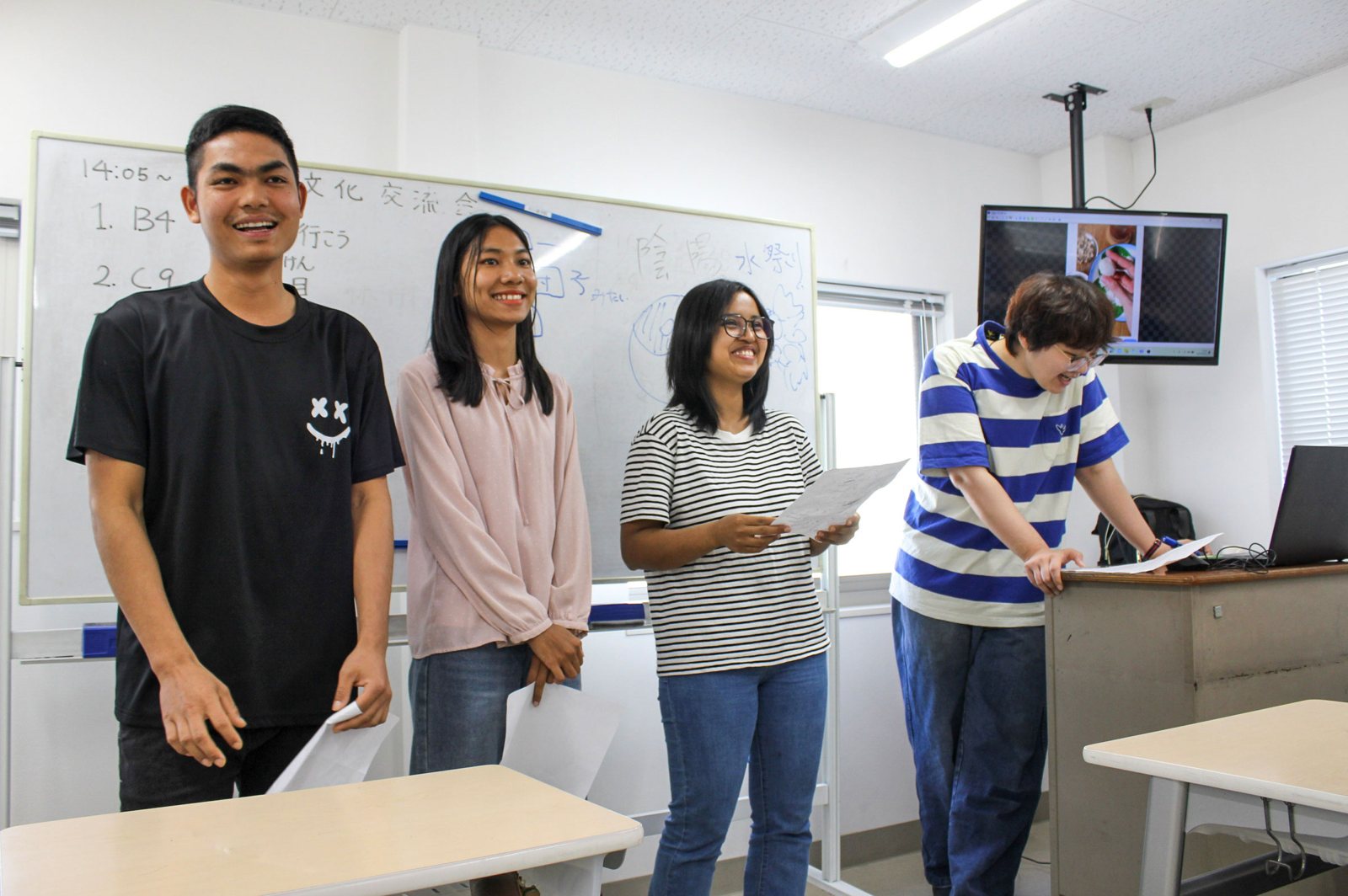
- Tokyo campus speech contest (Jul 30, 2021). Student performances between speeches, including guitar, singing and a photo slideshow, were enjoyed.
- Tokyo campus fun party (Dec 24, 2020): self-introductions in game form, puzzle solving, team quizzes and a bingo game
- Graduation trip
- Through off-campus activities and other means, the school works to help students understand and adapt to Japanese society.
On campus
- Self-study room — Rooms for self-study outside class hours are available.
- Books and media — The school keeps study books, workbooks, further-study materials and more. Computers for students are also available.
- Classroom — Each classroom has computers and audiovisual equipment.
- Career guidance room — A career guidance room is provided, with progression materials always available.
2026–2027 academic calendar
- Saturdays and Sundays
- Weekly
- Spring break
- Mar 16 – Apr 6
- Summer vacation
- Aug 1–31 · January 2026 intake (Aug 7–Aug 31); July 2026 intake (Aug 8–Aug 25)
- Autumn break
- Sep 26–Oct 4
- Winter break
- Dec 24–Jan 5, 2027
- Spring break
- Mar 13–Apr 5
School website · 2026-09-24 updated
Access
- Transit
- JR Nishi-Nippori Station, 7 min walk
- Nearby
- 4-1-16-107 Sendagi, Bunkyo-ku, Tokyo. 7-minute walk from JR Nishi-Nippori Station (Tokyo campus instructor recruitment guidelines).
- Dormitory
- Available¥40,000–¥60,000 per month · The Tokyo campus arranges student housing individually according to students' wishes and needs. Locations and properties are not fixed and are not announced in advance. · Based on school website
School website · Confirmed 2026-09-26
Dormitory — This dormitory information is for the Kobe student dormitories. The Tokyo campus arranges student housing individually according to students' wishes and needs. Ask for details by email. If you want housing, please contact the school early.
School website · 2026-09-24 updated
SALLAE has organized the school website and published data in English.
The update date is the day that material was last revised.
Photos are materials published by the school.
This information is compiled from official sources and is not updated daily. Please confirm with the official contact before signing or applying.