Kobe Toyo Japanese Language Institute
Kobe Toyo Japanese Language Institute
- Course
- Further-study course only ›
- Tuition
- On the cheaper side for Hyogo ›
- To station
- 3-minute walk · Motomachi Station
- Dormitory fee
- From ¥25,000 per month ›
Compare side by side with other schools →
Tuition and conditions may change depending on the intake. If you contact us, we will check with the school and give you accurate details.
Nearby schools comparedBy distance · no ads or paid placement
- Kobe Toyo Japanese Language InstituteThis schoolTuition/yr¥720,000Progression86%IntakesJan · Apr · Jul · Oct
- Communica Gakuin0.8km›Tuition/yr¥1,005,000Progression22%IntakesJan · Apr · Jul · Oct
- ECC Japanese Language Institute Kobe Campus0.9km›Tuition/yr¥826,000Progression—IntakesJan · Apr · Jul · Oct
- Kobe YMCA Gakuin College1.3km›Tuition/yr¥820,000Progression73%IntakesApr · Oct
— means SALLAE has not yet found the data.
About the school
This school focuses on progression to further education. Every course is a progression course, and in the school's published results for FY2025, of 287 graduates, 16 went to graduate school, 91 to university and 127 to vocational school (28 found jobs). Opened in 2003 with a capacity of 600, it stands 3 minutes on foot from JR and Hanshin Motomachi Station in Kobe, and runs 10 classes, A to S, split into morning and afternoon sessions by level. It advertises designated-school recommendations at nearly 30 schools in Kansai and one-on-one progression guidance, and also has a career support department and a license for fee-charging employment placement.
Published data and school website
Tuition
If you saw a lower amount elsewhere, it may not include the admission fee and application fee
Median 1-year tuition in other areas — Kyoto ¥911,000(7 schools) · Kanagawa ¥880,000(8 schools) · Okinawa ¥858,000(6 schools) · Tokyo ¥840,600(56 schools) · Fukuoka ¥835,000(12 schools) · Hyogo ¥825,500(7 schools) · Osaka ¥814,000(27 schools) · Shizuoka ¥790,000(9 schools) · Chiba ¥745,333(10 schools) · Aichi ¥740,667(5 schools)
Admission & dates
⚠ The application deadline differs by source. Please confirm with the school. Application guidelines: by the end of October of the previous year for April entry, the end of February for July, the end of April for October, and the end of August of the previous year for January. · Application method page: end of November of the previous year for the spring course, end of March for the summer course, end of May for the autumn course, and end of September of the previous year for the winter course. The enrollment procedure PDF has the same schedule. The table above follows the application guidelines, the most recent document. The dates differ by one month, so please confirm with the school.
- Apr intake
- 2-year course · Application April entry: by the end of October of the previous year · Classes 1,520 hours
- Jul intake
- 1 year 9 months course · Application July entry: by the end of February of the same year · Classes 1,330 hours
- Oct intake
- 1 year 6 months course · Application October entry: by the end of April of the same year · Classes 1,140 hours
- Jan intake
- 1 year 3 months course · Application January entry: by the end of August of the previous year · Classes 950 hours
- Japanese level
- JLPT N5 level or above
Applicants must have studied Japanese for at least 150 hours, or be at or above the JLPT N5 level.
Deadline and capacity rules
Capacity 600 students (October 2025). Applicants must have completed (or expect to complete) 12 or more years of schooling. Long-term courses require age 18 or older.
School website · 2026-06-08 updated
Classes
- Morning
- 09:00-12:15 Morning classes (9:00–12:15) are for Intermediate CC, Upper-intermediate D and DD, Advanced E and EE, and Superior F and S. 4 periods of 45 minutes.
- Afternoon
- 13:15-16:30 Afternoon classes (13:15–16:30) are for Beginner A, Beginner-intermediate B and Intermediate C. Depending on the number of students by intake and their Japanese level, a beginner class may also be set up in the morning.
- AM/PM placement
- Morning classes: Intermediate CC, Upper-intermediate D and DD, Advanced E and EE, Superior F and S. Afternoon classes: Beginner A, Beginner-intermediate B and Intermediate C.
- Class assignment
- Level-based 10 levels
- Elective classes
- EJU preparation · JLPT preparation · TOEFL preparation · The school introduction says preparation for official exams is done in regular classes and in elective classes · The class-hours pages in English, Chinese and Vietnamese list preparation classes at 13:30–15:00 (not on the Japanese page) · 1–2 months before an exam, the class is split in two; one half does exam preparation, and a mock exam is taken 2 weeks before the exam (English page, 2020) · Paid in-school cram classes such as university-entrance subjects and N1/N2 intensive classes are listed under "Short-term study."
Materials · Subjects · Timetable · Details
- Materials
- Beginner classes use Japanese for Beginners 1 and 2 (Daichi), and intermediate classes use Chukyu o Manabo, Nihongo Sou-matome N3 Vocabulary and others. Commercial textbooks are used together with the school's own handouts.
- Subject
- Shadowing · Vocabulary · Grammar · Integrated textbook · Conversation · Writing · Reading · Listening · Speeches · Media and news · JLPT preparation · EJU preparation · Beginner classes focus on conversation and speaking practice; advanced classes (especially Class F) focus on speech and presentation classes with an emphasis on conversation. Every January, beginner classes have a first-calligraphy-of-the-year lesson.
Typical timetable for Classes A and B (first half) Mon–Fri, 4 periods of 45 minutes
| Mon | Tue | Wed | Thu | Fri | |
|---|---|---|---|---|---|
| Period 1 | Shadowing / Review | Shadowing / Review | Shadowing / Review | Shadowing / Review | Shadowing / Review |
| Periods 2–3 | Main textbook | Main textbook | Main textbook | Main textbook | Main textbook |
| Period 4 | JLPT preparation | JLPT preparation | JLPT preparation | JLPT preparation | JLPT preparation |
Timetable for Class B (second half), BB and C Mon–Fri, 4 periods of 45 minutes
| Mon | Tue | Wed | Thu | Fri | |
|---|---|---|---|---|---|
| Period 1 | Shadowing / Vocabulary | Shadowing / Vocabulary | Shadowing / Vocabulary | Shadowing / Vocabulary | Shadowing / Vocabulary |
| Period 2 | Grammar | Grammar | Grammar | Grammar | Grammar |
| Periods 3–4 | Main textbook | JLPT preparation (N4–N3) | Main textbook | Conversation / EJU preparation | Main textbook |
Typical timetable for Classes D and E Mon–Fri, 4 periods of 45 minutes
| Mon | Tue | Wed | Thu | Fri | |
|---|---|---|---|---|---|
| Period 1 | Shadowing / Vocabulary | Shadowing / Vocabulary | Shadowing / Vocabulary | Shadowing / Vocabulary | Shadowing / Vocabulary |
| Period 2 | Grammar | Grammar | Grammar | Grammar | Grammar |
| Periods 3–4 | JLPT preparation (N2) | Main textbook | EJU preparation | Main textbook | EJU preparation |
Typical timetable for Class F Mon–Fri, 4 periods of 45 minutes
| Mon | Tue | Wed | Thu | Fri | |
|---|---|---|---|---|---|
| Period 1 | Speech / Listening | Speech / Listening | Speech / Listening | Speech / Listening | Speech / Listening |
| Period 2 | Vocabulary | Grammar | Vocabulary | Grammar | Vocabulary |
| Periods 3–4 | Media | Reading comprehension | Composition | Reading comprehension | Conversation |
Class hours by subject
| Subject | 2 years | 1 year 9 months | 1 year 6 months | 1 year 3 months | 1 year |
|---|---|---|---|---|---|
| Beginner | 380 hours | 190 hr | — | — | — |
| Lower intermediate | 190 hr | 190 hr | 190 hr | — | — |
| Intermediate | 380 hours | 380 hours | 380 hours | 380 hours | — |
| Upper intermediate | 380 hours | 380 hours | 380 hours | 380 hours | — |
| Advanced | 190 hr | 190 hr | 190 hr | 190 hr | 760 hours |
Class names (10 classes, A to S) and level goals are from the November 2025 brochure. The timetables are "typical" ones from the 2022–2024 class introduction pages, so the class names differ (A, B, BB, C, D, E, F). · Class hours by level are the April 2026 inspection report's hours in 45-minute units; for the 1-year courses (Spring I, Autumn I), all 760 hours are counted as advanced. · The goal at course completion is N1 for the 2-year, 1-year 6-month and 1-year courses, and N2 to N1 for the 1-year 9-month and 1-year 3-month courses. · All courses reportedly include university entrance exam, JLPT and EJU preparation classes.
Goals for each level · 6 levels
- N5 Beginner A (150 cumulative hours)
- Can understand and use familiar everyday expressions and basic phrases. Can introduce yourself and others, and ask and answer questions about personal information.
- N4 Beginner B (300 cumulative hours)
- Can exchange information on familiar matters in simple, routine situations. Can describe your background and circumstances in simple words.
- Intermediate C and CC (N3 first and second half; 450 and 600 cumulative hours)
- [Pass N3, EJU Japanese 200 or higher] Can understand and handle most everyday topics. Can follow conversation at near-natural speed, aiming at the N3 pass level.
- Upper-intermediate D and DD (N2 first and second half; 750 and 900 cumulative hours)
- [Pass N2, EJU Japanese 250 or higher] Can explain your opinions concretely in a wide range of situations and understand plain newspaper articles and news.
- Advanced E and EE (N1 first and second half; 1,050 and 1,200 cumulative hours)
- [Pass N1, EJU Japanese 300 or higher] Can explain complex, advanced topics logically and clearly, and understand complex texts and news.
- Superior F and S (first and second half; 1,350 and 1,500 cumulative hours)
- Can summarize highly specialized and abstract information and explain it logically and coherently. Can understand advanced, complex conversations, news and lectures.
School website · 2025-11-11 updated
Documents to prepare — student visa course
- Kobe Toyo Japanese College application form, 3 copies, plus 1 Japanese translation
- Japanese study history (150 hours or more) or a score at or above the JLPT N5 level. Original certificate of completion from the Japanese language institution that studied (showing total hours).
- Graduation certificate (from the last school attended), with a Japanese translation attached.
- Copy of passport (photo, number, issue date, expiry date, issuing authority) or a copy of a travel certificate
- 6 photos4 cm × 3 cm, hatless, taken within 3 months
- Copy of the application fee transfer receiptTransfer ¥35,000, which is the ¥30,000 application fee plus ¥5,000 bank fee
Financial supporter's documents · only if applicable · 4 application requirements
Submitted by the person paying the tuition (financial sponsor)
- Financial sponsorship statementNot required if the applicant is their own sponsor
- Certificate of employment
- Tax payment certificateLast 3 years
- Documents proving funds, such as the original bank balance certificate
- Materials proving the relationship between the person paying the expenses and the applicant
Only if applicable
- "Certificate of reason for entering school" certified by the principal of that elementary school (People who entered elementary school at age 5 or under, or age 8 or over)
- Please consult the administrative office (When a company or organization pays the study expenses)
Application requirements
Attach a Japanese translation to every document not in Japanese. If you ask the school to do the translation, a translation fee is required. Applicants and the person paying the expenses must fill in all forms by hand or on a computer themselves. The documents the person paying the expenses must prepare differ by country. Required documents vary by individual, and changes or additions may be requested after submission. Application documents and the screening fee are not refunded for any reason.
Please note that the documents the person paying the expenses must prepare differ by country.. SALLAE is confirming this with the school.
For short-term courses, only the following are submitted: Kobe Toyo Japanese Language Institute application form · résumé · guarantor's statement · 4 photos (4 cm × 3 cm, hatless, taken within 3 months) · copy of passport · copy of visa.
School website · 2026-06-08 updated
Admission process
- Request an admission consultation — Contact the admissions office to say you wish to apply, and the school will send you the list of required application documents. Download the application form from the website.
- Application form check — Before mailing the originals, first send the documents by email or fax so the school can check their contents.
- Screening fee — Pay the screening fee of ¥30,000 plus ¥5,000 in bank charges, ¥35,000 in total, by bank transfer and submit a copy of the transfer receipt. Cash is not accepted, and the fee is not refunded.
- Mailing application documents — Mail the documents in the enclosed submission envelope. They must arrive by the final deadline day; if you miss it, you will likely be moved to the next intake.
- Screening — Document screening (application form, study plan, Japanese study history, documents confirming education and living expenses). A Japanese test and interview may be given in some cases. The mention of an interview (China only) is from the 2018 flow chart.
- Announcement of results — Results are announced in mid-December of the previous year for April entry, mid-April for July entry, mid-June for October entry, and mid-October of the previous year for January entry. We do not answer phone inquiries about results.
- The school applies to the Immigration Services Agency for the Certificate of Eligibility (CoE) on your behalf — After the notice of acceptance is issued, the school prepares the Certificate of Eligibility application documents from your submitted documents and applies on your behalf at the Kobe branch of the Osaka Regional Immigration Services Bureau.
- Issuance of status of residence — Certificates are issued in late February to early March for April entry, late May to early June for July entry, late August to early September for October entry, and late November to early December for January entry. A copy and tuition payment instructions are sent to you.
- Tuition payment — Pay the tuition using a copy of the Certificate of Eligibility and the tuition payment instructions. After the payment is confirmed, the original and the admission permit are sent. If you do not complete the procedure by the deadline, it is treated as a withdrawal.
- Visa application — You apply for a visa yourself at the nearest Japanese embassy or similar office.
- Arrival in Japan · entrance ceremony — Entry to Japan is in early April for April entry, early July for July entry, early October for October entry, and early January for January entry.
- Placement test
- Class changes are basically not allowed. Skipping a level may be possible if your average exam score is 90 or higher and there is an opening. Attendance rate, learning attitude and homework submission rate are also considered.
School website · 2018-04-20 updated
Short-term study
- Duration
- 4 weeks–6 months
- Open now?
- Rolling admissions, so availability varies from time to time — SALLAE will confirm with the school
Course without a student visa
- Short-term course — For people who already hold a status of residence. Spring 3 months, spring–summer 6 months, autumn 3 months, autumn–winter 6 months, and 1 month (any time). No admission fee. Except for April and October, you need Japanese ability sufficient to join an existing class.
- In-school cram school — university-entrance subjects (paid) — EJU Japanese 130 hours; humanities general studies, humanities mathematics, physics, chemistry, biology and science mathematics 90 hours each. Tuition ¥100,000–¥140,000 per person (prices as of July 2025).
- In-school cram school — exam and English intensive class (paid) — N2 Spurt, 40 hours (for class CC or higher, or N3 holders) and N1 Spurt, 40 hours (for class DD or higher, or N2 holders): ¥60,000 each. TOEIC/TOEFL intensive, 30 hours (for expected high school graduates or above): ¥80,000 each.
- In-school cram school — graduate school VIP (paid) — Graduate school VIP: lab selection, email check, research plan coaching and revision, and interview coaching plus mock interview, ¥50,000 each. Basic course ¥160,000 up to Course D ¥1,250,000.
★Short-term courses are not listed in the published data — it counts only student-visa courses.
School website · 2026-01-14 updated
Graduate outcomes
| FY2025 | Admitted |
|---|---|
| Graduate school | 16 students |
| University | 91 students |
| Vocational school | 127 students |
| Employment | 28 students |
Passing an exam
| Exam | Pass |
|---|---|
| 25.12 2025 | 7 students |
| 25.12 2025 | 36 students |
| 25.07 2025 | 3 students |
| 25.07 2025 | 23 students |
| 2025 session 2 2025 | 12 students |
| 2025 session 1 2025 | 11 students |
December 2025: N1 7 of 16 (43.75%), N2 36 of 66 (54.55%). July: N1 3 of 8, N2 23 of 29.
See 35 more schools
See 35 more schools
FY2025: 287 students: graduate school 16, university 91, vocational school 127, employment 28, other 24. · 28 employed. Employers: 7 companies in 2025; in 2024, Oji Pharmaceutical Co., Ltd. and others; in 2023, Boston Consulting Group and others. · School website · Updated Apr 23, 2026
Reviews
If you study here or used to, tell others what the classes, teachers and daily life were like. It helps anyone deciding on this school.
Write the first reviewUniversity prep
- One-on-one progression guidance — At enrollment, academic affairs and administrative staff hold a three-way interview to discuss studies and progression. Individual progression guidance is given at any time.
- Off-campus and on-campus further-study briefings — The school invites more than 50 schools to hold progression information sessions on campus, and also takes students to off-campus information sessions in the Kansai area.
- Handling of mock exams and exam applications — Mock tests for the EJU and the JLPT are held 4 to 6 times a year. The school also handles exam applications on behalf of new students.
- Career support department — The school holds a license for fee-charging employment placement, partners with staffing companies to introduce companies in various industries, and has a career support department.
- Specified Skilled Worker exam preparation class — With the cooperation of top-level professionals, including a former concierge of a well-known hotel, students gain practical skills and the ability to pass.
- Joint company information sessions — A joint company information session for international students was held in FY2024. A record 76 companies took part.
- Career guidance staff — There are 14 career guidance staff (all concurrent).
Schedule to admission
- Year 1 · All courses
- Apr–Mar · Student interviews and goal setting · JLPT N2 preparation / TOEFL preparation (optional) · Off-campus and on-campus information sessions on progression · Take the JLPT N2 · Attend open campus events · JLPT N1 preparation / TOEFL preparation (optional) · Take the JLPT N1 · Take the TOEFL
- Year 1 · University track
- Apr–Mar · EJU preparation: Japanese / humanities (Mathematics I, General Studies) / sciences (Mathematics I, Chemistry, Physics) (optional) · Take the EJU · Career counseling · EJU practice: Japanese / humanities / sciences (optional)
- Year 1 · Graduate school track
- Apr–Mar · Literature search · Office software practice · Essay and short-thesis preparation · Research plan basics / presentations · Self-analysis / writing the research plan · Career counseling
- Year 2 · All courses
- Apr–Mar · JLPT N2 review / TOEFL preparation (optional) · Take the TOEFL · Apply to and take exams at selective private universities and graduate schools (Waseda, Keio, Sophia, MARCH, Kansai's Kankandoritsu) (optional) · Apply to and take exams at national and public graduate schools · Apply to and take exams at national and public universities · Graduation ceremony
- Year 2 · University track
- Apr–Mar · EJU practice: Japanese (humanities / sciences, optional) · Take the EJU · Decide which schools to apply to · University application coaching · University entrance exam preparation (short thesis, written exam, interview)
- Year 2 · Graduate school track
- Apr–Mar · Decide which schools to apply to / complete the research plan · Graduate school application coaching · Graduate school entrance exam preparation (short thesis, written exam, interview)
School website · 2025-11-11 updated
Daily-life support
- Native-language consultation — One teacher who teaches classes speaks Chinese. The teachers who support daily life speak Chinese, Vietnamese, English and Korean.
- Part-time job referrals — The school explains the permit needed for part-time work and how to find a job, and coaches students on writing a résumé and taking an interview. For students with good attendance, it may introduce a workplace and go with them to the interview.
- Visa renewal — Students submit visa renewal documents themselves, but before applying the school coaches them on how to fill in the documents.
- Mobile phone and internet — A telecom company visits the school at the enrollment briefing, and students who want to can sign a contract on the spot.
- Insurance — Insurance fees at enrollment are of 3 types: National Health Insurance, private medical insurance and damage insurance. For long-term students, the school pays the full National Health Insurance premium (any increase due to higher income is paid by the student). No refund is given if you do not enroll.
- Pension — Everyone aged 20 or over living in Japan, including foreign nationals, is automatically enrolled in the pension system. If your income is low and payment is difficult, you can apply for a reduction or exemption; tell an office staff member.
- Finding housing — After leaving the dormitory, you look for a room through a real-estate company. The school supports you.
- Returning home during breaks — You can return to your home country during the spring, summer, autumn and winter breaks, but you must get the school's permission before booking a ticket.
- Number of life guidance staff — There are 7 student life counselors (2 full-time, 5 concurrent) (April 2026 inspection report).
- Health checkup — A health checkup is given as early as possible after enrollment and every year after that (inspection report).
- Disaster drill — Once a year, a disaster drill assuming a fire is held under the Fire Service Act. Students evacuate to Hanakuma Park and learn how to use a water fire extinguisher.
School website · 2022-10-26 updated
Scholarship
⚠ The LSH Asia Scholarship amount differs between sources. Please confirm with the school. Ceremony notice: ¥20,000 per month for 5 months from August to December (¥100,000 in total). · LHS Asia Scholarship ¥100,000 per month (as written in the brochure). The ¥100,000 in the brochure equals the total in the notice, so the table above follows the notice.
⚠ The school scholarship amounts differ between sources. Please confirm with the school. ¥30,000 for top students by destination, ¥10,000 for others; the chairman's special award varies by year. · Kobe Toyo Japanese College Scholarship ¥30,000–¥100,000; Chairman's Special Scholarship ¥50,000–¥100,000 (brochure). The table above follows the more recently updated scholarship page.
- Excellence scholarship by destination (accepted to national, public or well-known private graduate schools)
- ¥30,000 Once¥30,000 for the 6 people accepted to national, public or well-known private graduate schools. Required: enrolled for 1 year or more and an attendance rate of 90% or higher. Multiple awards are not given.
- Excellence scholarship by destination (accepted to national, public or well-known private universities)
- ¥30,000 OnceAwards are given in this order: (1) former imperial universities, (2) national and public universities other than (1), (3) private universities. Same as for graduate schools.
- Annual attendance excellence (perfect attendance award)
- ¥10,000 Once¥10,000 in the graduation year. If there are many eligible students, awards go in order of highest average score on regular exams during enrollment.
- N1
- ¥10,000 Once 150 or higher
- N2
- ¥10,000 Once 120 or higher (non-kanji-background students only)
- Top EJU scorers
- ¥10,000 Once 330 or higher
- Chairman's special award
- Given to people the chairman judges to have contributed to the school, taking multiple factors into account (the number of recipients and amount vary by year, and attendance rate is not considered).
- Scholarship for high achievers in admission and progression results
- The number of places for the "Scholarship for high achievers in admission and progression results" has been greatly expanded (together with the tuition revision applied from April 2027).
- MEXT "Honors Scholarship for Privately Financed International Students"
- Monthly ¥48,000 × 1 yearOne student from the school was selected as a recipient of the MEXT "Honors Scholarship for Privately Financed International Students" (April 2026 to March 2027, ¥48,000 per month).
- LSH Asia Scholarship (specified nonprofit organization)
- Monthly ¥20,000 × 5 months 2025 LSH Asia Scholarship award ceremony. One student from the school was selected. ¥20,000 per month for 5 months from August to December (¥100,000 in total).
- Kobe Student Youth Center Rokko Scholarship Fund
- ¥50,000 OnceKobe Student Youth Center Rokko Scholarship Fund ¥50,000 per month (brochure)
School website · 2026-06-11 updated
Students
377 enrolled (2025) · Capacity 520 National median: 180 students
Based on the 377 students enrolled in 2025.
Public data from the Association for the Promotion of Japanese Language Education (Nisshinkyo) · verified 2026-09-20
School life
For 1 year
- 4
- April term entrance ceremony · New student welcome excursion
- 6
- Japanese-Language Proficiency Test preparation course (annual event in June). The annual schedule includes JLPT preparation and EJU preparation. · EJU and JLPT mock exams · Off-campus further-study briefing
- 7
- July term entrance ceremony · Tanabata festival · Exchange class with university students · In-school progression briefing · JLPT N2 exam
- 8
- Summer vacation · University application preparation · Summer festival held at the school on Aug 4 (2026). · Open campus attendance
- 9
- Final exams · Checking progression materials
- 10
- October term entrance ceremony · New student welcome excursion · EJU and JLPT mock exams
- 11
- EJU month
- 12
- Christmas party (exchange with Japanese people) · Winter break · JLPT N2 exam
- 1
- January term entrance ceremony · Japanese cultural experience class (first shrine visit, calligraphy, etc.)
- 2
- Winter sun festival · Lunar New Year and Setsubun
- 3
- Graduation ceremony · Speech contest · Final exams
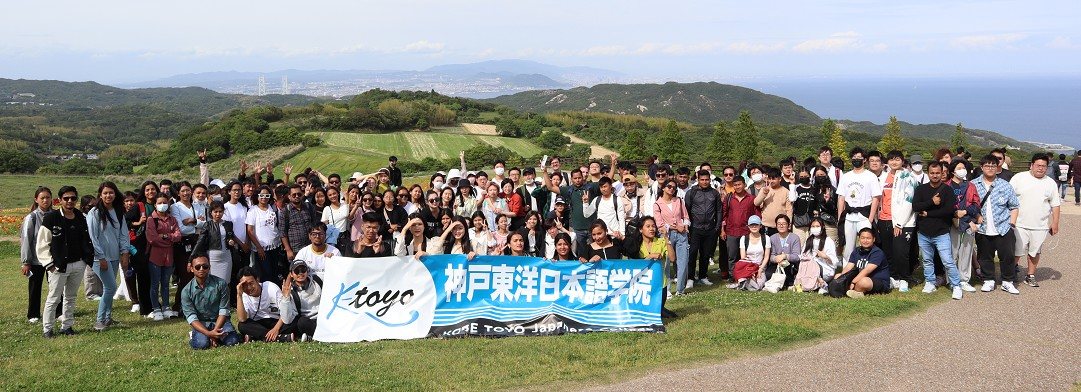
Combines the annual events in the brochure with the Year 1 progression schedule. · Recent excursions were to Hirakata Park (spring 2024–2026 and autumn 2025) and to Himeji Castle and Suma Sea World (autumn 2024); the spring excursion was in mid-May.
- Speech contest
- International students joined the Kobe branch of I.S.A., run by students of Kwansei Gakuin University and Konan University, and now take part every week. International exchange events are also held in cooperation with the event planning committee.
- International exchange classes at Konan University (Oct 23, Nov 6). Exchange class with Hyogo Prefectural Nagata High School (Aug 19).
- A summer festival is held at the school on Aug 4, with games such as super-ball scooping, shooting and ring toss, fan making, and Bon dance.
- Classes to experience Japanese culture such as the first shrine visit of the year, Setsubun and the Doll Festival, and visits to nearby museums and art museums.
- Won the grand prize at the 1st Tsunagou! Bridge of Language and Culture Speech Contest on Nov 2, 2024. Won an excellence award in the speech category of the Kobe City-sponsored Collaboration Ideas Contest for Coexistence.
- Volunteered at JAPAN BEACH GAMES Suma 2024, held Oct 5 and 6.
On campus
- Main building, 1st floor
- Administration office — The layout by floor follows the facilities page (2022).
- Main building, 2nd floor
- Library and 4 classrooms
- Main building, 3rd floor
- 4 classrooms
- Main building, 4th floor
- Faculty room and foreign affairs office
- Main building, 5th floor
- Multi-purpose room (large classroom) and 2 meeting rooms — (floor managed by the Kobe Toyo Medical College general incorporated association)
- Annex, 2nd floor
- 3 classrooms and a faculty room
- Annex, 3rd floor
- 3 classrooms
- Meeting room — A room for progression counseling (from a brochure photo).
- Bicycle parking
Academic calendar
- Spring break
- Late Mar to early Apr · Spring break of 2 weeks (class hours and holidays page).
- Summer vacation
- Aug · Summer break of 3 weeks (class hours and holidays page).
- Autumn break
- late Sep–early Oct · 2 weeks
- Winter break
- late Dec–early Jan · 2 weeks
- Lunar New Year
- · This is not a Japanese holiday; classes are held as usual.
School website · 2025-11-11 updated
Access
- Transit
- JR Motomachi Station, 3 min walk
Hanshin Electric Railway Motomachi Station, 3 min walk
Sannomiya, 8 min walk - Nearby
- About 20 minutes from Osaka by JR Special Rapid Service, about 1 hour from Kansai International Airport by limousine bus, and an 8-minute walk from Sannomiya. Many sightseeing spots are nearby, including Nankinmachi, the Kitano Ijinkan area and Harborland.
- Dormitory
- Available¥20,000–¥60,000 per month · There are 4 dormitories. Single rooms ¥38,000–¥60,000 and twin rooms ¥25,000–¥31,000 per month. 9–15 minutes to the school by bicycle. · Based on school website
School website · 2024-05-30 updated
Dormitory — Dormitories: Umemotocho Men's Dorm, Kita-Sakase Women's Dorm, Stella Court twin-room dorm and F-Heim single-room dorm. Dormitory entrance fee ¥50,000; facility, management and fire insurance fees ¥40,000 (excluding tax).
School website · 2025-11-07 updated
SALLAE has organized the school website and published data in English.
The update date is the day that material was last revised.
Photos are materials published by the school.
This information is compiled from official sources and is not updated daily. Please confirm with the official contact before signing or applying.