Kurashiki Foreign Language Institute
Kurashiki Foreign Language Institute
- Course
- Further-study course only ›
- Tuition
- On the cheaper side nationwide ›
- Age requirement
- Age 30 or under ›
Compare side by side with other schools →
Tuition and conditions may change depending on the intake. If you contact us, we will check with the school and give you accurate details.
Nearby schools comparedBy distance · no ads or paid placement
- Kurashiki Foreign Language InstituteThis schoolTuition/yr¥752,000Progression—IntakesApr · Oct
- Okayama College of Science and Technology15.2km›Tuition/yr¥719,000Installments OKProgression—IntakesApr · Oct
- Yakage Business College Japanese Language School16.2km›Tuition/yr¥690,000Progression—IntakesApr · Oct
- Okayama Business College16.3km›Tuition/yr¥730,000Progression91%IntakesApr · Oct
— means SALLAE has not yet found the data.
About the school
The admissions guidelines say the school teaches Japanese mainly to people who want to go on to Japanese universities or vocational schools, and it offers only two courses, a 2-year progression course (April entry) and a 1 year 6 months progression course (October entry), so it is a progression-focused school. It states a 98% progression rate from opening to April 2022 and lists Okayama University Graduate School, Okayama University of Science and vocational schools in Okayama and Tokyo as destinations. It is a 5-minute walk from JR Kurashiki Station, with a capacity of 500 (426 enrolled and 43 teachers as of April 2026), and 286 students graduated in FY2025. Of the 297 students enrolled in 2024, 203 were from Nepal. Depending on the class, lessons are in the morning or afternoon class, 4 periods a day. There is a school dormitory with 2 students per room, and living support such as airport pickup and an introduction to a first part-time job.
Published data and school website
Tuition
If you saw a lower amount elsewhere, it may not include the admission fee and application fee
Median 1-year tuition in other areas — Kyoto ¥911,000(7 schools) · Kanagawa ¥880,000(8 schools) · Okinawa ¥858,000(6 schools) · Tokyo ¥840,600(56 schools) · Fukuoka ¥835,000(12 schools) · Hyogo ¥825,500(7 schools) · Osaka ¥814,000(27 schools) · Shizuoka ¥790,000(9 schools) · Chiba ¥745,333(10 schools) · Aichi ¥740,667(5 schools)
Total by intake
| Intake · length | Full course |
|---|---|
| 1 year 6 months | ¥1,082,000 |
| 2 years | ¥1,412,000 |
Cost details · Course tables · Notes
- Per term
- ¥165,000 3 months
- One-time fees
- ¥92,000Application fee · Admission fee
| Duration | Total |
|---|---|
| 1 year 6 months | ¥1,082,000 |
| 1 year 9 months | ¥1,247,000 |
| 2 years | ¥1,412,000 |
★"Per term" and "One-time at start" were calculated by SALLAE from each course's total. The courses this school actually offers are 1 year 6 months onward — all amounts in the table are values calculated by SALLAE.
Calculated by SALLAE · verified 2026-09-16
Admission & dates
- Apr intake
- 2-year course · Application Sep 1–Oct 15 of the year before entry · Classes Progression 2-year course: total 1,600 hours (45 minutes per class period, 20 hours per week)
- Oct intake
- 1 year 6 months course · Application Mar 1–Apr 15 of the year of entry · Classes Progression 1 year 6 months course: total 1,200 hours (45 minutes per class period, 20 hours per week)
- Japanese level
- JLPT N5 or higher
At least 150 hours of Japanese study at a university, vocational school, junior/senior high school or language school, and N5 or higher or J-TEST Level F or higher obtained (or expected). Those the school recognizes as equivalent or higher are also accepted
Deadline and capacity rules
Progression 2-year course (April only), capacity 300; progression 1 year 6 months course (October only), capacity 200. Age 18 or older, 12 or more years of schooling, and in principle age 30 or under and less than 5 years since graduation.
School website · 2025-04-16 updated
Classes
- Morning
- 09:00-12:35 One class hour is 45 minutes.
- Afternoon
- 13:25-17:00 One class hour is 45 minutes.
- AM/PM placement
- Depending on the class, you will be in either the morning or the afternoon class.
- Class assignment
- Level-based 6 stages
- Elective classes
- In addition to regular Japanese classes, special preparation classes for the Examination for Japanese University Admission for International Students (EJU), such as science and mathematics, are offered to students who want to go on to university. · In addition to regular Japanese classes, special preparation classes for the Examination for Japanese University Admission for International Students (EJU), such as science and mathematics, are offered to students who want to go on to university.
Materials · Subjects · Timetable · Details
- Materials
- Minna no Nihongo I and II, Nihongo Hyojun Mondaishu, Chukyu e Ikou, Chukyu o Manabou, Goi Speed Master, Bunpo Speed Master, various newspapers and more.
Part 1 (morning) 8:45–12:10, Part 2 (afternoon) 13:00–16:25 (4 periods each). 20 hours (5 days)
| Part 1 | Part 2 | |
|---|---|---|
| Period 1 | 09:00-09:45 | 13:25-14:10 |
| Period 2 | 09:55-10:40 | 14:20-15:05 |
| Period 3 | 10:55-11:40 | 15:20-16:05 |
| Period 4 | 11:50-12:35 | 16:15-17:00 |
Class hours by subject
| Subject | 2 years | 1 year 6 months |
|---|---|---|
| Beginner I | 200 hours | — |
| Beginner II | 200 hours | 200 hours |
| Lower intermediate | 300 hr | 200 hours |
| Intermediate | 300 hr | 300 hr |
| Upper intermediate | 300 hr | 300 hr |
| Advanced | 300 hr | 200 hours |
Goal at course completion: N2 for the 2-year course, N3 for the 1 year 6 months course. Term 1: Apr 1–Sep 30; Term 2: Oct 1–Mar 31. JLPT preparation curriculum.
What each level covers · 4 stages
- Beginner I
- Japanese pronunciation and notation, about 200 kanji, 1,000 basic words, basic sentence patterns and grammar. About JLPT N4
- Beginner II
- About 400 basic kanji words, about 1,500 vocabulary words. Grammar, reading and conversation at about JLPT N3
- Intermediate I / Intermediate II
- 1,000 kanji, 6,000 vocabulary words. Grammar, reading and conversation at about JLPT N2
- Advanced
- About 2,000 kanji, 10,000 vocabulary words. About JLPT N1
School website · 2025-04-16 updated
Documents
- Application form (designated form), handwritten by the applicant. Write the name in the Latin alphabet above the name. Fill in every period without gaps, including years of exam preparation and military service. No correction tape; write the final copy in black ballpoint pen.
- Pages with the photo, the validity period and records of past visits to Japan
- Submit the original graduation certificate of your last school. If you also have an original bachelor's degree certificate or similar besides the diploma, submit it too.
- Transcript from last school attended
- Original JLPT result notice or original J-TEST certificate, and a certificate of Japanese study history. Proof of 150 or more hours of study and N5 level is required.
- Statement of study-abroad reasons (designated form), written in your native language. Describe your reasons and plans after finishing in concrete terms, drawing on your own experience.
- Photos: 4 cm tall × 3 cm wide, taken within 3 months, front-facing, hatless, plain background, 6 photos. Attach 1 to the application form; write name and date of birth on the back
- Must show the translator's name and contact details and be signed by the translator.
Financial supporter's documents · only if applicable · 10 application requirements
Submitted by the person paying the tuition (financial sponsor)
- Financial sponsor's statement (designated form): tick the tuition category (1 year, 1.5 years or 2 years). Payment method: "transfer to the student's account, or hand over in person".
- For parents, siblings and relatives: a certificate issued by a public body (family register copy, notarized document, birth certificate, etc.). For others: documents proving the relationship in detail.
- Bank balance certificate in the sponsor's name, on the bank's official form. 1.5-year course: about ¥1.5 million or more per person; 2-year course: about ¥2 million or more per person.
- Documents showing how the deposit balance was accumulated (copy of passbook covering at least the past year, proof of sale of assets, etc.). Must be issued within the last 3 months
Only if applicable
- Certificate of enrollment (must show either the enrollment period or the expected completion year and month of the course) (Current students)
- Certificate of the leave-of-absence period from the school (If you come to Japan while on leave)
- Certificate of employment: start date, period of employment, job duties and salary at the time of application. On company letterhead printed with the address, phone and fax numbers. (If you are currently employed)
- If 5 or more years have passed since graduating from the last school, state the purpose of study and your background in detail. For progression to a Japanese university, etc., state the field and why you must study it in Japan (if 5 or more years have passed since graduating from the last school)
Application requirements
All certificates must be issued within 3 months before the date the Immigration Services Bureau accepts the application. Attach a Japanese translation to every document that is not in Japanese (including English). Write the translator's name and contact details on the translation. If dates on certificates are not in the Gregorian calendar, convert all of them to Gregorian years. Certificates issued by schools or companies must show the issuing organization's name, address, phone and fax numbers, the issuer's name and job title, and a signature. Write school names and addresses accurately and in full, without abbreviation, down to the street number. If the address or phone number on the application form differs from other certificates, a statement of reasons and a certificate supporting it are required. Multiple financial sponsors: a married couple living together signs one financial sponsor's statement jointly; otherwise each sponsor makes a separate pledge. A balance certificate in local currency is acceptable, but it may be judged ineligible unless it is an official balance certificate from a bank that can make international remittances. Applications with missing documents cannot be accepted. The Immigration Services Bureau or the school may ask for additional documents. If any document or its contents turn out to be false, the right to enroll is cancelled immediately.
No document standards specific to Korean students are published. SALLAE is confirming this with the school.
School website · 2023-04-15 updated
Admission process
- Request an admission consultation — TEL 086-441-4948 / kla.appli@kurashikigaigo.jp / Monday–Friday 8:30–17:30 (closed Saturdays, Sundays and public holidays)
- Interview, document screening, Japanese test — Screening: an interview by the school's teachers, held on site or online, plus document screening and a written test (Japanese, English, mathematics). Screening is free.
- Prepare application documents — A (April intake) Sep 1 – Oct 15 / B (October intake) Mar 1 – Apr 15: Obtain the required documents (certificates, etc.) and apply for a passport
- Submit application documents (PDF) — Submit scanned data (PDF) of the application documents to the school. At the same time, pay the application screening fee (¥22,000) to the designated account.
- Submit application documents (originals by mail) — A (April intake) late November – early December / B (October intake) late May – early June: Send the originals of the application documents. Incomplete applications cannot be accepted
- Application to the Immigration Services Agency for the Certificate of Eligibility — A (April intake) early to mid-December / B (October intake) early to mid-June: The school applies for the Certificate of Eligibility to the Hiroshima Regional Immigration Services Bureau of the Ministry of Justice
- Announcement of whether the Certificate of Eligibility is issued — A (April intake) expected late February / B (October intake) expected late August (may be delayed). Recommending school and recommender are notified. If not issued, only the statement of reasons and original documents are returned
- Payment of admission fee, tuition and other fees — An invoice is sent immediately after the result is notified. Pay first-year tuition and dormitory fees. Payment deadline: A (April intake) Mar 15 / B (October intake) Sep 15
- Receive the original Certificate of Eligibility and the admission permit — After tuition and dormitory fees are confirmed as paid, the school sends the original Certificate of Eligibility and the admission permit to the recommending school and recommender in your home country.
- Obtain a visa — Submit the required documents (passport, Certificate of Eligibility, admission permit) to the Japanese embassy (consulate) abroad. If the visa is not granted, contact the school promptly.
- Arrive in Japan and enrol — A (April intake) mid to late March / B (October intake) mid to late September: Arrive in Japan in time for the entrance program. If you will be late, obtain permission
School website · 2025-04-16 updated
Short-term study
- Open now?
- Rolling admissions, so availability varies from time to time — SALLAE will confirm with the school
Course without a student visa
- Individual lessons — In person, individual ¥5,500; in person, group (2 or more) ¥3,500; online, individual ¥5,000; online, group ¥3,000 (45 minutes per lesson). Weekdays 9:00–18:00.
- Corporate lessons — Lessons are arranged by asking about needs and target goals, according to the work level of foreign employees. Fees vary by request and are quoted individually.
- Lessons for care facilities — Arranged according to the level of foreign staff such as EPA candidates, Specified Skilled Workers and technical intern trainees. Fees vary by request and are quoted individually.
★Short-term courses are not listed in the published data — it counts only student-visa courses.
School website · Confirmed 2026-09-26
Progression
| FY2025 | Admitted |
|---|---|
| Graduates | 286 students |
Passing an exam
| Exam | Pass |
|---|---|
| JLPT N1 2021 | 2 students |
| JLPT N2 2021 | 23 students |
| JLPT N3 2021 | 73 students |
JLPT results (2020–2021): N1 2 students, N2 23 students, N3 73 students
All schools accepted to so far
See 30 more schools
FY2025 graduates 286 (the most so far), FY2023: 245. Progression rate 98% (from opening through end of April 2022) · School website · Updated Apr 16, 2025
Reviews
If you study here or used to, tell others what the classes, teachers and daily life were like. It helps anyone deciding on this school.
Write the first reviewUniversity prep
- Career interview — The school asks about each student's desired path and supports them carefully toward achieving it.
- Career preference survey — Career preference survey
- Attend a school information session — Attend school information sessions
- Interview preparation and individual coaching — Interview preparation and individual coaching
- Applications and various procedures — Applications and various procedures
- EJU preparation and special classes — Special preparation classes for the EJU, such as science and mathematics, are offered to students who want to go on to university.
School website · 2023-04-07 updated
Daily-life support
- Airport pickup and transfer to the dormitory — After the visa is issued, tell the school your departure date, airline and flight number at least 10 days before arriving. The round-trip transport costs of the student and the staff member who meets them are covered by the school. Arrive on a weekday if possible.
- City office procedures and opening a bank account — School staff provide thorough support, from airport pickup and transfer to the dormitory to city office procedures and opening a bank account.
- Japanese life guidance — Thorough support on entry: city hall procedures, opening a bank account, part-time job introductions and guidance on life in Japan.
- Reassuring, comprehensive support — Staff listen to concerns such as trouble at a part-time job or a broken dormitory fixture, and think through solutions together.
- Part-time job introductions — The school can introduce a part-time job, for the first job only, to students who wish. You cannot choose the workplace when introduced. Introductions are not possible right after enrollment.
- Student insurance — All students are covered by student insurance (the cost is included in the miscellaneous fees). Incidents and accidents outside student life are not covered.
- Health checkup — A health checkup is held early after enrollment and then every year.
- Guidance to the nearest hospital or clinic — An infirmary where students can lie down and rest if they suddenly feel unwell. Staff also advise on which hospital to go to.
- Bicycle simulator lesson — A bicycle simulator lesson given by Kurabo Driving School at the October-entry orientation (featured in the Sanyo Shimbun).
- Temporary return to home country — Except for certain exceptional reasons (such as a relative's wedding or death), students are not allowed to return home temporarily.
School website · 2025-04-16 updated
Students
297 enrolled (2024) · Capacity 500 National median: 180 students
Based on 297 students enrolled in 2024.
Public data from the Association for the Promotion of Japanese Language Education (Nisshinkyo) · verified 2026-09-20
School life
For 1 year
- 1
- First shrine visit of the year · Calligraphy experience
- 3
- Graduation ceremony
- 4
- The entrance ceremony for students entering in April 2026 was held at the Kurashiki Public Hall.
- 5
- Kurashiki Bikan Historical Quarter walk rally
- 6
- Bitchu Kagura performance viewing
- 7
- Tanabata festival · About 30 volunteers joined the Kurashiki Tenryo Festival bon dance (Jul 20, 2024) · Excursion (Shikoku Aquarium)
- 10
- October students' entrance ceremony (Oct 28, 2022 · Oct 27, 2023 · Nov 1, 2024) · Halloween
- 11
- Field trip (Washuzan Highland)
- 12
- Candle night
Events from the school's news posts (2022–2026), grouped by month. They vary a little from year to year. Excursions are held twice a year.
- Monthly events to learn about Japanese culture as well as the language: cherry blossom viewing, calligraphy, yukata events and field trips. Annual events include the first shrine visit of the year, mochi making, Setsubun, Tanabata and Christmas.
On campus
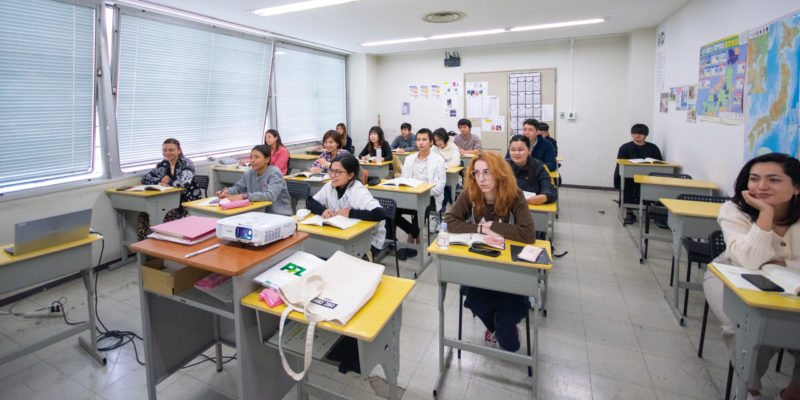
- Classroom — Each classroom has a TV, projector and other equipment.
- Staff room — Teachers' lesson preparation, materials and grading are done here. Student consultations and procedures such as tuition payment are also handled here.
- Library room — A library of about 1,000 books on history, culture, economics, literature and more. It can also be used as a study room for preparation and review.
- Infirmary — An infirmary where students can lie down and rest if they suddenly feel unwell.
2025–2026 academic calendar · Older data
- Summer vacation
- Aug 1 to the 4th Sunday of August
- Winter break
- Dec 23 to the 2nd Monday of January
- Spring break
- 3rd Saturday of March to 1st Sunday of April
School website · 2026-07-28 updated
Access
⚠ Dormitory fees varies by source — please confirm with the school. Association for the Promotion of Japanese Language Education published data: available, ¥20,000 per month · School website: entrance fee ¥90,000, 6 months of dormitory fees ¥180,000, total ¥270,000. Utilities and similar costs are paid at actual cost by the student.
- Transit
- JR JR Kurashiki Station on foot 5 min
- Nearby
- 5 min walk from JR Kurashiki Station. Around the school are shopping streets, restaurants, and convenience stores and supermarkets right in front. The branch building is at 3-16-21 Oimatsucho, Kurashiki
- Dormitory
- Available¥20,000 per month · 2 per room. Dormitory entrance fee ¥90,000, 6 months of dormitory fees ¥180,000 (total ¥270,000). Within cycling distance of school (up to about 15 min) · Based on school website
School website · 2023-06-28 updated
Dormitory — 4–5 dormitories within cycling distance of the school (up to about 15 minutes). Moving in is optional. Two students share a room, and rooms cannot be chosen. Contracts run in 6-month units, and you cannot leave before 6 months are up. Utilities are paid at actual cost; no meals provided.
School website · 2025-04-16 updated
SALLAE has organized the school website and published data in English.
The update date is the day that material was last revised.
Photos are materials published by the school.
This information is compiled from official sources and is not updated daily. Please confirm with the official contact before signing or applying.