Kurume International Exchange Institute
Kurume International Exchange Institute
- Progression
- University or similar 97% ›
- Tuition
- Low for Fukuoka ›
- Admission
- Twice a year · April and October ›
Compare side by side with other schools →
Tuition and conditions may change depending on the intake. If you contact us, we will check with the school and give you accurate details.
Nearby schools comparedBy distance · no ads or paid placement
- Kurume International Exchange InstituteThis schoolTuition/yr¥750,000Progression97%IntakesApr · Oct
- Kurume Seminar0.3km›Tuition/yr¥830,000Progression91%IntakesApr · Oct
- Fukuoka College of Civil Engineering and Construction26.7km›Tuition/yr¥850,000Progression—IntakesApr · Oct
- Asia Japanese Language Institute28.2km›Tuition/yr¥770,000Progression90%IntakesApr · Oct
— means SALLAE has not yet found the data.
About the school
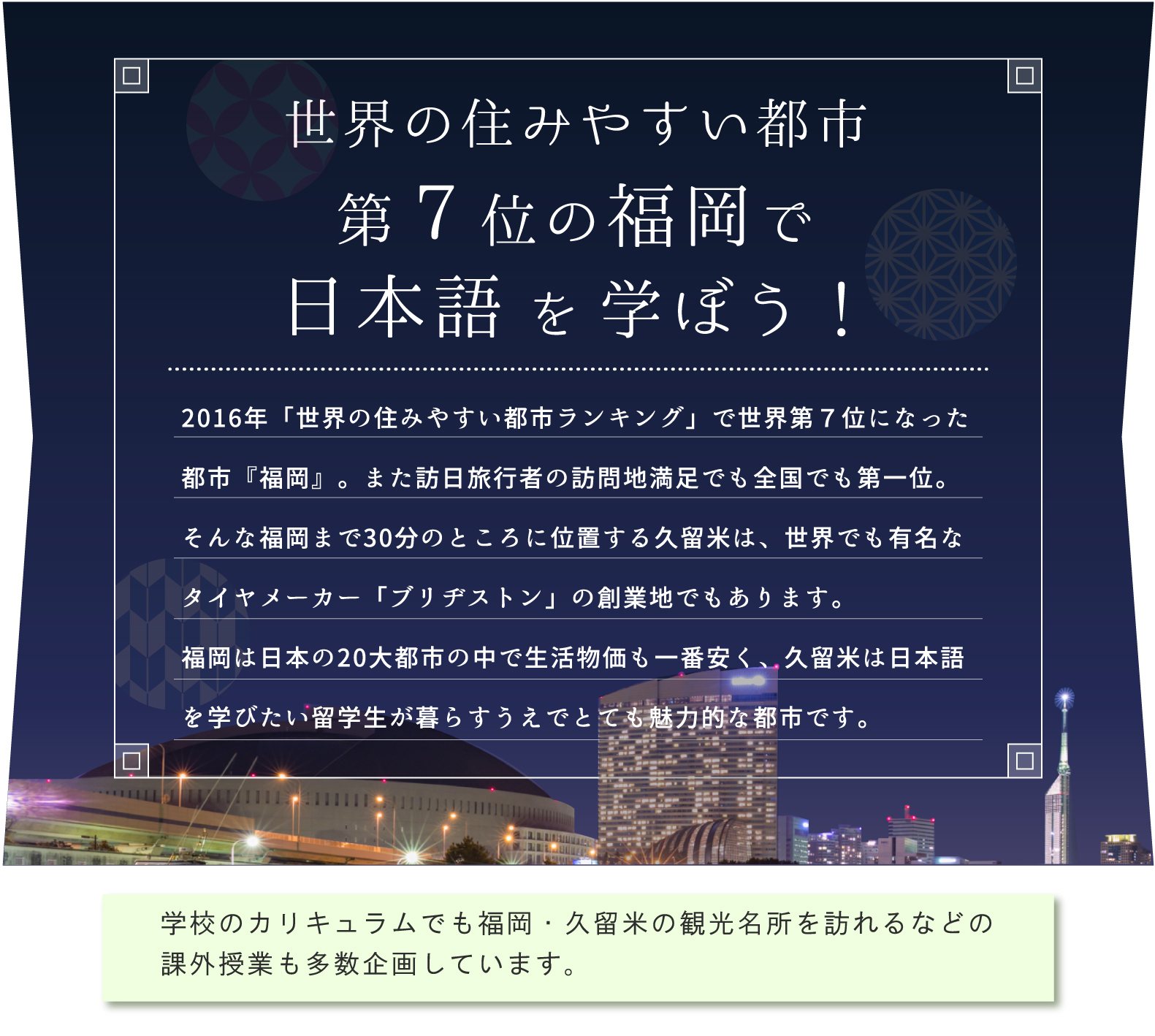
All courses registered with Immigration are progression courses (2 years, 1 year 6 months and 1 year), and 191 of the 196 students who completed the course in FY2025 went on to Japanese universities, vocational schools and similar institutions, so this is a progression-focused school. One-on-one meetings start in the first year, and each student's career record is used for guidance. The school is in Kurume, about 30 minutes from central Fukuoka. Of the 238 students enrolled in 2026, 170 are from Nepal, followed by students from Sri Lanka, Myanmar, Vietnam and Mongolia. All students live in the dormitory for the first 6 months after arriving, and more than 90% of enrolled students use the dormitory. According to the 2018 application form, there is a 2-year course starting in April and a 1 year 6 months course starting in October.
Published data and school website
Tuition
If you saw a lower amount elsewhere, it may not include the admission fee and application fee
Median 1-year tuition in other areas — Kyoto ¥911,000(7 schools) · Kanagawa ¥880,000(8 schools) · Okinawa ¥858,000(6 schools) · Tokyo ¥840,600(56 schools) · Fukuoka ¥835,000(12 schools) · Hyogo ¥825,500(7 schools) · Osaka ¥814,000(27 schools) · Shizuoka ¥790,000(9 schools) · Chiba ¥745,333(10 schools) · Aichi ¥740,667(5 schools)
Admission & dates
- Apr intake
- 2-year course
- Oct intake
- 1 year 6 months course
Deadline and capacity rules
Since opening, the school has focused on recruiting students locally, selecting them through interviews and exams. It signs contracts with local recruiting agencies after visiting them to check how they actually operate, and then recruits students.
School website · 2018-06-05 updated
Classes
Materials · Subjects · Timetable · Details
Classes are formed by Japanese level, and exams are held each term. Based on the results, teachers hold frequent one-on-one meetings with students.
School website · 2026-06-17 updated
Documents
- Application for Admission, with a 4 cm × 3 cm photo. Fill in education, work history, Japanese study history, Japanese ability, plans after studying Japanese, past visits to Japan, criminal record and deportation history.
- Student survey: fill in family, relatives in Japan, friends, financial sponsor and whether you have applied before.
- Reasons for studying Japanese: write concretely your motivation and purpose for studying in Japan and how you will use the experience gained in Japan in the future.
- Declaration Form: to comply with Japanese law and the school's rules and discipline; to understand that no tuition is refunded if you leave the school midway, and to submit a withdrawal notice; and to promptly leave Japan or change your status of residence.
Financial supporter's documents · 1 application requirement
Submitted by the person paying the tuition (financial sponsor)
- Financial sponsor's statement (Payment Guarantee), addressed to the Minister of Justice of Japan. Fill in tuition (yen per year), living costs (yen per month) and payment method. Forms for 1 sponsor (B01_1) and 2 sponsors (B01_2) are available.
Application requirements
* Please print and use.
The required document list (passport, graduation certificate, balance certificate and so on) is not posted on the website, and criteria by nationality are not published either.. SALLAE is confirming this with the school.
School website · 2022-02-10 updated
Admission process
- Placement test
- Whether students' Japanese ability is assessed by a test or similar before classes start, and classes are formed appropriately
School website · 2026-06-17 updated
Graduate outcomes
| FY2025 | Admitted |
|---|---|
| Employment | 2 students |
| Graduates | 196 students |
FY2025: course completers 196, total persons meeting the standard 196, withdrawals 0, 100.0%. Progression: 2-year 87, 1 year 6 months 104 · Persons permitted to change status of residence (FY2025): 2-year progression 2, 1 year 6 months progression 0 · School website · Updated Jun 17, 2026
Reviews
If you study here or used to, tell others what the classes, teachers and daily life were like. It helps anyone deciding on this school.
Write the first reviewUniversity prep
- One-on-one meetings from the first year — One-on-one meetings start in the first year, with guidance to raise students' motivation.
- Individual student records — The school keeps an individual record for each student and works to give detailed support by reviewing the career guidance given from entry to graduation.
- Progression and job-hunting materials — Whether up-to-date materials on further study and employment are provided and available for students to read
School website · 2026-06-17 updated
Daily-life support
- Orientation by native-speaker staff — An orientation on life as an international student is held in the student's native language when new students enter Japan.
- Regular homeroom sessions — Homeroom sessions for all enrolled students are held regularly to pass on the latest information about residence status and to address real noise and garbage-disposal problems.
- Accompaniment to the hospital — A staff member who speaks the student's native language accompanies them to health checkups and medical visits when unwell. When ill, consult the school office first.
- National Health Insurance and international student insurance — All eligible students join National Health Insurance and also enroll in insurance for international students. Medical costs are 30% copay
- Part-time work guidance — With a "permit for activity outside the status of residence", students may work part-time up to 28 hours a week. Illegal work or poor attendance may lead to revocation of the "status of residence"
- Police are asked to give guidance on traffic safety, crime prevention and more — Several times a year, the police are asked to give guidance on traffic safety, crime prevention and similar topics.
School website · 2026-06-17 updated
Students
238 enrolled (2026) · Capacity 300 National median: 180 students
Based on 238 students enrolled in 2026.
Public data from the Association for the Promotion of Japanese Language Education (Nisshinkyo) · verified 2026-09-20
School life
For 1 year
- 4
- Entrance ceremony (April entrants) and health checkup (1st year, April) · Orientation · Thingyan festival
- 5
- Sports day
- 6
- New-student field trip (travel) · Examination for Japanese University Admission for International Students (EJU), 1st sitting, and university trial classes
- 7
- Tanabata festival · JLPT (1st session)
- 8
- Summer vacation · Kurume Water Festival (mass dance)
- 9
- Cultural experience · Progression briefing
- 10
- Entrance ceremony (July and October entrants) · Dashain festival
- 11
- Cultural experience · EJU (2nd session)
- 12
- Winter break · JLPT (2nd session)
- 1
- First shrine visit of the year
- 2
- Tet festival · Tsagaan Sar festival · Speech contest
- 3
- Spring break · Graduation trip and graduation ceremony
Based on the annual schedule chart posted on the website in June 2017; this is past material. · Thingyan is the New Year festival of Myanmar, Dashain is Nepal's festival, Tet is Vietnam's New Year, and Tsagaan Sar is Mongolia's New Year.
- Ikebana (flower arrangement)
- The school takes an active part in city-sponsored events and festivals to build ties with the local community.
- As volunteer work, students also clean the roads around the school.
On campus
- On campus
- Self-study room — Self-study room
- Building
- Barrier-free — Whether barrier-free measures are in place: rating C (somewhat inadequate)
2017–2018 academic schedule · past material
- Summer vacation
- Aug
- Winter break
- Dec
- Spring break
- Mar
School website · 2020-02-17 updated
Access
- Nearby
- Fukuoka Airport to Nishitetsu Kurume: about 50 minutes by Nishitetsu express bus, about 60 minutes by subway and Nishitetsu train, or about 80 minutes by subway and JR Kyushu. About 30 minutes from central Fukuoka.
- Dormitory
- Available¥15,000 per month · For the first 6 months after arriving in Japan, everyone lives in the dormitory. Students cook their own meals. Over 90% of enrolled students use the student dormitory · Based on school website
School website · 2020-02-17 updated
Dormitory — The dormitory has internet connection ports. More than 90% of enrolled students use the student dormitory.
School website · 2020-02-17 updated
SALLAE has organized the school website and published data in English.
The update date is the day that material was last revised.
Photos are materials published by the school.
This information is compiled from official sources and is not updated daily. Please confirm with the official contact before signing or applying.