Kyoritsu Japanese Language School
Kyoritsu Japanese Language School
Compare side by side with other schools →
Tuition and conditions may change depending on the intake. If you contact us, we will check with the school and give you accurate details.
Nearby schools comparedBy distance · no ads or paid placement
- Kyoritsu Japanese Language SchoolThis schoolTuition/yr¥880,000Progression—IntakesApr · Oct
- Kudan Institute of Japanese Culture Japanese Language Institute1.1km›Tuition/yr—Progression2%IntakesJan · Apr · Jul · Oct
- Intercultural Institute of Japan1.4km›Tuition/yr¥989,000Progression—IntakesJan · Apr · Jul · Oct
- Nitchu Gakuin1.5km›Tuition/yr¥850,000Progression—IntakesApr · Oct
— means SALLAE has not yet found the data.
About the school
A small Japanese-language school with a capacity of 100, in the student district of Yushima, Bunkyo-ku. Most of the 91 enrolled students (2025) are from Vietnam and Nepal, and there are interpreter and counseling staff for each country. Of the 62 students who completed the course in FY2025, 40 went on to further study and 16 changed their status of residence for employment or other reasons. There are 22 shared dormitory rooms, ¥34,000–¥38,000 per month, within an 8-minute walk.
Published data and school website
Tuition
If you saw a lower amount elsewhere, it may not include the admission fee and application fee
Median 1-year tuition in other areas — Kyoto ¥911,000(7 schools) · Kanagawa ¥880,000(8 schools) · Okinawa ¥858,000(6 schools) · Tokyo ¥840,600(56 schools) · Fukuoka ¥835,000(12 schools) · Hyogo ¥825,500(7 schools) · Osaka ¥814,000(27 schools) · Shizuoka ¥790,000(9 schools) · Chiba ¥745,333(10 schools) · Aichi ¥740,667(5 schools)
Total by intake
| Intake · length | Full course |
|---|---|
| 1 year 6 months | ¥1,270,500 |
| 2 years | ¥1,661,000 |
Cost details · Course tables · Notes
- Per term
- ¥195,250 3 months
- One-time fees
- ¥99,000Application fee · Admission fee
| Duration | Total |
|---|---|
| 1 year 6 months | ¥1,270,500 |
| 1 year 9 months | ¥1,465,750 |
| 2 years | ¥1,661,000 |
★"Per term" and "One-time at start" were calculated by SALLAE from each course's total. The courses this school actually offers are 1 year 6 months onward — all amounts in the table are values calculated by SALLAE.
Calculated by SALLAE · updated 2026-02-05
Whether it is refundable
- Cancellation after submitting application documents
- The entrance examination fee is not refunded for any reason.
- Certificate of Eligibility (CoE) issued, but the student does not apply for a visa and does not come to Japan
- The entrance examination fee and admission fee are not refunded. Tuition and other fees are refunded in full upon return of the Certificate of Eligibility and the admission permit.
- Visa denied by a Japanese diplomatic mission abroad
- The entrance examination fee and admission fee are not refunded. After school staff confirm that the visa was not issued at the Japanese diplomatic mission abroad, tuition and other fees are refunded in full upon return of the Certificate of Eligibility and the admission permit.
- Cancellation of enrollment after the visa is issued by a Japanese diplomatic mission abroad
- The entrance examination fee and admission fee are not refunded. After it is confirmed that the visa was unused and has expired, tuition and other fees are refunded in full upon return of the admission permit.
See refund policy in detail · 1 more line
- After arrival in Japan
- The entrance examination fee, admission fee, and tuition and other fees for a term that has ended or is in progress are not refunded. Tuition for a term that has not started at the time the written notice is received is refunded except for a ¥50,000 cancellation fee; other fees are not refunded.
Admission & dates
- Apr intake
- 2-year course · Application April – end of July · Classes 1,600 hr
- Oct intake
- 1 year 6 months course · Application January – end of April · Classes 1,200 hr
- Japanese level
- JLPT N5 level or above
2-year progression course: completion of 150 or more hours of study at a Japanese-language institution, or a JLPT N5 pass. 1 year 6 months course: 450 or more hours or an N4 pass. CEFR A1 / A2 equivalent.
School website · 2026-02-05 updated
Classes
- Morning
- 09:00-12:25
- Afternoon
- 13:10-16:35
- Class assignment
- Level-based 8 stages
Materials · Subjects · Timetable · Details
- Materials
- Uses the Dekiru Nihongo series, kanji textbooks for international students, and materials for reading, listening, writing and exam preparation, by level.
- Subject
- Integrated · Writing · Characters and vocabulary · Reading · Listening · Exam preparation
Class hours by subject
| Subject | 3 months |
|---|---|
| Beginner I·II | 200 hours |
| Lower intermediate | 200 hours |
| Intermediate I·II·III·IV | 200 hours |
| Upper intermediate | 200 hours |
One class period is 45 minutes. 4 periods per day, 20 periods per week, at least 200 days per year and at least 800 periods per year.
What each level covers · 8 stages
- Beginner I
- 3 monthsIn class, students learn to introduce themselves and express their wants. Kanji are treated as vocabulary, and students learn to write and pronounce them correctly.
- Beginner II
- 3 monthsStudents can exchange information in areas that directly concern them, such as personal and family information, shopping and the neighborhood. They learn kanji as vocabulary for each situation, so they can write them as well as read them.
- Lower intermediate
- 3 monthsStudents can understand the main points of familiar topics met at work, school and leisure, exchange information and follow instructions.
- Intermediate I
- 3 monthsStudents can join a conversation without preparation on everyday life and personal interests.
- Intermediate II
- 3 monthsStudents can understand the main points of familiar social and cultural topics and give information and opinions. They can interview classmates using somewhat longer sentences.
- Intermediate III
- 3 monthsStudents can mostly understand TV and news on topics of interest and discuss solutions to practical problems.
- Intermediate IV
- 3 monthsStudents can understand the main points of current affairs on familiar topics and of general, academic and leisure topics. In exam preparation, they build the skills to pass JLPT N2.
- Upper intermediate
- 3 monthsStudents can understand the main points of a wide range of specialized topics and state their own ideas and opinions. In writing, they learn to write texts of about 400 characters that include kanji.
School website · 2026-02-04 updated
Documents
- Admission application form
- Résumé
- Original diploma from your last school
- Original final academic transcript
- Original certificate of Japanese study, completion certificate, or JLPT pass certificate and score reportJLPT / J-test / NAT-test are all accepted
- Copy of passportAll record pages
- 5 ID photos4 cm × 3 cm, write your name and nationality on the back
- Copies of the family register and ID of all family members
Financial supporter's documents · only if applicable · 4 application requirements
Submitted by the person paying the tuition (financial sponsor)
- Notarized certificate proving the family relationship with the applicantOriginal
- Bank time deposit certificateOriginal
- Attach a copy of the deposit certificate and a copy of the passbook showing the bank account's transactions for the past year.
- Copies of the family register and ID of all family members
- Certificate of employmentOriginal
- Income certificate for the past 1 yearOriginal
- Tax certificate for the past 1 yearOriginal
- If the financial sponsor lives in Japan, submit a residence certificate listing all household members and a copy of the residence card.
Only if applicable
- Certificate of enrollment (if enrolled at a university or junior college)
- High school diploma (original) (If you are expected to graduate)
- Original certificate of employment or of resignation (Only if you have work experience)
- Statement of the purpose of studying Japanese and plans after coming to Japan (If 5 or more years have passed since graduation)
Application requirements
All documents must bear an official seal. Attach a Japanese translation to every document that is not in Japanese. If an amount exceeding the household income is suddenly deposited into your account, be sure to attach a statement explaining the reason. Every certificate must show the issuer's job title and name (signature) and the issuing organization's address, phone number and fax number (if any).
School website · Confirmed 2026-09-21
Admission process
- Request an admission consultation — Please prepare the required documents in advance and consult your school teacher.
- Submit documents for screening — The student applies and submits the screening documents (flow chart)
- Admissions review — Application document screening and online interview
- Tuition payment — Admission screening and issuance of the acceptance notice (school) → Certificate of Eligibility application → issuance → tuition payment and visa application (student)
- Certificate of Eligibility application — The school applies for the Certificate of Eligibility; after it is issued, the student pays tuition and applies for the visa (flow chart)
- Enter Japan and enrol — After obtaining the visa, travel to Japan and enroll (flow chart)
- Placement test
- Application document screening and online interview
School website · Confirmed 2026-09-21
Graduate outcomes
| FY2025 | Admitted |
|---|---|
| Employment | 16 students |
| Graduates | 62 students |
Prepared Mar 31, 2026: course completers 62, persons meeting the standard 58 (93.5%). 1 year 6 months course: progression 40, status change 16, proof of A2 or higher 2 · Number of persons permitted to change status of residence: 1 year 6 months course 16 · School website · Updated Jun 26, 2026
Reviews
If you study here or used to, tell others what the classes, teachers and daily life were like. It helps anyone deciding on this school.
Write the first reviewUniversity prep
- Individual further-study consultation — The school supports progression through individual advice on further study, statement-of-purpose writing and interview practice.
- Supports progression and employment — We support progression and employment through Japanese ability building, JLPT preparation, writing the statement of purpose and interview practice.
- Supplementary lessons — During long vacations, full-time teachers hold supplementary classes.
School website · Confirmed 2026-09-21
Daily-life support
- Interpreter and counseling staff — The school has interpreter and counseling staff from students' home countries, and matters that academic or general affairs cannot handle are dealt with by the staff member for each country.
- Counseling room — The school is set up to handle concerns about studying and student life in Japan.
- Health support — A health checkup is held once a year.
School website · Confirmed 2026-09-21
Students
91 enrolled (2025) · Capacity 100 National median: 180 students
Based on 91 students enrolled in 2025.
Public data from the Association for the Promotion of Japanese Language Education (Nisshinkyo) · verified 2026-09-20
School life
- Volunteer activities are offered. The school regularly cleans and beautifies the neighborhood.
On campus
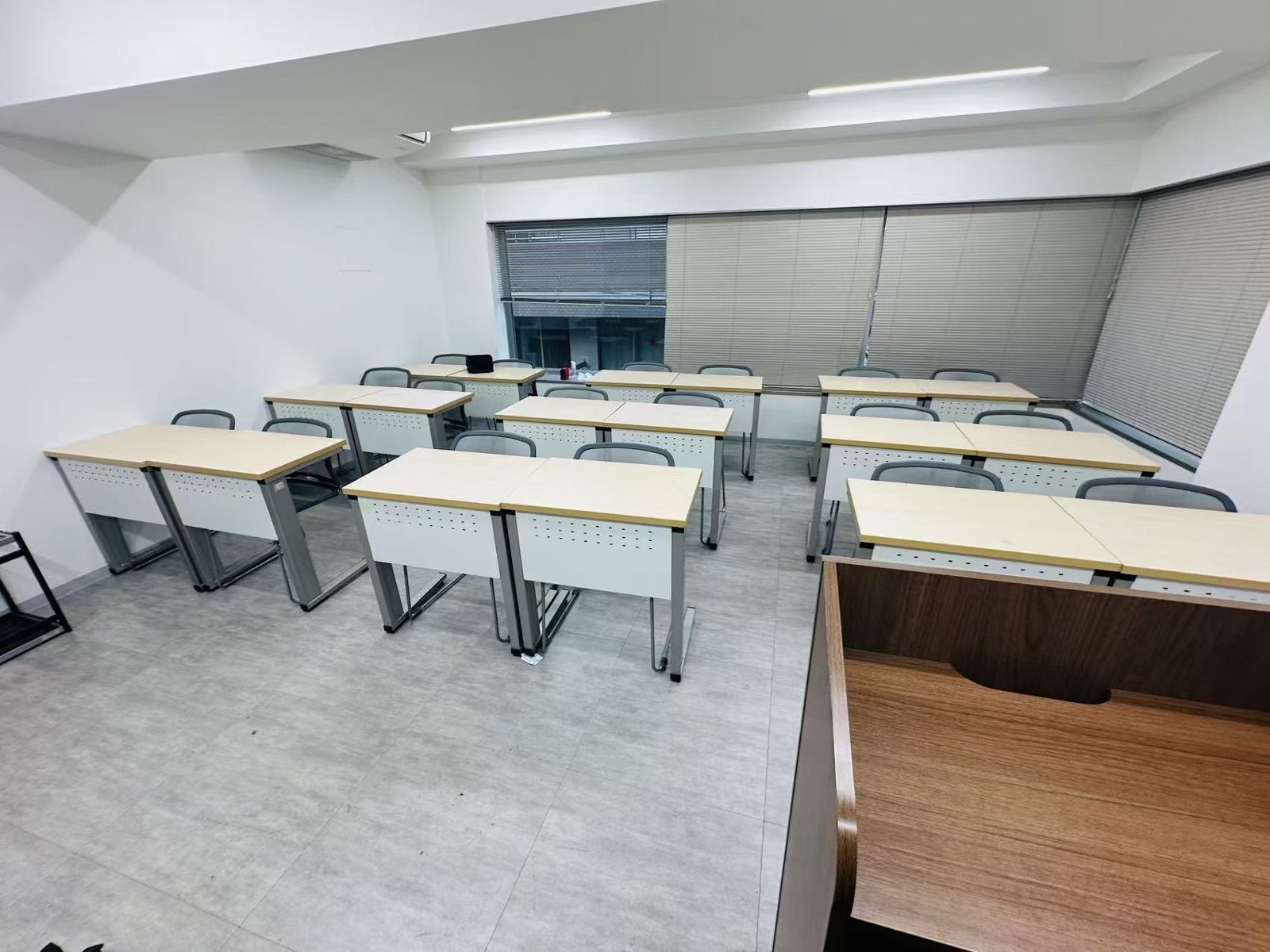
- Each classroom
- Electronic whiteboard — Each classroom is fully equipped with the latest electronic whiteboard, and lessons use video and audio.
- 4th floor
- There is a teachers' office, with a book corner and a counseling room next to it. — Books useful for studying Japanese are available, and staff can handle concerns about studying and student life in Japan.
- On campus
- Study room / cafeteria / school vending machines — Vending machines are installed on campus so students can refresh at any time.
School website · 2026-06-26 updated
Access
⚠ Rent varies by source — please confirm with the school. Machiya Dormitory ¥34,000–¥38,000 per month / Takinogawa Dormitory ¥40,000–¥48,000 per month (common service fee included; initial costs and utilities extra) · ¥37,000–¥54,500 per month (utilities and common service fee included) Dormitory information page: common service fee included, initial costs and utilities extra. Admission guidelines: utilities and common service fee included, initial costs extra.
- Transit
- Chiyoda Line, Yushima Station, 8 min walk
Marunouchi Line and Oedo Line Hongo-sanchome Station on foot 10 min - Nearby
- In Yushima, Bunkyo-ku. Accessible from several stations, including JR Ochanomizu Station, Hongo-sanchome Station and Yushima Station on the subway. An academic district near the University of Tokyo and Juntendo University.
- Dormitory
- Available · Machiya Dormitory has 7 rooms in 6-chome and 15 rooms in 8-chome, ¥34,000–¥38,000 per month, 8 minutes from Machiya Station to the school. Takinogawa Dormitory has 15 rooms. Higashi-Nippori Dormitory and Kita-Ueno Dormitory are also listed (rents being adjusted). · Based on school website
School website · 2026-05-11 updated
Dormitory — Machiya 6-chome and 8-chome dormitories: ¥34,000–¥38,000 per month (common service fee included; initial costs and utilities extra). Takinogawa Dormitory has 15 rooms in total, ¥40,000–¥48,000 per month (same terms).
School website · 2025-10-22 updated
Japanese language institution certified by MEXT Certification No. 20252130066 · certified Apr 30, 2026 →
SALLAE has organized the school website and published data in English.
The update date is the day that material was last revised.
Photos are materials published by the school.
This information is compiled from official sources and is not updated daily. Please confirm with the official contact before signing or applying.