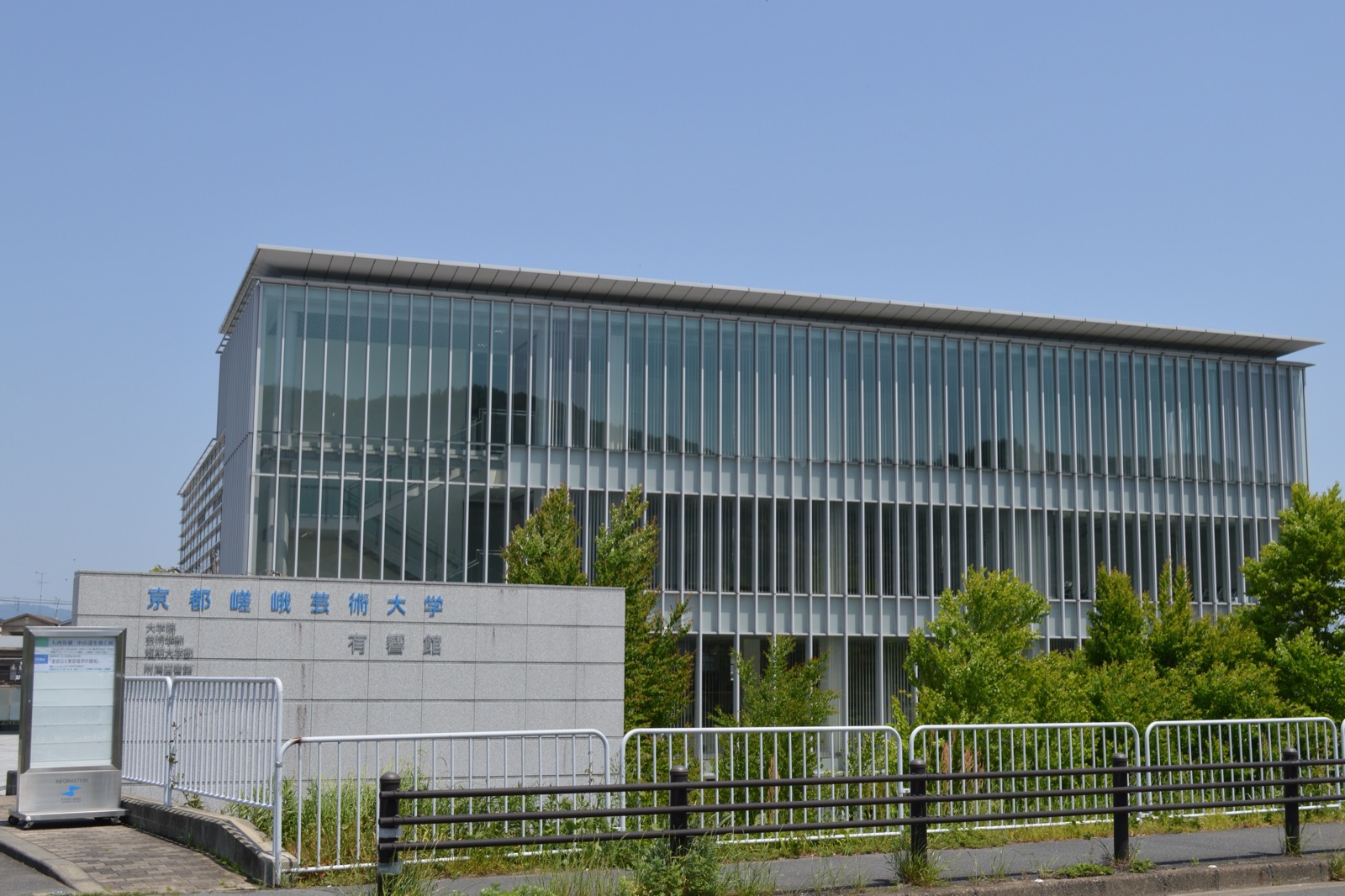
Saga University of Arts
嵯峨美術大学
ClosedAll applications for April 2027 entry have closed · new deadlines appear here when next year's guidelines come out
Compare with other universities →
Fees and conditions can change over time. Always check the school's guidelines before you apply.
Fees and conditions can change over time.
About the school
A private university founded in 2001. It has 775 students, including 13 international students (undergraduate 5 · graduate 8). There are 33 faculty members.
History · 7
- 1971
- Daikakuji Gakuen received approval and established Saga Art College as a specialist art junior college.
- 2000
- Approval was granted to establish Kyoto Saga University of Arts (December).
- 2001
- Kyoto Saga University of Arts opened with Fine Arts and Tourism Design departments. The junior college was renamed Kyoto Saga University of Arts Junior College.
- 2005
- The Graduate School of Arts opened at Kyoto Saga University of Arts with a master's program in Arts.
- 2011
- The Department of Design opened at Kyoto Saga University of Arts (85 places in Fine Arts; 95 in Design).
- 2017
- Kyoto Saga University of Arts was renamed Saga University of Arts, and its junior college was renamed Saga Art College.
- 2025
- Saga University of Arts increased its intake from 135 to 180 (57 in Fine Arts and 123 in Design).
大学
Admission requirements and dates
Saga University of Arts admits international students through 2 routes.Pick your situation below to see only the routes that fit · Based on the guidelines for April 2027 entry
EJUThe exam Japanese universities use for international student admission · June and November · also held outside Japan = Examination for Japanese University Admission · JLPTJapanese-Language Proficiency Test · N1 is the highest, then N2 = Japanese-Language Proficiency Test
Apply from Japan
Official name: 日本国内から
For people living in Japan with Student residence status. The first stage reviews your portfolio and documents; the second is an interview where you bring your works.
Applications for this year have closed — below are the remaining dates for those who applied
Apply 11/10–11/13; interview 12/5
- Apply 11/10~11/13
- →
- Exam 12/58 days left
- →
- Results 12/15
- →
- Admission fee ~1/12
- →
- Rest of fees ~2/19
Enrollment step 1 (admission fee) is due January 12, 2027. Step 2 (the initial tuition and education enhancement fee, plus other fees) is due February 19, 2027. The third payment (end of June) and fourth payment (end of October) in the first year are collected by bank transfer. First-stage document screening results are announced November 27, 2026.
EJU subjects · EJU Japanese: at least 220 points in total from Reading (200 points) and Listening and Listening-Reading (200 points). Passing JLPT N1 or N2 is also accepted.
Valid sittings · For EJU Japanese, you must have taken either the first or second test in 2025, or the first test in 2026.
Other requirements · You must have enough Japanese to follow classes after enrollment. There are no classes only for international students.
Apply from abroad
Official name: 日本国外から
You can apply by mailing documents from outside Japan. You must be able to obtain Student residence status for enrollment. The interview is at the university.
Applications for this year have closed — below are the remaining dates for those who applied
Apply 11/10–11/13; interview 12/5
- Apply 11/10~11/13
- →
- Exam 12/58 days left
- →
- Results 12/15
- →
- Admission fee ~1/12
- →
- Rest of fees ~2/19
Enrollment step 1 (admission fee) is due January 12, 2027. Step 2 (the initial tuition and education enhancement fee, plus other fees) is due February 19, 2027. The third payment (end of June) and fourth payment (end of October) in the first year are collected by bank transfer. First-stage document screening results are announced November 27, 2026.
EJU subjects · EJU Japanese: at least 220 points in total from Reading (200 points) and Listening and Listening-Reading (200 points). Passing JLPT N1 or N2 is also accepted.
Valid sittings · For EJU Japanese, you must have taken either the first or second test in 2025, or the first test in 2026.
Other requirements · You must have enough Japanese to follow classes after enrollment. There are no classes only for international students.
Good to know before applying
- If applying under eligibility category 2 (academic ability recognized as equivalent to completing 12 years of schooling), you must pass a preliminary eligibility review before applying. Your request must arrive October 6 (Tuesday) to October 9 (Friday). Only approved applicants may apply; attach a copy of the approval certificate.
- Eligibility excludes foreign nationals who are permanent residents of Japan. It covers, for example, foreign nationals who completed 12 years of schooling outside Japan.
- Applicants within Japan need Student residence status when applying. Applicants outside Japan must be able to obtain it for enrollment. Arrange the status needed to enter Japan yourself; applicants abroad submit a residence card copy after arrival.
- EJU Japanese scores from the first or second test in 2025, or the first test in 2026, are accepted.
- You cannot apply to both the university and junior college. The application guide covers both; choose your school, department, and field. You cannot change them after your application is accepted.
- There are no classes only for international students. Classes include lectures as well as practical work, so you need enough Japanese to understand them.
- Only applicants who pass the first-stage document screening may attend the second-stage interview. The ¥30,000 examination fee applies regardless of the first-stage result and is generally not refundable once paid.
- Submit a printed portfolio bound as one volume, with Form 6 as its cover. Portfolios are not returned. Video works must be no longer than 1 minute.
- Bring 1 to 3 works you have made to the second stage, within what you can carry in and out yourself. Helpers cannot enter campus. The university will not receive or return works by mail. Sign the self-authorship declaration on Form 6.
- Submit the tuition sponsor pledge (Form 5). If your funding comes by transfer from your home country, you may be asked for a bank balance certificate or similar proof.
- All applicants receive their results by express mail on the announcement date. Results are not posted on campus, and inquiries about results are not answered. Delivery may be delayed.
- If you withdraw after enrollment procedures, the admission fee is not refunded. Request a withdrawal form by phone by March 23, 2027 (Tuesday), and submit it by the end of March 2027 for a refund of other payments. After that deadline, only insurance, education supporters association, and student association fees are refunded.
- International students must join Japan's National Health Insurance. If you have not joined, do so before enrollment.
- Third-year university transfer and non-degree special research student programs have separate guides. This guide covers only first-year admission through the special selection for international degree students.
2027年度 嵯峨美術大学・嵯峨美術短期大学 外国人
Fees
- First-year fees
- ¥1,750,000
- Paid at enrollment
- from ¥587,500
- Application fee
- ¥30,000
- Planned fees for 2027.
- First-year university fees total ¥1,750,000: admission fee ¥200,000, tuition ¥1,250,000, and education enhancement fee ¥300,000.
- At enrollment, pay ¥200,000 in step 1, then ¥312,500 tuition and ¥75,000 education enhancement fee (¥387,500 total) in step 2.
- Pay ¥387,500 each at the end of June and October by bank transfer.
- From year 2, annual fees are ¥1,550,000 (tuition ¥1,250,000 and education enhancement fee ¥300,000).
- At enrollment step 2, also pay ¥76,660 in four-year fees: insurance ¥4,660, education supporters association ¥48,000, and student association ¥24,000.
- The alumni fee of ¥15,000 is due in the graduation year.
- Materials for practical classes cost extra depending on the department and field.
- The admission fee is not refundable.
- The examination fee is ¥30,000; applicants pay the bank transfer charge.
Places and fees by department 2
| Department | Places | First-year fees (¥) | |
|---|---|---|---|
| Faculty of Arts | |||
| Department of Fine Arts (Japanese Painting and Classical Painting; Oil Painting and Printmaking; Mixed Media) | A few seats (entering Year 1 in April 2027) | ¥1,750,000 | |
| Department of Design (Graphic Design; Illustration; Character Design; Tourism Design; Lifestyle Products; Dyeing and Textiles) | A few seats (entering Year 1 in April 2027) | ¥1,750,000 | |
Places are the total across all international student admissions. Fees are for 2027 entry.
For 2027 entry · from the school's guidelines
Documents to prepare
- Application form (Form 1-1, with photo and proof of examination fee payment attached to the back); examination ticket (Form 2); statement of purpose in Japanese (Form 3); applicant information form (Form 4); tuition sponsor pledge (Form 5); proof of Japanese ability (JLPT N1 or N2 certificate, or enter your EJU examinee number on the applicant information form); graduation or completion certificate and transcript from your previous school (in Japanese or English; other languages need a certified translation by a public body or your school); if currently at a Japanese language school, an expected graduation certificate and transcript (no copies); copies of the passport photo page and residence card; portfolio with Form 6 as the cover.
- Complete forms in a non-erasable pen, such as a black ballpoint pen.
- Applications are accepted only by mail.
Graduate outcomes
How these are counted
Figures cover undergraduate and graduate completers together.
Official materials do not give employment results for international students alone. Of 162 undergraduate and graduate completers overall, 96 entered regular employment or self-employment, and 9 continued their studies (April 2025 to March 2026).
University Portraits · figures for all students (not international students only)
Reviews from students
No reviews yet. If you attend or attended this school, please write the first one.
Write a review
Scholarships
- Scholarships include the JASSO Monbukagakusho Honors Scholarship for Privately Financed International Students (one year) and scholarships from other groups. Calls for applications are posted on campus noticeboards and the student portal.
- After admission, the Student and Career Support Group helps with campus life, classes, scholarships, insurance, residence status, health, and personal concerns (TEL 075-864-7872).
- Students can use all Adobe software, including Photoshop and Illustrator, and the latest version of Microsoft Office free of charge.
Student life support
- The guide does not mention a student dorm.
- International students seeking housing can be referred through National Students Information Center Co., Ltd. to shared houses, apartments, and flats about 20 minutes from campus on foot or by bicycle.
- Some properties have no referral fee; others charge an agency fee when you sign.
Getting there
- Saga University of Arts (Saga Gotomachi)
- Kurumazaki-jinja Station, Keifuku Electric Railroad Arashiyama Line (about 5 minutes on foot) · Department of Fine Arts and Department of Design (on the same campus as Saga Art College)
京都府京都市右京区嵯峨五島町1番地
SALLAE compiled this from the school's admission guidelines and official sources (such as University Portraits).
Photo: Atelier Verde · CC BY-SA 3.0 · Wikimedia Commons
This information is compiled from official sources and is not updated daily. Please confirm with the official contact before signing or applying.