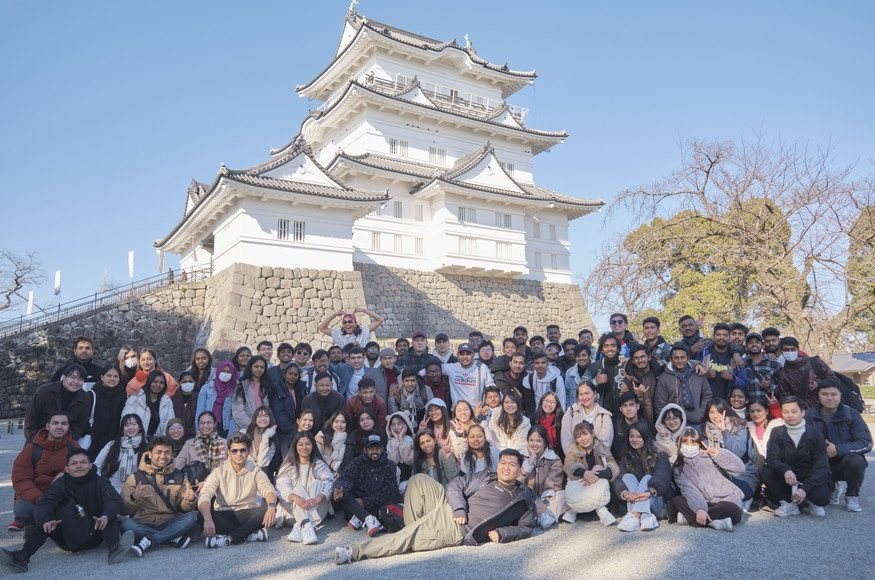
LIBERTY Odawara Japanese Language School
LIBERTY Odawara Japanese Language School
Compare side by side with other schools →
Tuition and conditions may change depending on the intake. If you contact us, we will check with the school and give you accurate details.
Nearby schools comparedBy distance · no ads or paid placement
- LIBERTY Odawara Japanese Language SchoolThis schoolTuition/yr¥825,000Progression84%IntakesApr · Oct
- Grandeur Global Academy Numazu Campus31.1km›Tuition/yr¥911,000Progression86%IntakesApr · Oct
- Kanagawa Judo Therapy and Acupuncture Vocational School, Japanese Language Department38.5km›Tuition/yr¥935,000Progression—IntakesApr · Jul · Oct
- Sagami International Academy39.5km›Tuition/yr¥813,000Progression99%IntakesJan · Apr · Jul · Oct
— means SALLAE has not yet found the data.
About the school
As the course names (Further Study 2 years and Further Study 1 year 6 months) suggest, this is a further-study-focused school. In the FY2025 immigration report, 64 students went on to universities and vocational schools (77 completed the program), and 86% of the March 2026 graduates went on to vocational schools. It opened in October 2016 in Odawara, Kanagawa, was founded by its parent company Tokai Building Maintenance, and is a 15-minute walk from Odawara Station. With the goal of passing JLPT N2 and N1, students enter in April (2 years) or October (1 year 6 months), and the dormitory has 2 people per room at ¥35,000 per month.
Published data and school website
Tuition
If you saw a lower amount elsewhere, it may not include the admission fee and application fee
Median 1-year tuition in other areas — Kyoto ¥911,000(7 schools) · Kanagawa ¥880,000(8 schools) · Okinawa ¥858,000(6 schools) · Tokyo ¥840,600(56 schools) · Fukuoka ¥835,000(12 schools) · Hyogo ¥825,500(7 schools) · Osaka ¥814,000(27 schools) · Shizuoka ¥790,000(9 schools) · Chiba ¥745,333(10 schools) · Aichi ¥740,667(5 schools)
Total by intake
| Intake · length | Full course |
|---|---|
| 1 year 6 months | ¥1,188,000 |
| 2 years | ¥1,551,000 |
Cost details · Course tables · Notes
- Per term
- ¥181,500 3 months
- One-time fees
- ¥99,000Application fee · Admission fee
| Duration | Total |
|---|---|
| 1 year 6 months | ¥1,188,000 |
| 1 year 9 months | ¥1,369,500 |
| 2 years | ¥1,551,000 |
★"Per term" and "One-time at start" were calculated by SALLAE from each course's total. The courses this school actually offers are 1 year 6 months onward — all amounts in the table are values calculated by SALLAE.
Calculated by SALLAE · verified 2026-09-16
Admission & dates
- Apr intake
- 2-year course · Application Jul 1–Oct 31 · Classes 1,600 hours (80 weeks)
- Oct intake
- 1 year 6 months course · Application Feb 1–Apr 30 · Classes 1,200 hours (60 weeks)
- Japanese level
- Applicants recognized as having Japanese ability of about JLPT N5 or higher
Applicants recognized as having studied Japanese for 150 hours or more and having Japanese ability of about JLPT N5 or higher (as of the application deadline). Applicants must have applied for the NAT-TEST Level 5.
Deadline and capacity rules
Further-study 2-year course: April intake, 80 students; further-study 1.5-year course: October intake, 40 students (PDF). Eligibility: those who have completed 12 or more years of school education overseas or an equivalent program. Within 5 years of graduating from the last school attended, and in principle under 30 years old
School website · 2026-06-17 updated
Classes
- Morning
- 09:00-12:30
- Afternoon
- 13:15-16:45
- Class assignment
- Level-based 6 stages
Materials · Subjects · Timetable · Details
- Materials
- Beginner: Minna no Nihongo Beginner / Intermediate: Minna no Nihongo Intermediate / Advanced: Manabou Nihongo Upper Intermediate and Advanced
Class period times 1 class period is 45 minutes. Periods 1 to 4. Days off: Saturdays, Sundays and public holidays
| Morning | Afternoon | |
|---|---|---|
| Period 1 | 09:00-09:45 | 13:15-14:00 |
| Period 2 | 09:55-10:40 | 14:10-14:55 |
| Period 3 | 10:50-11:35 | 15:05-15:50 |
| Period 4 | 11:45-12:30 | 16:00-16:45 |
Class hours by subject
| Subject | 2 years | 1 year 6 months |
|---|---|---|
| Beginner (first half) | 300 hr | 160 hours |
| Beginner (second half) | 300 hr | 240 hours |
| Intermediate | 500 hours | 400 hours |
| Advanced | 500 hours | 400 hours |
| Total | 1,600 hours | 1,200 hours |
Beginner → Upper beginner → Intermediate → Upper intermediate → Advanced → Super advanced. Class placement test every 3 months. The goal is to pass N2 and N1. Test subjects: characters and vocabulary, grammar, reading, conversation, listening and composition
What each level covers · 4 stages
- Beginner (first half)
- Survival daily conversation, basic use of adjectives and verbs, reading short texts, writing short compositions. Target: about 150 kanji and about 1,000 words. 160 hours (8 weeks) / 300 hours (15 weeks)
- Beginner (second half)
- Familiar conversation, verb forms such as potential, passive and causative, basic honorific language, simple diary writing. Target: about 300 kanji and about 2,000 words. 240 hours (12 weeks) / 300 hours (15 weeks)
- Intermediate
- Everyday conversation, gathering basic information from newspapers and magazines, and stating your own opinions. Target: about 1,000 kanji and about 6,000 words. 400 hours (20 weeks) / 500 hours (25 weeks)
- Advanced
- Conversation suited to the situation, discussion and negotiation in meetings, short essay training, and presentations using advanced expressions. Target: about 2,000 kanji and about 10,000 words. 400 hours (20 weeks) / 500 hours (25 weeks)
School website · 2025-08-15 updated
Documents to prepare — student visa course
- Admission application formSchool's prescribed form
- Resume (school's designated form). Be sure to attach a Japanese translation to (2) "Reason for study," (5), (6) and (10)
- Written pledgeSchool's prescribed form
- Health examination certificateOriginal
- Certificate of graduation or diploma from the last school attendedOriginal
- Academic transcript from the last school attended; if currently enrolled, a certificate of enrollment and a transcriptOriginal
- Documents proving Japanese study historyJLPT N5 or higher pass certificate, etc. (original)
- Copy of passportOnly the pages with a photo; if you have been to Japan before, also the entry-record pages
- 8 photos4 cm × 3 cm (white background, taken within the last 3 months)
Financial supporter's documents · only if applicable · 3 application requirements
Submitted by the person paying the tuition (financial sponsor)
- Financial sponsorship statementSchool's prescribed form) (handwritten by the sponsor
- Letter of guaranteeSchool's prescribed form) (handwritten by the sponsor
- Official documents proving the relationship between the sponsor and the applicantFamily register, etc.
- List of the sponsor's family membersFamily register, etc.
- Sponsor's bank deposit balance certificateOriginal
- Copy of bank passbook and documents explaining how the funds were accumulatedPassbook transaction record
- Sponsor's certificate of employmentoriginal (if the sponsor runs a company or is an officer: business license or certified copy of the corporate register, etc.)
- Document issued by a public agency that can verify the sponsor's identityID card, passport, etc.
- Income certificate and tax payment certificatePast 3 years
Only if applicable
- If currently enrolled, a certificate of enrollment and a transcript (original) (Current students)
- If the applicant is a working adult, submit a certificate of employment from the workplace (If you are employed)
- Certificate of residence (for all household members), tax payment certificate, etc. (showing income or earnings; for the past 3 years), and a copy of the residence card. * Not needed if the financial sponsor has Japanese nationality (If the financial sponsor lives in Japan)
- An official document that can confirm the applicant's identity, a bank balance certificate in the applicant's own name (original), the applicant's certificate of employment, and an annual income certificate (If the applicant pays the expenses)
Application requirements
The financial sponsor's documents are the standard for sponsors living abroad; if the sponsor lives in Japan or the applicant pays, check the documents for that case. Be sure to attach a Japanese translation to (1) "How the financial sponsorship came about" and "Method of payment," and to (3) through (9). Even documents in English must have a Japanese translation. The guarantor must be the student's parent or an adult who lives independently in their place, and who can take responsibility for paying the student's tuition and other expenses and for all personal matters
For short-term courses, only the application form, résumé, pledge, and guarantee of identity · 2 photos (3 cm × 4 cm) · copies of the passport and residence card · other documents (additional documents may be requested) are submitted.
School website · 2026-06-17 updated
Admission process
- Request an admission consultation — TEL: 0465-23-4411 FAX: 0465-23-4412 E-mail: info@lib-odawara.jp
- Prepare application documents — Admission guidelines and information materials are distributed. Information sessions and interviews for applicants (held on site or by Skype)
- Submit application documents and pay the application fee (¥20,000; ¥22,000 including tax) — The application fee of ¥20,000 (¥22,000 including tax) is paid when you submit the application documents. The application fee is never refunded, whether or not you are accepted. Send the application documents by EMS, OCS, DHL, FedEx, etc.
- First screening (document screening) — If the documents are incomplete, you may be asked to submit them again, so please be careful
- Second screening (on-site interview and written exam) — Second screening (on-site interview and written exam). Written exam: 1. Japanese 2. Composition (in Japanese or your native language). Interview: with the financial sponsor present
- Notice of result
- Application to the Immigration Services Agency for the Certificate of Eligibility — Apply for a Certificate of Eligibility at the Yokohama Branch of the Tokyo Regional Immigration Services Bureau
- Issuance result known and notified — The result of the Certificate of Eligibility is communicated to the applicant and the guarantor
- Pay first-year tuition — The Certificate of Eligibility is handed over after payment of the admission fee, tuition, facility fee and other costs is confirmed
- The admission letter and the Certificate of Eligibility are sent to the applicant
- Apply for a visa at a Japanese diplomatic mission abroad and obtain a student visa
- Arrive in Japan and enrol — Arrive in Japan (Haneda Airport or Narita Airport): airport pick-up and dormitory move-in guidance
- Placement test
- Students who work hard and build their skills can move up to a higher class through the class placement test held every 3 months
School website · 2026-06-17 updated
Short-term study
- Visa
- Temporary visitor or Working holiday(not a student visa)
- Open now?
- Rolling admissions, so availability varies from time to time — SALLAE will confirm with the school
Course without a student visa
- Short-term auditor course — For people who can obtain their own visa, or who are on a short stay or visa-exempt. Must have basic Japanese ability such as reading and writing hiragana. Minimum study period of 3 months. Starts 4 times a year
★Short-term courses are not listed in the published data — it counts only student-visa courses.
School website · 2026-06-17 updated
Graduate outcomes
| FY2025 | Admitted |
|---|---|
| Employment | 2 students |
| Graduates | 77 students |
See 19 more schools
All schools accepted to so far
Prepared Jun 5, 2026: 77 completed the course, 76 met the standard (92.7%), 5 withdrew. Progression: 2-year 47 · 1.5-year 17 · Number permitted to change to a status of residence in the upper column of Appended Table 1-1 or 1-2 of the Immigration Control Act: 1 (progression 2-year) · 1 (progression 1.5-year). 10% of the March 2026 graduates found employment · School website · Updated Jul 17, 2026
Reviews 1
External reviewAuto-translatedPersonal review · Google review · Oct 2024
I had a great time for two years.
두 해 동안 즐거웠어요.
External reviews are public posts that SALLAE collected and rewrote in the writer’s own voice. SALLAE keeps the original links.
University prep
- Progression guidance — Thorough career guidance by experienced specialist teachers. Continuous support from choosing a path until a university, vocational school or employer is decided. Detailed further-study guidance centered on universities and vocational schools in the Kanto region
- Special courses for the elective subjects of the exam for international students — For exam preparation, the school also offers special courses for the elective subjects of the exam for international students
- Interview practice — Interview practice for further study and job-hunting is built into classes, with thorough guidance
- Employment support — For students who graduated from university or the like in their home country and have excellent Japanese ability, the school actively supports finding jobs in Japan, such as with local companies around Odawara
- Partnership programs with universities — To help students go on to vocational schools and universities, the school is developing partnership programs with universities
School website · 2024-11-07 updated
Daily-life support
- General consultation on life and study in Japan — A support system is in place so that students can easily consult about anything that worries them in any aspect of their environment, such as life in Japan, finances and study content
- Airport pickup — Airport pick-up and dormitory move-in guidance
- Part-time work — Under Japanese law, students can work up to 28 hours per week. Some students work in hotels, supermarkets, restaurants and the like. There are part-time jobs at an easy level
- Health checkup — A health checkup is held once a year, as separately determined
School website · 2026-06-16 updated
Students
85 enrolled (2026) · Capacity 160 National median: 180 students
Based on 85 students enrolled in 2026.
Public data from the Association for the Promotion of Japanese Language Education (Nisshinkyo) · verified 2026-09-20
School life
For 1 year
- 4
- EJU preparation · Health examination · Cherry blossom viewing · Orientation
- 5
- JLPT preparation · April intake entrance ceremony
- 6
- JLPT preparation · EJU · Midterm exam
- 7
- New student welcome tour · JLPT
- 8
- Summer vacation · Summer supplementary classes · Progression guidance
- 9
- EJU preparation · Final exam
- 10
- October intake entrance ceremony · Health examination · Orientation · JLPT preparation
- 11
- JLPT prep · EJU · New student welcome tour
- 12
- Midterm exam · General cleaning · Winter break · JLPT
- 1
- First shrine visit of the year
- 2
- Speech presentation · Final exam
- 3
- Graduation ceremony · Spring break
The annual schedule is based on the June 2026 school guide. The school life page on the website (2024) separately lists a spring excursion in July and an autumn break in October · Holidays are based on the August 2025 version of the school rules, and depending on the day of the week, days off may shift slightly from year to year
- Seasonal events such as the first shrine visit of the year, Setsubun and the Tanabata festival are plentiful, so you can learn about Japanese culture
- Exchange activities rooted in the local community are also plentiful, such as visiting a local elementary school, touring a waste treatment facility, and visiting a factory that makes kamaboko, Odawara's specialty
- Through volunteer activities, students experience the local area of Odawara and Hakone and come to understand Japanese culture
- Spring excursion, strawberry picking, a friendly soccer match, cleanup activities, the Odawara Hojo Godai Festival and a fireworks display
On campus
- Classroom 1, Classroom 2, Classroom 3
- Library (study room)
- Infirmary
2025–2026 academic calendar · Older data
- Summer vacation
- Jul 25 to Aug 31
- Autumn break
- Nov 1 to Nov 4
- Winter break
- Dec 20 to Jan 5
- Spring break
- Mar 15 to Apr 5
School website · 2026-06-16 updated
Access
- Transit
- JR Tokaido Main Line, Odawara Station, 15 min on foot
Odakyu Odawara Line, Odawara Station, 15 min on foot - Nearby
- 15 minutes on foot from Odawara Station (12 minutes on foot per the school guide FAQ). About 30 minutes by Shinkansen from Tokyo Station. Odawara Castle, Hakone and Atami are nearby
- Dormitory
- Available¥35,000/month · Dormitory fee: ¥35,000 per person per month (utilities and wireless internet included). 2 people per room. Boys' dormitory 5 min on foot from the school, girls' dormitory 20 min on foot or 10 min by bicycle · Based on the school website
School website · 2024-11-07 updated
Student dormitory — Move-in fee (futon and equipment use fee, etc.) ¥30,000, dormitory deposit ¥45,000 (refunded on moving out; may be applied toward the return air ticket), repair fee ¥5,000, dormitory fee for 3 months ¥105,000, total ¥185,000. Bicycle rental is free during your stay
School website · 2026-06-16 updated
SALLAE has organized the school website and published data in English.
The update date is the day that material was last revised.
Photos are materials published by the school.
This information is compiled from official sources and is not updated daily. Please confirm with the official contact before signing or applying.