Mirai Japanese Language School
Mirai Japanese Language School
- Dormitory fee
- From ¥20,000 per month ›
- Admission
- Twice a year · April and October ›
- Japanese at entry
- From N5 ›
Compare side by side with other schools →
Tuition and conditions may change depending on the intake. If you contact us, we will check with the school and give you accurate details.
Nearby schools comparedBy distance · no ads or paid placement
- Mirai Japanese Language SchoolThis schoolTuition/yr¥799,000Progression85%IntakesApr · Oct
- Hitachi Gakuin0.8km›Tuition/yr¥715,000Progression98%IntakesJan · Apr · Jul · Oct
- Ibaraki International Academy3km›Tuition/yr¥670,000Progression—IntakesApr · Jul · Oct
- Hitachi Sakura Japanese Language School32.3km›Tuition/yr¥771,000Progression—IntakesJan · Apr · Jul · Oct
— means SALLAE has not yet found the data.
About the school
The study-abroad course is a single 2-year course for international students aiming at further study at vocational schools and similar institutions, or at employment, and its record is stronger in further study. Of the 19 students who completed the course in fiscal 2025, 17 went on to Japanese universities, vocational schools or similar. The school opened in 2018 in central Mito, Ibaraki (2nd to 5th floors of the Work Mito Building); capacity is 120, and as of the end of August 2026 it had 71 students and 6 teachers, with intakes in April and October. It offers career guidance such as JLPT and EJU preparation, résumé and interview practice, and life support such as visa procedures and accompanying students to hospital; the dormitory is a rental apartment introduced by the school, at about ¥20,000 per month.
Published data and school website
Tuition
If you saw a lower amount elsewhere, it may not include the admission fee and application fee
Median 1-year tuition in other areas — Kyoto ¥911,000(7 schools) · Kanagawa ¥880,000(8 schools) · Okinawa ¥858,000(6 schools) · Tokyo ¥840,600(56 schools) · Fukuoka ¥835,000(12 schools) · Hyogo ¥825,500(7 schools) · Osaka ¥814,000(27 schools) · Shizuoka ¥790,000(9 schools) · Chiba ¥745,333(10 schools) · Aichi ¥740,667(5 schools)
Total by intake
| Intake · length | Full course |
|---|---|
| April intake · 2 years | ¥1,520,200 |
| October intake · 2 years | ¥1,520,200 |
Cost details, tables by course and notes · 6 items
- One-time fees
- ¥798,600Tuition (1st-year annual fee ¥660,000) ¥660,000 · Application fee ¥22,000 · Admission fee ¥55,000 · Materials ¥22,000 · Activity fee ¥39,600
According to the school guide, one year's fees are paid in one lump sum at enrollment. SALLAE will check with the school whether you can pay in installments.
| Intake · course | Extra 2nd-year costs | All |
|---|---|---|
| April · 2 years | ¥721,600 | ¥1,520,200 |
| October · 2 years | ¥721,600 | ¥1,520,200 |
These are costs paid additionally in the 2nd year. The application fee and admission fee are not charged again. 2nd-year annual fees: tuition ¥660,000, materials ¥22,000, activity fee ¥39,600 (consumption tax included).
Items marked with * include consumption tax (10%). School rules: application fee ¥20,000, admission fee ¥50,000, tuition (general 2-year course) ¥1,200,000, consumption tax not included.
Please pay the application fee when applying. After the Certificate of Eligibility is issued, an invoice is sent, and one year of tuition and other fees is paid. After enrollment, payment is made every 6 months or every year.
Medical insurance ¥13,000 (annual, first year). When invoicing, ¥4,500 is charged as an international remittance fee; if there is a difference, it is settled after arrival in Japan.
Dormitory entry fee ¥20,000, rent ¥120,000 (for both the first and second half of the year), housing insurance ¥12,000. For airport pickup, a pickup fee of ¥10,000 applies; please consult us in advance, as the cost varies.
The admission fee is waived for those who have N3 or higher when the Certificate of Eligibility is issued.
Some events may be charged separately. If the consumption tax in Japan changes, the difference will also be collected during enrollment.
School website · 2026-08-17 updated
Whether it is refundable
- If the CoE is issued but the visa is not applied for and the student does not come to Japan
- Condition: return the admission permit and the Certificate of Eligibility. Refund: all payments are refunded except the application fee and admission fee.
- If the Japanese embassy or consulate refuses to issue a visa
- Condition: return the admission permit and provide proof that the visa was not issued. Refund: all payments are refunded except the application fee and admission fee.
- If you decline enrollment after obtaining an entry visa at an embassy or similar, before coming to Japan
- Condition: return the admission permit and confirm that the unused visa has expired. Refund: all payments are refunded except the application fee and admission fee.
- Not enrolling after arriving in Japan
- No refund is made for any reason.
See refund policy in detail · 2 more lines
- A student who obtained a visa, came to Japan and enrolled, and then withdraws without a justified reason
- As a rule, no refund
- When you receive a refund
- The application fee is not refunded for any reason. The remittance fee is borne by the applicant.
Admission & dates
⚠ The Japanese requirement at application differs between sources. Please confirm with the school. Those who passed a test equivalent to JLPT N5 in their home country. * For the October intake, those who passed a test equivalent to N4. · Those who passed a test equivalent to JLPT N5 in their home country, or who have 150 or more hours of study history. Document table: a pass certificate for N5 or higher, or a study certificate of 150 or more hours from a local Japanese language school. Please confirm with the school whether you can apply with only a 150-hour study certificate and no pass certificate, and whether the same applies to the October intake.
- Apr intake
- 2-year course · Application For April admission, application documents are submitted to the school in August. · Classes 1,520 hours (76 weeks) over 2 years, 20 hours per week. 1 class hour is 45 minutes.
- Oct intake
- 2-year course · Application For October admission, application documents are submitted to the school in March. · Classes 1,520 hours (76 weeks) over 2 years, 20 hours per week. 1 class hour is 45 minutes.
- Japanese level
- Proof of Japanese ability of JLPT N5 or higher (pass certificate)
For the October intake, those who passed a test equivalent to N4
Deadline and capacity rules
The application deadline is roughly 6 months before the enrollment date. Capacity 120; 71 students enrolled (as of the end of August 2026). Admission requires completion of 12 or more years of school education or equivalent.
School website · 2026-08-24 updated
Classes
- Morning
- 09:00-12:30 4 periods of 45 minutes
- Afternoon
- 13:20-16:50 4 periods of 45 minutes
- Class assignment
- Level-based 8 stages
Materials · Subjects · Timetable · Details
- Materials
- Elementary I to Intermediate II: Dekiru Nihongo. Intermediate III to Advanced II: Manabou! Nihongo. Advanced III: authentic materials and newspapers. Kanji Master and Nihongo Soomatome are used together.
Class period times 20 hours per week (one class period is 45 minutes), periods 1 to 4 each day.
| Morning | Afternoon | |
|---|---|---|
| Period 1 | 09:00-09:45 | 13:20-14:05 |
| Period 2 | 09:55-10:40 | 14:15-15:00 |
| Period 3 | 10:50-11:35 | 14:15-15:55 |
| Period 4 | 11:45-12:30 | 16:05-16:50 |
A course in which students start from hiragana, katakana and everyday conversation and, over two years, gain the speaking, listening, writing and reading skills needed for work or further study.
What each level covers · 8 stages
- Beginner I
- Acquire correct pronunciation and writing. Basic conversation and the first half of elementary sentence patterns. Write a composition of about 200 characters. 150 kanji. Complete N5-level grammar, vocabulary and reading.
- Beginner II
- Everyday conversation and completion of elementary sentence patterns. Understand short texts. Write a composition of about 300 characters. 300 kanji. Complete N4-level grammar, vocabulary and reading.
- Intermediate I
- Speak spontaneously and in logical order. Understand speech at natural speed. Write a composition of about 400 characters with paragraph structure. Complete N3-level grammar, vocabulary and reading.
- Intermediate II
- Conversation including honorific and politeness expressions. Read substantive texts. Write a composition of about 600 characters with paragraph structure. Acquire N2-level grammar, vocabulary and reading.
- Intermediate III
- Read coherent texts. Understand fairly long discourse. Write objective compositions. Complete N2-level grammar, vocabulary and reading.
- Advanced I
- Understand long texts. Develop listening and reading skills to infer and understand unfamiliar vocabulary. Learn to write your own opinions logically. Acquire N1-level grammar, vocabulary and reading.
- Advanced II
- Understand somewhat specialized texts. Learn to express your own views logically and objectively. Write short essays. Complete N1-level vocabulary, grammar and reading.
- Advanced III
- Understand papers, lectures, newspapers and news. Learn discussion and presentation skills. Write reports.
School website · 2026-08-24 updated
Documents
- Application form [school-designated form]: write your name as it appears in your passport.
- Résumé and statement of reasons for study (school's designated forms): fill in education and work history without gaps, give each school's location in full, and describe the reasons for study specifically, in line with the education and work history.
- Diploma of the last school attended. Original. Diploma or graduation certificate
- Transcript of the last school attended. Original. Showing grades from entrance to graduation
- Proof of Japanese ability (original): JLPT N5 or higher pass certificate, or a certificate of 150 or more hours of study at a Japanese language school in your home country.
- Passport. Copy. If you have entered Japan before, also submit a copy of the pages showing entry and exit.
- 5 photos, 4 cm tall × 3 cm wide, taken within the last 3 months. Write your name, nationality and date of birth on the back
Sponsor documents · Only if applicable · 5 application requirements
Submitted by the person paying the tuition (financial sponsor)
- Financial sponsorship statement (school form)
- Bank balance certificate (original)
- Copy of bank passbook * for the past 1 year3 years' worth
- Certificate of employment, etc. Employee: certificate of employment. Self-employed: copy of business license. Company officer: certified copy of company registration, etc.
- If a parent or relative living abroad pays the expenses: income certificate, original, for the past 3 years
- If a parent or relative living abroad pays the expenses: tax payment certificate, original, for the past 3 years, showing the income or earnings amount
- If a parent or relative living abroad covers the expenses: documents proving the relationship between the applicant and the financial sponsor, such as a notarized certificate of kinship or birth certificate
- If a relative living in Japan or the applicant pays the expenses: tax payment certificate for the past 3 years (tax payment certificate or tax assessment certificate)Showing the income amount
- If a relative living in Japan covers the expenses: residence certificate, for all household members
- If a relative living in Japan covers the expenses: documents proving the relationship between the applicant and the financial sponsor, such as a certified copy of the family register or a notarized certificate of kinship
- If the applicant pays the expenses: emergency contact, free format. State the name, relationship, address, phone number and email address of a family member or similar.
Only if applicable
- Certificate of enrollment, original; transcript, original (If you are currently enrolled in a high school, university or similar)
- Tuberculosis-free certificate (Vietnam, Nepal, the Philippines)
Application requirements
Submit original documents dated within 3 months of issue. The applicant and the financial sponsor must fill in the forms themselves. Tell the school at the time of application which certificates you want returned. Documents submitted to the Immigration Bureau are not returned by the Immigration Bureau. Please submit a Japanese translation. Please ask about tests that are recognized by the Immigration Services Agency as proving Japanese ability.
School website · 2026-08-17 updated
Admission process
- Request an admission consultation — Inquiry form (select the type of inquiry), MAIL: info@mirai-nihongo.jp, TEL: 029-350-2082.
- Submit application documents — Submit the application documents to the school in August for the April intake and in March for the October intake. Pay the application fee when applying.
- Interview and document screening — Interview and document screening in September for the April intake and in April for the October intake. A conversation test and a reading test are given at the interview. Written exam (given if needed).
- Submit application documents in the way the school specifies — Submit the documents needed for the application to the school from October to November for the April intake and from May to June for the October intake.
- Application to the Immigration Services Agency for the Certificate of Eligibility — The school submits the application for the Certificate of Eligibility to the Immigration Services Agency in mid-November for the April intake and mid-June for the October intake.
- Announcement of results — Results are announced in mid-February for the April intake and mid-August for the October intake. You are told that the certificate was issued, and an invoice is sent at the same time.
- Pay the admission fee and tuition — Pay the admission fee, tuition and other fees to the school in late February for the April intake and late August for the October intake. After receiving the invoice, pay directly to the school's Japanese bank account.
- Certificate of Eligibility and admission permit sent — Once payment is confirmed, the school sends the admission permit and Certificate of Eligibility.
- Complete the student visa procedure and arrange the flight — Apply for a student visa at the Japanese embassy or consulate in your country, and arrange your flight at the same time.
- Arrive in Japan and enrol — Arrive in Japan in April or October and enroll at Mirai Japanese Language School.
School website · 2026-08-24 updated
Short-term study
- Open now?
- Rolling admissions, so availability varies from time to time — SALLAE will confirm with the school
Course without a student visa
- Technical Intern Training course — About 1 month of training before placement for foreign nationals in technical internship and employment-for-skill-development programs. 22 days (176 hours in total): Japanese 82, life knowledge 72, skills 8, legal protection 8, police 2, disaster prevention 4 hours.
★Short-term courses are not listed in the published data — it counts only student-visa courses.
School website · 2026-08-24 updated
Graduate outcomes
| FY2025 | Admitted |
|---|---|
| Employment | 1 student |
| Graduates | 19 students |
Prepared Apr 1, 2026: 19 completed the course; 20 met the standard in total (including 1 who withdrew); standard-compliance rate 100.0%. · Number permitted to change to a status of residence in the upper column of Appended Table 1-1 or 1-2 of the Immigration Control Act (excluding Diplomat, Official and Technical Intern Training) · School website · Updated Apr 1, 2026
Reviews
If you study here or used to, tell others what the classes, teachers and daily life were like. It helps anyone deciding on this school.
Write the first reviewUniversity prep
- Consistent support from progression to employment — Besides preparation for the JLPT and the EJU, the school gives thorough support, from how to write a résumé to interview practice, until your path is decided.
School website · 2026-09-18 updated
Daily-life support
- Consultation on visa procedures and daily life — Consultation from visa procedures to daily life
- Accompaniment to the hospital — Life support system, including accompanying students to hospital visits.
- Airport pickup — Please consult us in advance about airport pickup. The cost varies. The pickup fee in the fee table is ¥10,000.
- Health checkup — Health checkups for students and staff are held once a year
- Disaster prevention learning — November: school events, health checkup, disaster prevention learning
School website · 2026-09-18 updated
Scholarship
- The admission fee is waived
- The admission fee is waived for those who have N3 or higher when the Certificate of Eligibility is issued.
- If there is a special reason, such as being a scholarship student
- School rules, Article 20: If there is a special reason, such as being a scholarship student, tuition may be reduced or waived in whole or in part, as separately determined.
School website · 2026-08-24 updated
School life
For 1 year
- 4
- Apr intake enrollment
- 5
- School events
- 6
- Regular exams
- 7
- 1st JLPT · School event
- 8
- Summer vacation
- 9
- Regular exams
- 10
- Oct intake enrollment
- 11
- School event · Health examination · Disaster-prevention learning
- 12
- 2nd JLPT · Regular exam · School event · Winter break
- 2
- School events
- 3
- Regular exam · Graduation ceremony · Spring break
This is the annual schedule on the course information page · No events are listed for January.
- Bowling tournament, excursion, barbecue, sports day
- Example for the morning class: classes start at 9:00; lunch after classes end at 12:30; part-time job at 14:00; free time after 18:00. Times are a guide.
On campus
- 2nd–5th floors
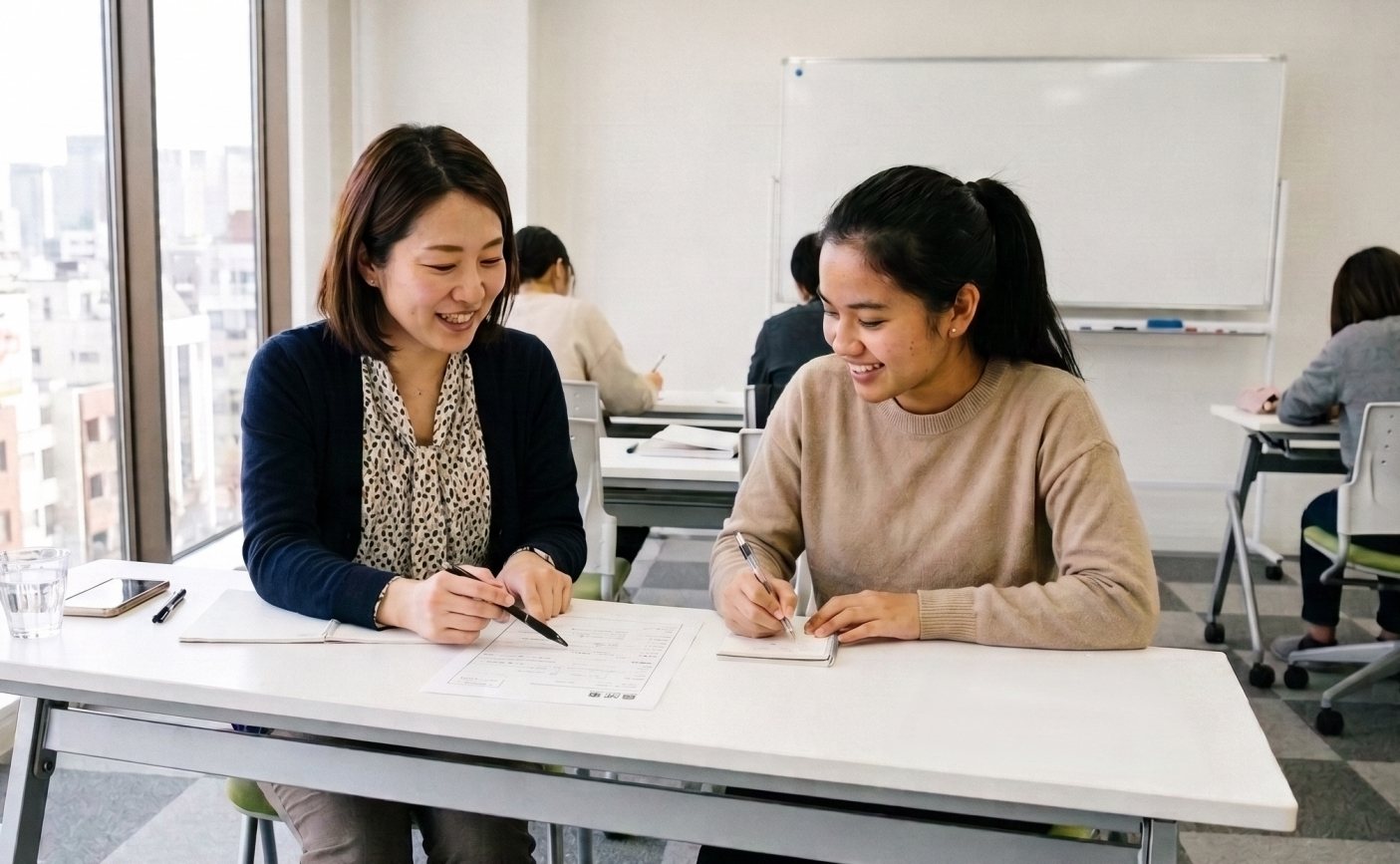
- School building and classrooms — 2nd to 5th floors of the Work Mito Building in central Mito. Commercial facilities and restaurants are nearby.
2026–2027 academic calendar
- Summer vacation
- In principle, early to mid-August
- Winter break
- In principle, late December to early January
- Spring break
- In principle, mid-March to early April
School website · 2026-08-24 updated
Access
- Nearby
- By car, from central Tokyo to Mito-Minami IC (about 90 minutes via the Joban Expressway and Kita-Kanto Expressway). Mito is the prefectural capital and has Kairakuen, and there are many Asian restaurants and food shops.
- Dormitory
- Available · Rental housing and apartments. Rent ¥120,000 (per first or second half of the year). The school is about a 10–20 minute walk from the dormitory. Utilities are paid by the student. · Based on school website
School website · 2026-08-17 updated
Dormitory — Furniture, appliances, cooking utensils, a full set of bedding, detergents and more are prepared so students can start living right after arriving in Japan. Wi-Fi available. Fully equipped with air conditioning and heating, refrigerator, washing machine and bed; unit bath (depending on the location).
School website · 2026-08-17 updated
SALLAE has organized the school website and published data in English.
The update date is the day that material was last revised.
Photos are materials published by the school.
This information is compiled from official sources and is not updated daily. Please confirm with the official contact before signing or applying.