Nagaoka University of Technology
長岡技術科学大学
Top Global University (Type B · Global Traction)ⓘOf the 37 universities MEXT has supported since 2014 to take more international students and expand English-taught classes and exchange, these 24 were chosen to lead the internationalization of Japanese universities.
Opening soonApplications open 12/1 · Privately financed international student admission (first-year entry)
- Exam location
- Online from outside Japan ›
- Japanese requirement
- Take the EJU (no minimum score) ›
- First-year fees
- from ¥817,800 ›
Compare with other universities →
Fees and conditions can change over time. Always check the school's guidelines before you apply.
Fees and conditions can change over time.
About the school
A national university founded in 1976. It has 2,271 students, including 278 international students (undergraduate 93 · graduate 185). There are 190 faculty members.
History · 6
- 1976
- Nagaoka University of Technology opened (newly established by an amendment to the National School Establishment Law). The Faculty of Engineering started in 1977 with 6 programs
- 1980
- The Graduate School of Engineering (master's program) was established. The doctoral program was established in 1986
- 1986
- The International Exchange Hall was completed (the 30th Anniversary Student Dormitory was completed in 2008)
- 2004
- It became the National University Corporation Nagaoka University of Technology
- 2015
- A 5-year integrated doctoral program (Technological Science Innovation major) was established in the graduate school. The undergraduate program names were also reorganized
- 2022
- The 6 programs of the Faculty of Engineering were reorganized into a single "Engineering Program," with study in 5 fields (Mechanical; Electrical, Electronics and Information; Information and Management Systems; Materials and Bioengineering; Environmental and Civil Infrastructure)
大学改革支援・学位授与機構「大学基本情報」2026(R8) (7-A) 学生数 · 大学改革支援・学位授与機構「大学基本情報」2026(R8) (11) 国費留学生,私費留学生,留学生以外の外国人学生 · 大学ポートレート(国公立大学) 長岡技術科学大学 大学の概要
Admission requirements and dates
Nagaoka University of Technology admits international students through 1 route.Based on the guidelines for April 2027 entry
EJUThe exam Japanese universities use for international student admission · June and November · also held outside Japan = Examination for Japanese University Admission · JLPTJapanese-Language Proficiency Test · N1 is the highest, then N2 = Japanese-Language Proficiency Test
Apply with EJU + English score + documents (no exam)
Official name: 日本留学試験+英語
You send your application documents from December 1 to 4, 2026, and results are announced on January 22, 2027. There is no written exam or interview; the decision is made on three things: your application documents, the EJU, and the TOEIC or TOEFL.
Applications open 12/1 · in 4 days
First-year privately financed international student admission · documents + EJU + English score
- Apply 12/1~12/4opens in 4 days
- →
- Results 1/22
- →
- Enroll ~2/5
Tuition is ¥267,900 for each of the first and second semesters (¥535,800 per year), paid by bank account transfer on June 1 for the first semester and November 1 for the second. The admission fee and tuition for the 2027 academic year have not been decided; the 2026 amounts (admission fee ¥282,000) are shown as a reference
EJU subjects · 4 subjects in 3 areas: Japanese, Mathematics (Course 2), and Science (any 2 subjects of your choice)
Valid sittings · The 1st (June) or 2nd (November) sitting of the 2026 academic year
Other requirements · You must have taken the TOEIC L&R (SP public test) or the TOEFL (iBT or iBT Home Edition) in January 2025 or later
Good to know before applying
- Results of the privately financed international student admission (first-year entry): in the 2026 academic year, 14 applicants and 0 admitted; in 2025, 8 applicants, 2 admitted, and 0 enrolled; in 2024, 11 applicants, 3 admitted, and 1 enrolled. The number of places is a small number in each of the 5 fields
- The university checks before you apply whether you meet the application requirements, so you must contact the Entrance Examination Section 1 of the Admissions Office by Monday, October 26, 2026, follow its instructions, and submit the specified documents
- You must have taken all 4 EJU subjects in 3 areas, Japanese, Mathematics (Course 2), and Science (any 2 subjects of your choice), at the 1st (June) or 2nd (November) sitting of the 2026 academic year. For Japanese, only the Reading, Listening, and Listening-Reading scores are used
- You need a TOEIC L&R (SP public test) or TOEFL (iBT or iBT Home Edition) score from a test taken in January 2025 or later. Send your TOEFL score from your ETS account to the university (DI code 1904); it is invalid if the university cannot confirm it by December 4. Only the Test Date score is used for TOEFL, not the MyBest score
- There is no written exam or interview; the decision is made on three things: your application documents, EJU scores, and TOEIC or TOEFL score
- To be eligible, you must not hold Japanese nationality or have Japanese permanent residence permission. You must also hold a residence status under the Immigration Control Act that allows you to enter a university, or be able to obtain one after admission.
- Submit original certificates (for foreign certificates whose originals cannot be submitted, copies certified as originals by a public body such as an embassy), and attach a translation to any document not in English or Japanese. Documents must arrive by December 4, 2026, by registered express mail or international courier
- Pay the ¥17,000 examination fee at a bank counter using the university's designated transfer request form (Japan Post Bank, post offices, and ATMs are not accepted). If you live overseas, pay by telegraphic transfer; you cover all fees, and the remitter's name must be the same as the applicant's. The examination fee is not refunded except in cases such as when you do not apply
- You choose one field as your first choice, and you may choose one field other than your first choice as your second choice
- Entry into the third year of the faculty (for graduates of colleges of technology, twinning programs, and so on) is a separate admission process; these guidelines cover first-year entry only
- The amounts payable for those entering in the 2027 academic year have not been decided; the 2026 amounts (admission fee ¥282,000, tuition ¥535,800 per year) are shown as a reference
長岡技術科学大学 募集概要
Fees
- First-year fees
- ¥817,800
- Application fee
- ¥17,000
- Examination fee ¥17,000 (paid at a bank counter; Japan Post Bank, post offices, and ATMs are not accepted).
- Admission fee ¥282,000; tuition ¥535,800 per year (2026 amounts).
- The amounts for those entering in the 2027 academic year have not been decided.
- Admission fee ¥282,000 + tuition ¥535,800 = ¥817,800 (calculated from the 2026 amounts)
Places and fees by department 5
| Department | Places | First-year fees (¥) | |
|---|---|---|---|
| Faculty of Engineering, Engineering Program | |||
| Mechanical Engineering | A small number of places | ||
| Electrical, Electronics and Information Engineering | A small number of places | ||
| Information and Management Systems Engineering | A small number of places | ||
| Materials and Bioengineering | A small number of places | ||
| Environmental and Civil Infrastructure Engineering | A small number of places | ||
Places are the total across all international student admissions. Fees are for 2026 entry.
For 2026 entry · from the school's guidelines
Documents to prepare
Application form (with photo), address label, payment of the ¥17,000 examination fee (with the payment certificate sheet attached), a copy of your EJU admission ticket, TOEIC score certificate (original, with photo) or TOEFL score (sent online from ETS), academic transcript (from your last school), statement of purpose (in Japanese, written by you), graduation (expected) certificate and copies of any relevant qualification certificates, and a resident record or similar (a copy of your passport if you live overseas)
Graduate outcomes
How these are counted
- Undergraduate graduates only (2025 academic year).
- Most of the 416 who went on to further study moved on to this university's graduate school.
- In addition to 45 who found jobs and 416 who went on to further study, 7 returned to their home country and 3 were other
Of the 471 undergraduate graduates in the 2025 academic year, 45 found jobs, 416 went on to further study, 7 returned to their home country, and 3 were other. Of the 373 master's program completers, 327 found jobs, 23 went on to further study, 11 returned to their jobs, 9 returned to their home country, and 3 were other
University Portraits · figures for all students (not international students only)
Reviews from students
No reviews yet. If you attend or attended this school, please write the first one.
Write a review
Scholarships
- Privately financed international students can apply for a full waiver (¥282,000) or half waiver (¥141,000) of the admission fee, or for a deferral of payment, under the university's own system. If you wish to apply for a waiver or deferral, do not pay the admission fee during the enrollment procedure period.
- For privately financed international students, tuition may be fully or half waived for each semester on application if you have difficulty paying for financial reasons and have excellent academic results
- There are private foundation scholarships you can apply for after enrollment (examples that need a university recommendation: JEES Scholarship for International Students (Study) ¥40,000 per month, Rotary Yoneyama Memorial Foundation ¥100,000 per month, Heiwa Nakajima Foundation ¥170,000 per month (undergraduate), and others. Application periods and amounts are from the list updated in October 2026)
- There is a Japanese government (MEXT) scholarship program for international students through embassy recommendation; ask the Japanese embassy in your home country
Student life support
- The university has housing that international students can live in (dormitory fees will be revised from April 2027): Student Dormitory (men, single rooms, 30 rooms for international students) ¥12,000 per month (currently ¥6,000); International Student Dormitory (women, single rooms, 15 rooms for international students) ¥15,000 per month (currently ¥9,000); International Exchange Hall (international men, single rooms, ¥14,000 per month without a bath and ¥16,000 with a bath; couple and family rooms are also available); 30th Anniversary Student Dormitory (single rooms, ¥18,000 per month).
- Common service fees and utilities are separate for these.
- The share-house style LinkTeCH House (23 international men and 12 international women) is ¥32,850 per month (room fee, utilities, internet, and shared supplies included; no revision)
Getting there
- Nagaoka University of Technology (Kamitomioka-cho Campus)
- About 30 minutes by bus bound for "Gidai-mae" from Bus Stop 7 at the Ote (west) exit of JR Nagaoka Station. By taxi, it is 8.5 km, about 20 minutes, from the Ote (west) exit of Nagaoka Station. From Tokyo, it takes about 90 minutes to Nagaoka Station by the Joetsu Shinkansen · Faculty of Engineering (Engineering Program)
新潟県長岡市上富岡町1603-1
SALLAE compiled this from the school's admission guidelines and official sources (such as University Portraits).
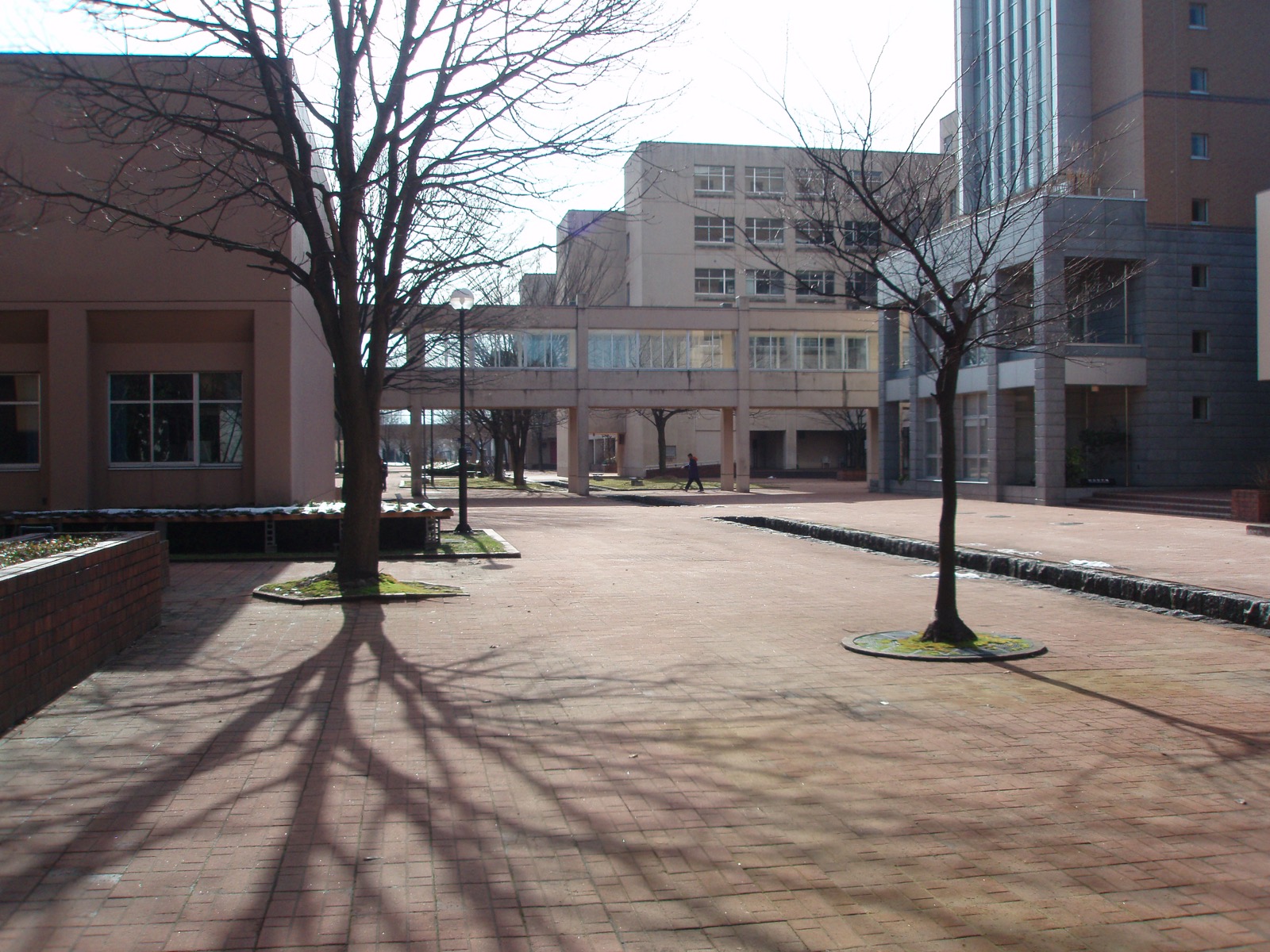
Photo: Original uploader was Umatake at ja.wikipedia · CC BY-SA 3.0 · Wikimedia Commons
This information is compiled from official sources and is not updated daily. Please confirm with the official contact before signing or applying.