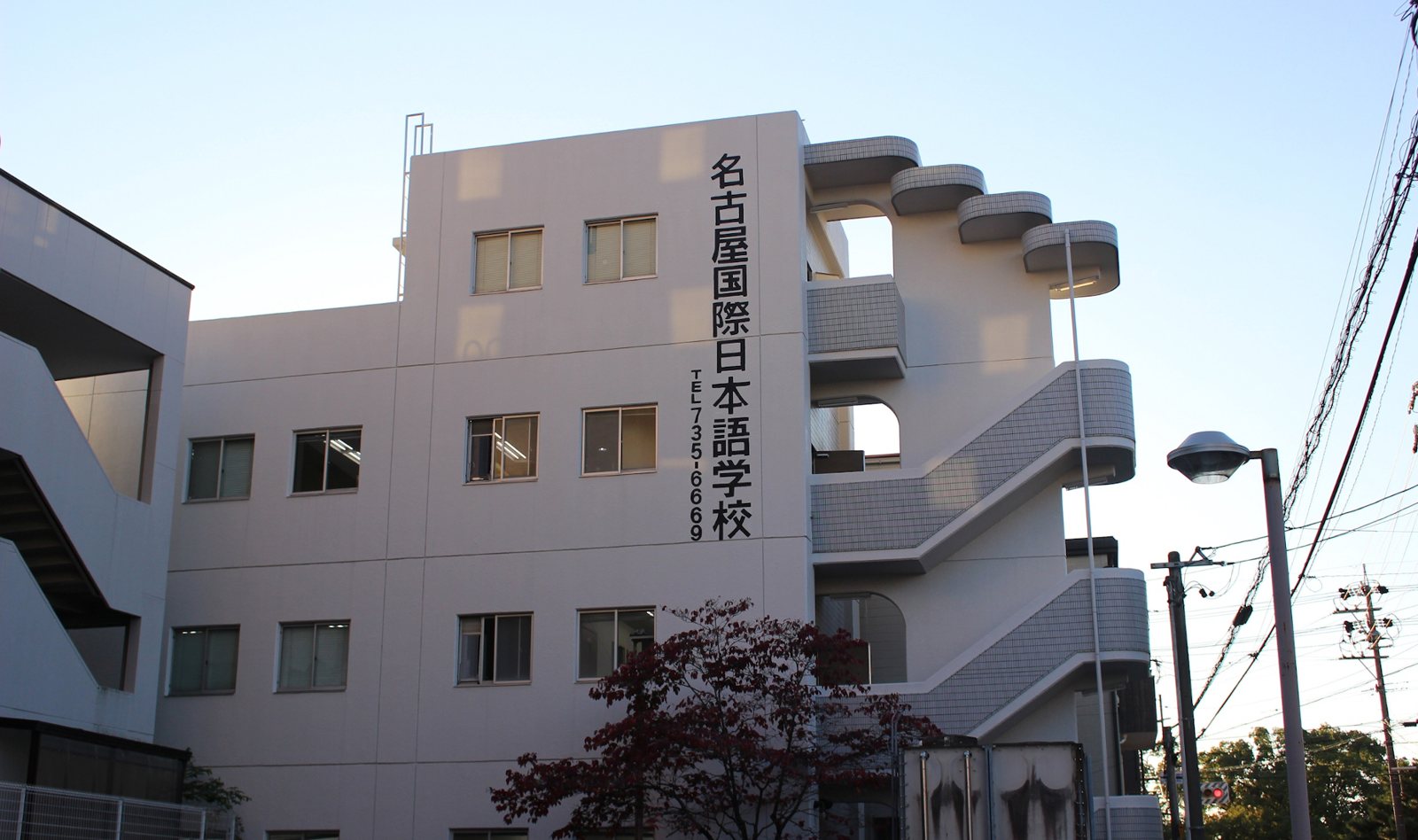
Nagoya International Japanese Language School
Nagoya International Japanese Language School
- Course
- Further-study course only ›
- Progression
- University or similar 73% · National median 86% ›
- Admission
- Twice a year · Apr, Jul ›
Compare side by side with other schools →
Tuition and conditions may change depending on the intake. If you contact us, we will check with the school and give you accurate details.
Nearby schools comparedBy distance · no ads or paid placement
- Nagoya International Japanese Language SchoolThis schoolTuition/yr¥774,000Progression73%IntakesApr · Jul
- Aichi International Academy1.3km›Tuition/yr¥719,000Progression93%IntakesApr · Oct
- Nagoya SKY Japanese Language School1.5km›Tuition/yr¥741,000Progression95%IntakesJan · Apr · Jul · Oct
- Kamiyama Gakuin Japanese Language School1.8km›Tuition/yr¥808,000Progression69%IntakesJan · Apr · Jul · Oct
— means SALLAE has not yet found the data.
About the school
Of the 70 graduates in fiscal 2025, 55 progressed to universities, vocational schools and the like and 9 found employment (Report No. 44). It is a progression-oriented school with only two progression courses, 2 years and 1 year 9 months, and homeroom teachers give one-on-one career guidance from the 3rd–4th month after enrollment. Opened in 2003 in Hazama-cho, Showa-ku, Nagoya, with a capacity of 158, it is in a quiet neighborhood right next to Tsuruma Park. Because the operating company holds a license for fee-based job placement, the school also helps with job-hunting consultation and company introductions, and 4 school dormitories (¥20,000–45,000 per month) are 6–14 minutes away on foot.
Published data and school website
Tuition
If you saw a lower amount elsewhere, it may not include the admission fee and application fee
Median 1-year tuition in other areas — Kyoto ¥911,000(7 schools) · Kanagawa ¥880,000(8 schools) · Okinawa ¥858,000(6 schools) · Tokyo ¥840,600(56 schools) · Fukuoka ¥835,000(12 schools) · Hyogo ¥825,500(7 schools) · Osaka ¥814,000(27 schools) · Shizuoka ¥790,000(9 schools) · Chiba ¥745,333(10 schools) · Aichi ¥740,667(5 schools)
Total by intake
| Intake · length | Full course |
|---|---|
| 1 year 9 months | ¥1,218,000 |
| 2 years | ¥1,366,000 |
Cost details · Course tables · Notes
- Per term
- ¥148,000 3 months
- One-time fees
- ¥182,000Application fee · Admission fee
| Duration | Total |
|---|---|
| 1 year 9 months | ¥1,218,000 |
| 2 years | ¥1,366,000 |
★"Per term" and "One-time at start" were calculated by SALLAE from each course's total. The courses this school actually offers are 1 year 9 months onward — all amounts in the table are values calculated by SALLAE.
Calculated by SALLAE · verified 2026-09-16
Whether it is refundable
- If the Certificate of Eligibility is not issued
- All payments except the application fee are refunded.
- Before visa application
- The application fee and admission fee are not refunded; tuition and other fees are refunded 100%. Administrative fee ¥20,000 (excluding tax; remittance fee extra). The admission permit and the Certificate of Eligibility must be returned.
- Visa not issued
- The application fee and admission fee are not refunded; tuition and other fees are refunded 100%. Administrative fee ¥20,000 (excluding tax; remittance fee extra). The admission permit must be returned and non-issuance of the visa must be confirmed.
- After obtaining a visa, before coming to Japan
- The application fee and admission fee are not refunded; tuition and other fees are refunded 100%. Administrative fee ¥20,000 (excluding tax; remittance fee extra). Confirmation that the visa was not used and return of the admission permit are required.
View refund policy in detail · 16 more lines
- After coming to Japan, before enrollment
- The application fee and admission fee are not refunded; 70% of tuition and other fees is refunded. Administrative fee ¥20,000 (excluding tax; remittance fee extra). Return to the home country and confirmation that the residence card has lapsed are required.
- Withdrawal procedure date for April-intake students (years 1 and 2 alike): April 1 – August 31
- Full tuition and other fees for the refundable period of October–March are refunded. Administrative fee ¥20,000 (excluding tax; remittance fee extra).
- Withdrawal procedure date for April-intake students (years 1 and 2 alike): September 1 – September 30
- The amount of tuition and other fees for the refundable period (October–March) minus 20%. Administrative fee ¥20,000 (excluding tax; remittance fee extra).
- Withdrawal procedure date for April-intake students (years 1 and 2 alike): October 1 or later (not eligible)
- Not refunded
- Withdrawal procedure date for July-intake students (year 1): July 1 – November 30
- Full tuition and other fees for the refundable period of January–June are refunded. Administrative fee ¥20,000 (excluding tax; remittance fee extra).
- Withdrawal procedure date for July-intake students (year 1): December 1 – December 31
- The amount of tuition and other fees for the refundable period (January–June) minus 20%. Administrative fee ¥20,000 (excluding tax; remittance fee extra).
- Withdrawal procedure date for July-intake students (year 1): January 1 or later (not eligible; no refund)
- Not refunded
- Withdrawal procedure date for July-intake students (year 2): July 1 – November 30
- Full tuition and other fees for the refundable period of January–March are refunded. Administrative fee ¥20,000 (excluding tax; remittance fee extra).
- Withdrawal procedure date for July-intake students (year 2): December 1 – December 31
- The amount of tuition and other fees for the refundable period (January–March) minus 20%. Administrative fee ¥20,000 (excluding tax; remittance fee extra).
- Withdrawal procedure date for July-intake students (year 2): January 1 or later (not eligible)
- Not refunded
- Depending on the reason for withdrawal, the following must be confirmed when processing the refund.
- For progression to a school in Japan, the destination's admission permit and student ID; for a change of status of residence for work, marriage, etc., the new residence card; for return to the home country, confirmation of departure within the period of stay and that the residence card has lapsed.
- Students subject to deportation, non-renewal of status of residence due to the student's own responsibility, forced withdrawal or removal from the register by the school
- Not refunded
- Transfer
- Not refunded
- Poor attendance
- No refund is given to students reported after an attendance warning for an average attendance rate below 80% during enrollment or a monthly attendance rate below 50%.
- Students who arrived late
- Tuition for classes not attended is not refunded.
- The school is not liable when classes are cancelled due to unavoidable circumstances such as natural disasters, accidents, infectious diseases, transport strikes, war or terrorism.
- Tuition for that period is not refunded.
Admission & dates
- Apr intake
- 2-year course · Application The application deadline for the 2-year progression course (April intake) is the end of October of the previous year. · Classes 1,520 hours (76 weeks)
- Jul intake
- 1 year 9 months course · Application The application deadline for the 1 year 9 months progression course (July intake) is the end of February of the same year. · Classes 1,350 hours (67.5 weeks)
- Japanese level
- Those with Japanese ability equivalent to JLPT N5.
JLPT or similar certificate, or a certificate of Japanese study (150 hours or more). After passing the interview, a pre-enrollment Japanese check is given, and students without A1 equivalent cannot enroll (fiscal 2023 self-evaluation).
Deadline and capacity rules
Capacity 158 students (2-year 120 · 1 year 9 months 38). Eligibility: high school education or higher, Japanese ability equivalent to N5, a clear study purpose, proof of ability to pay expenses, and a guarantor. Selection by document screening and an interview.
School website · 2025-02-19 updated
Classes
- Morning
- 09:25-12:45 Morning 9:25–12:45 (Period 1 9:25–10:10, Period 2 10:15–11:00, Period 3 11:10–11:55, Period 4 12:00–12:45)
- Afternoon
- 13:30-16:50 Afternoon 13:30–16:50 (Period 1 13:30–14:15, Period 2 14:20–15:05, Period 3 15:15–16:00, Period 4 16:05–16:50)
- AM/PM placement
- Intermediate classes are in the morning, and beginner classes are in the afternoon.
- Class size
- Max 20 students
- Class assignment
- Level-based 5 stages
- Elective classes
- JLPT prep course · EJU prep course · JLPT preparation courses and EJU preparation courses are offered for those who want them. In the annual schedule, both courses are in August.
Materials · Subjects · Timetable · Details
- Materials
- Beginner: Minna no Nihongo I and II; pre-intermediate: Wakatte Tsukaeru Nihongo; intermediate: TRY! JLPT N2.
- Subject
- Comprehensive Japanese · Reading · Listening · Composition · Conversation · Teachers change depending on the subject. Students also practice writing opinion essays, which are needed even for university entrance exams.
Levels and hours follow the appendix to the school regulations (in force from January 2024); class capacity is 20 for the 2-year course and 19 for the 1 year 9 months course · The course page on the website describes three stages: Beginner I and II 660 hours, pre-intermediate (N3) 510 hours and intermediate (N2) 350 hours (160 hours for the 1 year 9 months course) · Classes run Monday to Friday · Desks are arranged in a U-shape so everyone can speak equally, and classes change little from enrollment · Evaluation is done on a 4-level A–D scale combining exam results and study attitude, and students with a D take a supplementary exam · To graduate, an attendance rate of 80% or higher and a C or above in all subjects are required · The speech contest in February is the culmination of the two years of study.
What each level aims for · 5 levels
- Beginner I
- Beginner I, 10 weeks, 200 hours: aims at mastering first-half beginner grammar and basic vocabulary, and acquiring basic ability in the four skills.
- Beginner II
- Beginner II, 12.5 weeks, 250 hours: consolidation of first-half beginner grammar and teaching for practical use. Continues to aim at basic ability in the four skills.
- Intermediate
- Intermediate, 22.5 weeks, 450 hours: consolidation of beginner grammar overall, using similar expressions appropriately, more natural Japanese and communication ability. Aims at around N3.
- Upper intermediate
- Upper-intermediate, 22.5 weeks, 450 hours: aims at around N2. Touches on social issues and current affairs and builds the Japanese needed for further study and work.
- Advanced
- Advanced, 8.5 weeks, 170 hours: while studying N1-level vocabulary and grammar, students improve their Japanese so they can express themselves, mainly through conversation.
School website · 2024-03-03 updated
Documents to prepare — student visa course
- Admission application formSchool's designated form
- RésuméSchool's designated form
- DiplomaDiploma from the last school attended; if expected to graduate, a certificate of expected graduation (enrollment)
- Report card
- JLPT or similar test certificate, or a Japanese study certificate150 hours or more
- Photos (6) (taken within 6 months, 4 cm × 3 cm) and photo data
- Copy of passportThe pages with a photo
- Birth certificate
Financial supporter's documents · only if applicable · 2 application requirements
Submitted by the person paying the tuition (financial sponsor)
- Financial sponsorship statementSchool's designated form
- Certificate of family relationshipIf paying from Japan: certificate from your home country and a Japanese certificate of residence
- Certificate of employment
- Income certificateIf paying from Japan: tax assessment certificate or withholding tax slip
- Bank balance certificate
- Copy of passbook (1 year). If there is no passbook copy, a statement on how the funds were accumulated.
Only if applicable
- Certificate of employment (for those who have worked since graduating from the last school in their home country)
- For those who have been to Japan before: the pages with the landing permission and the Japan departure stamp (If you have entered Japan before)
Application requirements
Documents must be dated within 6 months of issuance for those from the home country and within 3 months for those from Japan. The financial supporter pledges to submit, when applying for an extension of the period of stay, documents that show the fact of support, such as a remittance certificate or a copy of a passbook in the student's name.
Document standards by country are not published — there is no standard for Korean applicants either. SALLAE is confirming this with the school.
For short-term courses, only the application form (school's designated form) · copy of the passport (the page with the photo and the page with the landing permission) · residence card · photos (6) (taken within 6 months, 4 cm × 3 cm) and photo data are submitted.
School website · 2025-02-19 updated
Admission process
- Request an admission consultation — TEL 052-735-6669, E-mail school@nagoyais.com, inquiry form. Business hours 9 a.m. to 6 p.m.
- Request materials and ask questions — If you wish to apply, please request materials; if you have any questions, please contact us.
- Admission application form — Book an interview date for the applicant and the guarantor in Japan, fill in the application form, and then visit the school.
- Interview — The school interviews the guarantor. The applicant is interviewed on site or, depending on the country, by Skype.
- Submit application documents — Prepare the application documents and submit them to the school.
- Application fee — Transfer the ¥22,000 application fee to the school's designated account. Re-applications after a previous non-issuance and former technical intern trainees pay ¥44,000.
- Application for the Certificate of Eligibility — The school applies to the Immigration Services Bureau for the issuance of the Certificate of Eligibility.
- The Certificate of Eligibility is issued — The Immigration Services Bureau reviews the application and, if there are no problems, the Certificate of Eligibility is issued.
- Tuition payment — After the applicant is notified that the Certificate of Eligibility has been issued, transfer the tuition to the school's designated account. Payment by cash or bank transfer is accepted.
- Receive documents — After payment is confirmed, the original Certificate of Eligibility, admission permit, guidance for coming to Japan and other documents are sent to the applicant.
- Apply for a student visa — After the Certificate of Eligibility arrives, the applicant applies for a "student visa" at the Japanese embassy or consulate abroad.
- Entry into Japan — Please enter Japan by the date designated by the school.
- Placement test
- Before classes start, students' ability is assessed by a test and appropriate classes are formed.
School website · 2024-03-03 updated
Short-term study
- Open now?
- Rolling admissions, so availability varies from time to time — SALLAE will confirm with the school
Course without a student visa
- Private course — Individual, group and corporate group lessons. 45–50 minutes per lesson; ¥2,000 per lesson as a guide, negotiable. Accepted at any time; for status of residence other than "student".
- Short-term study abroad program — Japanese study plus Japanese culture experiences during long holidays. About 2–4 weeks, 4 hours a day, Monday to Friday. In the past 3 years, held for students of Baekseok Arts University in Korea.
- Auditing student course — Applications are accepted at any time (April and July intakes), with a residence card. A high school diploma is not required if your study purpose is clear. No application fee; the admission fee is ¥50,000 lower than for progression courses, and tuition is the same.
- Corporate training — For 3 months from July to October 2022, online beginner Japanese training for Bangladeshi workers at a system development company in Nagoya, with a focus on conversation.
★Short-term courses are not listed in the published data — it counts only student-visa courses.
School website · 2024-03-03 updated
Graduate outcomes
| FY2025 | Admitted |
|---|---|
| Employment | 9 students |
| Graduates | 70 students |
Passing an exam
| Exam | Pass |
|---|---|
| JLPT N2 2021 | 3 students |
| JLPT N3 2021 | 15 students |
| JLPT N4 2021 | 10 students |
| JLPT N5 2021 | 1 student |
| JLPT N2 2020 | 11 students |
| JLPT N3 2020 | 37 students |
| JLPT N4 2020 | 20 students |
| JLPT N5 2020 | 1 student |
July 2021 JLPT: 45 examinees, 29 passed, pass rate 64%. December 2020 JLPT: 91 examinees, 69 passed, pass rate 75.8%.
See 14 more schools
70 international students graduated in FY2025. 55 progressed to universities, etc.; 9 found employment; 69 have CEFR A2-equivalent or higher (N4). 75 met the standard (100.0%). · 9 found employment (FY2025) · School website · Updated Jun 17, 2026
Reviews
If you study here or used to, tell others what the classes, teachers and daily life were like. It helps anyone deciding on this school.
Write the first reviewUniversity prep
- Progression and career guidance — Each class has a homeroom teacher, who gives individual career guidance in addition to regular classes.
- Job-hunting guidance — For students who hope to find work under the status of residence "Engineer/Specialist in Humanities/International Services" or "Specified Skilled Worker", the school draws out their ideal future in interviews, and presents and shares a direction.
- Job-hunting support project for international students who graduated from overseas universities — First among Japanese language institutions in Aichi Prefecture! Certified by Aichi Prefecture as a participating school in the "Job-Hunting Support Project for International Students Who Graduated from Overseas Universities".
- On-campus career briefing — In February of the first year, a career briefing for students entering their 2nd year was held. Teachers from universities and vocational schools explained at the public hall in Tsuruma Park, and 6 classes took part (article from February 2023).
- Information such as career decisions is shared via Slack. — Homeroom teachers hold individual interviews each term and record them in Lingual. Staff, each in charge of 5–7 students, gave job-hunting guidance.
- JLPT and EJU — The JLPT and the EJU are applied for collectively by the school. The exam fee is included in tuition, and everyone takes the exams.
Schedule to admission
- Start of individual guidance
- Year 1, Jun–Jul · From months 3–4, individual guidance with the homeroom teacher begins.
- On-campus career briefing
- Year 1, Feb · A career briefing is held for students entering Year 2.
- Explore schools
- Year 2, from Jun · Attend open campus events and career briefings
- Exam prep
- Year 2, Aug–Sep · Application preparation · Exam preparation such as interview practice
- Applications and entrance exams
- Year 2, Oct–Feb · Applications open at each university and vocational school · Entrance exams (interviews, written tests, etc.) · Results announced (in about 1–2 weeks)
- Graduation
- Mar · Graduation ceremony
School website · 2026-06-17 updated
Daily-life support
- Orientation — At the orientation on enrollment, the school gives guidance on garbage sorting, bicycle rules, crime prevention, what to do in disasters, life guidance, noise problems, carrying the residence card, and National Health Insurance.
- Consultation about part-time work, guidance on working in Japan, and management at part-time workplaces. — In the 1st year, consultations on dormitory life and part-time jobs; in the 2nd year, consultations on progression and employment. The principal also works on guidance about working styles and on managing part-time workplaces.
- Multilingual staff — Staff who can speak English and Vietnamese are assigned.
- Health checkup — A health checkup is done as early as possible after enrollment and every year thereafter. In the annual schedule, the checkup is in May.
- Evacuation drill — For the evacuation drill, the morning and afternoon classes both had a prior lecture and an actual evacuation drill.
- Response to traffic accidents — In 2 traffic accidents involving a bicycle and a car, the school coordinated communication between the insurance company and the students. It is considering holding traffic safety lectures.
- The school's official LINE — For attendance, the school created an official LINE account so that it can contact students.
- Insurance — Tuition includes ¥10,000 for "international student insurance and health checkup"; please pay National Health Insurance premiums yourself.
- Guidance on extension procedures for the period of stay — Does the school give guidance and support on procedures for extending the period of stay, temporary return to home countries and so on?
School website · 2026-06-17 updated
Scholarship
- School's own scholarship (for 1st-year students)
- Scholarships are chosen based on regular exam scores, attendance rate, class attitude and homework submission rate (first-year students). In the 2023 awards, 4 students per class were honored.
School website · 2026-03-10 updated
Students
Enrolled: 122 (2025) · Capacity: 158 National median: 180 students
Based on 122 students enrolled in 2025.
Public data from the Association for the Promotion of Japanese Language Education (Nisshinkyo) · verified 2026-09-20
School life
For 1 year
- 4
- Apr intake entrance ceremony
- 5
- Health checkup
- 6
- EJU
- 7
- July intake entrance ceremony · JLPT · Regular exam
- 8
- Summer vacation · EJU preparation course · JLPT preparation course
- 9
- Outing
- 10
- Sports day
- 11
- EJU
- 12
- Regular exam · Winter break
- 1
- First shrine visit of the year, or first calligraphy of the year
- 2
- Speech contest
- 3
- Graduation ceremony · Regular exam · Spring break
- A speech contest is held in February and is the culmination of two years of study.
- At an exchange with Toho High School, international students gave presentations introducing their countries and toured the school and its club activities.
- Exchange meetings are held about 3 times a year with students of the Faculty of International Liberal Arts at Chukyo University, and also with students at Chubu University who are interested in Japanese language education.
- Our international students also take part as volunteers in the "Aichi Global Exchange Club" for junior high school students, run under commission from the Nagoya City Board of Education.
- Yesterday, the 40th entrance ceremony of Nagoya International School of Japanese Language was held at Nagoya City Public Hall.
- On October 28, a field trip to Gifu Castle. Since Gifu Castle stands at the top of Mt. Kinka, students climbed the mountain.
- January: first shrine visit of the year, or first calligraphy of the year.
On campus
- Main building
- Classroom — All classrooms have LED lighting. Long desks are being replaced one by one with single desks. Electronic whiteboards have started to be used in the first-floor classrooms.
- Office
- Office
- Office
- Business office
- Office
- Staff room — The staff room has 9 desks and 6 computers.
- Office
- Library room — The library lends workbooks and reference books to those who want them, and study space is provided in the library, meeting rooms and elsewhere.
- A small classroom on the 2nd floor of the office
- Small classroom
- Infirmary
- Meeting room
2024–2025 academic calendar · earlier materials
- Saturdays and Sundays
- Weekly
- National holidays
- National holidays
- Summer vacation
- About 1 month between late July or early August and late August · Note: For the 1 year 9 months university progression course, the 1st year is 10 days in mid-August.
- Winter break
- About 2 weeks between late December and early January
- End-of-year break
- About 3 weeks between mid-March and March 31
School website · 2024-03-03 updated
Access
⚠ Rent for Parashion differs by source. Please confirm with the school. Rent: 1 person ¥45,000; 2 or more people ¥23,000. Layout: 2DK · Parashion details: rent ¥23,000 for 3 people and ¥20,000 for 4 people; 3–4 residents. Both pages were updated on March 3, 2024.
⚠ The monthly dormitory fee differs depending on the source. Please confirm with the school. Dormitory rent: ¥45,000 for 1 person (¥36,000 for 1 person at Sun Annex), ¥23,000 for 2 or more people, ¥20,000 for 4 people at Parashion · Dormitory fee ¥21,000–25,000 (per month). The website does not say which is the current amount.
- Nearby
- Tsurumai/Nagoya 8 min · Sakae 11 min · Imaike 12 min · Kana-yama 3 min · Kami-mae-zu 1 min
- Dormitory
- Available¥23,000–45,000 per month · 4 school dormitories. Rent is ¥36,000–45,000 for one person and ¥20,000–23,000 when shared by several. 6–14 minutes on foot to school. · Based on school website
School website · 2024-03-03 updated
Dormitory — Dormitory entry fee ¥50,000, deposit ¥10,000, contract period 1 year. Appliances, futons, wardrobes, etc. provided. Move-in is in April and July in principle, and applications are due 1 month before. The entry fee and 1 year of dormitory fees are paid in advance and, in principle, not refunded.
School website · 2024-03-03 updated
SALLAE has organized the school website and published data in English.
The update date is the day that material was last revised.
Photos are materials published by the school.
This information is compiled from official sources and is not updated daily. Please confirm with the official contact before signing or applying.