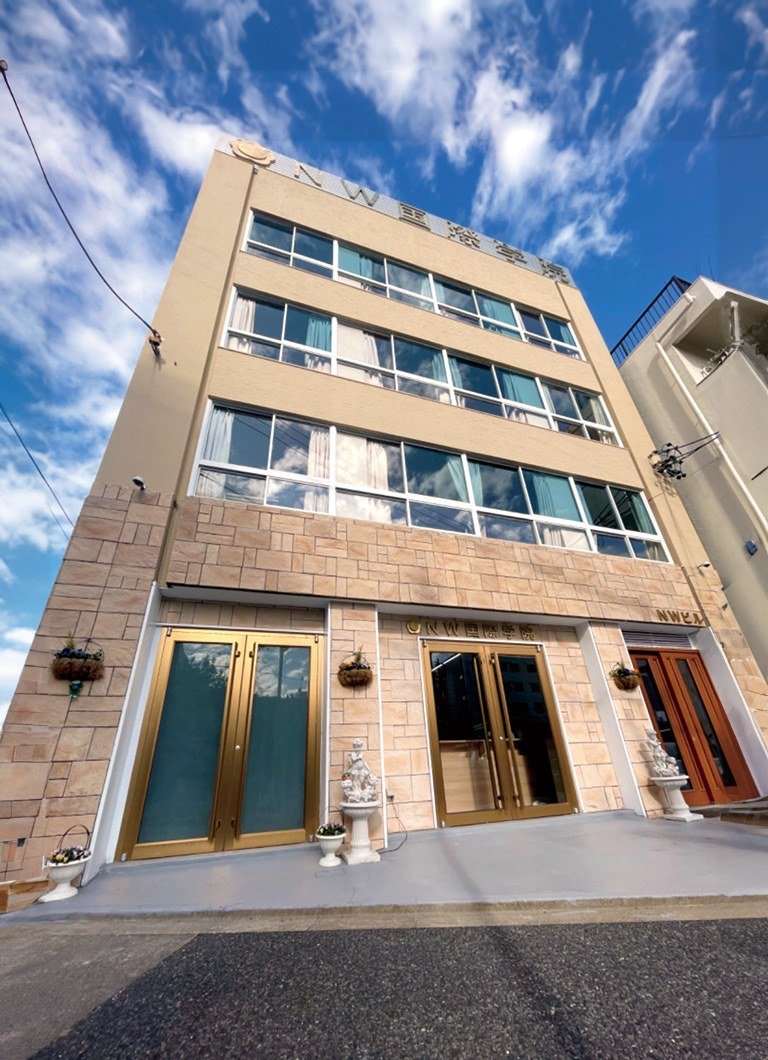
NW International Academy
NW International Academy
Compare side by side with other schools →
Tuition and conditions may change depending on the intake. If you contact us, we will check with the school and give you accurate details.
Nearby schools comparedBy distance · no ads or paid placement
- NW International AcademyThis schoolTuition/yr¥840,000Progression—IntakesApr · Jul
- Foreign Language Academy Advance Academy2.1km›Tuition/yr¥798,000Progression91%IntakesJan · Apr · Jul · Oct
- Nagoya YWCA Gakuin Japanese Language School3km›Tuition/yr¥758,000Progression—IntakesApr · Oct
- Nagoya SKY Japanese Language School3.1km›Tuition/yr¥741,000Progression95%IntakesJan · Apr · Jul · Oct
— means SALLAE has not yet found the data.
About the school
This is a Japanese language school with a capacity of 100 in Kita-ku, Nagoya, a 6-minute walk from Shigahondori Station on the subway. Its 17 enrolled students (2025) are from Myanmar, Vietnam and Sri Lanka; they enroll in April or July and study for 2 years or 1 year 9 months. Classes at 8 levels are split into morning and afternoon sessions, with individual progression guidance and job preparation such as resumes and interviews. A dormitory is available for ¥25,000–¥30,000 per month.
Published data and school website
Tuition
If you saw a lower amount elsewhere, it may not include the admission fee and application fee
Median 1-year tuition in other areas — Kyoto ¥911,000(7 schools) · Kanagawa ¥880,000(8 schools) · Okinawa ¥858,000(6 schools) · Tokyo ¥840,600(56 schools) · Fukuoka ¥835,000(12 schools) · Hyogo ¥825,500(7 schools) · Osaka ¥814,000(27 schools) · Shizuoka ¥790,000(9 schools) · Chiba ¥745,333(10 schools) · Aichi ¥740,667(5 schools)
Total by intake
| Intake · length | Full course |
|---|---|
| 1 year 9 months | ¥1,398,750 |
| 2 years | ¥1,584,000 |
Cost details, tables by course and notes · 2 items
- Per term
- ¥186,000 3 months
- One-time fees
- ¥96,000Application fee · Admission fee
| Duration | Total |
|---|---|
| 1 year 9 months | ¥1,398,000 |
| 2 years | ¥1,584,000 |
★"Per term" and "One-time at start" were calculated by SALLAE from each course's total. The courses this school actually offers are 1 year 9 months onward — all amounts in the table are values calculated by SALLAE.
Calculated by SALLAE · Confirmed 2026-09-21
Whether it is refundable
- If you do not apply for a visa after the Certificate of Eligibility (CoE) is issued and decline enrollment
- All payments are refunded, except for (1) the entrance examination fee, (2) the admission fee and (3) remittance fees. Return the admission permit and CoE by the date designated by the school
- If a visa is not issued at the overseas diplomatic mission
- Submitting documents that prove this is handled the same as item 1 above.
- If you decline enrollment after obtaining a visa at the overseas diplomatic mission
- Submitting a copy of every page of the passport is handled the same as item 1 above. (Make sure it is clear that the visa is unused and has expired.)
- If you withdraw before the end of a term after enrollment
- If you withdraw before the end of a term after enrollment, the payment for the next term (half-year) out of the one-year payment is refunded.
See refund policy in detail · 1 more line
- Transfer for personal reasons (a move to another Japanese language school in Japan is treated as a transfer, not as progression)
- Transfers for personal reasons are not covered by the refund rules for tuition and fees (including dormitory fees). However, if the principal judges that there are unavoidable reasons for the transfer, the tuition and fees are refunded according to the refund rules.
Admission & dates
- Apr intake
- 2-year course · Application Selection exam: early September to mid-October of the previous year; document submission: by early November of the previous year · Classes 1,520 hr
- Jul intake
- 1 year 9 months course · Application Selection exam: early December to mid-January; document submission: by early February · Classes 1,340 hr
- Japanese level
- JLPTN5 (JLPT)
The 1 year 9 months progression course is for those with JLPT N4 or higher or equivalent Japanese ability, and who have 150 or more hours of Japanese study experience
School website · Confirmed 2026-09-21
Classes
⚠ Class hours for the 1 year 9 month progression course (1,340 hours per the school rules / 1,140 class hours per the curriculum table) varies by source — please confirm with the school.1 year 9 month progression course (1,340 hours) · 20 class hours × 57 weeks = 1,140 class hours. The official documents give different total class hours, so please confirm with the school.
- Morning
- 09:05-12:35 All students must attend a 5-minute homeroom before classes start
- Afternoon
- 13:15-16:45
- Class assignment
- Level-based 8 stages
Materials · Subjects · Timetable · Details
- Subject
- General · Kanji · Listening · Reading · Composition / Essay · Oral expression · Vocabulary and grammar
2-year progression course: Elementary I 10 weeks and Elementary II 10 weeks (200 hours each) 400
| Mon | Tue | Wed | Thu | Fri | |
|---|---|---|---|---|---|
| Period 1 | Comprehensive | Comprehensive | Comprehensive | Comprehensive | Reading |
| Period 2 | Comprehensive | Comprehensive | Comprehensive | Comprehensive | Listening comprehension |
| Period 3 | Comprehensive | Comprehensive | Comprehensive | Comprehensive | Composition |
| Period 4 | Kanji | Kanji | Kanji | Kanji | Composition |
2-year progression course: Intermediate I–III, 10 weeks each (200 hours each) 600
| Mon | Tue | Wed | Thu | Fri | |
|---|---|---|---|---|---|
| Period 1 | Comprehensive | Comprehensive | Comprehensive | Comprehensive | Reading |
| Period 2 | Comprehensive | Comprehensive | Comprehensive | Comprehensive | Reading |
| Period 3 | Comprehensive | Comprehensive | Comprehensive | Comprehensive | Composition |
| Period 4 | Kanji | Listening comprehension | Kanji | Listening comprehension | Composition |
2-year progression course: Advanced I and II, 10 weeks each (200 hours each); Advanced III, 6 weeks (120 hours) 520
| Mon | Tue | Wed | Thu | Fri | |
|---|---|---|---|---|---|
| Period 1 | Comprehensive | Comprehensive | Vocabulary and grammar | Kanji | Reading |
| Period 2 | Comprehensive | Comprehensive | Vocabulary and grammar | Reading | Reading |
| Period 3 | Comprehensive | Comprehensive | Listening comprehension | Listening comprehension | Short essay |
| Period 4 | Kanji | Listening comprehension | Kanji | Oral expression | Short essay |
Elementary II (including review of I): 11 weeks (220 hours) 20
| Mon | Tue | Wed | Thu | Fri | |
|---|---|---|---|---|---|
| Period 1 | Comprehensive | Comprehensive | Comprehensive | Comprehensive | Reading |
| Period 2 | Comprehensive | Comprehensive | Comprehensive | Comprehensive | Listening comprehension |
| Period 3 | Comprehensive | Comprehensive | Comprehensive | Comprehensive | Composition |
| Period 4 | Kanji | Kanji | Kanji | Kanji | Composition |
1 year 9 month progression course: Intermediate I–III, 10 weeks each (200 hours each) 600
| Mon | Tue | Wed | Thu | Fri | |
|---|---|---|---|---|---|
| Period 1 | Comprehensive | Comprehensive | Comprehensive | Comprehensive | Reading |
| Period 2 | Comprehensive | Comprehensive | Comprehensive | Comprehensive | Reading |
| Period 3 | Comprehensive | Comprehensive | Comprehensive | Comprehensive | Composition |
| Period 4 | Kanji | Listening comprehension | Kanji | Listening comprehension | Composition |
1 year 9 month progression course: Advanced I and II, 10 weeks each (200 hours each); Advanced III, 6 weeks (120 hours) 520
| Mon | Tue | Wed | Thu | Fri | |
|---|---|---|---|---|---|
| Period 1 | Comprehensive | Comprehensive | Vocabulary and grammar | Kanji | Reading |
| Period 2 | Comprehensive | Comprehensive | Vocabulary and grammar | Reading | Reading |
| Period 3 | Comprehensive | Comprehensive | Listening comprehension | Listening comprehension | Short essay |
| Period 4 | Kanji | Listening comprehension | Kanji | Oral expression | Short essay |
Class hours by subject
| Subject | 2 years | 1 year 9 months |
|---|---|---|
| Comprehensive | 756 hr | 528 hr |
| Kanji | 218 hr | 142 hr |
| Listening comprehension | 158 hr | 139 hr |
| Reading | 158 hr | 114 hr |
| Composition and essay writing | 152 hours | 114 hr |
| Oral expression | 26 hr | 26 hr |
| Vocabulary and grammar | 52 hr | 52 hr |
Classes by level: Elementary I–II, Intermediate I–III and Advanced I–III (School Rules, Article 8)
School website · Confirmed 2026-09-21
Documents
- Admission application formDesignated form, signed
- Original diploma of the last school attended (graduation certificate) or certificate of expected graduation
- Japanese study history and proof of Japanese ability
- Photo3 cm × 4 cm) 6 photos (1 of which is attached to the application form
- Copy of passport
- Color copy of the certified family register, etc.A document that can prove the applicant's place of birth
- Employed persons: certificate of employment, business certificate, or certified copy of the registerSelf-employed persons
Financial supporter's documents · only if applicable · 2 application requirements
Submitted by the person paying the tuition (financial sponsor)
- Written pledgeDesignated form, signed
- Financial sponsorship statementDesignated form, signed
- Deposit balance certificate
- Color copy of a bankbook, or a statement explaining how the funds were accumulated
- Certificate of employment, business certificate, or certified copy of the registerSelf-employed persons
- Income certificate
- Certificate of family relationship between the financial sponsor and the applicant
- Color copy of the certified family register, etc.Needed for all family members
- Residence certificate (jūminhyō)all persons in the same household), or certificate of alien registration record (if the sponsor is a foreign resident of Japan
- Seal registration certificate
Only if applicable
- Copy of the visa page and the page with the entry and exit stamps (If you have entered Japan before)
- Certificate of residence (for everyone in the same household), or a certificate of matters recorded in the alien registration record, and a seal registration certificate (If the financial sponsor (in principle a relative within the third degree of kinship) is in Japan)
- The applicant's own pledge, a pledge from a guarantor (in principle a relative within the third degree of kinship), a bank balance certificate, an income certificate and a tax payment certificate (If the applicant is their own financial sponsor)
Application requirements
The financial sponsor (in principle a relative within the third degree of kinship) Depending on the applicant's nationality and personal circumstances, a simpler set of documents may be enough, or additional documents may be required
School website · Confirmed 2026-09-21
Admission process
- Request an admission consultation — Check the course, schedule and required documents first.
- Selection exam — Selection exam: early September to mid-October of the previous year (April enrollment); early December to mid-January (July enrollment)
- Submit documents — Document submission: by early November of the previous year (April enrollment); by early February (July enrollment)
- Immigration documents submitted, results notified — Immigration documents are submitted in early December (April enrollment) and early March (July enrollment), after the school's screening. Screening results are announced by the Immigration Services Agency at the end of February and the end of May
- Enrollment procedures — Enrollment procedures: tuition and other fees are remitted to the school in early March (April enrollment) and early June (July enrollment). After the transfer is confirmed, the school sends the Certificate of Eligibility and the admission permit
- Obtaining a visa and entering Japan — Visa acquisition: applicants who apply in mid-March (April enrollment) and mid-June (July enrollment) apply for a visa at the Japanese embassy or other overseas diplomatic mission
- Placement test
- Students belong to either the morning or the afternoon session, in classes matched to their level.
School website · Confirmed 2026-09-21
Reviews
If you study here or used to, tell others what the classes, teachers and daily life were like. It helps anyone deciding on this school.
Write the first reviewUniversity prep
- High-level individual progression guidance — High-level individual guidance on further education. Does the school work to raise and maintain the progression rate of students who want to continue their studies?
- Extensive progression information — Does the school explain the study support available, such as the library, self-study room, self-study materials and progression information (past entrance exams, etc.)?
- Guidance on finding part-time work — The school provides job listings and carefully coaches students on getting hired (how to write a resume, how to make phone calls, how to do interviews, etc.).
- Progression by recommendation — 2 students progressed by principal's recommendation.
School website · Confirmed 2026-09-21
Daily-life support
- Right after arrival in Japan — Is the necessary support provided for buying daily necessities right after arrival in Japan, signing various contracts (utilities, communications, etc.) and handling procedures at public offices?
- Visa renewals and changes, pension procedures — Are students informed in advance and given appropriate help with visa renewals and changes, pension procedures and applications for various exams during their studies?
- Health and problem consultation — Does the school have a system in place to provide appropriate support and advice when illness, accidents, interpersonal problems and the like occur on or off campus?
- Part-time work — Part-time work of up to 28 hours per week is permitted during the school term, and up to 40 hours per week during long breaks
School website · 2026-09-11 updated
Students
17 students enrolled (2025) · Capacity 100 National median: 180 students
Based on the 17 students enrolled in 2025.
Published by MEXT · Confirmed 2026-09-20
School life
For 1 year
- Apr
- Entrance ceremony · New student orientation · Cherry blossom viewing
- May
- Health checkup · Sports day
- Jun
- School trip · EJU
- Jul
- Tanabata festival · JLPT
- Aug
- Summer break · Fireworks festival
- Sep
- Final exam · School festival
- Oct
- Autumn break · Entrance ceremony · Orientation for new students
- Nov
- Autumn leaf viewing · EJU
- Dec
- Winter break · JLPT
- Jan
- New Year shrine visit · Coming-of-Age Day
- Feb
- Final exam · Field trip
- Mar
- Graduation ceremony · Spring break
* This is an example of the annual events. The schedule may change depending on circumstances.
Academic calendar
- Summer vacation
- Aug 1 – Aug 23
- Autumn break
- Sep 29 – Oct 8
- Winter break
- Dec 28 – Jan 6
- Spring break
- Mar 20 – Apr 8
Depending on the admission course and the year's calendar, long breaks may shift by about a week.
School website · 2026-09-11 updated
Access
- Transit
- Nagoya Subway Meijo Line 6 min walk from Shigahondori Station
Subway Meijo Line, Heian-dori Station, 8 min on foot
JR Line, Ozone Station, 15 min on foot - Nearby
- It is about 60 minutes from Nagoya's international airport to the school.
- Dormitory
- Available · Move-in fee (deposit and equipment fee) is ¥50,000. Rent is about ¥25,000–¥30,000 per month. · Based on school website
School website · 2026-09-11 updated
Dorm — Dormitory fee per month: ¥25,000–¥30,000 (depends on the property and capacity)
School website · 2026-09-11 updated
Japanese language institution certified by MEXT Accreditation No. 20241230010 · Certified Oct 30, 2024 →
SALLAE has organized the school website and published data in English.
The update date is the day that material was last revised.
Photos are materials published by the school.
This information is compiled from official sources and is not updated daily. Please confirm with the official contact before signing or applying.