Shinsekai Language Institute
Shinsekai Language Institute
Compare side by side with other schools →
Tuition and conditions may change depending on the intake. If you contact us, we will check with the school and give you accurate details.
Nearby schools comparedBy distance · no ads or paid placement
- Shinsekai Language InstituteThis schoolTuition/yr¥800,000Progression77%IntakesApr · Jul · Oct
- Yu International Culture Institute0.2km›Tuition/yr¥900,000Progression—IntakesApr · Oct
- Mid-Dream Japanese Language School0.3km›Tuition/yr¥908,000Progression—IntakesApr · Jul · Oct
- Sam Education Academy0.3km›Tuition/yr¥739,000Progression—IntakesJan · Apr · Jul · Oct
— means SALLAE has not yet found the data.
About the school
The student visa course consists of three progression courses: 2 years, 1 year 9 months and 1 year 6 months. Of the 109 FY2025 completers, 84 went on to universities and vocational schools, so the school puts effort into further education. It opened in 1988 and moved from Meguro to Shin-Okubo (Hyakunincho, Shinjuku-ku) in 2020. Capacity is 400, and many students come from Nepal, Myanmar, Vietnam and China. Classes are half-day morning and afternoon sessions with 20 or fewer students per class, in 5 levels from Elementary I to Advanced, and JLPT mock exams are held every month except December and March.
Published data and school website
Tuition
If you saw a lower amount elsewhere, it may not include the admission fee and application fee
Median 1-year tuition in other areas — Kyoto ¥911,000(7 schools) · Kanagawa ¥880,000(8 schools) · Okinawa ¥858,000(6 schools) · Tokyo ¥840,600(56 schools) · Fukuoka ¥835,000(12 schools) · Hyogo ¥825,500(7 schools) · Osaka ¥814,000(27 schools) · Shizuoka ¥790,000(9 schools) · Chiba ¥745,333(10 schools) · Aichi ¥740,667(5 schools)
Total by intake
| Intake · length | Full course |
|---|---|
| 1 year 6 months | ¥1,130,000 |
| 1 year 9 months | ¥1,295,000 |
| 2 years | ¥1,460,000 |
Cost details · Course tables · Notes
- Per term
- ¥165,000 3 months
- One-time fees
- ¥140,000Application fee · Admission fee
| Duration | Total |
|---|---|
| 1 year 6 months | ¥1,130,000 |
| 1 year 9 months | ¥1,295,000 |
| 2 years | ¥1,460,000 |
★"Per term" and "One-time at start" were calculated by SALLAE from each course's total. The courses this school actually offers are 1 year 6 months onward — all amounts in the table are values calculated by SALLAE.
Calculated by SALLAE · verified 2026-09-16
Admission & dates
- Apr intake
- 2-year course · Application April intake: until the end of July · Classes 2-year progression course 1,520 class hours; general 1-year course 760 class hours (45 minutes per class hour).
- Jul intake
- 1 year 9 months course · Application July intake: until the end of November · Classes 1.9-year progression course 1,320 class hours; general 1-year course 760 class hours.
- Oct intake
- 1 year 6 months course · Application October intake: until the end of February · Classes 1.6-year progression course 1,140 class hours; general 1-year course 760 class hours.
Deadline and capacity rules
Admission in April, July and October. Progression courses: April 2 years, July 1.9 years, October 1.6 years; general 1-year course every month. Capacity 400, with 45 minutes per class hour.
School website · 2024-09-09 updated
Classes
- Morning
- 09:00-12:20 4 periods of 45 minutes · 5 days a week (Mon–Fri)
- Afternoon
- 13:25-16:45 4 periods of 45 minutes · 5 days a week (Mon–Fri)
- Class size
- Max 20 students
- Class assignment
- Level-based 5 stages
Materials · Subjects · Timetable · Details
- Materials
- Elementary uses Minna no Nihongo, intermediate uses Chukyu e Ikou and Chukyu o Manabou, and advanced uses authentic materials such as newspapers, news, novels and essays.
Class hours by subject
| Subject | 2 years | 1 year 9 months | 1 year 6 months | 1 year |
|---|---|---|---|---|
| Elementary and elementary–intermediate | 380 hours | 380 hours | 380 hours | 380 hours |
| Intermediate | 380 hours | 380 hours | 380 hours | 380 hours |
| Upper intermediate | 560 hr | 560 hr | 380 hours | — |
| Advanced | 200 hours | — | — | — |
Half-day morning and afternoon sessions. Classes of 20 or fewer by level. 4 regular exams a year and about 10 mock exams for external tests.
What each level aims for · 5 levels
- Beginner I
- 3 months N5–N4. Basic communication so you can manage daily life. 80 sentence patterns, about 1,000 vocabulary words and 276 kanji.
- Beginner II
- 3 months N4–N3. Express your intentions and wishes and acquire language ability suited to social situations. 151 sentence patterns, about 2,000 vocabulary words and 555 kanji.
- Intermediate I
- 6 months N3–N2. Build N3-equivalent ability in 6 months. Intensive training with mock question sets just before the JLPT. About 380 sentence patterns, about 3,620 vocabulary words and about 926 kanji.
- Intermediate II
- 6 months N2–N1. Build N2-equivalent ability in 6 months and put opinions and arguments into words and writing. About 900 sentence patterns, about 5,920 vocabulary words and about 1,665 kanji.
- Advanced
- 6 months N1 and above. Raise interest in current affairs and society and culture, and put your own opinions into well-organized Japanese. About 1,000 sentence patterns, about 8,000 vocabulary words and about 1,900 kanji.
School website · 2020-08-05 updated
Documents
- Admission application form
- Résumé · Statement of reason for study
- Graduation certificate and academic transcript from your last school
- Japanese proficiency certificate or Japanese study certificate
- 3 photos4cm×3cm
Financial supporter's documents · only if applicable · 2 application requirements
Submitted by the person paying the tuition (financial sponsor)
- Financial sponsorship statement
- Bank balance certificateFor Nepal, transaction statements for 3 years are also needed
- Certificate of employment
- Income certificate
- Relationship certificate
- Tax payment certificate
- For Vietnam: birth certificate, family register and identity certificate.
Only if applicable
- Certificate of enrollment (only for those currently enrolled)
- ID card (Vietnam)
Application requirements
Prepare all certificates as originals created within the last 3 months. Attach a Japanese translation to documents not written in Japanese.
Documents for the financial sponsor are listed only for the standards of Nepal and Vietnam; the standard for South Korea has not been published. SALLAE is confirming this with the school.
School website · 2024-09-09 updated
Admission process
- Request an admission consultation — Contact the school through the inquiry form.
- Submit application form and documents — Submit the application form, resume, statement of study reasons and various certificates within the application period. Forms for the application, resume and statement of financial support are posted on the admission guidelines page.
- Selection method — Selection is by document screening, interviews with the student and the financial sponsor, and a written exam.
- Placement test
- The admission screening checks Japanese ability to some extent, and classes are formed with a placement test on arrival in Japan.
School website · 2024-09-09 updated
Short-term study
- Open now?
- Rolling admissions, so availability varies from time to time — SALLAE will confirm with the school
Course without a student visa
- Private lessons — 1 learner and 1 teacher (semi-private for 2–3 learners is also possible). ¥9,000 per 90 minutes, initial cost ¥20,000 (including a ¥15,000 admission fee), textbooks at actual cost.
★Short-term courses are not listed in the published data — it counts only student-visa courses.
School website · 2020-07-07 updated
Graduate outcomes
| FY2025 | Admitted |
|---|---|
| Employment | 4 students |
| Graduates | 109 students |
FY2025 Report No. 44 (prepared Jun 9, 2026): 109 completed the course · 109 met the standard (95.6%) · 84 progressed to further study · 4 changed status of residence · 22 at A2 equivalent. · 4 were permitted to change status of residence (progression 2-year course 2 · 1.9-year course 2 · 1.6-year course 0). · School website · Updated Jun 9, 2026
Reviews
If you study here or used to, tell others what the classes, teachers and daily life were like. It helps anyone deciding on this school.
Write the first reviewUniversity prep
- Homeroom teacher system — Close guidance by a homeroom teacher system.
- Career guidance — Career guidance supported by veteran teachers. Consistent career guidance is provided from admission, and career guidance records are kept.
- JLPT and EJU mock exams — In the annual study plan, JLPT mock exams are held every month except December and March, and EJU mock exams in May, October and March.
- Latest materials on career paths, including further study and employment — Up-to-date materials on further education, employment and other paths are available for students to read.
- Supplementary lessons — Full-time teachers serve as support staff, giving supplementary classes and providing study guidance and support.
- Report cards — Report cards are created and sent not only to the students themselves but also to parents in their home countries and intermediary agencies.
School website · 2020-08-05 updated
Daily-life support
- Orientation on study and daily life — An orientation on life as an international student is held right after admission and every month. Guidance on health, hygiene and weather warnings is also given at the orientations.
- The staff in charge of student consultations and complaints about classes and operations are clearly identified. — The academic affairs staff and the student life advisors each take responsibility for handling consultations and complaints.
- Part-time work — A part-time job survey is conducted online every month. International students may work up to 28 hours a week (8 hours a day during long breaks).
- About international student insurance and health checkups — The office confirms that all students are enrolled in National Health Insurance. The school carries international student insurance (life insurance, liability insurance, etc.), and students receive a tuberculosis diagnosis during their studies.
- Residence management — The school assigns a staff member approved by Immigration to handle applications and the like, and gives individual guidance to students with problems regarding their status of residence.
Monthly living costs · School information
| Item | 1 month |
|---|---|
| Rent: This is the amount when shared with several people. It is not a single-occupancy room. | ¥30,000 |
| Phone purchase | ¥4,000 |
| Food (¥1,000 per day × 30 days). Meals are mostly self-cooked. | ¥30,000 |
| Transportation (average 1-month commuter pass) | ¥6,000 |
| Water and utilities | ¥3,300 |
| Social expenses and others | ¥10,000 |
| National Health Insurance | ¥1,700 |
| Total | ¥85,000 |
Students live on about ¥85,000 a month. Working 28 hours a week for 4 weeks earns about ¥130,000 (minimum wage) to ¥182,000 (high-paying late-night work). Customer-service jobs are recommended, but support from parents is essential.
School website · 2024-09-09 updated
Students
31 enrolled (2022) · Capacity 180 National median: 180 students
Based on the 31 students enrolled in 2022 — Old materials.
Public data from the Association for the Promotion of Japanese Language Education (Nisshinkyo) · verified 2026-09-20
School life
For 1 year
- 4
- April intake entrance ceremony · JLPT practice test
- 5
- JLPT practice test · EJU practice test
- 6
- Sports day · First semester midterm exam · JLPT mock exam · EJU①
- 7
- July intake entrance ceremony · JLPT practice test · JLPT (1st)
- 8
- JLPT practice test · Summer vacation
- 9
- First semester final exam · JLPT mock exam
- 10
- October intake entrance ceremony · Dashain · JLPT practice test · EJU practice test
- 11
- Field trip · JLPT practice test · EJU (2nd)
- 12
- Christmas party · 2nd-half midterm exam · JLPT (2nd) · Winter break
- 1
- New Year's calligraphy · JLPT practice test
- 2
- Tet · Disaster prevention center · JLPT practice test
- 3
- Speech contest · Completion and graduation ceremony · 2nd-half final exam · EJU practice test · Spring break
Dashain is an event named after a Nepali festival
- A monthly orientation and about 6 extracurricular classes a year are planned.
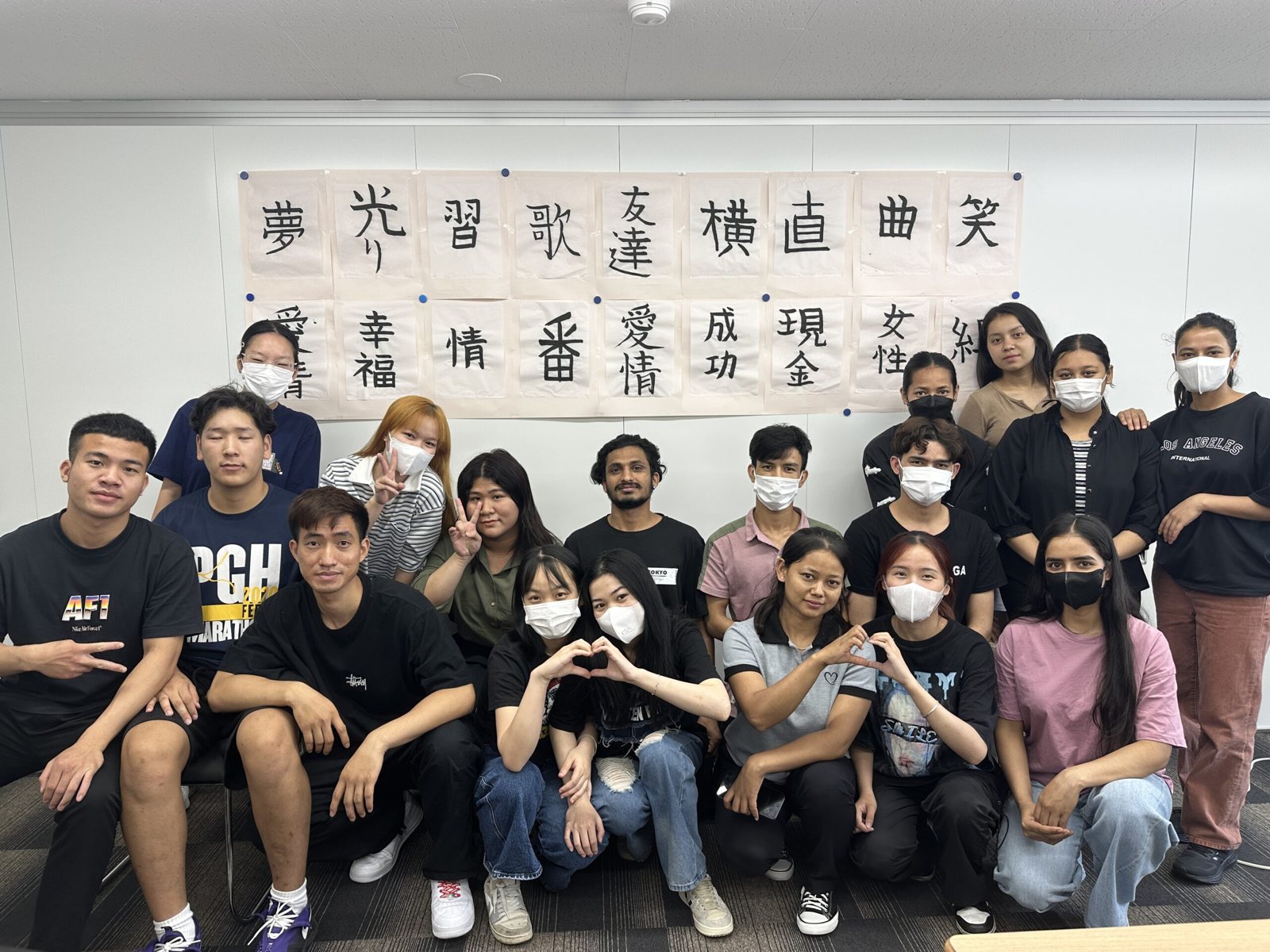
- Event photo page: cherry blossom viewing, Dashain, Tet, class outings, Tanabata, first calligraphy of the year, Setsubun, graduation ceremony, graduation trip and yukata experience
On campus
- Electronic whiteboard — Classroom equipment includes electronic whiteboards of 65 inches or larger, PCs and displays. Electronic whiteboards have been installed in all classes.
- Self-study room and library — A self-study room and library are available as rooms for self-study during class hours, and PCs can be used freely.
- Barrier-free measures are in place. — Since the office moved, people in wheelchairs can now get to the classrooms.
2025–2026 academic calendar · Older data
- Saturdays, Sundays and public holidays
- Weekly · Full-day classes (Mon–Fri)
- Spring break
- Mar 5, 2024 – Apr 6, 2025
- Summer vacation
- Jul 31, 2025 – Aug 17, 2025
- Autumn break
- Oct 4, 2025 – Oct 13, 2025
- Winter break
- Dec 24, 2025 – Jan 7, 2026
- Spring break
- Mar 4, 2026 – Apr 5, 2026 · * Planned
School website · 2020-08-05 updated
Access
- Transit
- JR Yamanote Line Shin-Okubo Station, 4 min on foot
JR Sobu Line, Okubo Station, 10 min on foot - Nearby
- Three school buildings: 4-14-15 Kitashinjuku (8-minute walk from Okubo Station), 2-11-24 Hyakunincho (1-minute walk from Shin-Okubo Station) and 2-7-9 Hyakunincho.
- Dormitory
- Available¥35,000/month · The school secures multiple dormitories and manages them in close contact with the managers. · Based on school website
School website · Updated 2026-08-31
Dorm — number of rooms, rent and distance are not stated on the website · FY2025 self-assessment standard
School website · 2026-06-25 updated
SALLAE has organized the school website and published data in English.
The update date is the day that material was last revised.
Photos are materials published by the school.
This information is compiled from official sources and is not updated daily. Please confirm with the official contact before signing or applying.