Nihon Gogaku Gakko
Nihon Gogaku Gakko
- Progression
- University or similar 95% ›
- Dormitory fee
- from ¥30,000 a month ›
- Admission
- 4 times a year · choose your intake month ›
Compare side by side with other schools →
Tuition and conditions may change depending on the intake. If you contact us, we will check with the school and give you accurate details.
Nearby schools comparedBy distance · no ads or paid placement
- Nihon Gogaku GakkoThis schoolTuition/yr¥825,000Progression95%IntakesJan · Apr · Jul · Oct
- Sakura International Language Academy18.1km›Tuition/yr¥710,000Progression—IntakesApr · Jul · Oct
- Sakura Japanese Language Institute34.4km›Tuition/yr¥850,000Progression98%IntakesJan · Apr · Jul · Oct
- Hakata Kokusai Gakuin35.4km›Tuition/yr¥891,000Progression—IntakesApr · Oct
— means SALLAE has not yet found the data.
About the school
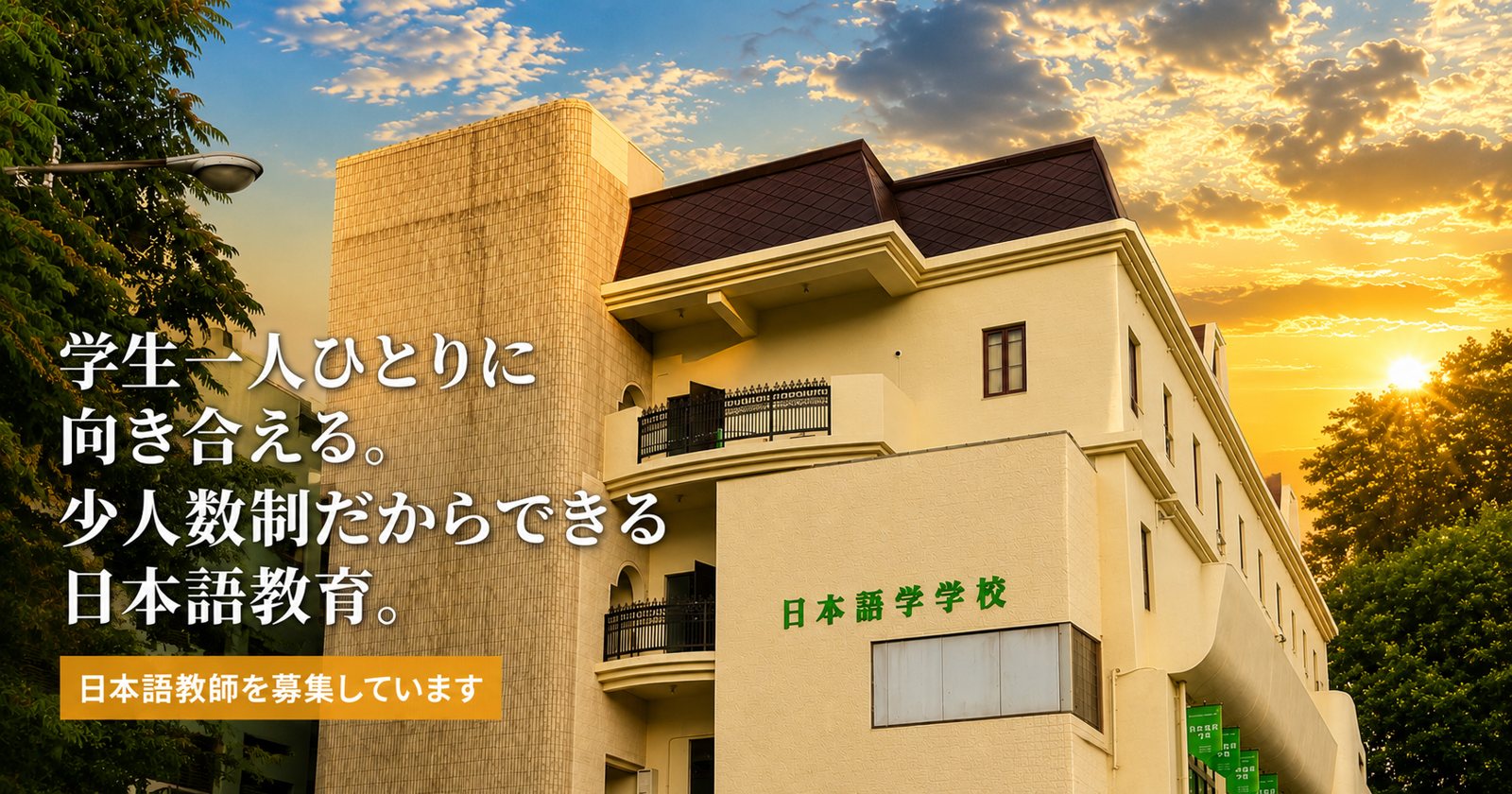
Its educational goal is progression to universities, graduate schools and vocational schools, and all four courses are progression courses, so it is a school that puts further education first. All students take the EJU, and 38 of the 40 FY2024 completers went on to universities and other institutions in Japan (from Notification No. 44 report published by the school). The school (formerly Kitakyushu Nihon Gogaku Gakko) is in Yahatanishi-ku, Kitakyushu, a 10-minute walk from JR Kurosaki Station, in a 4-story building. Its capacity is 220, and 121 of the 148 students enrolled in 2025 are from Nepal. Intakes are in April, July, October and January, and a walkable 2–4 person dormitory costs ¥30,000 per month (utilities and management fee ¥5,000 per month extra).
Published data and school website
Tuition
If you saw a lower amount elsewhere, it may not include the admission fee and application fee
Median 1-year tuition in other areas — Kyoto ¥911,000(7 schools) · Kanagawa ¥880,000(8 schools) · Okinawa ¥858,000(6 schools) · Tokyo ¥840,600(56 schools) · Fukuoka ¥835,000(12 schools) · Hyogo ¥825,500(7 schools) · Osaka ¥814,000(27 schools) · Shizuoka ¥790,000(9 schools) · Chiba ¥745,333(10 schools) · Aichi ¥740,667(5 schools)
Total by intake
| Intake · length | Full course |
|---|---|
| 1 year 3 months | ¥987,000 |
| 1 year 6 months | ¥1,149,000 |
| 1 year 9 months | ¥1,312,000 |
| 2 years | ¥1,474,000 |
Cost details · Course tables · Notes
- Per term
- ¥162,333 3 months
- One-time fees
- ¥175,335Application fee · Admission fee
| Duration | Total |
|---|---|
| 1 year 3 months | ¥987,000 |
| 1 year 6 months | ¥1,149,333 |
| 1 year 9 months | ¥1,311,666 |
| 2 years | ¥1,473,999 |
★"Per term" and "One-time at start" were calculated by SALLAE from each course's total. The courses this school actually offers are 1 year 3 months onward — all amounts in the table are values calculated by SALLAE.
Calculated by SALLAE · verified 2026-09-16
Admission & dates
- Apr intake
- 2-year course
- Jul intake
- 1 year 9 months course
- Oct intake
- 1 year 6 months course
- Jan intake
- 1 year 3 months course
- Japanese level
- JLPT N5 level or above
Those who have received at least 180 hours of instruction at a Japanese language school in their home country, or have passed JLPT N5 or higher
Deadline and capacity rules
All courses are progression courses (A: 2 years from April, B: 1 year 9 months from July, C: 1 year 6 months from October, D: 1 year 3 months from January). Applicants must have 12 or more years of education in their home country, be in good health, have the means to cover expenses, pass the exam and interview, and have a clear purpose for further study
School website · 2026-07-28 updated
Classes
- Morning
- 09:00-12:30 Based on the page about a typical day for current students (2017, a 2-year course student)
Materials · Subjects · Timetable · Details
A systematic structure that lets students reach N2–N3 level in 2 years of study. Evaluation: final exam 70%, in-class tests 20%, assignment submission rate 10%
What each level covers · 4 stages
- Beginner I and II
- Learn elementary grammar, about 300 kanji and about 1,500 vocabulary words, and be able to hold simple conversations and read and write plain sentences and short texts
- Elementary–intermediate I and II
- Learn basic grammar, about 600 kanji and about 3,000 vocabulary words, and be able to hold conversations useful in daily life and read and write simple texts
- Intermediate I and II
- Learn somewhat advanced grammar, about 1,000 kanji and about 6,000 vocabulary words, and be able to converse, read and write about general topics
- Advanced I and II
- Learn advanced grammar, about 2,000 kanji and about 10,000 vocabulary words. Acquire the overall skills needed for social life and the conversation, discussion and presentation skills that work at university
School website · 2017-01-10 updated
Documents
- 7 photos3 cm wide × 4 cm tall
- Résumé (3 sheets on the designated form) * The statement of study purpose requires a Japanese translation
- Original diploma. *Japanese translation required
- Transcript issued by the last school attended. *Japanese translation required
- Certificate of Japanese study
- Japanese proficiency certificate. *Japanese translation required
- Copy of passportCan be submitted later if you do not have it yet
Sponsor documents · 6 application requirements
Submitted by the person paying the tuition (financial sponsor)
- Financial sponsorship statementPrescribed form
- Copy of the certificate of residence listing all family members
- Certificate of family relationship
- Deposit balance certificate
- Copy of bank passbook (in principle 3 years) or a statement of how the funds were accumulated
- Copies of the ID of the applicant and the financial sponsor
- Certificate of employment
- Income certificate
Application requirements
* Attach a Japanese translation to all documents submitted by the financial sponsor. In principle, please use A4 size for all documents. Other sizes cannot be accepted. For the certificate of residence and the copy of the bankbook, write in the margin the date the copy was actually made, the signature of the person who made it and their relationship to the applicant Submitted documents are in principle not returned. Documents that cannot be reissued, such as the original diploma and the Japanese proficiency certificate, are returned after the application for the Certificate of Eligibility Please note that even if all documents are complete, the school's screening may find that the application cannot be submitted to the Fukuoka Regional Immigration Services Bureau. Get the designated forms (application form, health certificate, statement of financial support, pledge and reasons for study abroad) from the download page
In the school's list, the 7 photos and the Japanese proficiency certificate appear overlapped over two lines each · There is no section that separately states requirements for Korean education or Japanese ability. SALLAE is confirming this with the school.
School website · 2025-12-09 updated
Admission process
- Request an admission consultation — The school's website has no Korean-language page · Contact the school by phone (10:00–17:00), email or the inquiry form.
- Submit documents — Submit documents
- Selection: interview, written exam and document screening held locally — Document screening, a written exam, and an interview with the financial sponsor present. Students recommended through intermediary agencies of local educational institutions are selected by online interview
- Application to the Immigration Services Agency · Notice of the screening result for the Certificate of Eligibility — Application to the Immigration Services Agency · Notice of the screening result for the Certificate of Eligibility
- Pay the admission fee and tuition
- Issuance of the Certificate of Eligibility
- Apply for a visa at the Japanese embassy abroad
- Arrive in Japan and enrol
School website · 2017-01-10 updated
Graduate outcomes
| FY2024 | Admitted |
|---|---|
| Employment | 2 students |
| Graduates | 40 students |
Report No. 44 prepared Jun 25, 2025: 40 completed the course · 40 met the standard (100.0%). Progression 38 · status-of-residence change 2 · A2-equivalent or higher 16 · Number permitted to change to a status of residence under Appended Table 1 of the Immigration Control Act: progression 1 year 6 months course 1, 1 year 3 months course 1 · School website · Updated Jul 22, 2025
Reviews
If you study here or used to, tell others what the classes, teachers and daily life were like. It helps anyone deciding on this school.
Write the first reviewUniversity prep
- Progression guidance — Strong career guidance, including individual counseling, aimed at progression to universities and vocational schools. Career decisions are settled early through individual interviews with the career guidance teacher
- All students take the EJU — Based on academic Japanese instruction aligned with the EJU, all students take the EJU.
- Progression class — Excellent students are placed in a progression class aimed at national, public and leading private universities, with instruction in mathematics and English comprehensive subjects as well.
- Progression information session — An information session on further education (for first-year students) is held in February
School website · 2026-08-17 updated
Daily-life support
- Life guidance — Student life guidance staff always talk to students, deal with even small problems and worries, and hold individual counseling for improving daily life as needed
- Interpreting — Interpreters are assigned for students from Vietnam, Nepal and Sri Lanka and serve as a consultation point for students.
- Residence and life guidance — A staff member authorized to handle applications and a teacher in charge of students are assigned. At admission and regularly, orientations cover attendance rate, how to pay tuition, renewing residence cards and insurance cards, and bicycle traffic manners
- Tracking of addresses and survey of part-time work conditions — Addresses are tracked and part-time work conditions are surveyed, and the data is managed. Input and management are protected so that only administrators can see them
- Health checkup — Held once a year.
- Traffic safety seminar — The Yahatanishi Police Station holds seminars on traffic safety and other topics
- Evacuation guidance for natural disasters is communicated — Evacuation guidance for natural disasters is communicated, and information on typhoons, evacuation sites and emergency response in disasters is provided via social media
School website · 2026-06-30 updated
Students
148 enrolled (2025) · Capacity 220 National median: 180 students
Based on the 148 students enrolled in 2025.
Public data from the Association for the Promotion of Japanese Language Education (Nisshinkyo) · verified 2026-09-20
School life
For 1 year
- 4
- Japanese study abroad exam · New students enroll (Progression Course A)
- 5
- Welcome excursion
- 6
- Japanese study abroad exam
- 8
- Summer vacation
- 9
- First semester final exam
- 10
- New student enrollment (Progression B course) · Welcome outing
- 11
- EJU (2nd session)
- 12
- Japanese-Language Proficiency Test (JLPT) · Christmas party
- 2
- Information session on further education (for first-year students)
- 3
- Second-semester final exams · Graduation ceremony (students who enrolled in the previous year)
This is the annual schedule revised in January 2017 — it lists October enrollment as Progression Course B, which differs from the current course names (July = B, October = C) · The "Japanese study abroad exam" in April and June is kept as written in the original.
- The school creates an environment of experience activities that deepen understanding of Japanese culture, history, customs and habits. Cultural exchange with residents of Yahatanishi-ku, Kitakyushu
- Emphasis is placed on learning everyday Japanese greetings, manners and customs.
- Last year, the school held community cleanups twice, in spring and autumn.
- In January 2023 (Reiwa 5), the city of Kitakyushu asked to film a Philippine movie at the school, and 20 students took part as volunteers.
- A day for a 2-year course student: classes 9:00–12:30, lunch, self-study room 13:30–15:00, part-time job 16:00–22:00 (boxed lunch factory)
On campus
- 4-story school building
- Study room
- 4-story school building
- Community exchange room
- 4-story school building
- Training room
- 4-story school building
- Career counseling room
- Lobby
- Spacious lobby — You can enjoy table tennis and more in the spacious lobby
Academic calendar
- Summer vacation
- Aug
School website · 2017-01-10 updated
Access
- Transit
- JR Kagoshima Main Line, Kurosaki Station, 10 min on foot
- Nearby
- The only Japanese language school in Yahatanishi-ku. From Fukuoka Airport to Hakata Station (Fukuoka City Subway Airport Line) and Kurosaki Station (JR Kagoshima Main Line) takes 1 hour (¥1,880)
- Dormitory
- Available¥30,000 per month · Student dormitory where you live with 2 to 4 classmates. Dormitory fee ¥180,000 per 6 months; utilities and management fee ¥30,000 per 6 months. Within walking distance of the school · Based on the school website
School website · 2026-08-17 updated
Dormitory fee (6 months) ¥180,000; utilities and management fee (6 months) ¥30,000. Students live with 2–4 classmates, and appliances and furniture are provided. Facilities: kitchen, unit bath, washing machine, dining area and internet
School website · 2026-07-28 updated
SALLAE has organized the school website and published data in English.
The update date is the day that material was last revised.
Photos are materials published by the school.
This information is compiled from official sources and is not updated daily. Please confirm with the official contact before signing or applying.