Japanese Language Center
Japanese Language Center
- Employment results
- Employment, etc. 44% ›
- Tuition
- On the cheaper side within Kyoto ›
- Progression
- Universities, etc. 39% · national median 86% ›
Compare side by side with other schools →
Tuition and conditions may change depending on the intake. If you contact us, we will check with the school and give you accurate details.
Nearby schools comparedBy distance · no ads or paid placement
- Japanese Language CenterThis schoolTuition/yr¥774,000Progression39%IntakesApr · Oct
- Kyoto YMCA International College of Social Welfare0.8km›Tuition/yr¥860,000Progression—IntakesApr · Oct
- SCG Japanese Language School1.5km›Tuition/yr¥1,014,000Progression—IntakesApr · Oct
- Kyoto Japanese Language School (Kyoto Japanese Language Education Center)2.8km›Tuition/yr¥879,000Progression—IntakesApr · Oct
— means SALLAE has not yet found the data.
About the school
This is a school for adults who want to study with both employment and further education in Japan in view. In the completion report the school published for FY2025 (March 2026), 37 of 105 students changed to a status of residence that permits work, and 33 went on to universities and vocational schools. It has taught in Shimogyo-ku, Kyoto since 1979, has a capacity of 194, and offers only two courses: a 2-year course starting in April and a 1 year 6 month course starting in October. Classes have 20 or fewer students, and lessons are mainly in Japanese from the beginner level, centered on conversation and projects. According to the school, its 131 current students come from 27 countries, about 35% are from Europe and the Americas, and the average age is around 30.
Published data and school website
Tuition
If you saw a lower amount elsewhere, it may not include the admission fee and application fee
Median 1-year tuition in other areas — Kyoto ¥911,000(7 schools) · Kanagawa ¥880,000(8 schools) · Okinawa ¥858,000(6 schools) · Tokyo ¥840,600(56 schools) · Fukuoka ¥835,000(12 schools) · Hyogo ¥825,500(7 schools) · Osaka ¥814,000(27 schools) · Shizuoka ¥790,000(9 schools) · Chiba ¥745,333(10 schools) · Aichi ¥740,667(5 schools)
Total by intake
| Intake · length | Full course |
|---|---|
| 1 year 6 months | ¥1,117,000 |
| 2 years | ¥1,460,000 |
Cost details · Course tables · Notes
- Per term
- ¥171,500 3 months
- One-time fees
- ¥88,000Application fee · Admission fee
| Duration | Total |
|---|---|
| 1 year 6 months | ¥1,117,000 |
| 1 year 9 months | ¥1,288,500 |
| 2 years | ¥1,460,000 |
★"Per term" and "One-time at start" were calculated by SALLAE from each course's total. The courses this school actually offers are 1 year 6 months onward — all amounts in the table are values calculated by SALLAE.
Calculated by SALLAE · verified 2026-09-16
Admission & dates
- Apr intake
- 2-year course · Application April 2027 intake: CoE applications are closed. · Classes 2-year course: total 1,520 class hours (1 class hour = 45 minutes)
- Oct intake
- 1 year 6 months course · Application Visa application deadline: May 15, 2026 · Classes 1 year 6 months course: total 1,140 class hours (1 class hour = 45 minutes)
- Japanese level
- No Japanese level required
Complete beginners are welcome. The required documents include proof of Japanese study history (if applicable)
Deadline and capacity rules
Capacity 194 (two sessions). There is no 6-month course, and leaving a course partway is treated as withdrawal. Application documents are screened on a rolling basis
School website · 2026-09-15 updated
Classes
- AM/PM placement
- All students are assigned to the morning or afternoon class based on the result of the placement test
- Class size
- Max 20 students
Materials · Subjects · Timetable · Details
Class hours by subject
| Subject | 2 years | 1 year 6 months |
|---|---|---|
| Beginner | 380 hours | — |
| Lower intermediate | 380 hours | 380 hours |
| Intermediate | 380 hours | 380 hours |
| Upper intermediate | 380 hours | 380 hours |
20 hours a week (Mon–Fri, 4 hours a day). Classes are mainly in Japanese even at the beginner level, with English explanations only when absolutely necessary
What each level covers · 4 stages
- Beginner (N5/A1)
- Learn basic pronunciation, hiragana, katakana and basic sentence patterns. Introduce yourself, answer simple questions, and write your name and address
- Beginner (N4/A2)
- Exchange information in familiar situations such as ordering at a restaurant, and learn basic honorifics. Read menus and timetables and write short letters
- Intermediate (N3–N2 / B1–B2)
- Join in spontaneous conversation and give opinions on current affairs. Understand the main points of TV and radio and most of news and films
- Advanced (N1)
- Express complex ideas fluently and accurately, and understand long, complex texts. Write well-structured reports
School website · 2026-07-09 updated
Documents
- Admission application formPrepared by the school
- Copy of passport
- Recent passport-style photo
- Highest level of educationHigh school or university
Sponsor documents · Only if applicable · 1 application requirement
Submitted by the person paying the tuition (financial sponsor)
- Financial sponsorship statement
- Sponsor's employment certificate
- Sponsor's income certificateTax payment certificate, pay slip
- Financial sponsor's bank balance certificate
Only if applicable
- Certificate of Japanese study
Application requirements
Depending on your nationality and circumstances, the Immigration Services Agency may ask for additional documents
If you contact us, the admissions team will send you a detailed checklist. SALLAE is confirming this with the school.
School website · 2026-09-15 updated
Admission process
- Request an admission consultation — No payment is required at application. You can inquire in English, French and Japanese, and the admissions team sends a detailed checklist
- Submit application form and documents — Please submit the application and all required documents by the deadline. Apply early.
- Paying the application fee — Once your documents are approved and ready to be sent to Immigration, an invoice for the screening fee arrives. Paying it by the application deadline is the last step (screening fee ¥22,000)
- The school applies for the Certificate of Eligibility — The school submits the documents to the Immigration Services Agency in mid-November 2026. Issuance at the Osaka Immigration Bureau usually takes about 3 months
- Choosing housing — About 2 months before arrival, the school sends a list of partner companies, and you contact each facility directly
- CoE result → first payment — CoE results are notified in early 2027. After approval, an invoice for tuition, etc. is sent, and when the full amount is paid the original CoE is sent by express mail
- Visa application and issuance, arrival in Japan — Apply for the visa at the Japanese embassy in your home country with the CoE. The final visa application and arrival in Japan are in March–April 2027
- Placement test and orientation — All new students take a placement test before the term starts
- Placement test
- Levels are not self-reported but are decided by a written and oral test at admission.
School website · 2026-09-15 updated
Short-term study
- Open now?
- Rolling admissions, so availability varies from time to time — SALLAE will confirm with the school
Course without a student visa
- If you already hold a Japanese visa — If you have a valid long-term residence visa, you can enroll without the CoE procedure. Enrollment is in January, April, June and October, for 6 months to 2 years
★Short-term courses are not listed in the published data — it counts only student-visa courses.
School website · 2026-09-15 updated
Graduate outcomes
| FY2025 | Admitted |
|---|---|
| Employment | 37 students |
| Graduates | 105 students |
See 10 more schools
All schools accepted to so far
See 5 more schools
105 completed the course · 85 met the standard (81.0%) · 0 withdrew (prepared May 22, 2026) · Of the 105 graduates in March 2026, 37 found jobs in Japan (Engineer / Specialist in Humanities / International Services visa) · School website · Updated Jun 18, 2026
Reviews
If you study here or used to, tell others what the classes, teachers and daily life were like. It helps anyone deciding on this school.
Write the first reviewUniversity prep
- Progression consultation — Advice on choosing a university, the application schedule and preparing short essays. Support with university applications and interview preparation in Japanese
- Job-hunting preparation — Guidance on writing a Japanese-style resume and on the timing of job hunting
- Progression track — For those aiming at graduate school or professional qualifications, there is a higher-education course that covers both language skills and EJU preparation
- Partnerships with schools in the Kansai area — Partnerships with educational institutions including Kyoto Computer Gakuin (KCGI). Track record of partnerships with universities and vocational schools in the Kansai area
- Career guidance staff — The number of career guidance staff is 2
School website · 2026-09-15 updated
Daily-life support
- Multilingual support — A multinational staff supports students in English, French, Indonesian and Japanese. Office communication is in English
- Housing — The school sends a list of partner companies 2–3 months before arrival. A guarantor company is used, so no Japanese guarantor is needed. Applications, contracts and payments are made directly
- Part-time work — Job listings for students are posted on the school's bulletin board · Staff check and advise whether you would exceed the 28-hour weekly limit during the school term
- About international student insurance and health checkups — Accident insurance and the required health checkup are included in tuition. The health checkup is done as early as possible after admission and then every year
- Attendance guidance — Students whose monthly attendance rate falls below 80% are given guidance until it reaches 80% or higher
Monthly living costs · School information
| Item | 1 month |
|---|---|
| Rent (¥40,000–¥70,000 · shared room to studio) | ¥40,000 |
| Food (¥15,000–¥30,000) | ¥15,000 |
| Transportation (¥5,000–¥10,000 · bus pass or bicycle) | ¥5,000 |
| Mobile phone (¥2,000–¥4,000 · budget SIM) | ¥2,000 |
| Daily necessities, going out and clothing (¥5,000–¥15,000) | ¥5,000 |
| Total | ¥67,000 |
In the monthly living cost table the school provides, items with a range show the lower value — the table totals ¥67,000–¥129,000, and the school says a realistic range is ¥80,000–¥110,000 (¥80,000–¥120,000 on other pages) · Working 28 hours a week at Kyoto's minimum wage (about ¥1,100 per hour) earns about ¥110,000 a month, and you can work up to 40 hours a week during long breaks
School website · 2026-09-15 updated
Students
139 enrolled (2026) · Capacity: 194 students National median: 180 students
Based on the 139 students enrolled in 2026.
Public data from the Association for the Promotion of Japanese Language Education (Nisshinkyo) · verified 2026-09-20
School life
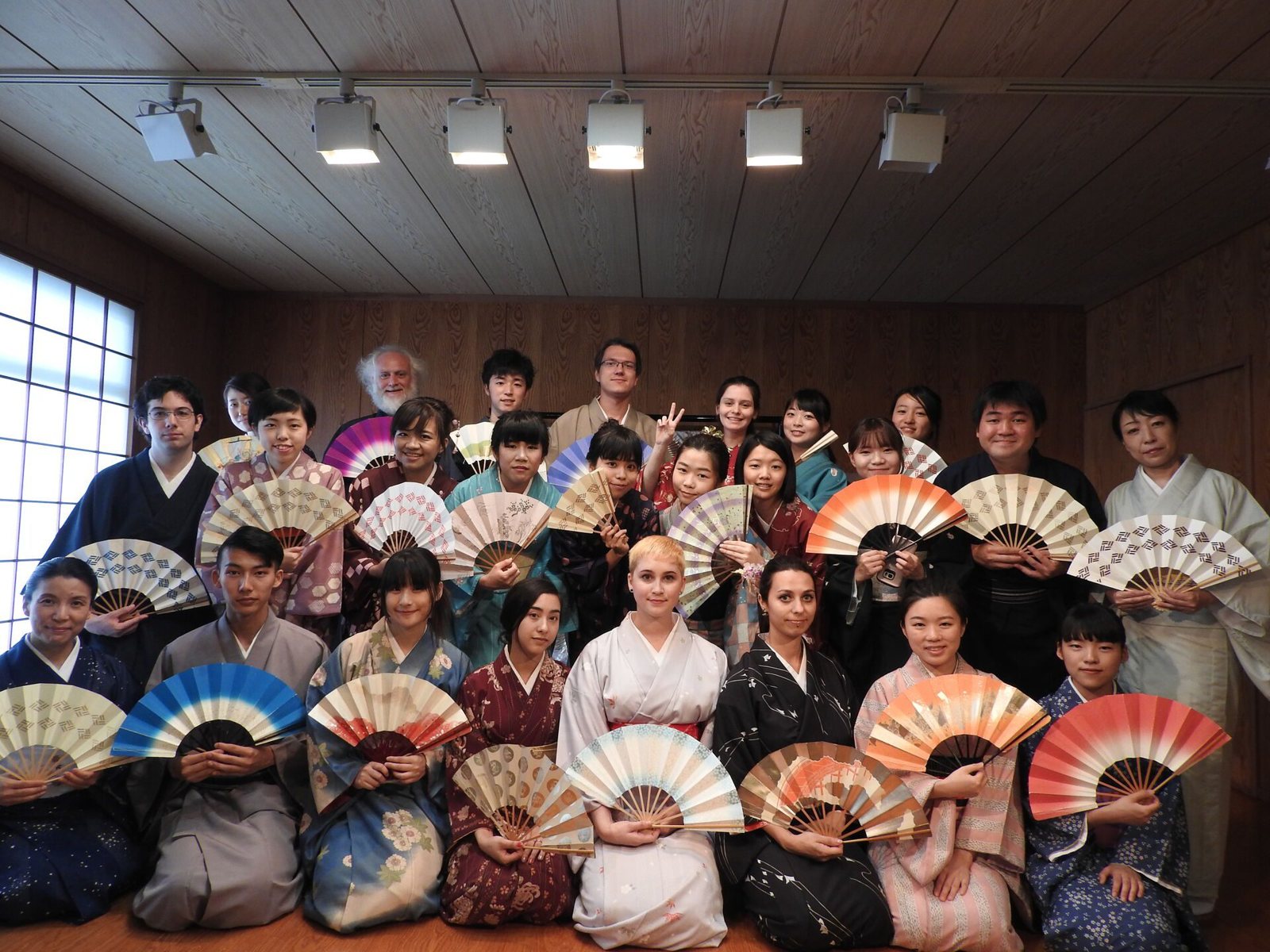
- DKP includes Zen meditation, taiko drumming, calligraphy, tea ceremony, Noh, walking tours and more. Held mainly on weekends and holidays about 8 times a year; participation is optional
- Guided visits to Fushimi Inari, the Arashiyama bamboo grove and Kinkaku-ji
- Rafting on the Hozu River, climbing Mt. Fuji in summer, skiing on fresh winter snow, or a friendly barbecue at Lake Biwa
- There is a "Sports Day," and a "farewell party" is held at the end of each term
- The school plans exchange events with Japanese university students
- The annual schedule is published at the start of each term
On campus
- 4 floors
- 6 dedicated classrooms — Up to 20 students per class, air conditioning and natural light, a whiteboard and projector in every room, and adult-size seating
- On campus
- Book corner — Japanese books and novels, manga, graded readers (N5–N1), newspapers and magazines can be borrowed free of charge during class hours
- Building
- Elevator — Elevator from the 1st floor
- Bicycle parking nearby
- Bicycle parking
- On campus
- Wi-Fi — The Wi-Fi on campus is for staff only, so students are advised to bring mobile data
2026–2027 academic calendar
- Summer vacation
- Aug 1–16
2026 spring term (Apr 13 – Oct 18)
School website · 2026-09-15 updated
Access
- Transit
- Hankyu Kyoto Line, Kawaramachi Station, 10 min on footEast exit
Keihan Main Line, Gion-Shijo Station, 12 min on foot Exit 2 or 3
Kyoto Municipal Subway Karasuma Line, Gojo Station, 10 min on foot Exit 2 - Nearby
- Sakura Building. 2-minute walk from the Kawaramachi-Matsubara stop (City Bus routes 17, 71 and 80), 20 minutes by bus from Kyoto Station
- Dormitory
- Available · Kowa Dormitory is the main partner student dormitory. Furnished private rooms near the school, with utilities and Wi-Fi included, from about ¥50,000 to ¥65,000 per month · Based on school website
School website · 2026-09-15 updated
Dorm — Tuition does not include housing costs. Applications, contracts and payments are made directly between the student and the housing company. Vacancies are limited, so book early after the CoE is issued
School website · 2026-09-15 updated
SALLAE has organized the school website and published data in English.
The update date is the day that material was last revised.
Photos are materials published by the school.
This information is compiled from official sources and is not updated daily. Please confirm with the official contact before signing or applying.