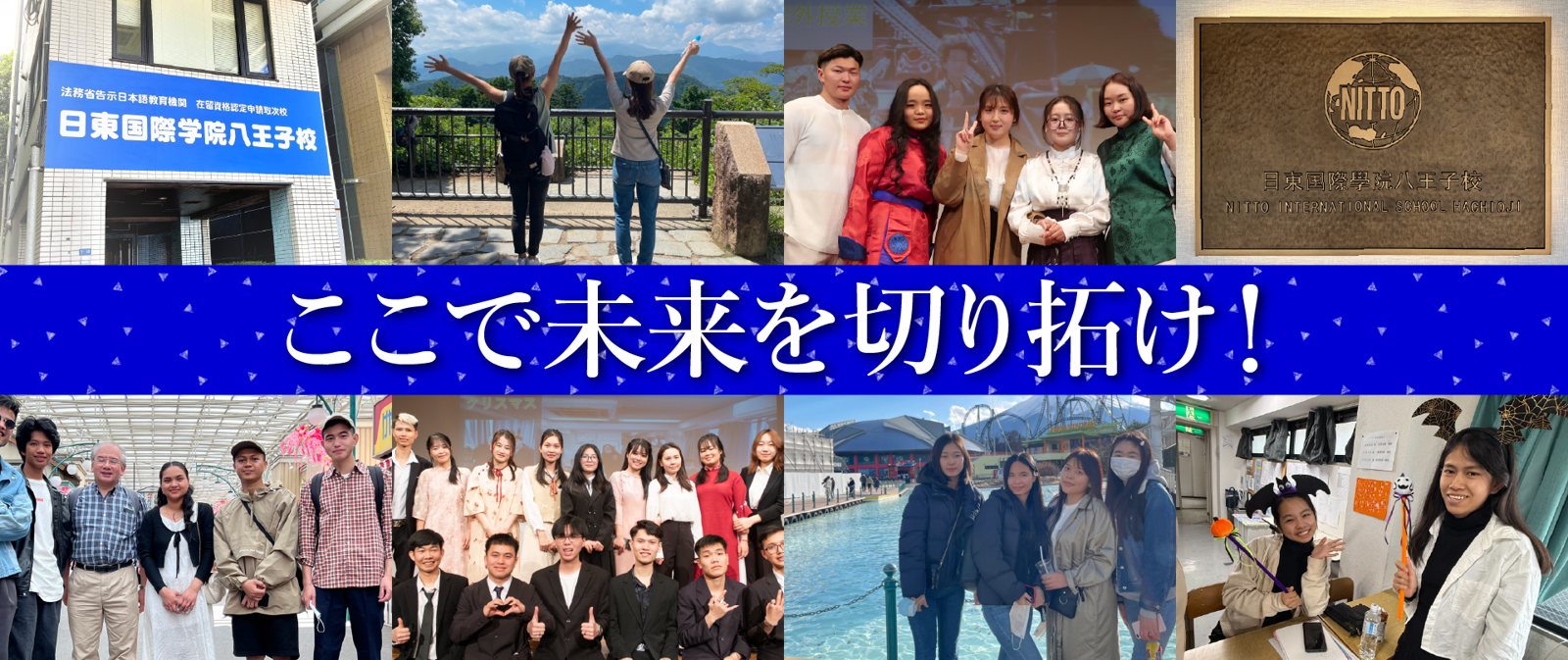
Nitto International Gakuin Hachioji Campus
Nitto International Gakuin Hachioji Campus
- Course
- Further-study course only ›
- Dormitory fee
- From ¥22,000 per month ›
- Admission
- 4 times a year · Jan, Apr, Jul, Oct ›
Compare side by side with other schools →
Tuition and conditions may change depending on the intake. If you contact us, we will check with the school and give you accurate details.
Nearby schools comparedBy distance · no ads or paid placement
- Nitto International Gakuin Hachioji CampusThis schoolTuition/yr¥910,000Progression—IntakesJan · Apr · Jul · Oct
- Tokyo International Exchange Academy0.5km›Tuition/yr¥888,000Installments OKProgression76%IntakesJan · Apr · Jul · Oct
- Tokyo International Foreign Language Academy1.3km›Tuition/yr¥782,000Progression—IntakesApr · Oct
- Hosanna Japanese Language Institute Tokyo Campus7.5km›Tuition/yr¥792,000Progression93%IntakesApr · Oct
— means SALLAE has not yet found the data.
About the school
A school that focuses on progression to universities and vocational schools. The school describes itself as "a school for international students considering university", and all four of its courses are progression courses. For the 2-year course, a monthly progression guidance schedule is set up, from the career survey and individual interviews in the first year to the statement of purpose, exam preparation and admission procedures in the second year. Listed destinations include 27 vocational schools and 4 universities such as Takushoku University and Teikyo University (the year is not stated). The school opened in Hachioji in 2016, and its capacity has been 260 students since April 2025. It has two buildings a 15-minute walk from JR Hachioji Station, and a dormitory 30 seconds away on foot. Of the 245 students enrolled in 2026, 103 are from Nepal.
Published data and school website
Tuition
If you saw a lower amount elsewhere, it may not include the admission fee and application fee
Median 1-year tuition in other areas — Kyoto ¥911,000(7 schools) · Kanagawa ¥880,000(8 schools) · Okinawa ¥858,000(6 schools) · Tokyo ¥840,600(56 schools) · Fukuoka ¥835,000(12 schools) · Hyogo ¥825,500(7 schools) · Osaka ¥814,000(27 schools) · Shizuoka ¥790,000(9 schools) · Chiba ¥745,333(10 schools) · Aichi ¥740,667(5 schools)
Total by intake
| Intake · length | Full course |
|---|---|
| January intake · 1 year 3 months | ¥1,108,700 |
| October intake · 1 year 6 months | ¥1,318,600 |
| July intake · 1 year 9 months | ¥1,519,200 |
| April intake · 2 years | ¥1,712,800 |
Cost details · course tables · notes · 5 items
- One-time fees
- ¥910,000Application fee ¥30,000 · Admission fee ¥50,000 · Tuition ¥700,000 · Facility fee ¥50,000 · Other costs ¥80,000
According to the school guide, fees are paid in one lump sum at enrollment. SALLAE will check with the school whether you can pay in installments.
| Intake · course | Extra 2nd-year costs | All |
|---|---|---|
| January · 1 year 3 months | ¥198,700 | ¥1,108,700 |
| October · 1 year 6 months | ¥408,600 | ¥1,318,600 |
| Jul · 1 year 9 months | ¥609,200 | ¥1,519,200 |
| April · 2 years | ¥802,800 | ¥1,712,800 |
Extra cost paid in the 2nd year — the application fee and admission fee are not charged again. The remaining costs of each course are paid before the end of the first year. For the second payment, the application fee and the admission fee are "—".
The costs above apply to enrollment from April 2026 onward.
Materials, accident insurance and health checkup fees, and extracurricular class and event costs are paid as other expenses together with tuition.
After notification that the Certificate of Eligibility has been issued, pay the first year in full, including the application fee. After payment is confirmed, the Certificate of Eligibility and the admission permit are sent.
In principle all new students live in the dormitory for the first 6 months after arriving in Japan, with dormitory fees charged separately. Dormitory fees are paid by bank transfer together with tuition and other payments.
National Health Insurance premiums are paid by each student. All fees for making payments are borne by the applicant.
School website · 2025-06-18 updated
Whether it is refundable
- Application fee
- Required even if the Certificate of Eligibility is not issued. The application fee is not refunded for any reason.
- If you withdraw before entering Japan for personal reasons
- After the Certificate of Eligibility and the admission permit are returned, a refund is made, excluding the application fee and the admission fee.
- If the Japanese embassy refuses to issue a visa
- Return the admission permit and submit a certificate of visa refusal. After confirmation, a refund is made, excluding the application fee.
- If you obtained an entry visa but declined enrollment before coming to Japan
- After the admission permit is returned and it is confirmed that the visa was not used and has expired, a refund is made, excluding the application fee and the admission fee.
See refund policy in detail · 2 more lines
- After entry
- Not refunded under any circumstances
- Cancellation due to natural disasters or similar reasons
- Not refunded
Admission & dates
- Jan intake
- 1 year 3 months course · Application Must arrive by Aug 10 of the previous year · Classes 1,000 hours (1 class hour: 45 minutes)
- Apr intake
- 2-year course · Application Must arrive by Oct 30 of the previous year · Classes 1,600 hours (1 class hour: 45 minutes)
- Jul intake
- 1 year 9 months course · Application Must arrive by Feb 28 of the same year · Classes 1,400 hours (1 class hour: 45 minutes)
- Oct intake
- 1 year 6 months course · Application Must arrive by May 13 of the same year · Classes 1,200 hours (1 class hour: 45 minutes)
- Japanese level
- JLPT N5 level or above
1 year 3 months: equivalent to N3, mock test 70 points. 2 years: equivalent to N5, 150 or more hours, 60 points. 1 year 9 months: equivalent to N4, 200 or more hours, 60 points. 1 year 6 months: equivalent to N4–N3, 60 points.
Deadline and capacity rules
Progression course. Applicants must be 18 or older and have completed 12 or more years of school education abroad or equivalent education.
School website · Confirmed 2026-09-26
Classes
- Morning
- 09:00-12:10 4 periods of 45 minutes
- Afternoon
- 13:00-16:10 4 periods of 45 minutes
- Class size
- Max 20 students
Materials · Subjects · Timetable · Details
Morning classes 9:00–12:10, afternoon classes 13:00–16:10. 20 hours per week. As of Oct 1, 2024: 9 classes, up to 20 and at least 8 students.
School website · 2025-10-01 updated
Documents
- Application form (on the school's designated form, with a 4 cm × 3 cm photo attached). Write your name as it appears in your passport and your address accurately down to the street number.
- Resume (on the school's designated form): list education from elementary school to the last school attended, with graduation dates down to the day. Write locations down to the street number and give specific, detailed reasons for applying.
- Original diploma or original graduation certificate from your last school
- Academic transcript from the highest level of education
- JLPT N5 level or aboveNAT-TEST, J-TEST and TOP-J are also accepted) original pass certificate or score report, and study certificate (name of the institution, period, total study hours, textbooks used
- Family register: 1 copy of all pages.
- Copy of ID: submit one each for the applicant and the financial sponsor, copying front and back onto one A4 sheet per person.
- 6 photos: 4 cm tall × 3 cm wide, taken within 3 months, all 6 identical. Write your name on the back; attach 1 to the application form.
Financial supporter's documents · only if applicable · 6 application requirements
Submitted by the person paying the tuition (financial sponsor)
- Statement of expenses and list of the sponsor's family members (on the school's designated forms). The financial sponsor must fill in everything by hand and describe in detail how they came to sponsor and how the expenses will be paid.
- Bank balance certificate: the balance must be enough to pay living costs and tuition in Japan during enrollment (deposit period of 6 months or more).
- Copies of bank passbooks for 3 years and a written explanation of how the funds were accumulated
- Certificate of employment: must state job duties, position and years of service. For relatives in the home country, it must also state the business registration number and tax number.
- Income certificate and tax payment certificate are required for the past 3 years.
- Documents proving the relationship between the financial sponsor and the applicant: copies of birth certificates and ID cards (submitted by both the sponsor and the applicant).
- Sponsor is a relative in the home country: proof of the sponsor's family composition (copy of the family register for all family members)
- Certificate of employment: for company owners and officers, a certified copy of the company register; for self-employed people, a copy of the final tax return.
- Tax assessment certificate, tax payment certificate: issued by the municipality, showing total income (past 3 years).
- Certificate of residence listing all household members, without My Number. For foreign nationals, a copy of the certificate of alien registration card matters or the alien registration card.
- Documents proving the relationship between the financial sponsor and the applicant: family register, birth certificate, etc. If they are not relatives, attach documents showing their relationship.
Only if applicable
- If enrolled in a university or similar, submit your high school diploma and transcript (Currently enrolled at a university or similar)
- Certificate of enrollment (submit together with the transcript) (If you are currently enrolled)
- Certificate of employment (submit if currently employed)
- Authentication of graduation certificate (If you have an authenticated graduation certificate)
- Copy of passport (if you have entered Japan before, copy all pages) (If you have a passport)
- Birth certificate, family register, and copies of the applicant's and financial sponsor's ID cards (each with a Japanese translation) (If you hold Vietnamese nationality)
Application requirements
Except for diplomas and certificates, submit all documents as originals dated within 3 months. Application documents must be filled in by the applicant and the sponsor; do not use correction fluid. Attach a Japanese translation to all documents not made in Japanese. Documents submitted to the Immigration Services Agency, except diplomas and certificates, are not returned. Copies must be A4, single-sided, and first-generation copies of the original only. Write the copy date, name and status. Additional documents may be requested as needed.
Required documents differ by country, so please contact the school office for details. SALLAE is confirming this with the school.
School website · Confirmed 2026-09-26
Admission process
- Request an admission consultation — Please contact the school by phone or through the inquiry form.
- Submit application documents — Application fee ¥30,000 (bank transfer). * Required even if the Certificate of Eligibility is not issued.
- Document screening and on-site interview — Document screening and an on-site interview (the applicant and the financial sponsor). A written test may also be given.
- Review by the Immigration Services Agency
- Results notice — The applicant is notified of the result as soon as the Immigration Services Agency issues the Certificate of Eligibility.
- Pay the costs including the application fee (1st year, 1 year) — Pay the first year in full, including the application fee. Dormitory fees are transferred together with tuition and other payments. The transfer fee is paid by the applicant.
- Certificate of Eligibility and admission permit dispatched — After payment is confirmed, the Certificate of Eligibility and the admission permit are sent.
- Visa application and arrival preparation
- Admission
- Placement test
- Before classes start, each student's Japanese ability is assessed by exams and other means, and classes are formed accordingly.
School website · Confirmed 2026-09-26
Reviews
If you study here or used to, tell others what the classes, teachers and daily life were like. It helps anyone deciding on this school.
Write the first reviewUniversity prep
- Progression information session — Annual events include a career consultation fair in June and the EJU. In June 2025, students attended a progression information session and listened eagerly at each booth.
- School tour — Visited Nihon Kogakuin and observed classes in many departments, and also heard from school graduates and international students (Jun 26, 2026). Visited the Graduate School of Takushoku University (Jul 6, 2022).
- Interview practice — Entered through the international student selection (self-recommendation). The teachers explained the key points of the interview, and the student practiced interviews many times.
Schedule to admission
- Year 1
- April · Enrollment · Progression orientation
- Year 1
- May · Career preference survey (1)
- Year 1
- May–Jul · Career guidance
- Year 1
- Aug–Oct · Individual progression interview (1)
- Year 1
- November · JLPT preparation
- Year 1
- Jan–Mar · Desired field
- Year 1
- February · Individual progression interview (2)
- Year 2
- Apr–Aug · Career preference survey (2)
- Year 2
- May–Jul · Career guidance
- Year 2
- Jul–Nov · Preparing application documents · Guidance on writing the statement of motivation · Exam preparation
- Year 2
- Jul–Dec · Taking exams · Passing
- Year 2
- Sep–Dec · Checking application documents · Applying
- Year 2
- Dec–Mar · Guidance on enrollment procedures · Progression preparation guidance
- Year 2
- March · Graduation · Progression
School website · Confirmed 2026-09-26
Daily-life support
- Airport pickup — Airport pickup + futon + daily necessities = ¥20,000. Please transfer it together with tuition and rent.
- Part-time job listings — The school receives part-time job listings, and some students work part-time at factories, convenience stores and the like.
- This is the period in which part-time work of up to 40 hours a week (up to 8 hours a day) is allowed. — During long vacations, up to 40 hours per week (up to 8 hours per day); at other times, the 28-hours-per-week rule applies. A long-vacation certificate is issued at the student's request.
- Police seminar — August: police seminar and health checkup (learn the rules of Japan!)
- Health checkup — August: health checkup
- National Health Insurance — International students are obliged to enroll in National Health Insurance. Students arrange it at the counter of the city or ward office where they live and pay the premiums themselves.
- Certificates after graduation — Apply at the counter or by email. Mailed only to the person named, by Letter Pack Light within Japan and by EMS overseas.
School website · Confirmed 2026-09-26
Students
245 enrolled (2026) · Capacity 260 National median: 180 students
Based on the 245 students enrolled in 2026.
Public data from the Association for the Promotion of Japanese Language Education (Nisshinkyo) · verified 2026-09-20
School life
For 1 year
- 4
- Entrance ceremony
- 6
- Career consultation session · EJU
- 7
- JLPT · Tanabata
- 8
- Police seminar · Health examination
- 10
- Halloween
- 11
- EJU
- 12
- JLPT · Christmas
- 1
- First shrine visit of the year · First calligraphy of the year
- 2
- Extracurricular outing (enjoy Japan's wonderful scenery and culture!)
- 3
- Graduation ceremony
* The events above are current plans, and the timing may change. The FY2026 entrance ceremony is May 15, 2026; the New Year calligraphy session is part of class.
- Took part in the Hachioji Festival, pulled a festival float and joined a community cleanup (Aug 8, 2026).
- 18 students took part as "helper international students" in Hachioji City's "Easy Japanese training" and interacted with about 70 city staff (Feb 10, 2026).
- Two students from Tokyo Metropolitan University visited and held a kyudo (Japanese archery) workshop (May 11, 2026).
- After watching a video at the Clean Center, students toured the facility and later presented a report (Jun 4, 2026).
- Went to Seibuen Amusement Park on an extracurricular outing
On campus
- Oiwake Main Building
- 7-10 Oiwakecho — A branch building was added in Oiwakecho in January 2023, and classrooms were added in April 2025 to make it the Oiwake Main Building.
- Yagicho Building
- 2-18 Yagicho — Moved to Yagicho in May 2019. 350 m from the Oiwake main building, 4 min on foot.
- Classroom
- Classroom numbers: 301, 401, 501, 601, S302, S303, S401, S402 — Capacity: 20 students (18 for room S402 only)
- On campus
- Library and infirmary (available)
- On campus
- Audio-visual equipment: 40 units
2025–2026 academic calendar · Older data
- Saturdays and Sundays
- Weekly
- Spring break
- Mar 15 – Apr 13, 2025
- Summer vacation
- Aug 1 – Aug 17, 2025
- Autumn break
- · The date has not been published.
- Winter break
- Dec 20, 2025–Jan 12, 2026
School website · Confirmed 2026-09-26
Access
- Transit
- JR Chuo Line, Hachioji Station, 15 min on foot
- Nearby
- Hachioji City in the Tama area of Tokyo. The Oiwake main building and the Yagicho school building are 350 m apart, and the location depends on the class assigned.
- Dormitory
- Available¥30,000–¥50,000 per month · Building 2 · rooms for 2 to 6 people · ¥22,000–28,000 plus a management fee of ¥2,000 · 30 seconds on foot from the school · Based on the school website
School website · Confirmed 2026-09-26
Dorm — Building 2 is a 20-minute walk to Hachioji Station. 4-person room ¥22,000, 3-person room ¥25,000, 2-person room ¥28,000 (each plus ¥2,000 management fee)
School website · Confirmed 2026-09-26
SALLAE has organized the school website and published data in English.
The update date is the day that material was last revised.
Photos are materials published by the school.
This information is compiled from official sources and is not updated daily. Please confirm with the official contact before signing or applying.