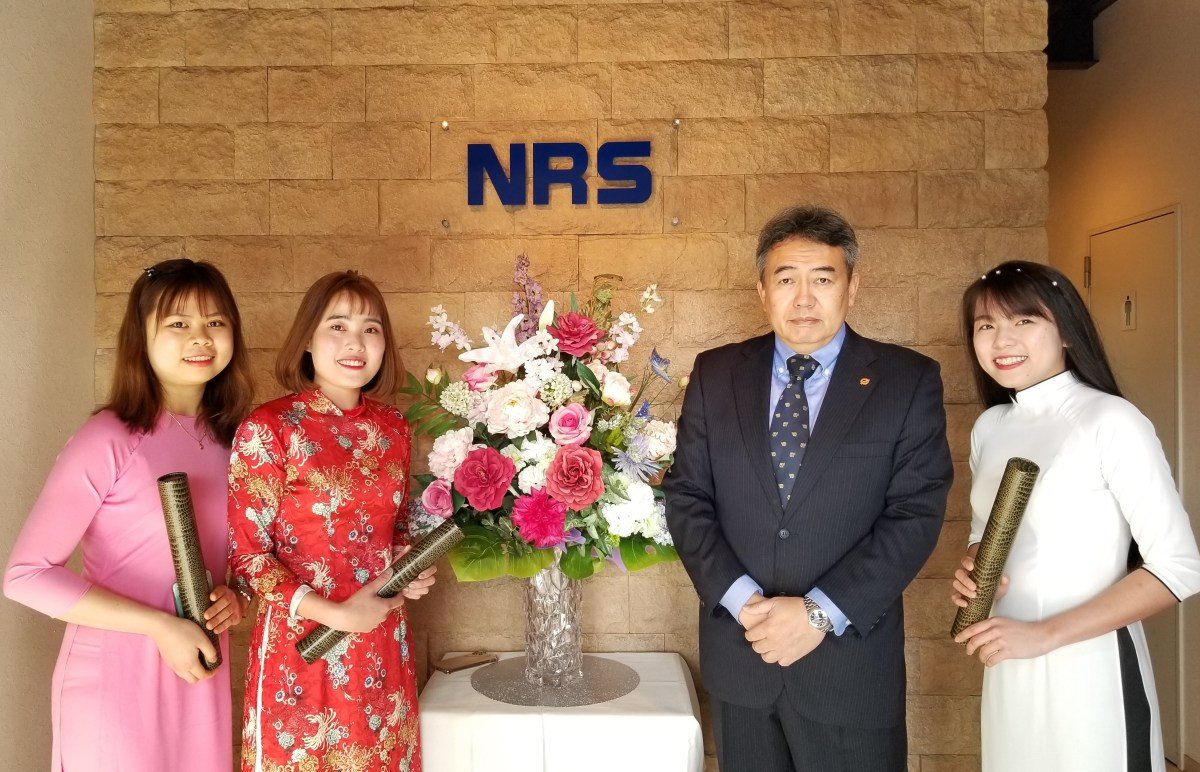
North River Japanese Language School
North River Japanese Language School
- Progression
- University or similar 95% ›
- AM & PM classes
- Decided by the school ›
- Admission
- 3 times a year · Apr, Jul, Oct ›
Compare side by side with other schools →
Tuition and conditions may change depending on the intake. If you contact us, we will check with the school and give you accurate details.
Nearby schools comparedBy distance · no ads or paid placement
- North River Japanese Language SchoolThis schoolTuition/yr—Progression95%IntakesApr · Jul · Oct
- Mitsuboshi Japanese Language School0.7km›Tuition/yr¥940,000Progression—IntakesApr · Oct
- JP Education1.7km›Tuition/yr¥840,000Progression—IntakesApr · Oct
- ASAHI Culture Institute2.2km›Tuition/yr¥796,000Progression—IntakesApr · Oct
— means SALLAE has not yet found the data.
About the school
A progression-focused school that offers only progression courses (2 years, 1 year 9 months and 1 year 6 months); it reports that 129 of its 139 FY2025 completers progressed to universities and vocational schools (Report No. 44). It opened in 2003 in Hataetori, Nakamura-ku, Nagoya, a 5-minute walk from Kintetsu Kogane Station. It teaches its capacity of 240 students in two shifts, morning and afternoon, and most students are from Nepal and Sri Lanka (171 of 213 in 2025). The school regulations state that students cannot advance or complete the course if they do not meet the attendance (85% and 90%) and grade standards in the January advancement exam of the first year and the February completion exam of the second year..
Published data and school website
Admission & dates
- Apr intake
- 2-year course · Classes 1,560 class hours (78 weeks)
- Jul intake
- 1 year 9 months course · Classes 1,340 class hours (67 weeks)
- Oct intake
- 1 year 6 months course · Classes 1,200 class hours (60 weeks)
- Japanese level
- Japanese ability at entry: 2-year course A2.1 or higher · 1 year 9 months course A2.2 or higher · 1 year 6 months course B1.1 or higher
2-year course A2.1 or higher · 1 year 9 months course A2.2 or higher · 1 year 6 months course B1.1 or higher
Deadline and capacity rules
Courses start in April, July and October and end in March of the year after next. Requirements: 12 or more years of school education, age 18 or older, and a reliable guarantor. Capacity: 240 students.
School website · 2026-09-16 updated
Classes
- Morning
- 09:00-12:20 Period 1 9:00–9:45 · Period 2 9:50–10:35 · Period 3 10:45–11:30 · Period 4 11:35–12:20 (until 12:40 on Fridays)
- Afternoon
- 13:00-16:20 Period 1 13:00–13:45 · Period 2 13:50–14:35 · Period 3 14:45–15:30 · Period 4 15:35–16:20 (until 16:40 on Fridays)
- AM/PM placement
- Classes are held in two shifts
- Class assignment
- Level-based 8 stages
Materials · Subjects · Timetable · Details
- Materials
- Dekiru Nihongo: Beginner, Pre-intermediate and Intermediate (through Advanced I) / Advanced II: Nihongo Nama Chukei, reading training and more
Class hours by subject
| Subject | 2 years | 1 year 9 months | 1 year 6 months |
|---|---|---|---|
| Beginner | 200 hours | — | — |
| Pre-intermediate I | 140 hours | 140 hours | — |
| Pre-intermediate II | 300 hr | 300 hr | 300 hr |
| Intermediate I | 120 hours | 120 hours | 120 hours |
| Intermediate II | 220 hr | 220 hr | 220 hr |
| Intermediate III | 140 hours | 140 hours | 140 hours |
| Advanced I | 220 hr | 220 hr | 220 hr |
| Advanced II | 200 hours | 200 hours | 200 hours |
Monday to Friday (excluding public holidays). Students advance or complete the course with an attendance rate of at least 85% or 90% and an overall grade of B or higher.
School website · 2026-09-16 updated
Documents
- Admission application formSchool-designated form
- RésuméSchool-designated form
- Original certificate of graduation or diploma from the last school attendedIf not yet completed, the original certificate of expected completion
- Original academic transcript from the last school attendedIf you have not graduated from high school, the latest transcript as of the application date
- A document that can prove Japanese abilitySee admission requirement 2(B) above
- Birth certificateFor applicants from Nepal, a family relationship certificate
- Health checkupschool's designated form) + certificate of freedom from tuberculosis (issued at a local medical institution designated by the Japanese government
- Guarantee statementSchool-designated form
Financial supporter's documents · only if applicable · 2 application requirements
Submitted by the person paying the tuition (financial sponsor)
- Financial sponsorship statementSchool-designated form
- Original bank balance certificate
- Deposit and withdrawal statements for the past 1 year, or an explanation of how assets were accumulated over the past 1 year
- Sponsor's certificate of employment and income
- Sponsor's tax payment certificate
- Copy of the family register for all of the sponsor's family members, etc.
Only if applicable
- Certificate of employment or enrollment ((if applicable))
Application requirements
Note: required documents may differ depending on the applicant's nationality, financial situation and other factors. Please feel free to contact us. The former English page says that records of deposits and withdrawals and assets are required for 3 years, and that the tuberculosis certificate is required only for some countries.
It is not published whether any documents are omitted or added depending on nationality. SALLAE is confirming this with the school.
School website · 2026-09-16 updated
Admission process
- Request an admission consultation
- Submit the application form — Submit the application form
- Screening of the applicant — Screening of the applicant
- Admission permit — The school issues an admission permit to successful applicants
- Submit application documents — The student submits application documents
- Application for status of residence (the school applies on your behalf) — Application for status of residence (the school applies on your behalf)
- Immigration Services Agency review — Immigration Services Agency review
- Issuance of the Certificate of Eligibility — The Nagoya Regional Immigration Services Bureau issues the Certificate of Eligibility (CoE) to successful applicants
- Tuition payment — The student pays the tuition
- Receive the Certificate of Eligibility — Receive the Certificate of Eligibility
- Visa application — The student applies for an entry visa at the Japanese embassy or other office in their home country
- Arrive in Japan and enrol
School website · 2026-09-16 updated
Graduate outcomes
| FY2025 | Admitted |
|---|---|
| Employment | 1 student |
| Graduates | 139 students |
All schools accepted to so far
+3 more schools
Prepared Jun 30, 2026: 139 completed · 136 met the standard (97.8%) · progression 77/52/0 · status-of-residence change 1/0/0 · A2-equivalent 2/3/1 · Number permitted to change to a status of residence in the upper column of Appended Table 1-1 or 1-2 of the Immigration Control Act · School website · Updated Jun 30, 2026
Reviews
If you study here or used to, tell others what the classes, teachers and daily life were like. It helps anyone deciding on this school.
Write the first reviewUniversity prep
- Progression consultation — Japanese language education for international students and progression counseling
- Career guidance staff — Career guidance staff: 1 full-time and 5 concurrent (April 2024)
- Progression information session — August: summer vacation and progression information session
School website · 2026-09-16 updated
Daily-life support
- Number of life guidance staff — Student life advisers: 1 full-time and 2 concurrent (April 2024) / school regulations require 2 or more
- Health checkup — A health checkup is given as soon as possible after enrollment and every year after that / in the annual event calendar, in May
School website · 2024-07-01 updated
Students
213 enrolled (2025) · Capacity 300 National median: 180 students
Based on the 213 students enrolled in 2025.
Public data from the Association for the Promotion of Japanese Language Education (Nisshinkyo) · verified 2026-09-20
School life
For 1 year
- 4
- April intake enrollment · Orientation
- 5
- Golden Week · Health examination · Study trip
- 6
- EJU · Regular exams
- 7
- July intake enrollment · JLPT · Orientation
- 8
- Summer vacation · Progression information session
- 9
- Regular exams
- 10
- October intake enrollment · Orientation
- 11
- Examination for Japanese University Admission for International Students (EJU)
- 12
- JLPT · Regular exam · Winter break
- 1
- January intake enrollment · Orientation
- 2
- Exercise presentation
- 3
- Final exam · Completion ceremony
Based on the annual event calendar on the school website (revised February 2026) · The calendar lists a January intake, but under the current school regulations the intakes are April, July and October · The February exercise presentation is for 2nd-year students only (English page) · Closure days follow the school regulations.
Academic calendar
- Saturdays and Sundays
- Weekly
- National holidays
- National holidays
- Summer vacation
- Aug 1–31
- Autumn break
- Autumn break (Sep 28 – Oct 4)
- Winter break
- Dec 27, 2025–Jan 5, 2026
- Spring break
- Spring break (Mar 21 – Apr 4)
School website · 2026-02-06 updated
Access
- Transit
- Kintetsu Line Koganecho Station, 5 min on foot
- Nearby
- Right next to the Kogane-bashi city bus stop / The school regulations list the school buildings at 2-8-3 Hataetori and 40 Okitacho
- Dormitory
- Available¥20,000 per month
School website · 2026-02-06 updated
SALLAE has organized the school website and published data in English.
The update date is the day that material was last revised.
Photos are materials published by the school.
This information is compiled from official sources and is not updated daily. Please confirm with the official contact before signing or applying.