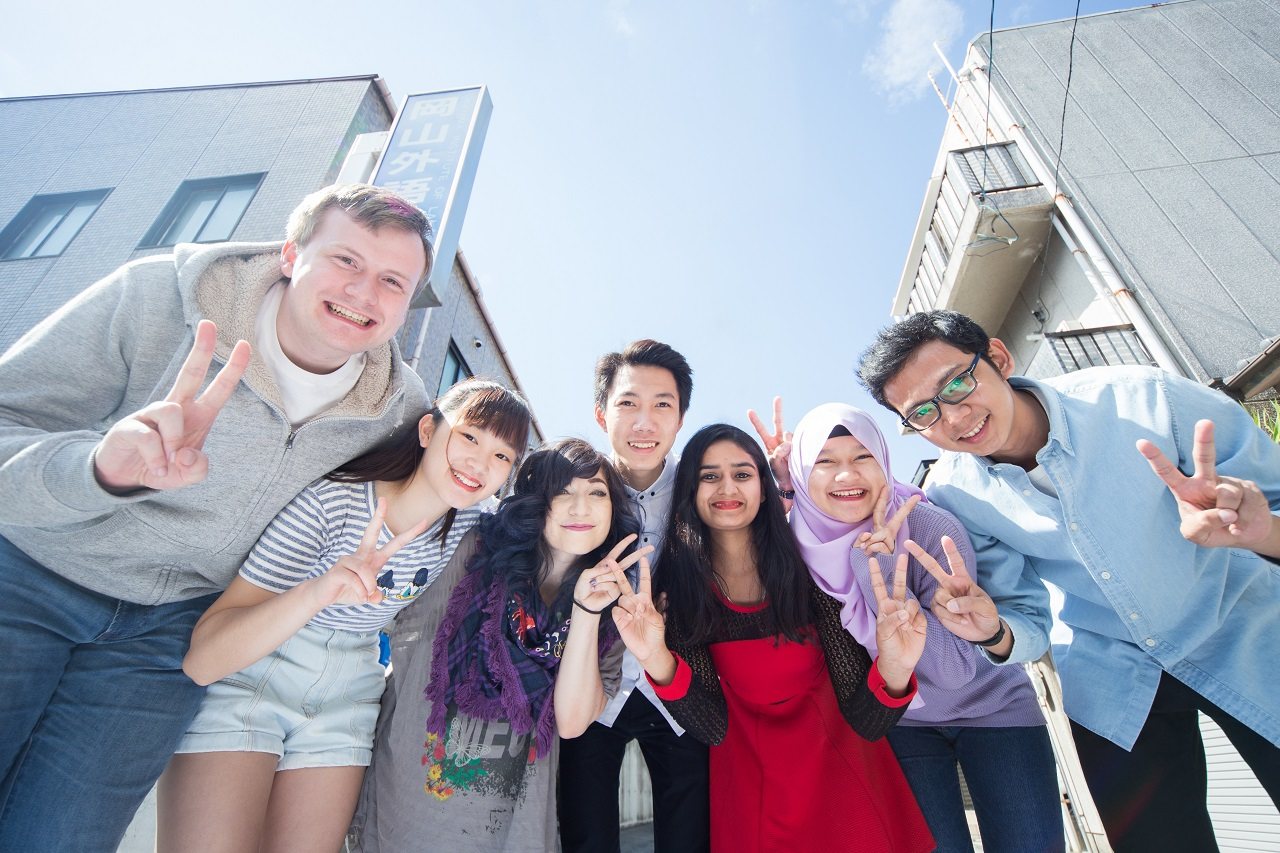
Okayama Foreign Language Institute
Okayama Foreign Language Institute
Compare side by side with other schools →
Tuition and conditions may change depending on the intake. If you contact us, we will check with the school and give you accurate details.
Nearby schools comparedBy distance · no ads or paid placement
- Okayama Foreign Language InstituteThis schoolTuition/yr¥838,000Progression—IntakesApr · Jun · Oct
- Okayama Business College2km›Tuition/yr¥730,000Progression91%IntakesApr · Oct
- Okayama College of Science and Technology2km›Tuition/yr¥719,000Installments OKProgression—IntakesApr · Oct
- Kurashiki Foreign Language Institute16.3km›Tuition/yr¥752,000Progression—IntakesApr · Oct
— means SALLAE has not yet found the data.
About the school
The study-visa courses are only progression courses (1–2 years) aimed at universities and vocational schools. In addition to the homeroom teacher, a full-time progression guidance teacher is always available, and students can reportedly progress through special recommendations under education agreements with more than 40 universities and vocational schools nationwide. The school has a capacity of 400 students and is in Funabashicho, Kita-ku, about 15 minutes by streetcar from Okayama Station. It has taught Japanese to international students since 1992 and also runs a Japanese teacher training course. Student dormitories with single and twin rooms are 10–25 minutes from the school by bicycle, and more than 90% of students commute by bicycle.
Published data and school website
Tuition
If you saw a lower amount elsewhere, it may not include the admission fee and application fee
Median 1-year tuition in other areas — Kyoto ¥911,000(7 schools) · Kanagawa ¥880,000(8 schools) · Okinawa ¥858,000(6 schools) · Tokyo ¥840,600(56 schools) · Fukuoka ¥835,000(12 schools) · Hyogo ¥825,500(7 schools) · Osaka ¥814,000(27 schools) · Shizuoka ¥790,000(9 schools) · Chiba ¥745,333(10 schools) · Aichi ¥740,667(5 schools)
Admission & dates
- Apr intake
- 2-year course · Application Interview applications (document submission) Jul 1 – Oct 10, 2026. Submit the remaining documents from the interview pass notification date to Oct 31. · Classes 1,520 class hours or more
- Apr intake
- 1-year course · Application Interview applications (document submission) Jul 1 – Oct 10, 2026. Submit the remaining documents from the interview pass notification date to Oct 31. · Classes 760 class hours or more
- June intake
- 1 year 9 months course · Classes 1,332 class hours or more
- Oct intake
- 1 year 6 months course · Classes 1,140 class hours or more
- Japanese level
- Japanese-Language Education reference framework A1 or higher (JLPT N5 or higher). The 1-year progression course requires upper A2 or higher (JLPT N4 or higher).
2-year course: JLPT N5, J.TEST Grade F, JPT 315 or higher, or 150 or more study hours. 1-year course: N4, Grade E, JPT 370 or higher, or 500 or more study hours.
Deadline and capacity rules
The progression 1-year, 1 year 6 months, 1 year 9 months and 2-year courses finish in March. For April 2027 enrollment: 20 students for the 1-year course and 100 for the 2-year course. Open to applicants who aim at further study, have completed 12 or more years of education and, in principle, are 18 or older.
School website · 2026-07-01 updated
Classes
- Morning
- 09:00-12:35 Intermediate to Advanced
- Afternoon
- 13:15-16:50 Beginner to Intermediate
- AM/PM placement
- Intermediate to Advanced: morning class 9:00–12:35. Beginner to Intermediate: afternoon class 13:15–16:50.
- Class size
- Max 20 students
- Class assignment
- Level-based 4 stages
- Elective classes
- EJU preparation · University entrance exam preparation course · EJU prep and university entrance exam courses are offered outside regular classes. The EJU prep course is an elective.
Materials · Subjects · Timetable · Details
- Subject
- General · Project · Reading · Listening · Composition · Vocabulary · Kanji · Homeroom · The general course balances all four skills. Projects run from planning through research, presentation and Q&A. Homeroom covers study management, interview and exam preparation.
Class hours by subject
| Subject | 2 years | 1 year 9 months | 1 year 6 months | 1 year |
|---|---|---|---|---|
| Beginner | 380 hours | 192 hr | 380 hours | — |
| Intermediate | 380 hours | 380 hours | 380 hours | 380 hours |
| Upper intermediate | 380 hours | 380 hours | 380 hours | 380 hours |
| Advanced | 380 hours | 380 hours | — | — |
Each level is 19 weeks, 380 class hours (only the Beginner level of the 1 year 9 months progression course is 10 weeks, 192 hours). 4 class hours daily, with 10-minute breaks, and a 15-minute break only between periods 2 and 3.
School website · 2026-01-15 updated
Documents to prepare — student visa course
- School application form
- Resume: list education and work history from elementary school entry to the time of application without omission (no gaps). Also state any history of visiting Japan, the reason for studying abroad and plans after completion.
- Diploma from the last school attended. Graduates of a 4-year university undergraduate program also submit their bachelor's degree certificate.
- 4 photos (color), 4 cm tall × 3 cm wide. Taken within 6 months before the submission date, facing front, without a hat or background. Write nationality and name on the back.
- Copy of passport: if you have one, copies of all pages showing entry to and exit from Japan and visas.
- Certificate of Japanese study
- Certificate showing no active tuberculosis: must be within 180 days of the date of the chest X-ray.
Sponsor documents · Only if applicable · 5 application requirements
Submitted by the person paying the tuition (financial sponsor)
- For the method of payment, state a method that can specifically prove the payment (such as bank transfer) at the time of "extension of period of stay".
- Certificates issued by public authorities, such as a family register.
- If the balance certificate does not state the bank's address, phone number and the name of the person in charge, attach a document that clearly shows them.
- If the financial sponsor is a salaried employee: a certificate of annual income for the past 1 year or more (issued by the employer) and a certificate of employment (position, period of employment, duties).
- If a company officer: a tax certificate or similar showing income for the past 1 year or more, and a certified copy of the company register or a copy of the business license.
- If self-employed or similar: a tax certificate or similar showing income (issued by the tax office) and a copy of the business license.
Only if applicable
- Certificate of enrollment (submit only if you are enrolled at an educational institution at the time of application.)
- Certificate of employment (stating the period of employment) (If you are currently employed)
- Submit a copy of an ID card (if you do not have a passport)
- If the applicant entered elementary school under 5 years old or over 8 years old, or the years enrolled were not 6, submit a certificate showing the entry date, years enrolled and graduation date. (If the years enrolled were not 6)
- If you have relatives in Japan, submit a copy of their residence card and tell us their workplace or school name. (Only those with relatives in Japan)
- Statement of expenses, documents proving the relationship, bank balance certificate, certificate of employment (certified company register copy for self-employed people), tax certificate, and certificate of residence for all family members. (If a person living in Japan is the financial sponsor)
Application requirements
Each certificate must have been issued on or after Sep 1, 2026 and must state the issuing institution's location, phone number and email, and the title and name (signature) of the person in charge. Attach Japanese translations of the documents. If you cannot prepare them, the school will accept them and translate them (a separate translation fee applies). If the financial sponsor is neither the applicant nor the applicant's parent, please submit an explanatory statement describing the specific circumstances that led to the sponsorship. Proof of a Japanese test requires the test name, test date and level (score); proof of study requires the institution's name, address, contact, study period, hours per week and hours already studied. Of the application documents, only original documents such as diplomas are returned. You may be asked to submit an additional education credential authentication.
Applicants from the Philippines, Nepal and Vietnam must submit a tuberculosis-free certificate issued by a designated health checkup facility listed on a separate sheet. Chinese nationals who do not hold a passport must submit a notarized certificate. SALLAE is confirming this with the school.
For short-term courses, only the application form [designated form] · 1 photo · copy of the passport are submitted.
School website · 2026-07-01 updated
Admission process
- Request an admission consultation — Contact by the inquiry form (reply in 3–4 business days), email or phone (086-231-5211)
- Apply for an interview — Application period Jul 1 – Oct 10, 2026. Submit the application form and resume to the school's Student Affairs Department on paper or as a PDF. Applications close once capacity is reached, even during the period.
- Interview — Individual interviews, in person or on the web. The decision is based on the Japanese test result, motivation to learn, attitude and other factors. The result is notified by email within 1 week.
- Submit documents 3 to 19 and pay the application fee — From the date of the interview pass notice until Oct 31, 2026, pay the application fee and submit the remaining documents. The result is notified by email around Nov 10. The application fee is not refunded.
- The school applies to the Hiroshima Regional Immigration Services Bureau for the Certificate of Eligibility (CoE) — For applicants who pass the admission screening, the school applies to the Hiroshima Regional Immigration Services Bureau for a Certificate of Eligibility (November 2026).
- Results notice (CoE issued) — Results are notified in late February 2027. Those who are issued a certificate pay tuition, dormitory fees and other charges. For those who are not issued one, a notice of non-issuance and the original diploma and other documents are returned.
- Documents needed to obtain the visa locally — After payment is confirmed, the documents needed to obtain a visa locally are mailed, and the original diploma and other documents are returned. If applying through a study-abroad agency, they are mailed to the agency.
- Visa application — Please apply for a visa at the Japanese embassy or consulate nearest to where the applicant lives.
- Please tell us your arrival date (and flight number). — Once you have booked your flight, be sure to contact the school at least 7 days before you enter Japan.
- Enrolment procedures — Please complete enrollment procedures at the school immediately after arriving in Japan.
- Placement test
- Classes are assigned by a placement test, even right after enrollment or in the middle of a term. Results such as J.TEST are also used as a reference. The class placement test is on Oct 5.
School website · 2026-07-01 updated
Short-term study
- Visa
- Temporary visitor or Working holiday(not a student visa)
- Admission
- RollingNo fixed intake months
- Open now?
- Rolling admissions, so availability varies from time to time — SALLAE will confirm with the school
Course without a student visa
- Progression course for residents — People with permanent resident, long-term resident, dependent or spouse-of-Japanese status of residence study in the same classes as international students. April and October enrollment, 6 months to 2 years. Students with an attendance rate of 85% or less cannot continue the course.
- Short-term course for residents — People living in Japan study with the same curriculum as international students. Minimum 2 weeks, in weekly units. Beginner first half starts in April and October; other levels can start any time from April to February. Counter application: documents → class placement test and interview → class observation → payment.
- Private lessons — In person 90 minutes, online 45 minutes; 4, 10 or 20 sessions. Monday to Friday 9:00–18:30 (until 21:00 on Wednesdays). For people with a status of residence; online is also available from overseas. About 1 week until a decision.
- Short-term summer program — About 2 weeks in summer (July and August). Japanese in the morning and activities such as tea ceremony, sushi making and fruit picking in the afternoon.
- Corporate training — Choose from in-person classes (4 periods daily Monday to Friday, minimum 2 weeks), in-person or online private lessons, and dispatched Japanese lessons (fewer than 10 students per class).
★Short-term courses are not listed in the published data — it counts only student-visa courses.
School website · Confirmed 2026-09-26
Reviews
If you study here or used to, tell others what the classes, teachers and daily life were like. It helps anyone deciding on this school.
Write the first reviewUniversity prep
- Full-time progression guidance instructors — Three progression staff members work with the head of academic affairs and each class's homeroom teacher to provide progression guidance.
- Special recommendation system — The school has education agreements with more than 40 universities and vocational schools nationwide, and students can also progress through special recommendation slots.
- On-campus further-study guidance — On campus, progression guidance sessions with institutions from all over Japan are held regularly. A progression guidance session is held at the end of the enrollment year, followed by individual interviews and interview practice.
- Exam preparation — The school also offers progression orientation, individual counseling, interview practice and EJU prep. Essay and interview practice are also thorough.
- Students with a strong wish to go on to university or graduate school — For students with a strong wish to go on to university or graduate school, the school partners with outside cram schools. A dedicated staff member gives individual guidance to those aiming at graduate school.
- Career guidance room — A career guidance room staffed by teachers and staff is set up, offering access to materials and individual consultations at any time.
- Employment support — A job-hunting support staff member is assigned at Asia no Kaze Career Support Co., Ltd., providing individual support.
- Progression rate over the last 3 years: 77% — The progression rate over the last 3 years is 77%, and every year students go on to national and public universities and graduate schools.
School website · Confirmed 2026-09-26
Daily-life support
- Native-language consultation — Staff who speak English, Chinese, Vietnamese, Mongolian and Sinhala (Sri Lanka) are always on site.
- Life support after arrival (foreign resident registration at the ward office, opening a bank account, buying a bicycle). — The school supports all aspects of daily life, including help with foreign resident registration at the ward office, opening a bank account and buying a bicycle, which are needed right after arrival. More than 90% of international students commute by bicycle.
- National Health Insurance and medical institution guidance — Staff and teachers work together to support all aspects of life, such as when a student falls ill. International students enroll in National Health Insurance and in an international student plan insurance.
- Part-time work — Activities outside the status of residence are limited to 28 hours per week (during long vacations, up to 8 hours per day and 40 hours per week). When starting, submit a "part-time job notification" to the Student Affairs Department. Students are advised to limit themselves to one workplace.
- Multilingual enrollment orientation — A multilingual enrollment orientation is held right after enrollment, and a multilingual "Student Handbook" is distributed.
- "24-hour emergency contact" — Students are informed of a "24-hour emergency contact".
- 3 consecutive days of unexcused absence — After 3 consecutive days of unexcused absence, the homeroom teacher or a student life adviser makes a home visit. Students whose monthly attendance rate falls below 80% receive guidance.
- Traffic safety seminar by police officers — A police officer gives a traffic safety lecture in April and October, when new students enroll. An evacuation drill for all students is held in October.
- Health checkup — A health checkup is given once a year. Progression 1-year and 2-year courses: late May to early July. 1 year 6 months and 1 year 9 months courses: late November to early December.
- Apartment introductions — The school can introduce a real estate company to those who wish.
- Transfer support in case of disasters, etc. — In case of a disaster or similar event, the school arranges transfers to Japanese language institutions in the Chugoku or Kanto region with which it has signed agreements.
Monthly living costs · School information
| Item | 1 month |
|---|---|
| Housing costs | ¥27,000 |
| Food costs | ¥28,000 |
| Utilities | ¥9,000 |
| Commuting costs | ¥3,000 |
| Hobbies and entertainment | ¥5,000 |
| Other | ¥7,000 |
| Total | ¥79,000 |
Average monthly living cost per person: ¥79,000 in total (from the JASSO FY2021 survey of privately financed international students, covering students at Japanese language institutions in the Chugoku region).
School website · 2026-07-01 updated
Scholarship
- MEXT learning incentive for international students
- Monthly ¥30,000 × 1 year
- LSH Asia Scholarship Society scholarship
- ¥100,000 Once ¥100,000 per year
- Kyoritsu Maintenance Scholarship Fund scholarship
- Monthly ¥60,000 × 1 year
- Okayama Foreign Language Institute Scholarship
- ¥50,000 OnceA scholarship system for students with excellent grades who set an example for other students (the Okayama Foreign Language Institute Scholarship is ¥50,000, selected twice a year).
- Junko Okuda Dream Fund
- ¥100,000 Once ¥100,000 per year
- Nakajima Memorial Foundation Scholarship
- Monthly ¥10,000 × 1 year
- In-school award: Effort Award
- ¥5,000 OnceSelected twice a year
- In-school award: Perfect Attendance Award
- The amount is not listed on the website.
School website · Confirmed 2026-09-26
Students
326 enrolled (2025) · Capacity 400 National median: 180 students
Based on the 326 students enrolled in 2025.
Public data from the Association for the Promotion of Japanese Language Education (Nisshinkyo) · verified 2026-09-20
School life
For 1 year
- 10
- Oct 5: Entrance ceremony, class placement test. · Oct 6: Traffic safety course, orientation (new progression-course students).
- 11
- Nov 6: Health examination (new progression-course students). · EJU
- 12
- Bus excursion for new students · JLPT
- 3
- Mar 3–9 Exam week · Mar 10 End-of-term ceremony (2nd term) · Mar 15 Graduation ceremony
This is the schedule for October 2026 to March 2027 (second term). It is based on the admission guidelines for the progression course for residents and the short-term study course; the first-term (April–September) schedule is not on the website.
- About 30 students take part every month in "Nishikawa-Edagawa Canal Cleanup Squad".
- Teachers, staff and international students all take part in nearby schools' sports days and shopping street festivals.
- Entrance ceremony, graduation ceremony, closing ceremony, short-term training, excursions, field trips, sports tournament, speech contest, graduation anthology and more
On campus
- On campus
- Self-study room and library facilities — Self-study room and library facilities are provided, and evacuation drills and disaster prevention measures are also carried out appropriately.
- On campus
- Career guidance room — A career guidance room staffed by teachers and staff is set up, offering access to materials and individual consultations at any time.
- On campus
- AED — It is inside the school.
- East side of the school building
- Parking lot
- Building
- Building — The school building is old, about 50 years, and rebuilding is being considered in the next few years. Barrier-free work is planned for the next large-scale renovation.
2026–2027 academic calendar
- Summer vacation
- 2026-07-30~08-18
- Autumn break
- 2026-09-19~10-06
- Winter break
- 2026-12-26~2027-01-05
- Spring break
- 2027-03-11~04-11 · * Planned
School website · 2026-04-13 updated
Access
⚠ Dormitory fees for about 6 months, per person varies by source — please confirm with the school. (single room) ¥195,000 (double room) ¥365,000 * Amounts as of June 2025, so they may change. · Double room ¥200,000, single room ¥373,000 (about 6 months of dormitory fees per person, as of June 2026). Website (as of June 2025): (single room) ¥195,000 (double room) ¥365,000 / Application guidelines (as of June 2026): double room ¥200,000, single room ¥373,000
- Nearby
- About 10 minutes by taxi from Okayama Station. There is parking on the east side of the school building. Commuter passes cannot be bought for JR, buses and the like. More than 90% of international students commute by bicycle.
- Dormitory
- Available¥23,833 per month · About 20 m², 1K. About 10–25 minutes to school by bicycle. 6 months of dormitory fees per person: ¥195,000 (website) to ¥373,000 (admission guidelines). · Based on school website
School website · Confirmed 2026-09-26
Student dormitory — The contract generally runs about 6 months from enrollment. You can choose a room but not the building. If the building is full on a first-come basis, the school arranges another apartment (conditions depend on the arrangement at the time). Electricity and gas are charged at actual cost. No refund if you leave the dormitory partway.
School website · 2026-07-01 updated
Japanese language institution certified by MEXT Certification no. 20242330037 · Certified Mar 1, 2025 →
SALLAE has organized the school website and published data in English.
The update date is the day that material was last revised.
Photos are materials published by the school.
This information is compiled from official sources and is not updated daily. Please confirm with the official contact before signing or applying.