Osaka Minami Japanese Language School
Osaka Minami Japanese Language School
- Course
- Further-study course only
- Dormitory fee
- From ¥25,000 per month ›
- AM & PM classes
- Decided by the school ›
Compare side by side with other schools →
Tuition and conditions may change depending on the intake. If you contact us, we will check with the school and give you accurate details.
Nearby schools comparedBy distance · no ads or paid placement
- Osaka Minami Japanese Language SchoolThis schoolTuition/yr¥800,000Progression94%IntakesApr · Jul · Oct
- Osaka Japanese Academy1.5km›Tuition/yr¥760,000Progression86%IntakesJan · Apr · Jul · Oct
- SANWA Foreign Language Institute2.1km›Tuition/yr¥754,000Progression96%IntakesApr · Jul · Oct
- Osaka Taiyo Language Institute3.3km›Tuition/yr¥840,000Progression—IntakesApr · Oct
— means SALLAE has not yet found the data.
About the school
A school that puts effort into progression. It has only three progression courses (2 years, 1 year 9 months and 1 year 6 months), and in the immigration report for FY2025 published by the school, 102 of 110 completers progressed to universities and other institutions. Opened in 2007 with a capacity of 192, it is in Kire, Hirano-ku, Osaka, a 10-minute walk from Kire-Uriwari Station on the Tanimachi Line, and gives progression guidance down to how to fill in application forms and interview practice. New students live in the school dormitory in principle (double room ¥25,000/month, single room ¥40,000/month, 5–10 minutes to school by bicycle), and the school has 10 kinds of in-school scholarships based on JLPT and EJU results, university admission and attendance.
Published data and school website
Tuition
⚠ Total costs by course vary by source — please check with the school. MEXT published data: 2-year ¥1,380,000 · 1 year 9 months ¥1,222,000 · 1 year 6 months ¥1,055,000 (including application fee and admission fee) · School website: progression 2-year course ¥1,526,000, progression 1 year 9 months course ¥1,346,000, progression 1.5-year course ¥1,166,000 (including personal liability insurance ¥6,000) · School website: progression 2-year course total tuition ¥1,440,000, progression 1 year 9 months course ¥1,270,000, progression 1 year 6 months course ¥1,100,000. The sources appear to reflect prices from different periods. The amounts on this page are based on the latest sources, the 2026 school regulations and application guidelines.
⚠ The admission fee when a visa is not granted differs between sources. Please confirm with the school. If the visa application is not approved, the application fee and admission fee paid are not refunded. · If a visa is refused, the admission fee and tuition are refunded. The school regulations are the newer material.
⚠ The amount to pay when withdrawing before enrollment differs between sources. Please confirm with the school. However, if the student states before enrollment that they will withdraw, student payments are refunded except the admission fee and application fee. · If the student withdraws after the COE is issued (after arrival in Japan), they must pay the application fee, admission fee and 20% of first-term tuition. The school regulations are the newer material. The refund table follows the school regulations.
If you saw a lower amount elsewhere, it may not include the admission fee and application fee
Median 1-year tuition in other areas — Kyoto ¥911,000(7 schools) · Kanagawa ¥880,000(8 schools) · Okinawa ¥858,000(6 schools) · Tokyo ¥840,600(56 schools) · Fukuoka ¥835,000(12 schools) · Hyogo ¥825,500(7 schools) · Osaka ¥814,000(27 schools) · Shizuoka ¥790,000(9 schools) · Chiba ¥745,333(10 schools) · Aichi ¥740,667(5 schools)
Total by intake
| Intake · length | Full course |
|---|---|
| 1 year 6 months | ¥1,166,000 |
| 1 year 9 months | ¥1,346,000 |
| 2 years | ¥1,526,000 |
Cost details, tables by course and notes · 6 items
- One-time fees
- ¥800,000Tuition ¥640,000 · Application fee ¥30,000 · Admission fee ¥50,000 · Materials, etc. ¥80,000
According to the school guide, one year's fees are paid in one lump sum at enrollment. SALLAE will check with the school whether you can pay in installments.
The first table is the 2-year course table from the April 2026 admissions guidelines. The totals by course are the amounts in the school regulations in effect from April 2026.
For the 1 year 9 months (July admission) and 1 year 6 months (October admission) courses, the school regulations give only the total amount and do not say when or how much to pay.
All students must enroll in liability insurance at ¥6,000 for 2 years.
Facility and equipment fee ¥80,000, materials ¥80,000 (progression 2-year course)
For applicants who have applied through another school or have stayed in Japan before, the application fee is ¥50,000.
Payment is by bank transfer. Payment in cash is not accepted in principle.
School website · 2025-07-15 updated
Whether it is refundable
- After the immigration application
- Application fee
- After the COE is issued (before arrival in Japan)
- Application fee and admission fee
- After the COE is issued (after arrival in Japan)
- Application fee, admission fee and 20% of first-term tuition
- After entry
- Application fee, admission fee and 100% of first-term tuition
See refund policy in detail · 2 more lines
- If a visa is refused
- If a visa is refused, the admission fee and tuition are refunded.
- When you receive a refund
- Expenses needed for the refund are deducted. Submit or show the receipt for the fees paid, a statement of circumstances, the unused Certificate of Eligibility, your passport and so on
Admission & dates
- Apr intake
- 2-year course · Application April intake: from Jul 1 · Document screening and interview
- Jul intake
- 1 year 9 months course · Application July intake: from Jan 1 · Document screening and interview
- Oct intake
- 1 year 6 months course · Application October intake: from Mar 1 · Document screening and interview
- Japanese level
- JLPT N5 level or above
Japanese ability equivalent to JLPT N5, J.TEST Level F or NAT-TEST Level 5 or higher. Japanese study certificate (proof of 150 or more hours of study)
Deadline and capacity rules
Applications for the Class of 2026 (April, July and October intakes) are closed because capacity has been reached. The next intake is April 2027, with applications opening around June 2026. Capacity 192
School website · 2026-03-01 updated
Classes
- Morning
- 09:20-12:30 4 periods of 45 minutes
- Afternoon
- 13:30-16:40 Afternoon classes 13:20–16:30
- AM/PM placement
- You cannot choose. Through tests at enrollment or while enrolled, each student is placed in a class that matches their ability.
Materials · Subjects · Timetable · Details
- Materials
- PowerPoint slides are made wherever possible and shared so that part-time teachers can use them too, to reduce the burden of class preparation.
- Subject
- Grammar / Conversation · Reading / Grammar · Reading / Conversation · Kanji / Characters and vocabulary · Composition presentation · Reading preparation · Listening preparation · JLPT preparation: characters and vocabulary · JLPT preparation: grammar · JLPT preparation: listening · JLPT preparation: reading · Career design · Project work · Japanese society · Presentation of results · These are the subjects in the school regulations' table, and the makeup changes with the period.
Weekly class hours of the 2-year progression course (by level name and period) Total 20 class hours per week. 1 class hour is 45 minutes
| Beginner 1: Apr–Jun | Beginner 2: Jul–Oct | Lower-intermediate: Nov–Dec | Lower-intermediate: Jan–Mar | Intermediate: Apr–Jun | Intermediate: Jul | Upper-intermediate: Aug–Sep | Upper-intermediate: Oct–Nov | Upper-intermediate: Dec–Mar | |
|---|---|---|---|---|---|---|---|---|---|
| Grammar and conversation | 15 | 15 | |||||||
| Reading/grammar | 14 | 8 | |||||||
| Reading and conversation | 5 | 5 | 5 | 5 | 5 | ||||
| Kanji / characters and vocabulary | 2 | 2 | 2 | 2 | 2 | 2 | 2 | 2 | 2 |
| Composition and presentation | 1 | 1 | 1 | 1 | 1 | 1 | 1 | 1 | 1 |
| Reading preparation | 1 | 1 | 1 | 3 | 3 | 3 | |||
| Listening preparation | 1 | 1 | 1 | 2 | 2 | 2 | |||
| JLPT prep: characters and vocabulary | 1 | 1 | |||||||
| JLPT prep: grammar | 3 | 5 | 5 | 5 | 5 | 2 | |||
| JLPT prep: listening | 2 | 2 | |||||||
| JLPT reading preparation | 2 | 2 | |||||||
| Career design | 1 | 1 | 1 | 1 | |||||
| Project work | 1 | 1 | 1 | 1 | 1 | 1 | 2 | ||
| Japanese society and culture | 6 | ||||||||
| Presentation of results | 2 | ||||||||
| Total | 20 | 20 | 20 | 20 | 20 | 20 | 20 | 20 | 20 |
The aim is progression to Japanese universities, graduate schools and vocational schools. Learning is evaluated on four grades, A, B, C and D (D is a fail). First term April to September, second term October to March
What each level covers · 4 stages
- Beginner
- Reading and writing basic texts on familiar topics and basic conversation in everyday situations. About 400 kanji, about 1,000 beginner words
- Intermediate
- Reading and writing coherent texts on general topics, and conversation including opinions and explanations. About 1,300 kanji cumulative, about 2,000 intermediate words cumulative
- Advanced 1
- Reading texts with varied content, writing complex explanatory texts, and conversation suited to the situation and the other person. About 1,800–2,000 kanji cumulative, about 3,000 advanced words cumulative
- Advanced 2
- Understanding advanced content such as newspapers, editorials and specialized texts, and handling research presentations and discussions. About 2,000 or more kanji cumulative, about 4,000 or more advanced words cumulative
School website · 2026-03-01 updated
Documents
- PassportCopy of every page with entries; all holders must submit
- Copy of ID
- 6 face photos4 cm × 3 cm) taken within 3 months, preferably wearing a jacket with a collar. (Write your name on the back
- Admission application form
- Statement of reason for studying abroadIncluded in the application form
- Diploma from the highest level of educationOriginal; remove the thick cover
- Pass certificate of a Japanese test
- Proof of Japanese studyProof of 150 hours or more of study
- Copy of family registerFor all family members living together
- Pledge: to be written by the person who pays expenses and the guarantor themselves
Financial supporter's documents · only if applicable · 3 application requirements
Submitted by the person paying the tuition (financial sponsor)
- Financial sponsorship statement
- Copy of ID
- Deposit balance certificateOriginal
- Income and tax payment certificate stating the income amount for 3 years
- Certificate of occupationCompany owner: certified copy of the corporate register; company employee: certificate of employment; self-employed person: copy of business license
- Documents proving the relationship to the applicantBirth certificate, notarized certificate of kinship, etc.
Only if applicable
- Certificate of enrolment or certificate of expected graduation [copy]
- Admission ticket for the Japanese test (must be submitted if results are not yet known) (If results are not yet known)
- Certificate of employment (Only those with work experience)
Application requirements
Translations are attached to all documents except the passport, photos, application form, Japanese test documents and pledge. Documents for when the sponsor lives in a country other than Japan. If the sponsor lives in Japan or the applicant pays their own expenses, consult the office. Additional documents may be requested depending on the screening situation
Based on the April 2026 admissions guidelines; country-specific documents and balance amount criteria are not shown. SALLAE is confirming this with the school.
School website · 2025-07-09 updated
Admission process
- Request an admission consultation — If you wish to enroll, contact us by email, phone or Teams. A staff member usually replies within 2 business days (excluding weekends and holidays). Admissions guidelines are available in Japanese, English, Chinese and Vietnamese
- Document screening and interview — Check of study status and grades in the home country, document screening, check of the intention and ability to pay expenses, interview (in person or online), written exam
- Receive the admission permit — Sent to the applicant by email. The original is mailed to the applicant after the status of residence is granted.
- The school applies for the Certificate of Eligibility — The school applies to the immigration office for the Certificate of Eligibility. It takes about 2 to 3 months to get a result.
- Receive the Certificate of Eligibility — When the Immigration Services Agency issues the Certificate of Eligibility, the school sends it by email.
- Fee payment by bank transfer — After checking the Certificate of Eligibility, the financial sponsor pays the fees. After the school confirms payment, the original is mailed. Payment is by bank transfer; cash is not accepted in principle
- Obtaining a visa — The applicant applies for and obtains the visa at the embassy or consulate of their own country.
- Entry to Japan and moving into the dormitory — Contact the school immediately after getting the visa. For dormitory residents arriving at Kansai Airport on the day the school designates, the school will pick you up at the airport
- Orientation — Enrollment orientation explains the educational policy, school rules and so on, followed by a written exam and class placement.
- Placement test
- Written exam and class placement at enrollment orientation. Through tests at enrollment or while enrolled, each student is placed in a class that matches their ability
School website · 2026-03-01 updated
Short-term study
- Open now?
- Rolling admissions, so availability varies from time to time — SALLAE will confirm with the school
Course without a student visa
- Post-arrival training for technical intern trainees — Start and end dates are irregular. Class hours, number of weeks and training period vary by the host company of the training. The supervising organization's training curriculum is carried out. The company bears the training costs
★Short-term courses are not listed in the published data — it counts only student-visa courses.
School website · 2025-06-30 updated
Graduate outcomes
| FY2025 | Admitted |
|---|---|
| Employment | 4 students |
| Graduates | 110 students |
Prepared Apr 3, 2026. 110 completed the course; 109 met the standard (99.1%). Progression 99 · 0 · 3, status-of-residence change 4 · 0 · 0, test certificate 82 · 0 · 5 · Number permitted to change to a status of residence in the upper column of Appended Table 1-1 or 1-2 of the Immigration Control Act (excluding Diplomat, Official and Technical Intern Training) · School website · Updated Apr 3, 2026
Reviews 6
External reviewAuto-translatedPersonal review · Google review · Jul 2025
It's the best, really great.
최고예요, 아주 좋아요.
External reviewAuto-translatedPersonal review · Google review · Mar 2025
It's terrible.
형편없어요.
External reviewAuto-translatedPersonal review · Google review · Oct 2024
This school is really bad. Please don't choose this school. Trust me.
이 학교 너무 별로예요. 이 학교는 고르지 마세요. 믿어 주세요.
External reviewAuto-translatedPersonal review · Google review · Apr 2024
It's a really wonderful school!
정말 멋진 학교예요!
External reviewAuto-translatedPersonal review · Google review · Jun 2023
If I could choose again, I wouldn't study at this school. The money side of things isn't transparent.
다시 고를 수 있다면 이 학교에서 공부하지 않을 거예요. 돈 문제가 투명하지 않아요.
External reviewAuto-translatedPersonal review · Google review · Oct 2017
It's very good.
아주 좋아요.
External reviews are public posts that SALLAE collected and rewrote in the writer’s own voice. SALLAE keeps the original links.
University prep
- Career consultation — We listen to each student's desired path and give guidance that fits it.
- Career-related events — Holds career-related events (talks by graduates, progression information sessions, attending open campuses). Graduates give talks on their destination schools and on how they prepared while enrolled
- On-campus further-study briefing — With many universities and vocational schools taking part, the school holds its own progression information session. It also actively takes part in progression information sessions held elsewhere.
- Application guidance — Guidance on filling in application forms, checking documents and writing statements of purpose
- Interview coaching — Guidance goes from original video explanations to group instruction to individual instruction, repeated until students can do it themselves.
- Proposes destination schools — The school proposes destination schools that match each student's wishes and ability, and students take the exams.
School website · 2023-09-28 updated
Daily-life support
- Airport pickup — For dormitory residents arriving at Kansai Airport on the day the school designates, the school will pick you up at the airport.
- Counseling — Accepts consultations on progression, daily life, part-time work and more.
- Health checkup — Health checkups are held once a year, as separately specified.
- Insurance — Those with the Student status of residence must enroll in National Health Insurance. All students are required to enroll in liability insurance
Monthly living costs · School information
| Item | 1 month |
|---|---|
| Housing costs | ¥25,000 |
| Food costs | ¥30,000 |
| Mobile phone | ¥5,000 |
| Water and utilities | ¥5,000 |
| Other | ¥10,000 |
| Total | ¥75,000 |
Example living costs: ¥75,000 per month. Part-time work is allowed within 28 hours a week (8 hours a day during long breaks) after obtaining permission to engage in activity outside the status of residence
School website · 2025-07-09 updated
Scholarship
- Passed JLPT N1
- Monthly ¥10,000 × 6 months¥10,000 per month for 6 months. Items 1–5: only one applies · paid to those with 100% monthly attendance. If you pass the JLPT in July: paid from October; if you pass in December: paid from April. For those with no problems in assignment submission rate, class attitude, cheating, or overdue tuition and dormitory fees
- Passed JLPT N2
- Monthly ¥5,000 × 6 months¥5,000 per month for 6 months (items 1–5: only one applies · paid to those with 100% monthly attendance)
- Passed JLPT N3
- Monthly ¥3,000 × 6 months¥5,000 per month for 6 months (items 1–5: only one applies · paid to those with 100% monthly attendance)
- EJU 300 points
- Monthly ¥10,000 × 6 months If you obtain your EJU June score: paid from October; if you obtain your EJU November score: paid from April. Items 1–5: only one applies · paid to those with 100% monthly attendance
- EJU 240 points
- Monthly ¥5,000 × 6 months¥5,000 per month for 6 months (items 1–5: only one applies · paid to those with 100% monthly attendance)
- Admission to a national or public university
- ¥100,000 Once
- Admission to a highly selective private university
- ¥50,000 OnceWhich universities apply is not listed on the website.
- Good attendance award
- ¥5,000 Once ¥5,000 (100% attendance for half a year)
- Good attendance award
- ¥3,000 Once ¥3,000 (98% or higher attendance for half a year)
- Principal's award
- ¥10,000 Once ¥10,000 (100% total attendance for the whole enrollment period)
School website · 2023-08-11 updated
Students
193 enrolled (2025) · Capacity 136 National median: 180 students
Based on the 193 students enrolled in 2025.
Public data from the Association for the Promotion of Japanese Language Education (Nisshinkyo) · verified 2026-09-20
School life
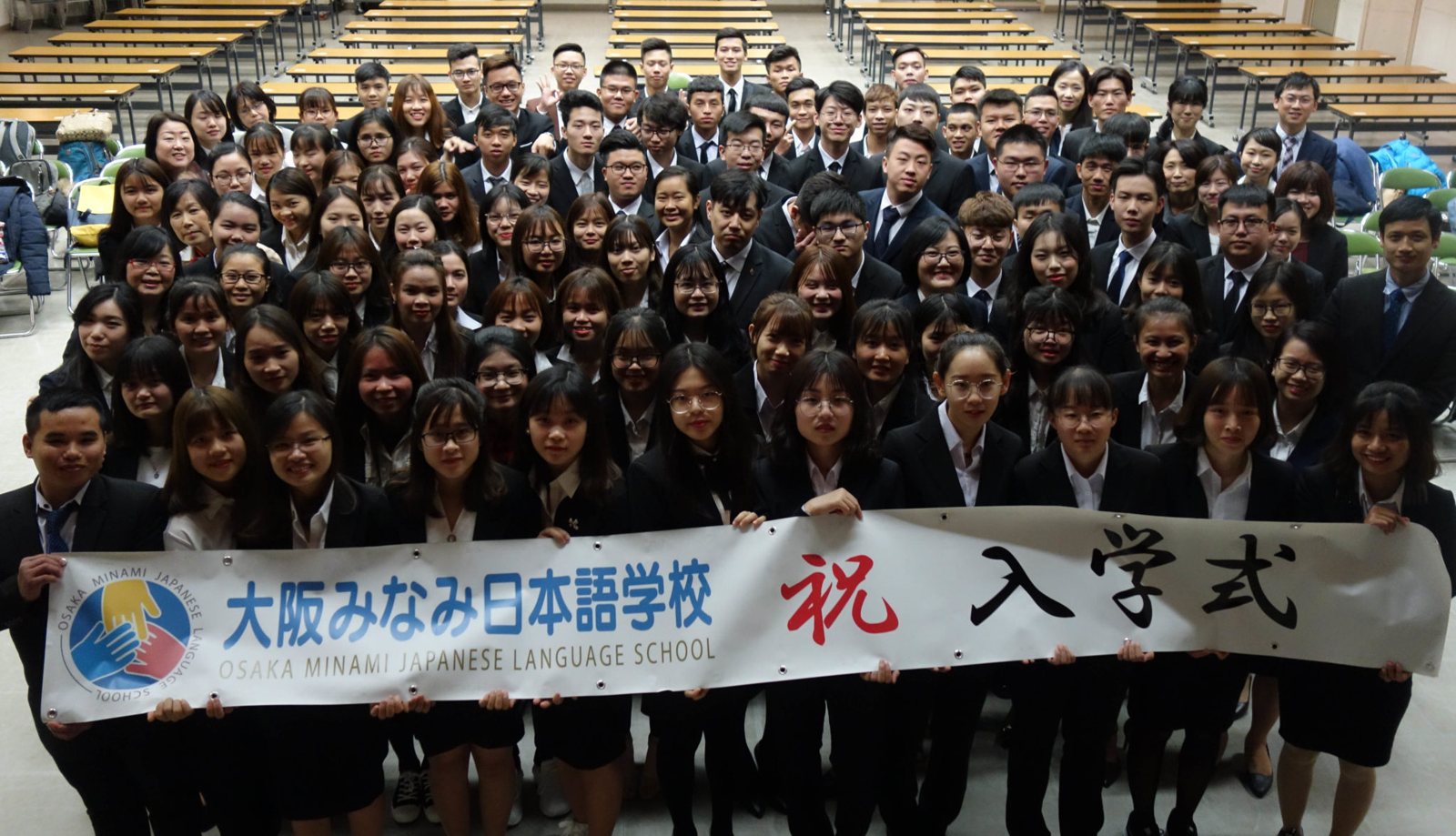
- You can experience various cultures, such as wearing a yukata, calligraphy, tea ceremony, kendo, ikebana and Japanese cooking.
- Students take part in volunteer activities at local shopping streets and children's cafeterias. Halloween volunteering at the Hirano shopping street (October 29, 2022)
- Exchange classes are held with university students from Hannan University, Tenri University, Otemon Gakuin University, Kansai University and others.
- In class, students wrote their wishes on strips of paper.
- Extracurricular classes, seasonal events and events aimed at international exchange are planned.
On campus
- Books
- Free Wi-Fi
2026–2027 academic calendar
- Spring, summer and winter breaks
- To be set separately before the start of the school year.
School website · 2023-09-29 updated
Access
- Transit
- Tanimachi Line, Kire-Uriwari Station, 10 min on foot
- Nearby
- This school is not eligible for student commuter passes, so students commute using a regular commuter pass or pay ordinary fares.
- Dormitory
- Available¥25,000 per month · Double room ¥150,000 (¥25,000 per month), single room ¥240,000 (¥40,000 per month). 5–10 min by bicycle from the school · Based on the school website
School website · 2026-03-19 updated
Dormitory — New students live in the dormitory in principle. Dormitory entry fee ¥20,000, deposit ¥30,000 (refunded in full when you move out if there are no problems), dormitory fee paid 6 months in advance before move-in and no moving out for the first half year, water ¥1,000/month, utilities at actual cost, internet free
School website · 2025-07-09 updated
SALLAE has organized the school website and published data in English.
The update date is the day that material was last revised.
Photos are materials published by the school.
This information is compiled from official sources and is not updated daily. Please confirm with the official contact before signing or applying.