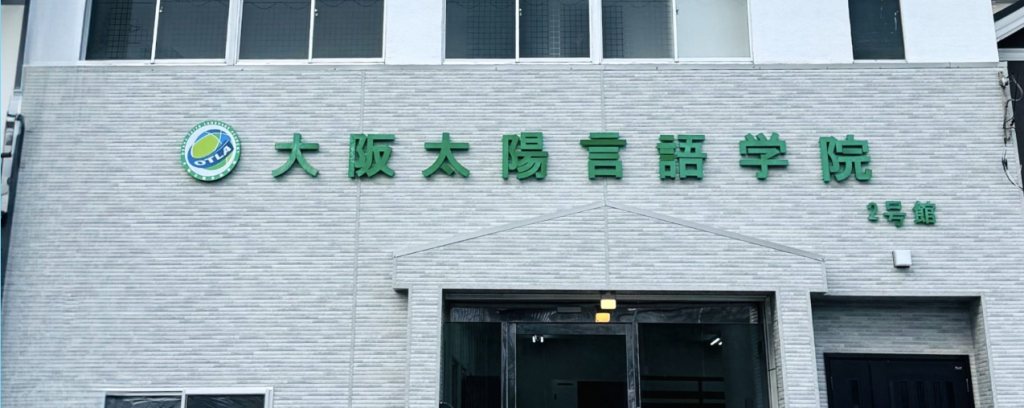
Osaka Taiyo Language Institute
Osaka Taiyo Language Institute
- Course
- Further-study course only
- To station
- 1 min walk · Minami-Tatsumi Station
- Dormitory fee
- From ¥28,000 per month ›
Compare side by side with other schools →
Tuition and conditions may change depending on the intake. If you contact us, we will check with the school and give you accurate details.
Nearby schools comparedBy distance · no ads or paid placement
- Osaka Taiyo Language InstituteThis schoolTuition/yr¥840,000Progression—IntakesApr · Oct
- Himawari Osaka Japanese Language Academy1.3km›Tuition/yr¥775,000Progression—IntakesApr · Oct
- SANWA Foreign Language Institute1.4km›Tuition/yr¥754,000Progression96%IntakesApr · Jul · Oct
- Umikaze Japanese Language School (affiliated with Asia House)2.6km›Tuition/yr¥973,000Progression—IntakesApr · Jul · Oct
— means SALLAE has not yet found the data.
About the school
A school that puts effort into progression — it has only two courses, a 2-year progression course with April admission and a 1 year 6 months progression course with October admission, and according to the career announcement on its website, of the 39 FY2025 graduates, 12 progressed to university and 23 to vocational schools. It opened in October 2022 with a capacity of 225, and the main building is a 30-second walk from Exit 2 of Minami-Tatsumi Station on the Osaka Metro Sennichimae Line in Tatsumi, Ikuno-ku, Osaka, with classes of 20 or fewer. Most students are from Vietnam, Nepal and Myanmar, and there are double-room and 4-person-room dormitories (¥28,000/month) 5–15 minutes from the school by bicycle.
Published data and school website
Tuition
If you saw a lower amount elsewhere, it may not include the admission fee and application fee
Median 1-year tuition in other areas — Kyoto ¥911,000(7 schools) · Kanagawa ¥880,000(8 schools) · Okinawa ¥858,000(6 schools) · Tokyo ¥840,600(56 schools) · Fukuoka ¥835,000(12 schools) · Hyogo ¥825,500(7 schools) · Osaka ¥814,000(27 schools) · Shizuoka ¥790,000(9 schools) · Chiba ¥745,333(10 schools) · Aichi ¥740,667(5 schools)
Total by intake
| Intake · length | Full course |
|---|---|
| 1 year 6 months | ¥1,200,000 |
| 2 years | ¥1,560,000 |
Cost details · Course tables · Notes
- Per term
- ¥180,000 3 months
- One-time fees
- ¥120,000Application fee · Admission fee
| Duration | Total |
|---|---|
| 1 year 6 months | ¥1,200,000 |
| 1 year 9 months | ¥1,380,000 |
| 2 years | ¥1,560,000 |
★"Per term" and "One-time at start" were calculated by SALLAE from each course's total. The courses this school actually offers are 1 year 6 months onward — all amounts in the table are values calculated by SALLAE.
Calculated by SALLAE · verified 2026-09-16
Admission & dates
- Apr intake
- 2-year course · Application Applications open Aug 15 and close around Oct 15 (April admission) · Classes 20 class hours/week × 80 weeks = 1,600 class hours (45 min each).
- Oct intake
- 1 year 6 months course · Application Applications open Feb 15 and close around Apr 15 (October admission) · Classes 20 class hours/week × 60 weeks = 1,200 class hours (45 min each).
- Japanese level
- Japanese ability equivalent to the first half of A1 of the Japanese Language Reference Framework (when recruiting for the 2-year course)
2 years: at recruitment (July–September) the first half of A1; at application (December) pass an A1-equivalent test. 1 year 6 months: at recruitment (January–March) pass A1; at application (June) pass A2. Applicants who fail are deferred. English at CEFR A2 or higher (oral interview)
Deadline and capacity rules
Completed or expected to complete 12 or more years of school education; a graduation grade of 70% or higher at the last school is the guideline. A reliable financial sponsor is required (income from work outside the status of residence is not counted). Capacity 225 (school overview)
School website · 2026-04-07 updated
Classes
- Morning
- 09:00-12:30 Morning session: 4 periods; period 1 is 9:00–9:45
- Afternoon
- 13:30-17:00 Afternoon session: 4 periods; period 1 is 13:30–14:15
- Class size
- Max 20 students
- Class assignment
- Level-based 4 stages
- Elective classes
- EJU prep · For students who wish to go on to university, the school has a system in which they can take EJU preparation classes as an elective.
Materials · Subjects · Timetable · Details
Timetable
| Session 1 | Session 2 | |
|---|---|---|
| Period 1 | 09:00-09:45 | 13:30-14:15 |
| Period 2 | 09:55-10:40 | 14:25-15:10 |
| Period 3 | 10:50-11:35 | 15:20-16:05 |
| Period 4 | 11:45-12:30 | 16:15-17:00 |
45-minute periods. 20 hours a week, 20 weeks, 400 hours (2 years 1,600 hours, 1 year 6 months 1,200 hours). JLPT and EJU preparation from the beginner level. Grades are on 5 levels A to E; E is a fail
What each level covers · 4 stages
- Beginner
- N4 level reached: 2,000 words, 335 kanji. 2-year course 340 periods, 1 year 6 months course 40 periods. Aiming to pass N4
- Lower intermediate
- N3 level reached (cumulative): 3,000 words, 530 kanji. 260 periods. Aiming to pass N3
- Intermediate
- N2 level reached (cumulative): 6,000 words, 1,230 kanji. 500 periods. Aiming to pass N2
- Advanced
- N1 level reached: 2 years: 10,000 words, 2,000 kanji, 500 periods; 1 year 6 months: 9,200 words, 1,850 kanji, 400 periods
School website · 2026-05-13 updated
Documents
- PassportCopy of every page with entries; all holders must submit
- Copy of ID cardTranslation
- 6 face photos4 cm × 3 cm) taken within 3 months, preferably wearing a jacket with a collar. (Write your name on the back
- Admission application formUniversity's prescribed form
- Statement of reason for studying abroad(within the admission application form) (university's prescribed form; translation)
- Diploma from the highest level of education(original; remove any thick cover) (translation)
- Certificate of passing a Japanese test at A1 level or equivalentCertificate of passing a Japanese test at A2 level or equivalent (1 year 6 months course; 2-year course)
- Copy of family register(for all family members living together) (translation)
- Pledge. The financial sponsor and the guarantor must write it themselvesUniversity's prescribed form
Financial supporter's documents · only if applicable · 3 application requirements
Submitted by the person paying the tuition (financial sponsor)
- Financial sponsorship statementUniversity's prescribed form; translation
- Copy of ID cardTranslation
- Deposit balance certificate(original) (translation)
- Income and tax payment certificate stating the income amount for 1 yearTranslation
- Proof of occupation: (1) company owners: certified copy of company registry; (2) company employees: certificate of employment; (3) self-employed: copy of business licenseTranslation
- Documents proving the relationship to the applicant(birth certificate, notarized proof of family relationship, etc.) (translation)
Only if applicable
- Certificate of enrollment or certificate of expected graduation (translation, if currently enrolled)
- Employment certificate (translation; must be submitted if the applicant has work experience)
Application requirements
Translation. Additional documents may be requested depending on the screening. If the financial sponsor lives in Japan, please consult the office.
The school does not publish a list of documents by nationality or a balance amount criterion. SALLAE is confirming this with the school.
School website · 2026-04-07 updated
Admission process
- Request an admission consultation — Email info@otla.co.jp, phone 06-4306-3479. The website is available in Japanese, English, Burmese, Nepali and Vietnamese
- Document screening and interview — Check of study status and grades in the home country, document screening, check of the intention and ability to pay expenses, interview, written exam.
- Issuance of the admission permit — Sent to the applicant by email. The original is mailed to the applicant after the status of residence is granted.
- Application for the Certificate of Eligibility — The school submits the applicant's documents to the Immigration Services Agency and applies for the Certificate of Eligibility.
- Issuance of the Certificate of Eligibility — When the Immigration Services Agency issues the Certificate of Eligibility, the school sends it by email.
- Fee payment by bank transfer — The applicant's financial sponsor pays the fees. After the school confirms payment, the original is mailed. Payment is by bank transfer; cash payment is not accepted in principle
- Visa application and issuance — The applicant applies for and obtains the visa at the embassy or consulate of their own country.
- Decide the departure date, arrange the flight, enter Japan, move into the dormitory — Contact the school immediately after getting the visa. For dormitory residents arriving at Kansai Airport on the day the school designates, the school will pick you up at the airport
- Enrollment orientation and written exam, start of classes — Enrollment orientation explains the educational policy, school rules and so on, followed by a written exam and class placement.
- Placement test
- Class placement by the written exam at enrollment orientation. Classes are formed based on the level test at enrollment and end-of-term exam results
School website · 2026-04-07 updated
Graduate outcomes
| FY2025 | Admitted |
|---|---|
| University | 12 students |
| Vocational school | 23 students |
| Employment | 1 student |
| Graduates | 39 students |
Passing an exam
| Exam | Pass |
|---|---|
| JLPT N2 2025 | 9 students |
| JLPT N3 2025 | 29 students |
| JLPT N4 2025 | 61 students |
| JLPT N1 2024 | 3 students |
| JLPT N2 2024 | 21 students |
| JLPT N3 2024 | 37 students |
| JLPT N4 2024 | 34 students |
FY2025 JLPT passes: N1 0, N2 9, N3 29, N4 61 (153 students enrolled). FY2024: N1 3, N2 21, N3 37, N4 34 (105 students enrolled)
FY2025: 12 to university (1 junior college), 23 to vocational school, 4 other. FY2024: 18 university, 41 vocational, 7 other. FY2023: 6 university, 21 vocational, 7 other · Number permitted to change to a status of residence under Appended Table I of the Immigration Control Act: 1 (entered April 2024, 2-year course) · School website · Updated 2026-05-13
Reviews
If you study here or used to, tell others what the classes, teachers and daily life were like. It helps anyone deciding on this school.
Write the first reviewUniversity prep
- Progression information sessions and orientation — Holds progression information sessions and orientation
- Homeroom teacher system — Careful guidance by the homeroom teacher system
- Career counseling at any time — Career counseling is available at any time
- Career-building education from year 1 — The school gives students chances to think about their careers early and has them think for themselves about their destination school, what to study and the schedule up to progression
- Individual interview — Individual interviews on study, life and career are held at least twice a year, and necessary measures are taken
School website · 2026-04-07 updated
Daily-life support
- Airport pickup — OTLA staff meet you at Kansai International Airport (KIX) and take you straight to the school, so you will not get lost.
- Resident registration — You need to register your residence to live in Japan. You do the residence registration together with OTLA staff.
- National Health Insurance — The school supports the enrollment procedures at the ward office. All eligible students enroll in National Health Insurance and also in liability insurance
- Bank account opening support — International students can also open accounts at the post office and banks. The cash card arrives at your home about 2 weeks after the procedure
- Mobile phone contract — If you need a smartphone or other mobile phone, OTLA staff help with the contract procedures.
- Part-time work — With permission for activities outside the status of residence from the Immigration Services Agency, part-time work is allowed up to 28 hours a week (up to 8 hours a day during long breaks)
- Health checkup — A health checkup is given within 1 month of enrollment, and every year after that.
- Status of residence renewal — OTLA staff help you obtain the Certificate of Eligibility needed for visa renewal applications.
- School handbook (for students: Vietnamese, Burmese, Nepali and English) — The school handbook (for students: Vietnamese, Burmese, Nepali and English) is used and shared at teachers' meetings, orientation and other occasions
- Evacuation guidance for disaster prevention and emergencies — Evacuation guidance for disaster prevention and emergencies is given both on and off campus.
School website · 2026-04-07 updated
Scholarship
- Tuition reduction system
- Academic ability at enrollment. A tuition reduction or exemption system is available for students with excellent Japanese ability.
- Academic excellence scholarship
- A scholarship system is available for students with excellent grades after enrollment.
School website · 2026-04-07 updated
Students
111 students enrolled (2026) · Capacity 225 National median: 180 students
Based on the 111 students enrolled in 2026.
Public data from the Association for the Promotion of Japanese Language Education (Nisshinkyo) · verified 2026-09-20
School life
For 1 year
- 4
- Entrance ceremony · Orientation · Health checkup · Classes start
- 5
- Field trip · Traffic safety education
- 6
- EJU · Midterm exams
- 7
- Japanese-Language Proficiency Test (JLPT)
- 8
- Summer vacation · Field trip · Traffic safety education
- 9
- Final exams · Speech contest
- 10
- Entrance ceremony · Orientation · Health checkup
- 11
- EJU · Field trip
- 12
- JLPT · Midterm exams · Winter vacation
- 1
- Disaster prevention center
- 2
- Cultural experiences
- 3
- Final exams · Graduation ceremony · Spring break
Events may change depending on circumstances. Spring, summer and winter breaks are set separately before the start of the school year
- Plenty of school events that bring new encounters, smiles and excitement. Cultural experience in February
- With staff of the Ikuno Ward Community Development Center, students present their home countries and have cultural exchange with Japanese people at the ward's salon.
- With staff of the Japan International Cooperation Center (general incorporated association), students take part in local disaster-prevention activities, introduce their home cultures and interact with local Japanese people.
On campus
- Classroom — Osaka Taiyo Language Institute keeps classes small, with 20 students or fewer per class.
- Lounge — You can have meals and study on your own here.
- PC space
- Library room
- Staff room — Teachers are always in the staff room, so students can ask for advice or ask questions at any time.
- Office — At the office, you can ask for advice at any time, from daily life to Japanese.
2025–2026 academic calendar · Older data
- Summer vacation
- Aug
- Winter break
- Dec
- Spring break
- Mar
School website · 2025-01-09 updated
Access
- Transit
- Osaka Metro Sennichimae Line Minami-Tatsumi Station, 1 min walk Exit 2, 30-second walk, Osaka Taiyo Language Academy main building
Osaka Metro Sennichimae Line Minami-Tatsumi Station, 4 min walk Exit 3, 4-minute walk, Osaka Taiyo Language Academy Annex No. 2 - Nearby
- The main building and Annex No. 2 are 400 m apart, a 5-minute walk. 17 min from Namba on the Sennichimae Line, 10 min from Tsuruhashi, 13 min from Tanimachi 9-chome. Nearby: ward office, hospital, park, post office, pharmacy, supermarket, Konan
- Dormitory
- Available¥25,000–¥28,000/month · Twin room / 4-person room (2DK), dorm fee ¥28,000/month, about 5–15 minutes from school by bicycle · Based on the school website
School website · 2025-01-20 updated
Dormitory — Dormitory entry fee ¥40,000, dormitory fee ¥168,000 (paid 6 months in advance before move-in; no moving out for 1 year), deposit ¥20,000 (refunded in full when you move out if there are no problems), total payment ¥228,000. Utilities at actual cost
School website · 2026-02-16 updated
SALLAE has organized the school website and published data in English.
The update date is the day that material was last revised.
Photos are materials published by the school.
This information is compiled from official sources and is not updated daily. Please confirm with the official contact before signing or applying.