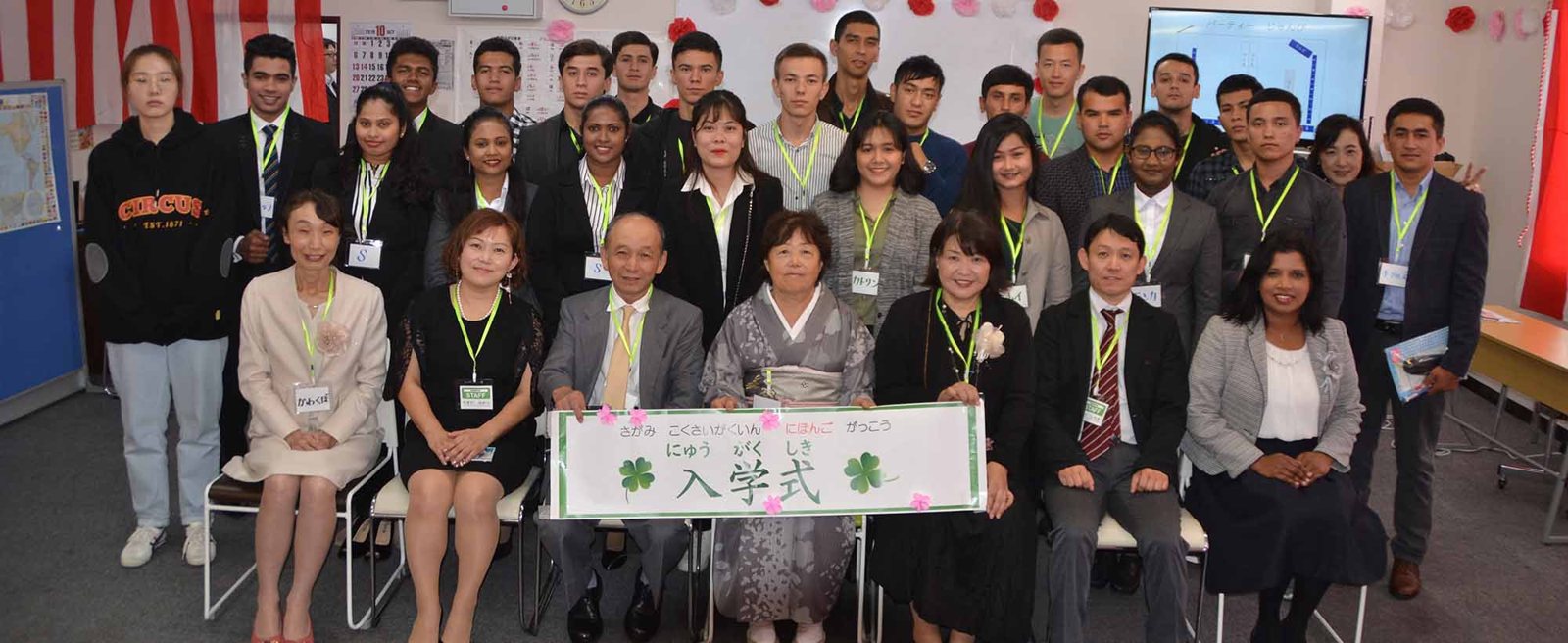
Sagami International Gakuin
Sagami International Gakuin
- Progression
- University or similar 99% ›
- Dormitory fee
- From ¥25,000 per month ›
- Admission
- 4 times a year · choose your intake month ›
- Age requirement
- Age 30 or under ›
Compare side by side with other schools →
Tuition and conditions may change depending on the intake. If you contact us, we will check with the school and give you accurate details.
Nearby schools comparedBy distance · no ads or paid placement
- Sagami International GakuinThis schoolTuition/yr¥813,000Progression99%IntakesJan · Apr · Jul · Oct
- Kanagawa Judo Therapy and Acupuncture Vocational School, Japanese Language Department1.2km›Tuition/yr¥935,000Progression—IntakesApr · Jul · Oct
- Tokyo Showa International Academy9.6km›Tuition/yr¥890,000Progression—IntakesApr · Oct
- Tokyo Sakura International School13.3km›Tuition/yr¥791,000Progression79%IntakesApr · Jul · Oct
— means SALLAE has not yet found the data.
About the school
A school where all 4 courses are progression courses. According to the report on those who completed the course in March 2026 published on its website, 103 of the 106 graduates went on to Japanese universities, vocational schools and other institutions. It is in Sagamihara, Kanagawa Prefecture, 10 minutes on foot from Sagami-Ono Station on the Odakyu Line, and about 30 minutes to Shinjuku by express. First-year students are in afternoon classes and second-year students in morning classes, with 4 periods of 45 minutes per day. If you wish, you can also study the EJU general subjects, mathematics and science, and near the school there are twin-room dormitories from ¥25,000 per month.
Published data and school website
Tuition
If you saw a lower amount elsewhere, it may not include the admission fee and application fee
Median 1-year tuition in other areas — Kyoto ¥911,000(7 schools) · Kanagawa ¥880,000(8 schools) · Okinawa ¥858,000(6 schools) · Tokyo ¥840,600(56 schools) · Fukuoka ¥835,000(12 schools) · Hyogo ¥825,500(7 schools) · Osaka ¥814,000(27 schools) · Shizuoka ¥790,000(9 schools) · Chiba ¥745,333(10 schools) · Aichi ¥740,667(5 schools)
Total by intake
| Intake · length | Full course |
|---|---|
| 1 year 6 months | ¥1,182,000 |
| 2 years | ¥1,551,000 |
Cost details · Course tables · Notes
- Per term
- ¥184,500 3 months
- One-time fees
- ¥75,000Application fee · Admission fee
| Duration | Total |
|---|---|
| 1 year 6 months | ¥1,182,000 |
| 1 year 9 months | ¥1,366,500 |
| 2 years | ¥1,551,000 |
★"Per term" and "One-time at start" were calculated by SALLAE from each course's total. The courses this school actually offers are 1 year 6 months onward — all amounts in the table are values calculated by SALLAE.
Calculated by SALLAE · verified 2026-09-16
Whether it is refundable
- General rule
- If you withdraw before enrollment or leave school, apply in writing in advance. Tuition is refunded by quarter (3 months). The transfer fee is paid by the recipient.
- If you decline after submitting the application form
- If you decline after submitting the application, the application fee is not refunded, whether or not a Certificate of Eligibility is issued. The application fee includes the fee for the issuance application.
- If you decline after the Immigration Bureau issues the Certificate of Eligibility but before paying tuition
- The application fee is not refunded.
- If you decline after the Immigration Bureau issues the Certificate of Eligibility and after paying tuition, but before classes start
- The application fee and admission fee are not refunded. After the Certificate of Eligibility and the admission permit are returned, the remaining tuition is refunded. However, if you had wished to live in the dormitory, the dormitory entrance fee is charged.
See refund policy in full · 7 more lines
- If you decline enrollment after obtaining the entry visa but before coming to Japan
- The application fee and admission fee are not refunded. Tuition is refunded after confirming that the entry visa has not been used and the admission permit has been returned. However, if you had wished to live in the dormitory, the dormitory entrance fee is charged.
- If the Japanese embassy or consulate refuses to issue the visa
- The application fee and admission fee are not refunded. After you submit a certificate of visa refusal and return the admission permit, the amount is refunded with the application fee, admission fee and, if you had wished to live in the dormitory, the dormitory entrance fee deducted.
- If you come to Japan on the entry visa but decline before enrolling (before first taking part in a school event or class)
- The application fee and admission fee are not refunded. After the admission permit is returned, the amount is refunded with the application fee, admission fee and, if you had wished to live in the dormitory, the dormitory entrance fee deducted, once complete return to your home country is confirmed.
- If a withdrawal notice is submitted after enrolment
- Withdrawal is accepted upon submission of a withdrawal notice. Tuition for the first 3 months is not refunded for any reason. The rest is refunded in units of terms (3 months) in which you did not attend classes, minus an administrative fee of ¥20,000 (excluding tax). Refunds are made after confirming your return home or the acquisition of another visa.
- If you are deported for breaking the law, or expelled for violating school rules
- No refund at all.
- If the school is closed or classes are cancelled because transportation may stop due to natural disasters, accidents, infectious disease, transportation strikes or weather conditions
- The school is exempt from liability.
- If your arrival in Japan is delayed
- If your arrival in Japan is delayed, tuition for classes not attended is not refunded. If you had wished to live in the dormitory, the planned period of residence is charged regardless of whether you came to Japan.
Admission & dates
- Apr intake
- 2-year course · Application April 2027 entry: September 1 – October 20, 2026 · Classes 1,536 class hours
- Jul intake
- 1 year 9 months course · Application July 2027 entry: December 1, 2026 – February 10 · Classes 1,344 class hours
- Oct intake
- 1 year 6 months course · Application October 2027 entry: March 1 – May 10, 2027 · Classes 1,152 class hours
- Jan intake
- 1 year 3 months course · Application January 2028 entry: June 1 – August 10, 2027 · Classes 960 instructional hours
- Japanese level
- JLPT N5 level or above
Passed N5, or 150 hours of Japanese study
Deadline and capacity rules
Progression Course I (April), II (July), III (October) and IV (January) enrollment; graduation in March. The school may close recruitment before the application deadline once the number of applicants reaches capacity.
School website · Confirmed 2026-09-26
Classes
- Morning
- 09:15-12:40 [Morning section] 2nd year, 20 hours each per week (Mon–Fri), 9:15–12:40. 45-minute classes × 4 periods.
- Afternoon
- 13:30-16:55 [Afternoon section] 1st year, 20 hours each per week (Mon–Fri), 13:30–16:55. 45-minute classes × 4 periods.
- AM/PM placement
- [Morning section] 2nd year; [Afternoon section] 1st year
- Class assignment
- Level-based 5 stages
- Elective classes
- General subjects · Mathematics · Science (physics, chemistry, biology) · Students can take the general subjects, mathematics and science, each according to their wishes. Each is taught by teachers who have guided students at universities and graduate schools.
Materials · Subjects · Timetable · Details
- Materials
- The main textbooks are 'Dekiru Nihongo' (beginner, pre-intermediate and intermediate). For kanji, 'Kanji Tamago' is used, and from intermediate level, 'Speed Master N3 and N2'.
- Subject
- General Japanese · Skills-based Japanese · JLPT prep · Graduation project · A graduation project is done as the finishing touch of the course. Past works include kanji research, promotional videos, books about students' home countries, and personal histories.
About 16 students per class. Students first learn Japanese verb conjugation, and do extensive reading when they start studying. The goal is to pass JLPT N3.
What each level aims for · 5 levels
- Beginner I
- N5. Can communicate using simple, limited expressions needed to meet specific needs.
- Beginner II
- N4. Can communicate using simple expressions about familiar topics such as family, friends and part-time work.
- Intermediate I
- First half of N3. Can communicate using a variety of strategies about fields of interest such as hobbies.
- Intermediate II
- N3–N2. By preparing, can communicate about their future and interests, even beyond the 'here and now'.
- Advanced I
- N2. By preparing in advance, can communicate about their desired field of study.
School website · Confirmed 2026-09-26
Documents
- Admission application formSchool form, written by the applicant
- Résumé · Statement of reasons for studying JapaneseSchool form, written by the applicant
- Diploma of the last school attended (original) and transcript
- Japanese study certificateStudy hours stated, 150 hours or more
- Certificate of a Japanese proficiency test, etc.Including J-Test and NAT
- Photo8 sheets) (taken within 6 months, 4 cm × 3 cm
- Certificate of employment
Sponsor documents · 3 application requirements
Submitted by the person paying the tuition (financial sponsor)
- Notarized certificate of family relationship
- Bank balance certificate of ¥3,000,000 or 200,000 yuan or more
- Copy of passbookShowing how the money came in and went out
- Financial sponsorship statementInstitute's own form
- Certificate of employment
- Income certificate for the past 3 yearsWith itemized breakdown
- Copy of business licenseFor sole proprietors
- Tax payment certificateFor sole proprietors
Application requirements
[Documents of the financial sponsor] — in the case of remittance from parents in the home country * In addition, additional documents may be requested if they are judged necessary during the screening process. Materials showing how funds were accumulated over the past 1 year (deposit and withdrawal statements, copy of bankbook, fixed deposit statements, documents from a public institution certifying the income situation and the materials supporting them, etc.)
It says to submit the unified exam and proof of your final education (if a university graduate), but it does not say what to submit for Korean educational credentials. SALLAE is confirming this with the school.
School website · Confirmed 2026-09-26
Admission process
- Request an admission consultation — Apply directly to the school by email, phone, social media, etc.
- Interview sheet preparation
- Prepare and submit application documents — Application form (xls) and statement of expenses form (xls), in Japanese and English
- Selection — Screening (interview and document screening)
- Application for the Certificate of Eligibility
- Notice of Certificate of Eligibility issuance
- Enrolment procedures — Enrollment procedures (pay tuition, submit documents)
- Admission permit and Certificate of Eligibility sent — We prepare the application for permission to engage in activities outside the status of residence and send it together with the COE.
- Visa application and issuance
- Enrolment and start of classes
School website · Confirmed 2026-09-26
Short-term study
- Open now?
- Rolling admissions, so availability varies from time to time — SALLAE will confirm with the school
Course without a student visa
- Japanese course for residents — 1 term (3 months). Students study together with international students. There are also long breaks. 180 minutes per day, Monday to Friday, 13:30–16:55.
- Learn Japanese with a focus on conversation, from once a week. — For those staying on a family or work visa. For those who want to go on to further study or find a job in Japan, a regular course 5 days a week is available.
- Private lessons — If you would like private lessons, please call the school for a consultation first.
- Japanese training for companies — We design original courses to suit a wide range of foreign personnel, from technical intern trainees to highly skilled professionals.
★Short-term courses are not listed in the published data — it counts only student-visa courses.
School website · Confirmed 2026-09-26
Graduate outcomes
| FY2025 | Admitted |
|---|---|
| Employment | 1 student |
| Graduates | 106 students |
Completers of March 2026: course completers 106, qualifying students total 104, qualifying rate 98.1% · Number permitted to change to a status of residence (excluding Diplomat, Official and Technical Intern Training): 2-year progression course 1; 1-year September progression course 0 · School website · Updated 2026-05-20
Reviews
If you study here or used to, tell others what the classes, teachers and daily life were like. It helps anyone deciding on this school.
Write the first reviewUniversity prep
- Individual guidance for students wishing to go on to further study — In the graduating year, from before summer vacation, the school asks each student about their career wishes and looks for a school to go on to based on aptitude and conditions. Individual interviews are held almost every week.
- Application and exam guidance — Application procedures, exam coaching for written tests and interviews, procedures after passing, and moving procedures and arrangements.
- EJU prep — We coach students for university and graduate school entrance exams so that they can pass without attending a cram school. Students can take the general subjects, mathematics and science, each according to their wishes.
- Guidance on the statement of motivation and research plan — Teachers familiar with the humanities and sciences coach students on the statements of purpose that matter in entrance exams for international students, and on research plans for graduate school exams.
- You can also get a qualification and work under 'Specified Skilled Worker'. — Those who have already graduated from university can also find a job, or get a qualification and work under 'Specified Skilled Worker'.
- On-campus further-study briefing — Today, teachers from vocational schools talked with us a lot. Hotels, IT, nursing care, business, etc.
Schedule to admission
- Ask about each student's career wishes
- In the graduating year, from before summer vacation, the school asks each student about their career wishes. · Based on aptitude and conditions, we look for the most suitable career path or school to go on to. · Individual interviews are held almost every week
- By October, the school to go on to is mostly decided and students move on to preparing applications.
- By October most students have settled on where to go next, and move on to preparing applications · Application preparation · Coaching for written exams and interviews · Procedures after acceptance and moving arrangements
School website · Confirmed 2026-09-26
Daily-life support
- New life support pack — Set price ¥22,000. Pick-up from Haneda Airport (one way), bank account opening, resident registration, National Health Insurance enrollment, part-time job introduction and mobile phone contract support. Only for those living in Sagamihara City.
- Airport pick-up conditions — Send your flight information at least 10 business days before arrival. Haneda Airport only, arrivals between 5:00 and 14:30 only. If no one else arrives on the same day, an extra ¥5,000.
- Permission to engage in activities outside the status of residence (part-time work) — When we send the COE, we prepare the application for permission to engage in activities outside the status of residence and send it with it. Complete the procedure at the airport on entering Japan.
- Part-time job referrals — Job listings are posted and distributed. Help with phone calls to apply, speaking coaching and practice for hiring interviews. Food processing plants and logistics centers may offer work right after arrival in Japan.
- Support with applications to extend the period of stay
- Support with city hall procedures, mobile phone contracts, bank account opening and part-time work
- Apartment introductions — For those who wish to live in a private apartment, a local real estate agent is introduced. Renting an apartment requires about 4–5 months of rent, including brokerage fee, deposit and key money.
- National Health Insurance — When you register your residence at the ward office (city hall), we also help you enroll in National Health Insurance. We also help you apply for the reduction if you have no income.
- Bicycle insurance — Bicycle insurance is mandatory in Kanagawa Prefecture and Sagamihara City. For details and consultation, contact the office.
- Procedures can also be handled in English, Chinese and other languages. — The staff are Japanese people and alumni who studied at the school as international students. Procedures can also be handled in English, Chinese and other languages.
Monthly living costs · School information
| Item | 1 month |
|---|---|
| Housing and dormitory costs | ¥25,000 |
| Utilities, management fees and fixtures costs | ¥10,000 |
| Food, communication costs (mobile phone), etc. | ¥50,000 |
| Total | ¥85,000 |
The minimum monthly amounts the school lists (all 'from')
School website · Confirmed 2026-09-26
Scholarship
- Sagami Scholarship A
- Monthly ¥20,000 × 6 monthsSagami International Academy provides various scholarships to students who are highly evaluated for grades and attendance and who have an excellent attitude toward study.
- Sagami Scholarship B
- Monthly ¥10,000 × 6 months
- Sagami International Academy Scholarship (A, B and C)
- The amount is not stated on the website or in the admission guidelines.
- Japanese-Language Proficiency Test pass award system
- JLPT study incentive: N1 pass ¥30,000, N2 pass ¥20,000, N3 pass ¥10,000 (2025 admission guidelines). The scholarship page says: "There is an award system with prize money for those who pass JLPT level 2 or 1."
- Perfect attendance award
- Prize money is given to students with perfect attendance (2024 English guide) · The amount is unknown.
- JASSO Privately Financed International Student Encouragement Grant
- Monthly ¥30,000 × 1 yearGiven to students who are especially highly evaluated for grades and attendance and who have an excellent attitude toward study. After deciding on a university or similar institution, students can receive a reservation recommendation for the privately financed international student encouragement grant provided there.
- Scholarships from local governments and international exchange organizations, and scholarships from private scholarship foundations
- We also introduce scholarships from local governments, international exchange organizations and private scholarship foundations that you can receive, and help you prepare your applications.
School website · Confirmed 2026-09-26
Students
Enrolled: 206 (2025) · Capacity 100 National median: 180 students
Based on the 206 students enrolled in 2025.
Public data from the Association for the Promotion of Japanese Language Education (Nisshinkyo) · verified 2026-09-20
School life
For 1 year
- 2
- Second-year students held a graduation project presentation. Each student presented a speech they had prepared on the theme of their own personal history.
- 3
- Graduation ceremony
- 5
- A Japanese speech festival was held, and 2 students from Sagami International Academy took part.
- 7
- Every year, bamboo grass is decorated to celebrate Tanabata on July 7. Students wrote their wishes in Japanese on strips of paper.
- 9
- Sports day was held on September 22.
- 12
- First-year students went on a field trip to Odawara, and second-year students to Ebina (Boot Booth).
The website has no annual calendar, so this was compiled from the school blog articles for 2025–2026 · Holidays are for fiscal 2026, and detailed dates are announced in the school-year calendar at the start of each term.
- Experience Japanese traditional arts (tea ceremony, flower arranging, calligraphy, traditional music, etc.). Opportunities to learn Japanese culture such as kimono and tea ceremony are offered.
- The 'Sagami Cafe' is held regularly, where students chat over tea with local university students.
- Exchange events with Japanese university students, high school students and schoolchildren
- Events such as sports day, class field trips, a graduation trip, Enoshima and BBQs
- Cherry blossom viewing in spring, swimming at the beach in summer, hiking in autumn and skiing in winter. Students also visit Tokyo Disneyland, Fuji-Q Highland, Nikko Edo Wonderland and other places.
- Disaster prevention drills and police lectures
On campus
- Library room — The library lends Japanese study books and Japan-related books, plus 3,000 manga.
- Infirmary
- Computer room
- Building 3 — A new Building No. 3 opened in April.
2026–2027 academic calendar
- Rainy-season break
- June 24 – June 29
- Summer break
- July 25 – August 17
- Autumn break
- October 1 – October 19
- Winter break
- Dec 26–Jan 6
- Spring break
- From March 19
School website · Confirmed 2026-09-26
Access
- Transit
- Odakyu Line, Sagami-Ono Station, 10 min walk
- Nearby
- Get off at Sagami-Ono Station on the Odakyu Line and walk 10 minutes. Please come via Ono Ginza Street or the main road.
- Dormitory
- Available¥20,000–¥30,000 per month · Dormitories are provided near the main school building (Misono, Futaba, Minamidai, Higashi-Rinkan and Odasaga). The student dormitories house about 70 students, with ¥25,000 per month as the standard rent. · Based on school website
School website · Confirmed 2026-09-26
Dorm — Misono Dormitory, Futaba Dormitory (bicycle commute), Minamidai Dormitory and Higashi-Rinkan Dormitory are 2 people to a room. Odasaga Dormitory is a studio apartment with rent of ¥30,000. Dormitory entrance fee ¥20,000; deposit (1 month's rent) ¥25,000.
School website · Confirmed 2026-09-26
SALLAE has organized the school website and published data in English.
The update date is the day that material was last revised.
Photos are materials published by the school.
This information is compiled from official sources and is not updated daily. Please confirm with the official contact before signing or applying.