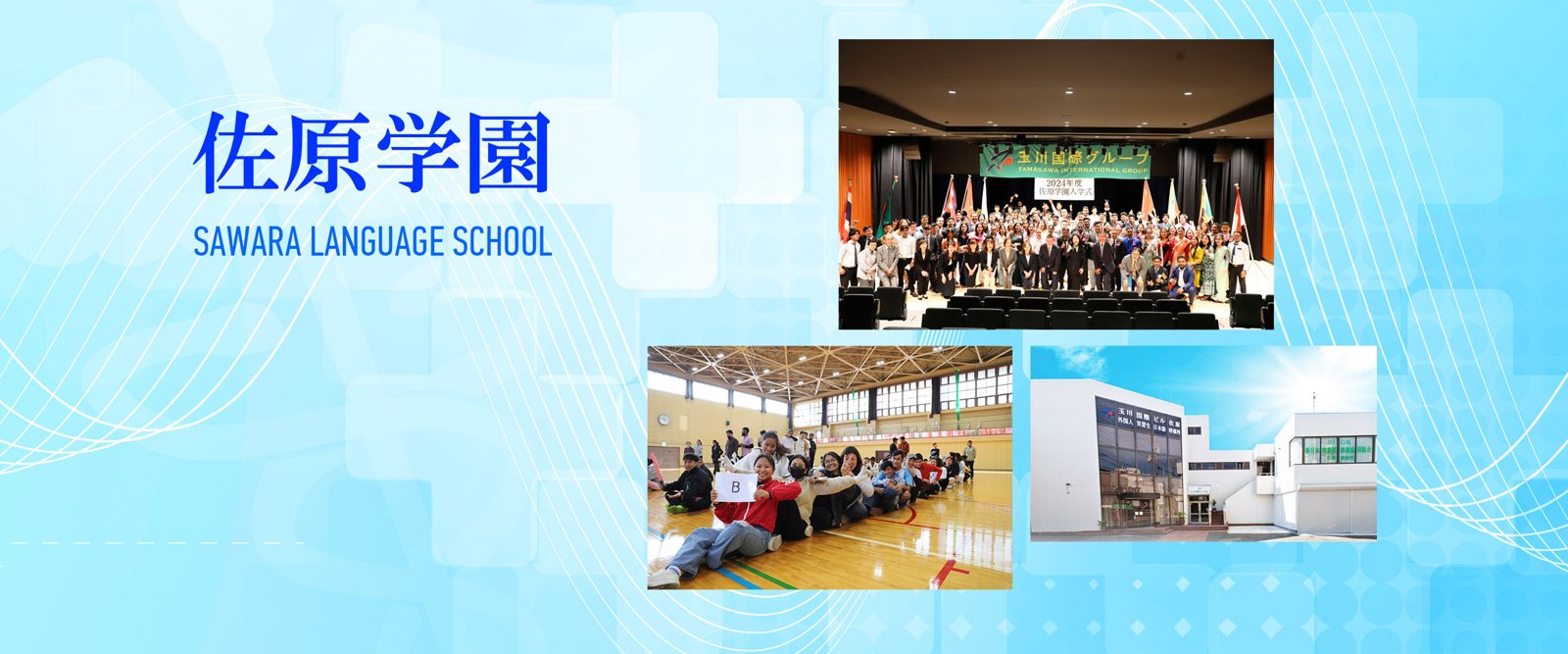
Sawara Gakuen
Sawara Gakuen
- Progression
- University or similar 98% ›
- Dormitory fee
- from ¥30,000 a month ›
- Admission
- 4 times a year · choose your intake month ›
Compare side by side with other schools →
Tuition and conditions may change depending on the intake. If you contact us, we will check with the school and give you accurate details.
Nearby schools comparedBy distance · no ads or paid placement
- Sawara GakuenThis schoolTuition/yr¥793,000Progression98%IntakesJan · Apr · Jul · Oct
- Elite Sky Japanese Language School21.1km›Tuition/yr¥720,000Installments OKProgression—IntakesApr · Oct
- Tokai Gakuin Culture and Liberal Arts College38.4km›Tuition/yr¥700,000Progression—IntakesApr · Oct
- International Academy Japanese Language Institute, Toride Campus39km›Tuition/yr¥794,000Progression—IntakesApr · Oct
— means SALLAE has not yet found the data.
About the school
A school that focuses on progression to further study. In the completer report submitted in June 2026 (fiscal 2025), 59 of the 60 eligible students went on to Japanese universities, etc. The progression course is divided by goal into graduate school, university and vocational school, and there are also EJU mathematics and integrated-subject preparation classes. The school opened in October 2017 with a capacity of 140, a 10-minute walk from JR Sawara Station in Katori, Chiba Prefecture, and about 30 minutes by car from Narita Airport. It belongs to the Tamagawa International Group, which also has schools in Tokyo and Ibaraki. Admission is 4 times a year (April, July, October, January); the dormitory is in principle a 4-person room at ¥30,000 per month. Of the 121 students enrolled in 2026, 119 are from Nepal and Sri Lanka.
Published data and school website
Tuition
If you saw a lower amount elsewhere, it may not include the admission fee and application fee
Median 1-year tuition in other areas — Kyoto ¥911,000(7 schools) · Kanagawa ¥880,000(8 schools) · Okinawa ¥858,000(6 schools) · Tokyo ¥840,600(56 schools) · Fukuoka ¥835,000(12 schools) · Hyogo ¥825,500(7 schools) · Osaka ¥814,000(27 schools) · Shizuoka ¥790,000(9 schools) · Chiba ¥745,333(10 schools) · Aichi ¥740,667(5 schools)
Total by intake
| Intake · length | Full course |
|---|---|
| 1 year 3 months | ¥969,000 |
| 1 year 6 months | ¥1,145,000 |
| 1 year 9 months | ¥1,322,000 |
| 2 years | ¥1,498,000 |
Cost details · Course tables · Notes
- Per term
- ¥176,333 3 months
- One-time fees
- ¥87,335Application fee · Admission fee
| Duration | Total |
|---|---|
| 1 year 3 months | ¥969,000 |
| 1 year 6 months | ¥1,145,333 |
| 1 year 9 months | ¥1,321,666 |
| 2 years | ¥1,497,999 |
★"Per term" and "One-time at start" were calculated by SALLAE from each course's total. The courses this school actually offers are 1 year 3 months onward — all amounts in the table are values calculated by SALLAE.
Calculated by SALLAE · verified 2026-09-16
Admission & dates
- Apr intake
- 2-year course · Application July to October (4 months)
- Jul intake
- 1 year 9 months course · Application November to February (4 months)
- Oct intake
- 1 year 6 months course · Application February to May (4 months)
- Jan intake
- 1 year 3 months course · Application May to August (4 months)
- Japanese level
- At least 200 hours of Japanese study
If your highest education is high school (12 years of schooling), you must hold a pass certificate of JLPT Level 4 or above, J-TEST (Grade F or above) or NAT-TEST Level 4.
Deadline and capacity rules
Admission 4 times a year (April, July, October, January); graduation in March. Capacity 140. At least 12 years of schooling, within 5 years of graduating, and a reliable financial sponsor. Recognized education is general high school, junior college and a university bachelor's course; technical schools, vocational high schools, etc. are not accepted.
School website · 2026-09-10 updated
Classes
- Morning
- 08:20-11:35 4 periods a day (45 min each), 20 periods a week
- Afternoon
- 13:00-16:30 4 periods a day (45 min each), 20 periods a week
- Class assignment
- Level-based 5 stages
Materials · Subjects · Timetable · Details
- Materials
- Beginner: Minna no Nihongo; intermediate: Chukyu kara Manabu Nihongo; advanced: Joukyu de Manabu Nihongo; plus authentic materials such as newspapers, videos and the internet.
- Subject
- Reading · Listening · Conversation · Writing · Current affairs practice (newspaper editorials and commentaries) · Prep classes in mathematics I and II, general subjects and English as well as Japanese · Essay practice · Interview practice · JLPT course (levels 1 and 2): explanation of past exams, mock tests and prep classes · The progression course is divided by goal. Graduate school: email contact with professors, research plans and interview practice. University: current affairs and EJU preparation. Vocational school: essay writing and interview drills. Preparation for exams other than Japanese is paid.
Class period times 4 periods per day (45 minutes each), 20 periods per week; 760 study hours per year.
| Morning | Afternoon | |
|---|---|---|
| Period 1 | 08:20-09:05 | 13:00-13:45 |
| Period 2 | 09:10-09:55 | 13:55-14:40 |
| Period 3 | 10:00-10:45 | 14:50-15:35 |
| Period 4 | 10:50-11:35 | 15:45-16:30 |
The Japanese program has Basic, Beginner, Intermediate, Advanced and Progression levels. Beginner, Intermediate, Advanced and Progression each have many classes, with conversation classes and off-campus study.
What each level covers · 4 stages
- Beginner
- 6 months2,000 words and 500 kanji; passing JLPT Level 3. Basic grammar and sentence patterns, consolidation of the four skills, and self-expression useful in daily life.
- Intermediate
- 6 months7,000 words and 1,000 kanji; passing JLPT Level 2. Somewhat advanced grammar, idioms and set phrases, and simple short essays.
- Advanced
- 6 months10,000 words and 2,000 kanji; passing JLPT Level 1. Reading complex texts, conversation suited to the situation, and logical writing.
- Further study
- 6 monthsClasses centered on past entrance exam papers, guidance on entrance exam essays, and understanding of distinctively Japanese expressions and social customs.
School website · 2020-02-25 updated
Documents
- Admission application formAttach a photo
- RésuméUse the academy's designated form, 4 sheets in total
- 6 photos3 cm × 4 cm, with name and date of birth written on the back
- Original diploma from your last school
- Certification report
- Report card
- Certificate of Japanese study
- Copy of passport
- Copy of ID
- Copy of certified family registerSame address as on the résumé; if different, attach a separate explanation
Financial supporter's documents · only if applicable · 4 application requirements
Submitted by the person paying the tuition (financial sponsor)
- Financial sponsorship statementUse the academy's designated form
- Notarized certificate of family relationshipOfficial documents showing the relationship between the applicant and the sponsor
- Sponsor's bank balance certificate¥3,000,000 or RMB 200,000 or more
- Sponsor's certificate of employment, income certificate and tax payment certificateShowing income for the past 3 years
Only if applicable
- Certificate of enrolment and certificate of expected graduation (If you are currently enrolled)
- Pass certificate for JLPT Level 4, NAT-TEST Level 4 or J-Test Level F, etc. (high school graduates)
- Proof of Japanese study hours (200 hours or more) (Junior college or university graduates)
- Copy of pages with the visa and entry and exit date stamps (If you have entered Japan before)
- Copy of the passport of a relative in Japan (parents, siblings, spouse, children, etc.), copy of both sides of the alien registration card, and a copy of the student ID of their school or an employment certificate (relative in Japan)
- Business license (if the sponsor is self-employed)
- Sponsor's certificate of residence or certificate of alien registration record, certified copy of family register, bank balance certificate (¥3,000,000 or more), certificate of employment, income certificate (withholding tax slip, etc.), tax payment certificate stating income, certified copy of the company registry, and company brochure (If the financial sponsor lives in Japan)
Application requirements
Sponsors must be direct relatives only Documents are valid only if issued within 3 months of the submission date Documents differ by nationality and how expenses are paid, so be sure to ask the office before applying. Applicant: resume (filled in carefully with a black fountain pen or black ballpoint pen), original ID, original diploma and transcript of the last school attended, phone number and detailed address of that school, notebook, black pen. Financial sponsor: original ID.
There is no country-specific guidance on application documents. The wording assumes applicants from China, such as the academic credential verification report, RMB balance and Chinese Ministry of Education certification. SALLAE is confirming this with the school.
School website · 2026-09-10 updated
Admission process
- Request an admission consultation — Inquiries by phone, email, Skype and WeChat; reception hours are weekdays 9:00–18:00.
- Application — Mail the application form, resume and financial sponsor's statement set (standard version and a version for applicants from China), together with the documents of the applicant and the financial sponsor, to the application destination.
- Written test — The written test is in Japanese. The school notifies you of the time and place through referral agencies, etc.
- Interview — The financial sponsor and parents must accompany the applicant to the interview. Successful applicants pay a ¥20,000 screening fee. School staff interview applicants locally each term, asking about purpose of study, background and family composition.
- Admission decision — Admission is decided after assessing Japanese ability at the interview and whether the submitted documents meet the standards.
- Issuance of Certificate of Eligibility · payment of first-year tuition — First-year payments are the same for every admission month, and are due within 1 week of the date the Certificate of Eligibility is issued.
- Placement test
- Based on the placement test at enrollment and the results of regular exams, appropriate classes are formed according to each student's Japanese ability.
School website · 2026-09-10 updated
Short-term study
- Visa
- Working holiday(not a student visa)
- Duration
- 4 weeks – 3 months
- Open now?
- Rolling admissions, so availability varies from time to time — SALLAE will confirm with the school
Course without a student visa
- General short-term course (3 months) — The general short-term course is 3 months. There is an auditing system, and short-term transfer for 1–3 months is possible depending on Japanese level.
- Working holiday visa short-term course — Only the name appears in the course guide.
- For those on a dependent visa — Only the name appears in the course guide.
★Short-term courses are not listed in the published data — it counts only student-visa courses.
School website · 2020-02-25 updated
Graduate outcomes
| FY2025 | Admitted |
|---|---|
| Employment | 1 student |
Prepared June 30, 2026: qualifying students 60, progression 59, change of status of residence 1. Prepared April 1, 2025: 65, progression 60, changes 5 · Number permitted to change to a status of residence in the upper column of Appended Table I-1 or I-2 of the Immigration Control Act (excluding Diplomat, Official and Technical Intern Training) · School website · Updated 2026-06-30
Reviews
If you study here or used to, tell others what the classes, teachers and daily life were like. It helps anyone deciding on this school.
Write the first reviewUniversity prep
- Progression orientation — Regular progression orientations, twice a year (school life page) or four times a year (home page), teach how to go on to Japanese universities.
- Progression information session — Regular progression briefings 2–3 times a year (home page). Course guide: an on-campus progression guidance session once a year, and students attend progression briefings in Tokyo.
- Progression guidance — It starts with individual counseling by career guidance teachers and the homeroom teacher, followed by a year-round curriculum from summer-break drills and basic exercises to last-minute mock exams.
- Progression-related guidance — The homeroom teacher and a progression specialist teacher give careful, friendly advice, interview coaching and guidance on writing research plans.
- EJU prep class — Preparation classes are held for Japanese as well as Mathematics I and II, the integrated subject and English. Preparation classes for exams other than Japanese are paid.
- Career preference survey — A career-preference survey is conducted from enrollment, and individual advice is given through regular progression guidance and career interviews. Students can view the latest materials on progression and employment.
- Job-hunting support course — This course was created in line with the need for international talent and to support students' job hunting as well.
- Specified Skilled Worker (i) exam preparation curriculum — For students aiming at Specified Skilled Worker status, we have created an exam-preparation curriculum specialized for passing the Specified Skilled Worker exam.
School website · 2020-10-29 updated
Daily-life support
- Part-time job introductions — Part-time job openings from various companies are posted on a notice board, and the school holds joint part-time job briefings with staffing agencies and chain stores.
- Part-time work information — Permission to engage in activity other than that permitted is required; work is limited to 28 hours per week (up to 8 hours per day during long breaks), and work related to the adult entertainment trade is prohibited. You need to prepare a bank account and mobile phone and understand Japanese manners.
- Main part-time jobs by Japanese level — N4: cleaning, food factories, izakaya dishwashing, warehouse work. N3: izakaya kitchens, supermarket stocking. N2 and above: floor service, cash registers, etc. Some find a job within a month; others take half a year.
- Management of part-time work status (recorded interviews on workplace, working hours, hourly pay and monthly pay) — If you start a part-time job, be sure to tell your class teacher. The school regularly checks workplaces and work status and guides students to follow the permitted conditions and working hours.
- Report card on study and daily life attitude — Once or twice a year, attendance rate, school exam results, EJU and JLPT results and comments on study attitude are translated into each country's language and sent to parents.
- Orientation — At the enrollment orientation, Japanese living rules and school life are explained to deepen understanding of the importance of complying with laws and rules.
- Regular interviews and dormitory rounds — Staff keep track of students' living conditions through regular interviews and dormitory rounds. If a student is absent without notice, staff visit the dormitory that same day. Rounds and coordination with workplaces continue on holidays and during long breaks.
- National health insurance and health checkups — All students on a student status of residence enroll in national health insurance at enrollment, and health checkups are held regularly. Everyone receives a tuberculosis screening before enrollment (April 2025 edition).
- Traffic accidents and emergencies — Students are told to report to the school promptly in case of traffic accidents or emergencies, and the school provides appropriate response and support as needed.
- Disaster prevention — For weather warnings and disasters, the principal decides and conveys stay-at-home or evacuation instructions by social media or phone. Evacuation drills are held regularly (self-evaluation A).
School website · 2025-08-29 updated
Scholarship
- Program to Promote Acceptance of International Students (MEXT learning incentive for international students), while at a Japanese language school
- ¥30,000 OnceFor privately funded international students aiming at further study who are excellent in both academics and character but in financial difficulty. Awarded after school screening and screening by the Ministry of Education. About 30–40 students from this school receive it each year.
- Study incentive for students who go on to a vocational school or higher in Japan based on their EJU results
- Monthly ¥30,000 × 1 yearFor students with excellent EJU results who newly enroll as regular students in a Japanese university undergraduate program, junior college or specialized course at a vocational school: ¥30,000 per month for one year.
- The school's own scholarship
- For students enrolled for at least 1 year, the school's own scholarship is paid based on an evaluation of grades, attendance, study attitude, etc.
School website · 2026-09-10 updated
Students
121 enrolled (2026) · Capacity 140 National median: 180 students
Based on 121 enrolled students in 2026.
Public data from the Association for the Promotion of Japanese Language Education (Nisshinkyo) · verified 2026-09-20
School life
For 1 year
- Apr–May
- Entrance ceremony · Orientation · City tour
- Jun
- EJU mock exam · Attend a school information session · First semester midterm exam
- Jul and Aug
- 1st JLPT · Excursion · Summer vacation · Festival
- Sep–Oct
- First-term final exams · Entrance ceremony · City tour
- Nov
- EJU mock exam · 2nd EJU · Attend a progression information session
- December, January
- 2nd JLPT · Christmas party · Second-term midterm exams · Winter vacation · Winter vacation supplementary classes
- Feb
- Graduation exams · Graduation trip
- Mar
- Graduation ceremony · Second-term final exams · Spring break · Spring break supplementary classes
An annual schedule is available. The photo gallery has photos of the speech contest, sea bathing, fireworks, the Sawara Festival and more.
- Students go on city sightseeing and extracurricular classes within the prefecture by school bus, and on tours of Tokyo and excursions by Tamagawa International Group bus.
- Students with 100% attendance can enjoy boating and a barbecue at the Tamagawa International Group's marina.
- Students take part in local events and cultural activities, volunteer for neighborhood cleanups, and cooperate with police crime-prevention and traffic-safety campaigns.
On campus
- On campus
- Practice room and library — The practice room, which doubles as a library, can be used freely for practice, breaks, etc.
- Classroom
- Large displays and audio equipment — The school provides an effective classroom environment that makes use of ICT.
- On campus
- Infirmary — A health room is provided so that students who feel unwell can rest with peace of mind.
- Building
- School building — Building
School website · 2025-06-19 updated
Access
- Transit
- JR Sawara Station, 10 min walk
- Nearby
- Narita Airport Station → JR Narita Station (7 min) → JR Sawara Station (30 min) → 10-minute walk. 30 minutes by car. Koedo (Little Edo) is a 5-minute walk away, and Katori Shrine is 3 km away.
- Dormitory
- Available¥30,000–¥32,000 per month · Rent is ¥30,000 per month (utilities at actual cost). Rooms are in principle for 4 people, or in a detached house. About 10 minutes by bicycle to school. · Based on school website
School website · 2020-03-02 updated
Dorm — Shared kitchen, toilets and showers. Beds, refrigerator, microwave, air conditioner, rice cooker, cooking utensils, washing machine, etc. Dormitory fees are paid at the office by the 16th of each month. Dormitory places are secured for all students (self-inspection, April 2025).
School website · 2025-08-29 updated
SALLAE has organized the school website and published data in English.
The update date is the day that material was last revised.
Photos are materials published by the school.
This information is compiled from official sources and is not updated daily. Please confirm with the official contact before signing or applying.