Shinjuku Gyoen Gakuin
Shinjuku Gyoen Gakuin
- Course
- Further-study course only ›
- To station
- 2-minute walk · Shinjuku-gyoenmae Station
- Admission
- 4 times a year · Jan, Apr, Jul, Oct ›
Compare side by side with other schools →
Tuition and conditions may change depending on the intake. If you contact us, we will check with the school and give you accurate details.
Nearby schools comparedBy distance · no ads or paid placement
- Shinjuku Gyoen GakuinThis schoolTuition/yr¥873,000Progression84%IntakesJan · Apr · Jul · Oct
- Tokyo International Japanese Language Institute0.1km›Tuition/yr¥780,000Progression—IntakesJan · Apr · Jul · Oct
- KCP International Japanese Language School0.5km›Tuition/yr¥878,000Progression—IntakesJan · Apr · Jul · Oct
- Tokyo Kogakuin Japanese Language School0.5km›Tuition/yr¥660,000Progression—IntakesApr · Oct
— means SALLAE has not yet found the data.
About the school
All 4 courses are progression courses to universities, graduate schools and vocational schools. Of the 71 students who completed in fiscal 2025, 57 went on to university and similar, and all 10 of the main destinations the school lists for graduates are vocational schools. It opened in 1988 on the 3rd floor of a building along Shinjuku-dori, a 2-minute walk from Exit 1 of Shinjuku-gyoenmae Station. The capacity is 174, classes are split into morning and afternoon sessions of 4 periods of 45 minutes a day, and most students are from Vietnam and Nepal.
Published data and school website
Tuition
⚠ Total costs by course vary by source — please check with the school. School website, from April 2027: first year ¥873,000 plus the remainder (2nd year ¥771,000 / 9 months ¥600,000 / 6 months ¥415,000 / 3 months ¥218,000) · Association for the Promotion of Japanese Language Education published materials, total until course completion (first 12 months plus the remaining period, tax included): 2-year progression course ¥1,644,000 / 1 year 9 months ¥1,473,000 / 1 year 6 months ¥1,288,000 / 1 year 3 months ¥1,091,000. For all 4 courses, the school's table is ¥120,000–160,000 higher. Even by the school regulations' figure for 2026 (first year ¥858,000) it is higher than the published figure, so you need to ask the school which year the published amount reflects.
If you saw a lower amount elsewhere, it may not include the admission fee and application fee
Median 1-year tuition in other areas — Kyoto ¥911,000(7 schools) · Kanagawa ¥880,000(8 schools) · Okinawa ¥858,000(6 schools) · Tokyo ¥840,600(56 schools) · Fukuoka ¥835,000(12 schools) · Hyogo ¥825,500(7 schools) · Osaka ¥814,000(27 schools) · Shizuoka ¥790,000(9 schools) · Chiba ¥745,333(10 schools) · Aichi ¥740,667(5 schools)
Total by intake
| Intake · length | Full course |
|---|---|
| January intake · 1 year 3 months | ¥1,091,000 |
| October intake · 1 year 6 months | ¥1,288,000 |
| July intake · 1 year 9 months | ¥1,473,000 |
| April intake · 2 years | ¥1,644,000 |
Cost details, tables by course and notes · 4 items
- One-time fees
- ¥873,000Tuition ¥685,000 · Application fee (once paid) ¥22,000 · Admission fee ¥80,000 · Materials ¥64,000 · Insurance ¥12,000 · Health management fee ¥10,000
According to the school guide, fees are paid in one lump sum at enrollment. SALLAE will check with the school whether you can pay in installments.
| Intake · course | Extra 2nd-year costs | All |
|---|---|---|
| January · 1 year 3 months | ¥218,000 | ¥1,091,000 |
| October · 1 year 6 months | ¥415,000 | ¥1,288,000 |
| Jul · 1 year 9 months | ¥600,000 | ¥1,473,000 |
| April · 2 years | ¥771,000 | ¥1,644,000 |
Additional costs for the second year. The application fee and admission fee are not charged again. No application fee or admission fee in the second year. Fees for the remaining period are paid by 1 month before that period starts.
First-year tuition for those enrolling from April 2027 is ¥873,000 (tax included). Under the school regulations in force from April 2026, first-year tuition is ¥858,000 (no health management fee item)
All courses: first 12 months ¥873,000 (including the ¥22,000 application fee).
The application fee is paid when you apply. After issuance of the Certificate of Eligibility is confirmed, pay the admission fee, tuition and so on (first 12 months) within the period stated in the letter of admission
The materials fee does not include the exam fees for the EJU and the JLPT.
School website · 2026-09-29 updated
Whether it is refundable
- Application fee
- If you withdraw, whether before applying for the Certificate of Eligibility or after it is issued, nothing is refunded, whatever the reason
- If you cancel your study abroad before arriving in Japan, for unavoidable reasons, after paying tuition
- Refunded on condition of written notice of the reason and return of the Certificate of Eligibility and letter of admission. The application fee and admission fee are excluded.
- If you withdraw after enrolment
- Tuition up to the 6th month is not refunded
- If you have been enrolled for 6 months or more after enrollment
- If enrolled for 6 months or more after enrollment, tuition for months not yet started is refunded. The application fee, admission fee, materials fee and international student insurance are excluded.
See refund policy in detail · 2 more lines
- If expelled for violating laws or school rules
- Tuition is not refunded
- When you receive a refund
- An administrative fee of ¥33,000 (tax included) is deducted from the refund amount. The bank transfer fee is borne by the recipient.
Admission & dates
- Apr intake
- 2-year course · Application Submit application documents by October of the previous year · Classes 20 class periods a week (45 minutes each), 76 weeks of classes (April enrollment, 24 months).
- Jul intake
- 1 year 9 months course · Application Submit application documents by February · Classes 20 class periods a week (45 minutes each), 67 weeks of classes (July enrollment, 21 months).
- Oct intake
- 1 year 6 months course · Application Submit application documents by mid-May · Classes 20 class periods a week (45 minutes each), 57 weeks of classes (October enrollment, 18 months).
- Jan intake
- 1 year 3 months course · Application Submit application documents by mid-August · Classes 20 class periods a week (45 minutes each), 48 weeks of classes (January enrollment, 15 months).
- Japanese level
- JLPT N5 or above, or 150+ hours of Japanese study
1 year 9 months and 1 year 6 months progression courses: A2 equivalent; 1 year 3 months course: B1 equivalent (JLPT N4, N3) or above. For July, October and January enrollment: at least 300 hours of study history. Without a certificate, it is checked at the interview
Deadline and capacity rules
Completed at least 12 years of school education, aged 18 or over at enrollment, and qualified for university entrance in your home country. Preferably up to about age 26 for university graduates and about age 21 for general high school graduates
School website · 2026-09-12 updated
Classes
- Morning
- 09:20-12:50 Morning session 9:20–12:50 (9:20–10:05, 10:15–11:00, 11:10–11:55, 12:05–12:50)
- Afternoon
- 13:10-16:40 Afternoon session 13:10–16:40 (13:10–13:55, 14:05–14:50, 15:00–15:45, 15:55–16:40)
Materials · Subjects · Timetable · Details
- Subject
- Grammar · Vocabulary and kanji · Reading · Listening · Conversation and presentations · Writing · Exam prep · Preparing for further study · Japanese society · Exam preparation covers the JLPT, and the EJU according to your career plans and exam schedule. Writing ranges from everyday texts to opinion essays, statements of purpose and reports.
Class hours by subject
| Subject | 2 years | 1 year 9 months | 1 year 6 months | 1 year 3 months |
|---|---|---|---|---|
| Beginner | 300 hr | — | — | — |
| Lower intermediate | 300 hr | — | — | — |
| Intermediate | 300 hr | 430 hr | 300 hr | 200 hours |
| Upper intermediate | 300 hr | 400 hours | 340 hr | 250 hr |
| Advanced | 320 hours | 500 hours | 500 hours | 500 hours |
Direct method (teaching Japanese in Japanese). The target for each course is B2. Completion requires an attendance rate of 80% or higher (school regulations).
What each level covers · 4 stages
- A1–A2 level
- Builds the ability to understand basic expressions needed for daily life and school life and to hold simple exchanges.
- A2–B1 level
- Builds the ability to understand information on familiar topics and school life and to explain your own experiences, thoughts and wishes in simple terms.
- B1 level
- Builds the ability to explain, read, exchange opinions and write as needed to prepare for further study, and to organize and convey your own thoughts on familiar social and academic issues.
- B2 level
- Builds the ability to read multiple sources, understand the key points of lectures and explanations, state opinions with supporting evidence, and give presentations and take questions.
School website · Updated 2026-08-26
Documents
- Admission application formPlease leave no blanks (empty fields).
- Résumé. Write education from elementary school entry, and any work history and entry/exit history without fail. Japanese study history must match the study certificate; give your reasons for study concretely across past, present and future; and give your plans after completion concretely, including the faculty of your target school
- 4 photos4.0 cm tall × 3.0 cm wide, no hat, taken within 3 months, different from the graduation photo, with your name on the back
- Copy of passportIf you have entered Japan before: the photo page and the pages with all entry stamps
- Documents proving your last educationDiploma, etc.: the original is returned after being shown
- Academic transcript from your last school
- Family register transcript or birth certificate, etc.
Sponsor documents · Only if applicable · 7 application requirements
- From the April 2027 admission guide (Simplified Chinese) Health certificate — school's designated form No. 106, examined at a hospital in your home country
Submitted by the person paying the tuition (financial sponsor)
- Financial sponsor's statement (stating how the sponsor came to cover the expenses). Sponsors are basically parents or direct relatives; otherwise, describe the circumstances in detail
- Documents proving the family relationship with the studentNotarized certificate of family relationship, etc.
- Bank balance certificate, etc.Currency of the country accepted, equivalent to ¥2,000,000
- Documents showing how the funds came to be accumulatedCopy of passbook, etc.
- Certificate of employmentWhen the sponsor works for a company, etc.
- Certified copy of corporate registry, etc.If the sponsor is a company officer, etc.
- Business license, etc.When the sponsor is self-employed
- Documents proving the sponsor's family compositionCopy of the household register of all the sponsor's family members, etc.
- Income certificateWhen the sponsor works for a company, etc. Past 3 years
- Tax payment certificateStating income or earnings. Past 3 years
- Residence certificate or certificate of items recorded in the alien registration recordFor all family members
- Tax payment certificateStating income or earnings. Past 3 years
Only if applicable
- Certificates of Japanese study history (JLPT, J.TEST, NAT-TEST, etc.). (Please submit proof of Japanese study history, etc. if possible.)
- A statement of your purpose in learning Japanese and your plans after graduating from Shinjuku Gyoen Gakuin, in concrete terms. (if 5 or more years have passed since you graduated from your last school)
Application requirements
The documents below are valid for 3 months. Attach a Japanese translation with the translator's name, address and phone number. If you ask the school to translate, the translation fee is ¥33,000 (tax included). Fill in with a black ballpoint pen. Match each certificate word for word. Correction fluid is invalid; to correct, draw two lines and rewrite. The financial sponsorship statement is filled in by the person bearing the costs (parents, etc.); not needed if you pay yourself. Example: tuition ¥800,000 a year and living expenses ¥90,000 a month. Part-time work covering about ¥80,000 a month is accepted. Prove it with remittance certificates, etc.; handing over cash is not accepted. Documents accepted by the Tokyo Regional Immigration Services Bureau (except originals such as diplomas) are not returned. Even during or after screening, enrollment may be cancelled if doubts arise about the documents. Depending on circumstances, the school may ask for supplementary documents.
No documents specific to Korean applicants are published — it is the common list in the admission guide. SALLAE is confirming this with the school.
School website · 2025-12-26 updated
Admission process
- Request an admission consultation — Apply from the APPLY page. Staff reply within 1–2 days.
- Submit application documents and pay the application fee — Submit at the school office, or send by registered mail or similar after contacting the school. Applications through an agent are made at the office. The ¥22,000 application fee is paid by transfer to the designated bank or at the school.
- Screening by the school — Learning ability, motivation to study, ability to cover expenses, Japanese ability and so on are checked against supporting documents. The school tries to have school staff and others conduct an interview
- The Tokyo Regional Immigration Services Bureau screens applications, and a Certificate of Eligibility is issued to students it finds appropriate. — After the application for the Certificate of Eligibility is made to the Immigration Services Bureau, it takes about 2 to 2.5 months until the certificate is issued.
- CoE issuance; payment of admission fee, tuition and other fees — After confirming issuance, the school notifies the student or the agent who applied on their behalf. Pay the admission fee, tuition and so on within the period stated in the letter of admission. If payment cannot be confirmed by the deadline, admission may be cancelled
- Letter of admission and Certificate of Eligibility — After confirming payment, the school hands the Certificate of Eligibility and related documents to the student or the agent who applied on their behalf.
- Visa application — Apply for a visa at a Japanese embassy or other mission abroad. It takes about 4 to 5 months from application to receipt.
- Enter Japan and enrol
- Placement test
- After enrollment, all students take a test. Placement is decided from the result and an overall evaluation.
School website · 2025-12-26 updated
Short-term study
- Duration
- 4 weeks–6 months
- Admission
- RollingNo fixed intake months
- Open now?
- Rolling admissions, so availability varies from time to time — SALLAE will confirm with the school
Course without a student visa
- Short courses — A valid Japanese status of residence is required. Apply at least 1 month in advance. Mon–Fri, morning 9:20–12:50 or afternoon 13:10–16:40, 4 periods a day (45 minutes each). Materials and other costs are paid at actual cost
- Private lessons — A valid status of residence is required. Mon–Fri 9:20–16:40, 45-minute lessons, 1–2 students. Reserve at least 7 days in advance, at least 2 lessons per session and at least 10 lessons a month. Cancellations less than 10 days before are not refunded
- Working holiday course (1 or 3 months) — A working holiday visa and JLPT N3 or above are required · Dorm fees are included in the price · Apply anytime; closes when capacity is reached · The price list is based on 2020.
- Summer and winter courses — Mornings are Japanese classes; afternoons are experiences such as tea ceremony, wadaiko drumming and yukata, plus Tokyo sightseeing · Summer 2025 ran Aug 1–16, and winter 2026 ran Feb 16–28 · For those with a Japanese status of residence · Dorm and transport costs are separate.
- Custom course — Duration, content, level and schedule are arranged to suit individual or group requests — please inquire to discuss.
★Short-term courses are not listed in the published data — it counts only student-visa courses.
School website · 2026-09-15 updated
Graduate outcomes
| FY2025 | Admitted |
|---|---|
| Employment | 1 student |
| Graduates | 71 students |
All schools accepted to so far
See 15 more schools
FY2025: course completers 71, qualifying students 68 (95.8%), progression 57, change of status of residence 1, CEFR A2 or above 10. · Number permitted to change to an eligible status of residence: 1 · School website · Updated 2026-08-07
Reviews
If you study here or used to, tell others what the classes, teachers and daily life were like. It helps anyone deciding on this school.
Write the first reviewUniversity prep
- Progression counseling and interview practice — Individual progression counseling and interview practice are also provided.
- Career guidance — The school provides career guidance sessions and individual progression guidance.
- Graduates' exam experience reports — Graduates who went on to well-known universities share their exam experiences.
- Progression materials — A wide range of materials on Japanese universities, junior colleges and vocational schools is available.
- On-campus further-study briefing — At a progression briefing for 2nd-year students, they heard about vocational schools (article of July 1, 2025).
School website · 2026-07-08 updated
Daily-life support
- Airport pickup — Airport pickup costs from ¥5,000 per person per trip. The fee is paid directly to the staff member who comes to meet you.
- Student counseling desk — You can consult in the office about study, progression, daily life, housing, health, residence procedures and part-time work. Japanese, Chinese, English and Vietnamese, Mon–Fri 9:00–16:00.
- Insurance — All students join the international student compensation program of the National Japanese Language Education Institutions Mutual Aid Cooperative. All students also join accident insurance and National Health Insurance.
- New student orientation — When you come to school, you are instructed in the new-student orientation.
- Key rules on work outside the status of residence and the status of residence — Part-time work requires permission to engage in activity outside the status of residence. Up to 28 hours a week, and up to 8 hours a day during long vacations. Report an address change within 14 days after moving.
- Health checkup — A health checkup is given once a year as separately set out.
- How much are living costs? — Living costs are about ¥150,000–¥200,000 a month (excluding tuition). Rent about ¥73,000–¥113,000, food ¥30,000–¥50,000, utilities around ¥10,000.
School website · 2026-09-03 updated
Scholarship
- International student study incentive grant
- Monthly ¥30,000 × 1 yearThe school recommends students with excellent class attitude, attendance and academic results, and recipients are decided by selection. Only students in the progression course can take part. Award period 1 year, ¥30,000 a month
School website · 2026-09-03 updated
Students
129 enrolled (2025) · Capacity 174 National median: 180 students
Based on 129 students enrolled in 2025.
Public data from the Association for the Promotion of Japanese Language Education (Nisshinkyo) · verified 2026-09-20
School life
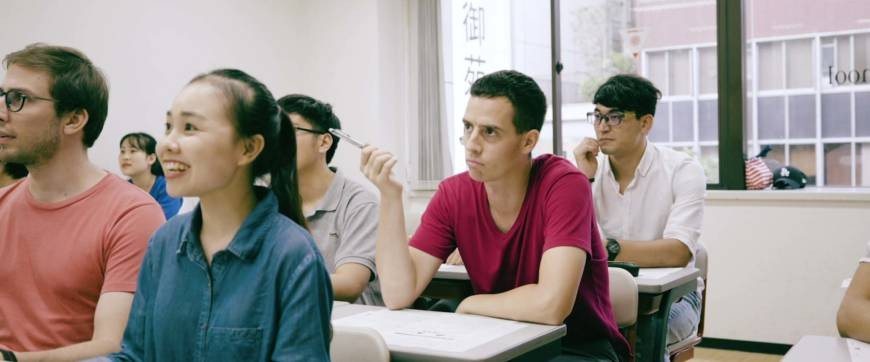
- Events students can enjoy are held all year round, such as tea ceremony, kimono dressing classes, and visits to Tokyo Tower and shrines.
- 2 students took part in the Japanese speech contest "Shabere-on '24" and won second and third place.
- In November we went to Shinjuku Gyoen. There was a chrysanthemum exhibition, and everyone enjoyed seeing the many kinds of chrysanthemums.
- Students wore yukata and experienced the tea ceremony.
- The entrance ceremony was on April 24, 2025, July students entered in July, and the graduation ceremony was on March 4.
On campus
- Ohashi Building, 3rd floor
- Classrooms: 5 — Moved to the current building in 2011
2026–2027 academic calendar
- Golden Week
- end of Apr–early May
- Spring break
- Wed, Apr 1–Wed, Apr 15, 2026 · Spring break is for 1st-year students only (Wed, Apr 1–Wed, Apr 15, 2026).
- Summer break
- Aug 1–16, 2026
- Autumn break
- Sat, Oct 3–Thu, Oct 15, 2026 · Spring break is for 1st-year students only (Wed, Apr 1–Wed, Apr 15, 2026).
- Winter break
- Sat, Dec 19, 2026–Wed, Jan 6, 2027
- Spring break
- 1st-year students: Sat, Mar 20–Wed, Mar 31, 2027; 2nd-year students: Tue, Feb 16–Wed, Mar 31, 2027 · Except Thu, Mar 4, 2027
School website · 2026-05-14 updated
Access
- Transit
- Tokyo Metro Marunouchi Line Shinjuku-gyoenmae Station on foot 2 minExit 1
JR Shinjuku Station, 8 min walk - Nearby
- Shinjuku-dori, Ohashi Building, 3rd floor. 10 minutes on foot from Shinjuku Station, 3 minutes on foot from the nearest station (website).
- Dormitory
- Available¥45,000–69,000 a month · Dorm fee from ¥45,000 (utilities included), 3–15 minutes on foot from Shinjuku Gyoen Gakuin. Meals are not provided at the dorms. · Based on school website
School website · 2025-12-26 updated
Student dorm — Applies from June 2025. Long-term students pay, on moving in, a dorm entry fee of ¥21,000, a deposit of ¥10,000, a dorm fee from ¥45,000 (utilities included) and a move-out cleaning fee of ¥24,000. The entry fee and cleaning fee are not refunded. Short-term students pay a deposit of ¥10,000 and a dorm fee from ¥73,000
School website · 2025-07-09 updated
SALLAE has organized the school website and published data in English.
The update date is the day that material was last revised.
Photos are materials published by the school.
This information is compiled from official sources and is not updated daily. Please confirm with the official contact before signing or applying.