Shizuoka International School
Shizuoka International School
- Progression
- University or similar 97% ›
- Admission
- Twice a year · April and October ›
- Japanese at entry
- From N5 ›
Compare side by side with other schools →
Tuition and conditions may change depending on the intake. If you contact us, we will check with the school and give you accurate details.
Nearby schools comparedBy distance · no ads or paid placement
- Shizuoka International SchoolThis schoolTuition/yr¥762,000Progression97%IntakesApr · Oct
- Shizuoka Japanese Language Institute4.3km›Tuition/yr¥782,000Progression96%IntakesApr · Oct
- Shizuoka Japanese Language Education Center5.1km›Tuition/yr¥615,000Progression95%IntakesApr · Oct
- International Kotoba Gakuin Japanese Language School6.2km›Tuition/yr¥650,000Installments OKProgression91%IntakesApr
— means SALLAE has not yet found the data.
About the school
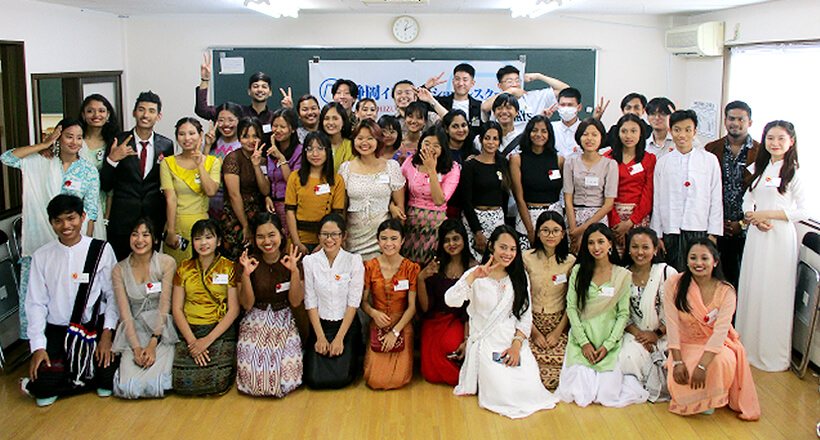
Both courses are progression courses (2 years and 1 year 6 months), and the school focuses on further study: of the 88 graduates in March 2026, 83 went on to vocational schools (73) or universities and junior colleges (10). It is in a residential area of Sena, about 6 km east of central Shizuoka (about 10 minutes by bus from JR Kusanagi Station). Opened in 1991 with a capacity of 180, it had 159 students enrolled in 2025, of whom 150 were students from Myanmar, Nepal and Sri Lanka. The dormitory consists of private apartments rented by the school (2 students per 1DK) at ¥17,000–¥30,000 a month. The school is scheduled to open as a certified Japanese language institution under the Ministry of Education, Culture, Sports, Science and Technology in April 2027.
Published data and school website
Tuition
If you saw a lower amount elsewhere, it may not include the admission fee and application fee
Median 1-year tuition in other areas — Kyoto ¥911,000(7 schools) · Kanagawa ¥880,000(8 schools) · Okinawa ¥858,000(6 schools) · Tokyo ¥840,600(56 schools) · Fukuoka ¥835,000(12 schools) · Hyogo ¥825,500(7 schools) · Osaka ¥814,000(27 schools) · Shizuoka ¥790,000(9 schools) · Chiba ¥745,333(10 schools) · Aichi ¥740,667(5 schools)
Total by intake
| Intake · length | Full course |
|---|---|
| 1 year 6 months | ¥1,062,000 |
| 2 years | ¥1,362,000 |
Cost details · Course tables · Notes
- Per term
- ¥150,000 3 months
- One-time fees
- ¥162,000Application fee · Admission fee
| Duration | Total |
|---|---|
| 1 year 6 months | ¥1,062,000 |
| 1 year 9 months | ¥1,212,000 |
| 2 years | ¥1,362,000 |
★"Per term" and "One-time at start" were calculated by SALLAE from each course's total. The courses this school actually offers are 1 year 6 months onward — all amounts in the table are values calculated by SALLAE.
Calculated by SALLAE · verified 2026-09-16
Admission & dates
- Apr intake
- 2-year course · Application Entry sheet: July to early September of the year before · Application: September to mid-October of the year before · Classes 1,520 hours (380 class days)
- Oct intake
- 1 year 6 months course · Application Entry sheet: February to early April · Application: March to mid-May · Classes 1,140 hours (285 class days)
- Japanese level
- JLPT N5 level or above
Equivalent ability may also be shown through tests such as J-TEST or NAT-TEST.
Deadline and capacity rules
April entry is the 2-year progression course (capacity 54, 3 classes); October entry is the 1 year 6 month progression course (capacity 36, 2 classes). Capacity per year group is 90 in 5 classes, and 180 for the whole school
School website · 2025-05-16 updated
Classes
Materials · Subjects · Timetable · Details
One class period is 50 or 45 minutes, 4 periods a day, Monday to Friday. Classes are formed by Japanese level, about 18 students per class
School website · 2025-05-16 updated
Documents
- Application formSchool's prescribed form
- Certificate of graduationHighest level of education
- TranscriptAll school years from year 1 of your last school
- Japanese study certificate and Japanese proficiency certificate
- Copy of passport or identity document
- Health certificateSchool's prescribed form
- Face photoTaken within 3 months
- QuestionnaireSchool's prescribed form
- Application fee¥25,000
Financial supporter's documents · 1 application requirement
Submitted by the person paying the tuition (financial sponsor)
- Financial sponsorship statementImmigration's prescribed form
- Documents showing the relationship between the financial sponsor and the applicantResident record, etc.
- Bank balance certificate (issued by the bank) and a copy of the bankbook
- Certificate of employment or business permit
- Documents proving the financial sponsor's incomeMost recent 3 years
Application requirements
Others (the school will contact you if needed)
School website · 2025-05-16 updated
Admission process
- Request an admission consultation — Contact the school by phone at 054-262-1120 or by e-mail. If applying from overseas through an intermediary agency, prepare documents following the agency's instructions
- Prepare and submit entry sheet — Contact the school, then prepare and submit an entry sheet.
- Document screening → interview — Interview after document screening; the school sends the application form to successful candidates. Many teachers take part in Zoom interviews, which are held for every applicant
- Prepare application documents — Various certificates are needed, and some documents require a Japanese translation.
- Application — Submit the application together with the application fee.
- You are notified that the Certificate of Eligibility has been issued. — Notice of Certificate of Eligibility issuance comes around the end of February for April entrants and around the end of August for October entrants. If it is not issued, the school explains the reason and confirms whether you wish to reapply
- Pay fees within 2 weeks — The school sends an invoice. Pay the fees within 2 weeks. (If entering the dormitory, pay the dormitory costs at the same time)
- Receive the admission permit and Certificate of Eligibility — The school sends the admission permit and Certificate of Eligibility, and also tells you the date for accepting you into Japan.
- Apply for a student visa at the Japanese embassy.
- Buy the plane ticket and tell the school your arrival date. — The school contacts you separately about airport pickup and the like.
- On arrival in Shizuoka, the school guides you to your lodging. — The day after you arrive in Japan is the school's entrance day.
- Placement test
- Students' Japanese ability is assessed by tests and similar methods, and classes are formed accordingly (FY2025 self-evaluation).
School website · 2025-05-16 updated
Graduate outcomes
| FY2025 | Admitted |
|---|---|
| University | 10 students |
| Vocational school | 73 students |
| Employment | 3 students |
| Graduates | 88 students |
Passing an exam
| Exam | Pass |
|---|---|
| JLPT N1 2025 | 2 students |
| JLPT N2 2025 | 36 students |
| JLPT N3 2025 | 44 students |
| JLPT N4 2025 | 6 students |
N1: 2 · N2: 36 · N3: 44 · N4: 6 (88 graduates in March 2026)
March 2026 graduates: 10 to university or junior college, 73 to vocational school, 3 employed, 2 returned home. Report No. 44: 87 completers, 87 qualifying students (100%) · 3 employed (March 2026 graduates). Status-of-residence changes permitted: 0 · School website · Updated 2026-06-04
Reviews
If you study here or used to, tell others what the classes, teachers and daily life were like. It helps anyone deciding on this school.
Write the first reviewUniversity prep
- The career guidance staff set out a plan from the start of enrollment to graduation — The person in charge of career guidance sets out a plan from the start of enrollment to graduation, and homeroom teachers provide appropriate career guidance with good results
- Provides materials and information on further study and employment — Collects materials and information on further study and employment and provides them to students.
- The school tracks where graduates go after graduation. — The school tracks where graduates go after graduation.
School website · 2026-05-20 updated
Daily-life support
- Pickup contact; lodging guidance after arrival in Shizuoka — The school contacts you about airport pickup and the like. After you arrive in Shizuoka, it guides you to your lodging.
- Guidance on student life in Japan — Regular guidance sessions on student life. The student-life head sets out a guidance plan from admission to graduation. Student-life guidance staff: 3 dedicated, 6 concurrent
- Native-language support — If needed, a support system in the student's native language can be arranged.
- A system is in place to give guidance on health and hygiene. — A health and hygiene guidance system is in place. Procedures for serious illness, traffic accidents and infectious disease outbreaks are defined and communicated. Disaster drills and traffic safety classes
- Guidance on residence matters — Points to note under immigration law are regularly communicated and taught. The school continues efforts to prevent overstays, violations of permission for activities outside status of residence, and involvement in crime
- Can I work part-time? — Not allowed during the first month after enrollment. After that, up to 28 hours a week with permission for activities outside status of residence (8 hours a day during long breaks); adult-entertainment businesses are not allowed. Jobs in factories, parcel sorting centers, convenience stores, etc.
Monthly living costs · School information
| Item | 1 month |
|---|---|
| Rent | ¥19,000 |
| Utilities (gas, water, electricity) | ¥7,000 |
| Food costs | ¥24,000 |
| Communication costs | ¥10,000 |
| Transportation | ¥1,000 |
| Medical expenses | ¥1,000 |
| Clothing | ¥4,000 |
| Social expenses | ¥5,000 |
| Other | ¥4,000 |
| Total | ¥75,000 |
The total average from a student survey is ¥75,000. Monthly living costs are about ¥70,000–¥80,000, not including tuition. Hourly wages in Shizuoka are about ¥944–¥1,100
School website · 2025-05-16 updated
Students
159 enrolled (2025) · Capacity 180 National median: 180 students
Based on 159 students enrolled in 2025.
Public data from the Association for the Promotion of Japanese Language Education (Nisshinkyo) · verified 2026-09-20
School life
For 1 year
- 4
- Start-of-term ceremony · Entrance orientation · April entrants' entrance ceremony and celebration
- 5
- Welcome excursion · Traffic safety class · Disaster drill, health checkup
- 6
- Social party (April entrants) · Examination for Japanese University Admission for International Students
- 7
- Tanabata gathering · JLPT · Class activity (barbecue) · End-of-term ceremony · Start of summer vacation (about 1 month)
- 8
- Opening ceremony
- 9
- First semester final exam
- 10
- Entrance orientation · October entrants' entrance ceremony and celebration · Bus excursion
- 11
- Health checkup (Oct intake) · Traffic safety class · Examination for Japanese University Admission for International Students · Social party (October entrants)
- 12
- Tea ceremony class · JLPT · End-of-term ceremony · Start of winter vacation (about 2 weeks)
- 1
- Start-of-term ceremony and Kagami-biraki · Speech contest preliminaries
- 2
- Final of the speech contest · Graduation exams (2nd year) · Compiling the graduation anthology · Second-term final exams (1st year) · Setsubun
- 3
- Graduation ceremony · End-of-term ceremony · Cherry blossom viewing · Start of spring break (about 2 weeks)
- The 1st alumni reunion was held in July 2003 (held every year since). The first overseas reunion was held in Jakarta, Indonesia in September 2012
- Takes part in international-understanding education and community activities at local schools, and interacts with local people.
- Informs students about volunteer work and community activities.
On campus
- 2nd floor
- Classroom
- Lobby
- Exchange room
- Self-study space — Provides a space for self-study outside class hours.
- ICT teaching equipment — Educational equipment and facilities are in place that allow classes using ICT.
Academic calendar
- Summer vacation
- About 1 month (after the end-of-term ceremony in July)
- Winter break
- About 2 weeks (after the end-of-term ceremony in December)
- Spring break
- About 2 weeks (after the end-of-term ceremony in March)
School website · 2025-05-16 updated
Access
⚠ The monthly cap on dormitory fees differs depending on the source. Please confirm with the school. The charge is ¥17,000–¥25,000 per month. (Gas, electricity and water extra) · (Rent is ¥17,000–¥30,000 a month depending on the room) The admission guide lists rent at ¥17,000–¥30,000 a month and living costs in Japan at ¥17,000–¥25,000 a month
- Transit
- Nearest station: JR Kusanagi Station (2nd stop from Shizuoka Station on the inbound line). From the north exit, take the Shizutetsu Justline bus bound for Senashinden, about 10 minutes Get off at Sena Link Nishina-mae, 3 min walk
- Nearby
- 6 km east of JR Shizuoka Station and Shizuoka Aoi Ward Office, in a residential area. There are many bus services, and from the highway bus stop near Sena IC it takes about 2.5 hours to Tokyo or Nagoya
- Dormitory
- Available¥17,000–¥30,000 a month · The school rents private apartments, basically 2 students per 1DK. Rent is ¥17,000–¥30,000 a month depending on the room (gas, electricity and water extra); 0–2 km from the school, 12–13 minutes by bicycle · Based on school website
School website · 2026-06-04 updated
Dorm — All applicants who wish to can live in the dormitory. Move-in payment ¥120,000 (move-in fee ¥50,000 [bedding set, rice cooker, room cleaning fee, etc.] + rent ¥70,000 [2–3 months]); rent is paid monthly starting about 3 months later
School website · 2025-05-16 updated
SALLAE has organized the school website and published data in English.
The update date is the day that material was last revised.
Photos are materials published by the school.
This information is compiled from official sources and is not updated daily. Please confirm with the official contact before signing or applying.