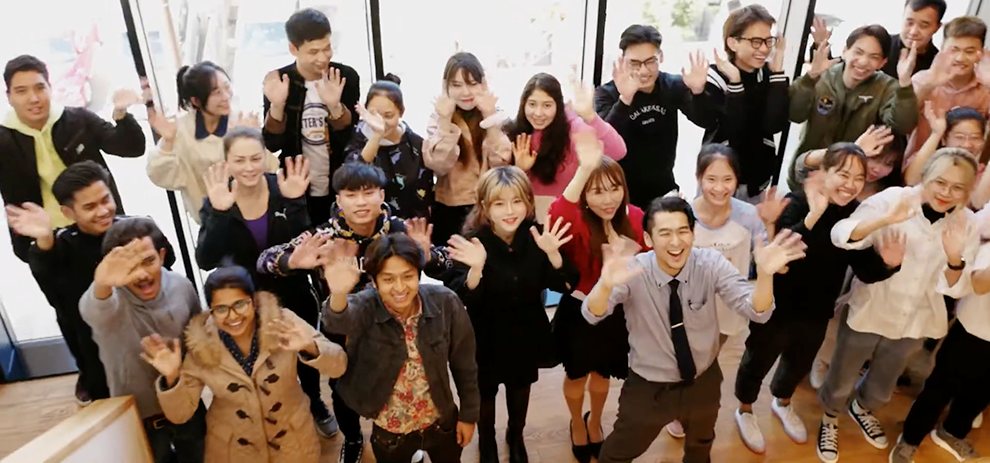
Shizuoka Japanese Language Institute
Shizuoka Japanese Language Institute
- Progression
- Universities etc. 96% ›
- To station
- 3-minute walk · Yunoki Station
- Dormitory fee
- from ¥30,000 a month ›
Compare side by side with other schools →
Tuition and conditions may change depending on the intake. If you contact us, we will check with the school and give you accurate details.
Nearby schools comparedBy distance · no ads or paid placement
- Shizuoka Japanese Language InstituteThis schoolTuition/yr¥782,000Progression96%IntakesApr · Oct
- Shizuoka Japanese Language Education Center0.9km›Tuition/yr¥615,000Progression95%IntakesApr · Oct
- International Kotoba Gakuin Japanese Language School1.9km›Tuition/yr¥650,000Installments OKProgression91%IntakesApr
- Shizuoka International School4.3km›Tuition/yr¥762,000Progression97%IntakesApr · Oct
— means SALLAE has not yet found the data.
About the school
This school focuses on further study. It reports that 97 of the 105 students who completed the course in FY2025 went on to universities, vocational schools and the like (Notice No. 44 report). Going on to Shizuoka Institute of Science and Technology or one of 5 vocational schools of the same school corporation waives the application fee and admission fee, and brings tuition discounts and recommended admission. It opened in Numazu in 2017 as Numazu Japanese Language Academy, then moved to Aoi-ku, Shizuoka in April 2025 and changed its name. It is a 3-minute walk from Yunoki Station on the Shizuoka Railway and shares an address with Shizuoka Sangyo Gijutsu College of the same corporation. Courses are the 2-year (April) and 1 year 6 month (October) progression courses, taught with Dekiru Nihongo, and the school also offers daily-life support such as apartments it introduces, airport pickup and bicycle commuting.
Published data and school website
Tuition
If you saw a lower amount elsewhere, it may not include the admission fee and application fee
Median 1-year tuition in other areas — Kyoto ¥911,000(7 schools) · Kanagawa ¥880,000(8 schools) · Okinawa ¥858,000(6 schools) · Tokyo ¥840,600(56 schools) · Fukuoka ¥835,000(12 schools) · Hyogo ¥825,500(7 schools) · Osaka ¥814,000(27 schools) · Shizuoka ¥790,000(9 schools) · Chiba ¥745,333(10 schools) · Aichi ¥740,667(5 schools)
Total by intake
| Intake · length | Full course |
|---|---|
| 1 year 6 months | ¥1,112,000 |
| 2 years | ¥1,442,000 |
Cost details · Course tables · Notes
- Per term
- ¥165,000 3 months
- One-time fees
- ¥122,000Application fee · Admission fee
| Duration | Total |
|---|---|
| 1 year 6 months | ¥1,112,000 |
| 1 year 9 months | ¥1,277,000 |
| 2 years | ¥1,442,000 |
★"Per term" and "One-time at start" were calculated by SALLAE from each course's total. The courses this school actually offers are 1 year 6 months onward — all amounts in the table are values calculated by SALLAE.
Calculated by SALLAE · verified 2026-09-16
Admission & dates
- Apr intake
- 2-year course · Application Aug 3 (Mon) – Aug 21 (Fri), 2026 · Classes 1,600 hours (400 days)
- Oct intake
- 1 year 6 months course · Application Mar 1 (Mon) – Mar 19 (Fri), 2027 · Classes 1,200 hours (300 days)
- Japanese level
- JLPT N5 equivalent or higher
2-year progression course (April): JLPT N5 equivalent or above, reference framework A1 or above, or 150 hours or more of study. 1 year 6 months progression course (October): N4 equivalent or above, A2 or above, or 300 hours or more of study
Deadline and capacity rules
Within 5 years after completing 12 or more years of schooling. After 5 or more years, there must be a clear purpose of study and a concrete plan for after graduation. Technical intern trainees must use their acquired skills after returning home and have no serious violations of law. Additional recruitment available
School website · 2026-07-13 updated
Classes
- Morning
- 09:10-12:30
- Afternoon
- 13:10-16:30
Materials · Subjects · Timetable · Details
- Materials
- Based on the Dekiru Nihongo textbooks and curriculum. Goals for each class are set according to the accompanying syllabus
- Subject
- Dekiru Nihongo · JLPT prep · EJU prep · JLPT preparation covers every level from N1, including grammar, vocabulary, reading and listening. EJU preparation covers Japanese, Comprehensive Subjects, mathematics and science
Class period times4 periods a day (45 minutes each); the auditing student guide says 5 days a week (Mon–Fri).
| Morning course (periods 1–4) | Afternoon course (periods 5–8) | |
|---|---|---|
| Period 1 | 09:10-09:55 | 13:10-13:55 |
| Period 2 | 10:00-10:45 | 14:00-14:45 |
| Period 3 | 10:55-11:40 | 14:55-15:40 |
| Period 4 | 11:45-12:30 | 15:45-16:30 |
2-year progression course: Beginner, Pre-intermediate, Intermediate I, Intermediate II (year 1); Upper-intermediate, Advanced I, Advanced II, Advanced III (year 2) / 1 year 6 month progression course: Intermediate I to Advanced III (196 hours each)
School website · 2025-06-02 updated
Documents
- Application form (school-designated document), handwritten by the applicant. If prepared on a computer, the signature field must be signed by hand.
- Statement of study reasons (on the same sheet as page 3 of item 1): why you want to learn Japanese. If written in your native language, attach a separate Japanese translation.
- Graduation certificate from the last school attended (copy at application, original after acceptance)
- Copy of the transcript from a high school, university, junior college, vocational school or similar in Japan, in Japanese
- Certificate of Japanese ability: copy of a JLPT N5 or higher (or equivalent) pass certificate, or a Japanese school study certificate (150 hours or more)
- Statement of financial support (school-designated form): documents showing the expense supporter, the supporter's annual income, the amount carried and the monthly remittance, etc. The original must be handwritten by the expense supporter
- 8 photos. Write your name on the back. Within 3 months of the application date4 cm tall × 3 cm wide
- Passport copy, copy(pages with name, photo and Japan entry and exit stamps) * If you do not have one, documents proving your identity in place of a passport (e.g., national ID or original birth certificate)
Sponsor documents · Only if applicable · 5 application requirements
Submitted by the person paying the tuition (financial sponsor)
- Original documents proving the relationship between the applicant and the person who pays the expenses (original birth certificate, notarized proof of family relationship, residence certificate, etc.)
- Original bank balance certificate (showing a balance sufficient for the planned period of study)
- Copy of passbook for the past 1 year
- Income certificate; income and tax assessment certificate, original, for the past 3 years
Only if applicable
- Certificate of how funds were accumulated (If item 8 cannot be submitted, the original of a document explaining how the deposit amount was built up from that income)
- Original certificate of employment (If the financial sponsor works for a company or similar)
- Certified copy of corporate registration and original business license (If the financial sponsor is a business owner, company officer, etc.)
- Certificate of enrolment (academic transcript, etc.) (If enrolled at a university in your home country)
- Tuberculosis-free certificate (Only those designated by the Immigration Services Agency)
Application requirements
Documents issued in Japan must be within 3 months of the issue date; documents from abroad within 6 months. Each document needs a Japanese translation. Copies of documents must be printed single-sided on A4. One set of original documents is needed per person. Your native language and second language are checked during screening. If you have applied for a visa to stay in Japan before, you must declare it.
Required documents may differ by nationality. Sri Lanka: original O-level and A-level certificates. Nepal: kinship certificate issued by the local administrative district. SALLAE is confirming this with the school.
School website · 2026-07-13 updated
Admission process
- Request an admission consultation — Inquiry form (select nationality, whether you live in Japan, and who to contact). Shizuoka Japanese Language Academy, Tel. 054-297-3804
- Submit application documents — Application documents must arrive by the deadline (2-year progression: Aug 3–21, 2026; 1 year 6 months progression: Mar 1–19, 2027). Intermediary agencies submit a separate list of applicants. Forms are standardized on A4
- Document screening, then written test and interview (online) — Document screening and written test / interview: 2-year course Aug 24 – Sep 18, 2026; 1 year 6 months course Mar 23 – Apr 23, 2027. Japanese written test 30 min, basic math written test 15 min, Japanese interview 15 min, held online. Depending on the document screening result, the written test and interview may be skipped
- Documents for the Certificate of Eligibility application — Applicants who pass the written test and interview promptly submit the full set of application documents (originals). Deadline: 2-year course, must arrive by Tuesday, Oct 20, 2026; 1 year 6 months course, must arrive by Thursday, May 20, 2027
- Result of status of residence issuance announced — Announcement of Certificate of Eligibility results: 2-year progression course, late February 2027; 1 year 6 months progression course, late August 2027
- Tuition payment — The total for one year of tuition and other fees is paid by bank transfer when the Certificate of Eligibility is issued. Remittance fees are borne by the student.
- Placement test
- Classes are formed by proficiency, based on the intake period and regular exam results (FY2024). Students at upper-intermediate level (N3-equivalent or higher) can be transferred into a class matching their proficiency
School website · 2026-07-13 updated
Short-term study
- Open now?
- Rolling admissions, so availability varies from time to time — SALLAE will confirm with the school
Course without a student visa
- Auditing student course — For people who already have a status of residence. A visa allowing a stay of 6 months or more plus daily attendance. April and October intakes; in principle 6 months or more, up to 2 years. 4 hours a day (morning or afternoon), Monday to Friday. A certificate is issued with an attendance rate of 90% or higher, and a commuter pass is available with the student ID
★Short-term courses are not listed in the published data — it counts only student-visa courses.
School website · 2025-03-25 updated
Progression
| FY2025 | Admitted |
|---|---|
| Graduates | 105 students |
Passing an exam
| Exam | Pass |
|---|---|
| JLPT N1 2024 | 9 students |
| N2 or above 2024 | 30 students |
| N3 or above 2024 | 73 students |
Reiwa 6: among 90 second-year students, 9 passed N1, 30 passed N2 or above and 73 passed N3 or above. Reiwa 5: 2 passed N1, 23 passed N2 and 80 passed N3
+58 more schools
FY2025 (Reiwa 7): 105 completed the course; 101 met the standard (96.2%); 93+4 went on to further study; 0 changed status; 66+4 at CEFR A2-equivalent or higher (prepared June 26, 2026) · School website · 2026-06-26 updated
Reviews
If you study here or used to, tell others what the classes, teachers and daily life were like. It helps anyone deciding on this school.
Write the first reviewUniversity prep
- Progression to the Shizuoka Institute of Science and Technology group — Students can go on to Shizuoka Institute of Science and Technology (including its graduate school) and 5 vocational schools. Benefits include waived application and admission fees, tuition discounts, recommended admission and a transfer system
- Individual guidance for students wishing to go on to further study — Individual guidance from choosing a school to preparing application documents and interview prep, alongside EJU and JLPT prep. Homeroom teachers hold individual interviews 4 times a year (Reiwa 6)
- Progression information and interview coaching — Advice based on admission requirements and tuition information collected from destination schools; brochures and posters are always on display; open-campus attendance is encouraged; interview coaching (FY2024)
- Career consultation — For students who want to work: career counseling, résumé and interview coaching, and briefings on employment and on visa applications and renewals
School website · 2025-06-11 updated
Daily-life support
- International Student Support Section staff / student-life guidance staff — Even if you run into trouble in daily life, staff of the International Student Support Section will support you.
- Online orientation — Before you enter Japan, staff and senior students from your home country give an online orientation.
- Apartment introductions — So that you can move into an apartment right after arriving in Japan, the school introduces apartments that match your wishes.
- Airport pickup — Staff will meet you after you arrive at the airport, so you can reach your apartment with peace of mind.
- Orientation on study and daily life — Right after arrival, daily-life rules, manners, laws and regulations are explained. Points to note under immigration law are taught at orientation on arrival and before long breaks
- Can I commute to school by bicycle? — International students commute from their apartments to school by bicycle. The police also hold briefings on traffic rules.
- Part-time job introductions — Support from the application for permission for activities outside status of residence through introductions to part-time employers. Guidance to prevent double jobs and overwork. During long breaks, up to 8 hours a day and 40 hours a week
- Guidance to the nearest hospital or clinic — Guidance to a hospital near the apartment that suits the symptoms. Staff also accompany students to the hospital (FY2024)
- Health checkup — A health checkup is given once a year and follow-up is based on the results.
- Help with various procedures — Staff help with various procedures, such as resident registration, National Health Insurance and National Pension enrolment.
- Senior supporters — A senior supporter system is in place, in which current students cooperate to support new students when they arrive in Japan (FY2024)
- Evacuation drill — Evacuation drills are held in preparation for disasters such as earthquakes and bad weather.
Monthly living costs · School information
| Item | 1 month |
|---|---|
| Food costs | ¥25,000 |
| Communication costs | ¥5,000 |
| Electricity | ¥3,000 |
| Gas | ¥3,000 |
| Water | ¥2,500 |
| Total | ¥38,500 |
Guide to monthly living costs: food ¥25,000, communications ¥5,000, utilities (electricity from ¥3,000, gas from ¥3,000, water from ¥2,500)
School website · 2025-03-25 updated
Students
195 enrolled (2025) · Capacity 225 National median: 180 students
Based on 195 students enrolled in 2025.
Public data from the Association for the Promotion of Japanese Language Education (Nisshinkyo) · verified 2026-09-20
School life
- The school works to promote mutual understanding through taking part in community group activities and through school events.
On campus
- Classroom
- Classrooms are equipped with projectors, audio equipment, wireless LAN and so on, and their use in lessons is being advanced (FY2025 self-evaluation).
- Classroom
- Self-study room — Each lecture room is open to students as a self-study room, but it cannot be said that the hours and how to use them are sufficiently publicized (FY2025)
2026–2027 academic calendar
- Summer vacation
- Aug 8–23, 2026
- Autumn break
- Sep 18, 2026 – Oct 4, 2026
- Winter break
- Dec 19, 2026–Jan 5, 2027
- Spring break
- Mar 13–Apr 11, 2027 (planned)
School website · 2026-06-03 updated
Access
- Transit
- Shizuoka Railway Yunoki Station, 3 min walk
- Nearby
- At 110-11 Miyamaecho, the same address as Shizuoka Sangyo Gijutsu College. Moved from Numazu to Shizuoka on April 1, 2025 (Reiwa 7). Students commute from the apartment to school by bicycle
- Dormitory
- Available · Apartments introduced by the school. Rent ¥360,000 (year 1); reference monthly rent for a single room ¥47,000. Students commute from the apartment to school by bicycle · Based on school website
School website · 2025-07-14 updated
Dorm — Apartment rent ¥360,000 (April entrants, years 1 and 2) / ¥180,000 (October entrants); comprehensive housing insurance ¥4,000 / ¥2,000; futon ¥12,000. Rent and insurance vary by property and number of residents, and any excess is collected separately
School website · 2026-06-11 updated
SALLAE has organized the school website and published data in English.
The update date is the day that material was last revised.
Photos are materials published by the school.
This information is compiled from official sources and is not updated daily. Please confirm with the official contact before signing or applying.