Subaru Gakuin Motosu Campus
Subaru Gakuin Motosu Campus
- Employment results
- Employment etc. 13% ›
- Course
- Further-study course only ›
- Admission
- Twice a year · Apr, Jul ›
Compare side by side with other schools →
Tuition and conditions may change depending on the intake. If you contact us, we will check with the school and give you accurate details.
Nearby schools comparedBy distance · no ads or paid placement
- Subaru Gakuin Motosu CampusThis schoolTuition/yr¥790,000Progression80%IntakesApr · Jul
- Misono International Language School17km›Tuition/yr¥890,000Progression100%IntakesApr · Jul · Oct
- Nagoya Education Institute24.6km›Tuition/yr¥765,000Progression—IntakesJan · Apr · Jul · Oct
- Aichi Kotonoha Gakuin25.8km›Tuition/yr¥830,000Progression100%IntakesApr · Oct
— means SALLAE has not yet found the data.
About the school
This school focuses on further study. It has only two courses, a 2-year Japanese progression course (April entry) and a 1 year 9 month course (July entry), and its school rules state that its purpose is progression to universities and the like. According to the school's career graph, 80% of the March 2026 graduates went on to universities, junior colleges and vocational schools (the remaining 20% found jobs). It opened in 2008 in Kamimakuwa, Motosu, Gifu Prefecture, with a capacity of 160, about a 10-minute walk from Kitagata-Makuwa Station on the Tarumi Railway, and has a sister school of the same name in Ogaki. Right next to the school is a student dormitory of about 20 rooms for around 50 students (¥20,000–¥30,000 a month), and classes are split into a morning session (8:30–12:00) and an afternoon session (13:00–16:30).
Published data and school website
Tuition
If you saw a lower amount elsewhere, it may not include the admission fee and application fee
Median 1-year tuition in other areas — Kyoto ¥911,000(7 schools) · Kanagawa ¥880,000(8 schools) · Okinawa ¥858,000(6 schools) · Tokyo ¥840,600(56 schools) · Fukuoka ¥835,000(12 schools) · Hyogo ¥825,500(7 schools) · Osaka ¥814,000(27 schools) · Shizuoka ¥790,000(9 schools) · Chiba ¥745,333(10 schools) · Aichi ¥740,667(5 schools)
Total by intake
| Intake · length | Full course |
|---|---|
| 1 year 9 months | ¥1,330,000 |
| 2 years | ¥1,510,000 |
Cost details · Course tables · Notes
- Per term
- ¥180,000 3 months
- One-time fees
- ¥70,000Application fee · Admission fee
| Duration | Total |
|---|---|
| 1 year 9 months | ¥1,330,000 |
| 2 years | ¥1,510,000 |
★"Per term" and "One-time at start" were calculated by SALLAE from each course's total. The courses this school actually offers are 1 year 9 months onward — all amounts in the table are values calculated by SALLAE.
Calculated by SALLAE · verified 2026-09-16
Admission & dates
⚠ Application deadline for the 2-year course (April entry) varies by source — please confirm with the school. Sep 30, Oct 15, Jan 31 and so on differ between the school's materials, and the school says it closes early once capacity is reached — please confirm with the school before applying.
- Apr intake
- 2-year course · Application Application deadline for the 2-year Japanese progression course (April entry) is Sep 30. · Classes 1,520 hours (45-minute periods)
- Jul intake
- 1 year 9 months course · Application Application deadline for the 1 year 9 month Japanese progression course (July entry) is Jan 31. · Classes 1,340 hours (45-minute periods)
- Japanese level
- Able to prove at least 150 hours of study at a Japanese language educational institution
Submit the original of a JLPT, J-TEST or NAT-TEST score report or certificate, or a certificate of 150 or more hours of study at a Japanese language institution.
Deadline and capacity rules
Aged 18 or older at enrollment and having completed 12 or more years of school education or an equivalent course. Able to pay their expenses, healthy in mind and body, and able to abide by laws and regulations
School website · 2026-07-15 updated
Classes
- Morning
- 08:30-12:00 Morning session: arrive at 8:20; classes 8:30–12:00 (periods 1–4).
- Afternoon
- 13:00-16:30 Afternoon session: arrive at 12:50; classes 13:00–16:30 (periods 1–4).
- AM/PM placement
- * Students belong to either the morning or the afternoon session
- Class size
- Max 20 students
Materials · Subjects · Timetable · Details
- Materials
- Basic textbooks: Minna no Nihongo for beginner, Chukyu e Ikou for pre-intermediate, and Chukyu o Manabou for intermediate.
- Subject
- Characters and vocabulary · Grammar · Reading · Listening · Social conversation · Writing · At beginner, intermediate and advanced levels alike, there are 6 subjects: characters and vocabulary, grammar, reading, listening, social conversation and writing (weekly class hours are in the school rules table).
Class days and start and end times One class period is 45 minutes.
| Morning | Afternoon | |
|---|---|---|
| Period 1 | 08:30-09:15 | 13:00-13:45 |
| Period 2 | 09:25-10:10 | 13:55-14:40 |
| Period 3 | 10:20-11:05 | 14:50-15:35 |
| Period 4 | 11:15-12:00 | 15:45-16:30 |
Class hours by subject
| Subject | 2 years | 1 year 9 months |
|---|---|---|
| Beginner characters and vocabulary | 38 hr | 20 hours |
| Beginner grammar | 190 hr | 100 hours |
| Beginner reading | 38 hr | 20 hours |
| Beginner listening | 38 hr | 20 hours |
| Beginner social conversation | 38 hr | 20 hours |
| Beginner writing | 38 hr | 20 hours |
| Intermediate characters and vocabulary | 56 hr | 56 hr |
| Intermediate grammar | 224 hr | 224 hr |
| Intermediate reading | 112 hr | 112 hr |
| Intermediate listening | 112 hr | 112 hr |
| Intermediate social conversation | 28 hr | 28 hr |
| Intermediate writing | 28 hr | 28 hr |
| Advanced characters and vocabulary | 58 hr | 58 hr |
| Advanced grammar | 174 hr | 174 hr |
| Advanced reading | 116 hours | 116 hours |
| Advanced listening | 116 hours | 116 hours |
| Advanced social conversation | 58 hr | 58 hr |
| Advanced writing | 58 hr | 58 hr |
According to its school rules, the school's purpose is to teach Japanese and basic subjects to international students who want to go on to Japanese universities and the like · Hours by subject are counted in 45-minute units as weekly hours in the school rules' subject table × number of weeks (the school rules also give hours for the 1 year 6 month course, but it is omitted because it is not currently recruiting) · Based on regular exam results, students can move to a class that fits their level · Grades are on a 10-point scale based on exams, attendance and class attitude, and graduation requires attendance at 80% or more of all classes · The attendance rate should in principle be 90% or higher; below 80% the student receives a written warning and a meeting, and below 70% the school considers whether to dismiss the student.
What each level aims for · 3 levels
- Beginner
- JLPT N5 and N4 level
- Intermediate
- N3, N2 and EJU level
- Advanced
- N1 and EJU level
School website · 2026-06-18 updated
Documents
- Admission application form
- Résumé
- Original diploma or original graduation certificate from the last school attended
- Original transcript from last school attended
- Original JLPT or other score report or certificate, or a certificate of 150 or more hours of study at a Japanese language institution.
- Documents that officially prove nationality, name, sex, date of birth, place of birth, current address, family composition, etc.
- 8 photos (4 cm tall × 3 cm wide). Photos made as color copies are not accepted. Taken within 3 months before applying.
Financial supporter's documents · only if applicable · 6 application requirements
Submitted by the person paying the tuition (financial sponsor)
- Financial sponsorship statement
- Documents proving the relationship with the applicantNot needed if the applicant pays the expenses personally
- Bank balance certificate: original, in the expense supporter's name
- Original bank transaction statement or copy of the bankbook (past 1 year). If there are no or extremely few transactions, attach a statement explaining how the funds were accumulated
- Certificate of employment, corporate registry copy, business license, copy of the tax return, etc. (proof of occupation).
- Income certificate for the past 1 year (for those living outside Japan). For those living in Japan, income and tax certificate (past 1 year).
- Official document listing all family members
- Residence certificate (jūminhyō)When the financial sponsor lives in Japan
Only if applicable
- For those enrolled, on leave, withdrawn or employed: the original certificate (Certificate of expected graduation, enrollment, leave of absence, withdrawal or employment (applicable persons only))
- Pages showing personal details and history of entry to Japan (If you have a passport)
- Applicants of Vietnamese nationality need an educational authentication certificate such as VJEEC proving completion of their last education. (If you hold Vietnamese nationality)
Application requirements
Submit documents issued within 3 months before the date of submission to the Immigration Services Agency (see page 3). Attach a Japanese translation on a separate sheet to documents in languages other than Japanese. If there are corrections, do not use correction fluid; draw a double line through the correction and In the margin of each document copy, write the date the copy was made, the name of the person who made it and the relationship to the applicant. The application form, résumé and statement of financial support come as one set Additional documents may be requested as needed.
No document list or balance criteria specific to Korean applicants has been published · Only documents for Chinese and Vietnamese nationals are listed separately. SALLAE is confirming this with the school.
School website · 2026-07-03 updated
Admission process
- Request an admission consultation — Web application is recommended. Applying by e-mail or phone is also possible. The course you want may already be full
- Pay the application fee and submit documents — Pay the application fee into the school's designated bank account and send all the documents needed for the application. Interview details are then sent. Deadline: Sep 30 for the 2-year course, Jan 31 for the 1 year 9 month course.
- Document screening and interview — For applicants who pass the document screening and interview, the school submits the application documents to the Immigration Services Agency. Late November for the 2-year course, mid-March for the 1 year 9 month course.
- Announcement of whether the Certificate of Eligibility is issued — Notice that the Certificate of Eligibility has been issued. Applicants for whom it is issued receive instructions for paying tuition, dormitory fees and so on. Mid-February for the 2-year course, late May for the 1 year 9 month course.
- Pay tuition, dormitory fees, etc. — Pay tuition, dormitory fees and so on; after the payment is confirmed, the Certificate of Eligibility and the admission permit are sent. Early March for the 2-year course, early June for the 1 year 9 month course.
- Visa application — Apply for the visa at the Japanese embassy or consulate general with jurisdiction. Mid-March for the 2-year course, mid-June for the 1 year 9 month course.
- Visa issuance — After obtaining the visa, contact the school, then notify it again of your arrival date and flight number once you have booked the ticket. If the visa is not issued, the admission permit is returned and so on, and everything except the application fee and admission fee is refunded.
- Entry into Japan — Entry into Japan: early April for the 2-year course, early July for the 1 year 9 month course.
- Placement test
- Placement test
School website · 2026-01-02 updated
Short-term study
- Admission
- RollingNo fixed intake months
- Open now?
- Rolling admissions, so availability varies from time to time — SALLAE will confirm with the school
Course without a student visa
- Auditing students — Status of residence is in principle other than student. In principle renewed every 3 months, and enrollment is possible at any time. Application fee ¥15,000; ¥135,000 for 3 months or ¥3,000 per day. Progression and job support is in principle not provided
★Short-term courses are not listed in the published data — it counts only student-visa courses.
School website · 2026-04-13 updated
Graduate outcomes
| FY2025 | Admitted |
|---|---|
| Employment | 9 students |
| Graduates | 70 students |
See 4 more schools
See 5 more schools
FY2025: course completers 70, qualifying students 70 (100.0%). Progression 29 · 12 · 15; change of status of residence 4 · 3 · 2; A2 or above 33 · 17 · 17. · Status-of-residence changes permitted (FY2025): 2-year 4, 1 year 9 months 3, 1 year 6 months 2. March 2026 graduates: 20% employed (food service, manufacturing, hotel and tourism, etc.). · School website · Updated 2026-06-15
Reviews
If you study here or used to, tell others what the classes, teachers and daily life were like. It helps anyone deciding on this school.
Write the first reviewUniversity prep
- Progression guidance — Besides Japanese education aimed at further study, the school offers math supplementary lessons, interview preparation and more according to student needs.
- Progression guidance for current students — Progression guidance for current students
- Interviews and general cleaning — Annual schedule: interviews and general cleaning on July 31, September 29 and December 24; current-student and graduate interviews and general cleaning in March.
- Individual job counseling — The school asks about desired occupation and work location, and provides the required Japanese level, the type of status of residence and its acquisition schedule, job listings, application support, résumé coaching and exam support.
- Mock job interviews — Staff hold mock interviews and give advice on clothing, manner of speaking and likely questions.
- Follow-up after a job offer — As follow-up after a job offer, the school helps confirm employment terms, accept the offer, change status of residence and complete joining procedures.
- Job introductions — Paid employment placement business license No. 21-yu-300301. The school receives job listings for international students; students who see a listing apply, and in some cases a staff member acts as intermediary.
- Qualification examples — Examples of qualifications obtained: JLPT, EJU, various Specified Skilled Worker exams, JFT-Basic.
School website · 2026-05-29 updated
Daily-life support
- Airport pickup — Transport costs after arrival, such as a chartered large vehicle from Chubu Centrair International Airport to the school.
- Bedding — The cost of futon, pillow, sheets and so on.
- Part-time work — After obtaining permission for activities outside status of residence on arrival, students can work part-time. In principle up to 28 hours a week, and up to 8 hours a day during long breaks.
- National Health Insurance and accident insurance — Enrollment in National Health Insurance is mandatory, and students pay the premiums directly to their local government.
- Health checkup — A health checkup is given once a year: in May for April entrants and in August for July entrants
- Homeroom teacher system and individual meetings — The school provides attentive study and life support through a homeroom teacher system and individual meetings.
- Disaster drill — On December 8, 2025, a disaster-prevention talk and evacuation drill; in the November 5, 2024 drill, students tried using a fire extinguisher (talk by fire department staff).
Monthly living costs · School information
| Item | 1 month |
|---|---|
| Food costs | ¥30,000 |
| Rent | ¥30,000 |
| Other expenses | ¥20,000 |
| Total | ¥80,000 |
According to a JASSO survey, living costs are about ¥80,000 a month (food ¥30,000, rent ¥30,000, miscellaneous ¥20,000). The guide on the website is ¥65,000–¥83,000 including the dormitory fee.
School website · 2026-07-03 updated
Scholarship
- Passed any one of JLPT N2 or higher, NAT-TEST Level 2 or higher, or J-TEST Grade C or higher
- ¥70,000 OnceApplies to those reported to the school by the date the Certificate of Eligibility is issued before enrollment.
- Passed any one of JLPT N3, NAT-TEST Level 3 or J-TEST Grade D or higher
- ¥50,000 OncePassed any one of JLPT N3, NAT-TEST Level 3 or J-TEST Grade D or higher
- Passed any one of JLPT N4, NAT-TEST Level 4 or J-TEST Grade E or higher
- ¥20,000 OncePassed any one of JLPT N4, NAT-TEST Level 4 or J-TEST Grade E or higher
School website · 2026-06-01 updated
Students
109 enrolled (2026) · Capacity 160 National median: 180 students
Based on 109 students enrolled in 2026.
Public data from the Association for the Promotion of Japanese Language Education (Nisshinkyo) · verified 2026-09-20
School life
For 1 year
- 4
- Spring break · Placement test · Entrance ceremony / orientation · Classes begin
- 5
- School trip
- 6
- 1st EJU · Extracurricular activities
- 7
- 1st JLPT · Entrance ceremony / orientation · * EJU applications until late July · Interviews and big cleaning
- 8
- Summer vacation · Classes resume
- 9
- Final conversation exam · Final exams · * JLPT applications until mid-September · Interviews and big cleaning · Autumn break
- 10
- Autumn break · Classes begin · Sports day
- 11
- 2nd EJU
- 12
- 2nd JLPT · Interviews and big cleaning · School festival · Winter vacation
- 1
- Winter vacation · Classes begin / first shrine visit of the year · Further-education guidance for current students
- 2
- Home-country showcase and speech contest · * EJU applications from February to early March
- 3
- Current students' final conversation exam · Graduation exams · Graduate interviews and big cleaning · Graduation ceremony · Final exams · Current students' interviews and big cleaning · Spring break · * JLPT applications until mid-March
Guide to break dates: summer Aug 1–20, autumn Oct 1–7, winter Dec 20–Jan 5, spring Mar 20–Apr 10 (set each year).
- Besides Japanese, students can experience traditional Japanese culture such as tea ceremony, yukata and calligraphy.
- Students can interact with Japanese neighbors through events such as visits to elementary schools, local festivals and volunteer activities
- Four traffic safety promotion leaders received helmets from Kitagata Police Station and act in line with bicycle traffic rules (March 2025).
- On the school trip, students left by night bus and went to Tokyo Disneyland (May 2024 and May 2025).
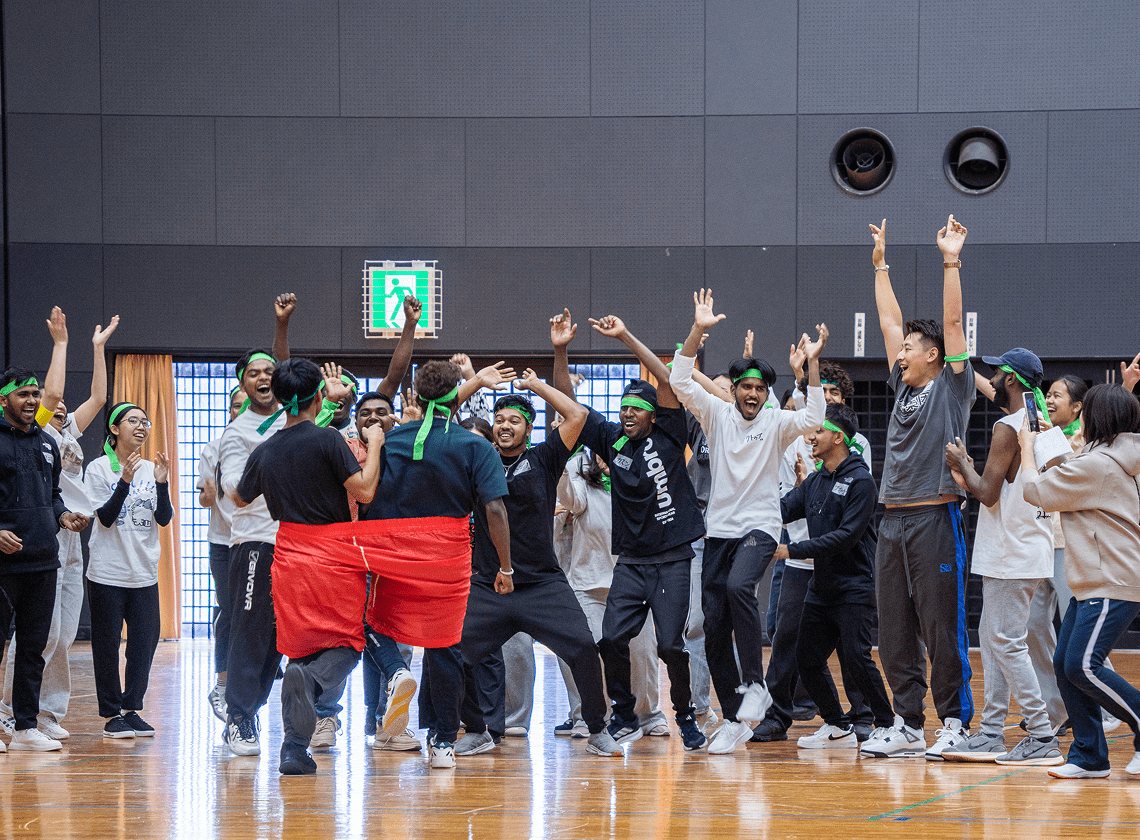
- A Molkky tournament was held, and students also enjoyed indiaca and Dodgebee (May 21, 2025). The sports day is in the annual schedule.
On campus
- On campus
- Internet — Students can use the Internet free of charge.
2026–2027 academic calendar
- Spring break
- Apr 1–Apr 12 (spring break)
- Summer vacation
- Aug 1–Aug 19 (summer break)
- Autumn break
- Sep 30–Oct 12 (autumn break)
- Winter break
- Dec 26–Jan 5 (winter break)
- Spring break
- Mar 18–Mar 31 (spring break)
School website · 2026-04-30 updated
Access
⚠ Dormitory fees varies by source — please confirm with the school. 1 person: room fee (6 months) ¥180,000, then ¥30,000 a month after 6 months; 2 people: ¥150,000, then ¥25,000. · Room fee (6 months): 1 person ¥150,000, 2 people ¥135,000, 3–6 people ¥120,000; per month ¥25,000, ¥22,500 and ¥20,000 respectively. The 3–6 person room (¥120,000 for 6 months, ¥20,000 a month) is the same on both pages · The newer material was used for the summary.
- Transit
- Tarumi Railway Ogaki Station → Tarumi Railway Kitagata-Makuwa Station (about 20 min). Kitagata-Makuwa Station, 10 min walk
Gifu Bus bound for Ono Bus Center [O85] → Apita Kitagata-mae (about 30 minutes) Apita Kitagata-mae on foot 8 min - Nearby
- JR Nagoya Station → JR Gifu Station (about 25 minutes). By car, about 10 minutes from Motosu IC on the Tokai-Kanjo Expressway; on-site parking is available. A supermarket is within walking distance.
- Dormitory
- Available¥20,000–¥25,000/month · Next to the school. About 20 rooms, capacity 50. Air conditioning, bed, refrigerator and Wi-Fi included. After the first 6 months, room fee is ¥20,000–¥30,000 a month · Based on school website
School website · 2026-01-11 updated
Student dorm — Application deposit ¥30,000. Room fee (6 months): ¥180,000 for 1 person, ¥150,000 for 2, ¥120,000 for 3–6. After 6 months: ¥30,000, ¥25,000 and ¥20,000 a month. Utilities extra; no refund if you leave the dormitory within 6 months
School website · 2026-04-30 updated
SALLAE has organized the school website and published data in English.
The update date is the day that material was last revised.
Photos are materials published by the school.
This information is compiled from official sources and is not updated daily. Please confirm with the official contact before signing or applying.