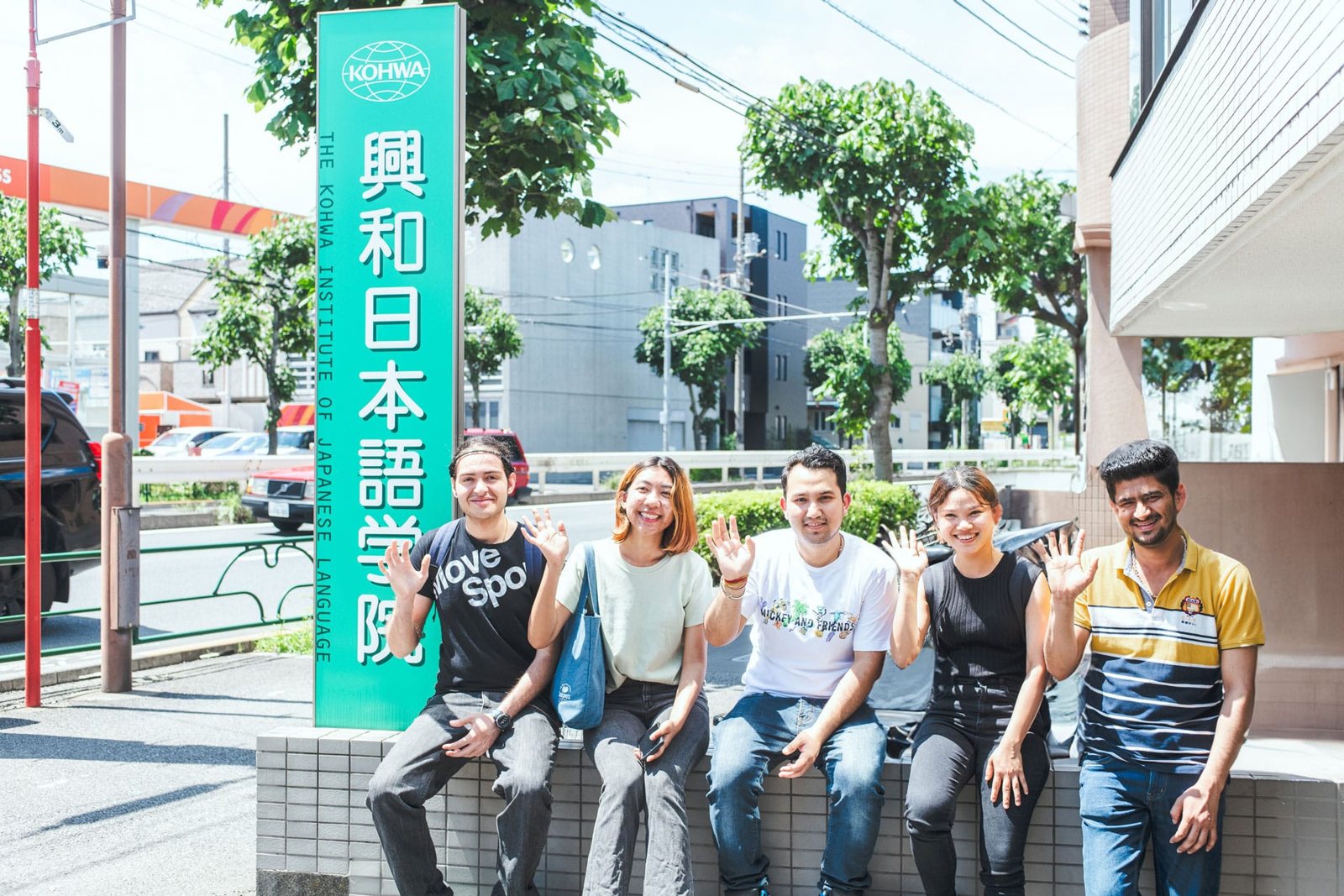
Kowa Japanese Language Institute
Kowa Japanese Language Institute
- Course
- Further-study course only
- Tuition
- On the cheaper side for Tokyo ›
- Age requirement
- Age 26 or under ›
- Progression
- University or similar 70% · National median 86% ›
Compare side by side with other schools →
Tuition and conditions may change depending on the intake. If you contact us, we will check with the school and give you accurate details.
Nearby schools comparedBy distance · no ads or paid placement
- Kowa Japanese Language InstituteThis schoolTuition/yr¥730,000Progression70%IntakesApr · Jul · Oct
- Tokyo Education College Tamagawa Campus3.2km›Tuition/yr¥670,000Progression—IntakesApr · Jul · Oct
- West Coast Language Institute3.3km›Tuition/yr¥995,000Progression74%IntakesApr · Jul · Oct
- Foreign Language Business College5.8km›Tuition/yr¥880,000Progression—IntakesApr · Oct
— means SALLAE has not yet found the data.
About the school
All 3 courses are progression courses (2 years, 1 year 9 months, 1 year 6 months), and 47 of the 82 students who completed in FY2025 went on to universities and vocational colleges in Japan. The school opened in 1987 in Sanno, Ota-ku, Tokyo, 13 minutes on foot from the west exit of JR Omori Station, and guides each student's career path through several individual interviews. Of the 134 students enrolled in 2025, 105 are from Vietnam.
Published data and school website
Tuition
If you saw a lower amount elsewhere, it may not include the admission fee and application fee
Median 1-year tuition in other areas — Kyoto ¥911,000(7 schools) · Kanagawa ¥880,000(8 schools) · Okinawa ¥858,000(6 schools) · Tokyo ¥840,600(56 schools) · Fukuoka ¥835,000(12 schools) · Hyogo ¥825,500(7 schools) · Osaka ¥814,000(27 schools) · Shizuoka ¥790,000(9 schools) · Chiba ¥745,333(10 schools) · Aichi ¥740,667(5 schools)
Total by intake
| Intake · length | Full course |
|---|---|
| 1 year 6 months | ¥1,057,000 |
| 1 year 9 months | ¥1,220,000 |
| 2 years | ¥1,384,000 |
Cost details · Course tables · Notes
- Per term
- ¥163,500 3 months
- One-time fees
- ¥76,000Application fee · Admission fee
| Duration | Total |
|---|---|
| 1 year 6 months | ¥1,057,000 |
| 1 year 9 months | ¥1,220,500 |
| 2 years | ¥1,384,000 |
★"Per term" and "One-time at start" were calculated by SALLAE from each course's total. The courses this school actually offers are 1 year 6 months onward — all amounts in the table are values calculated by SALLAE.
Calculated by SALLAE · verified 2026-09-16
Admission & dates
- Apr intake
- 2-year course · Application Application period: Sep 1–Nov 10
- Jul intake
- 1 year 9 months course · Application Application period: Dec 1–Feb 20
- Oct intake
- 1 year 6 months course · Application Mar 1–May 10
Deadline and capacity rules
Applicants must be high school graduates (12 years of school education) or above and aged 26 or under. A certificate of at least 150 hours of Japanese study is required. Courses: April intake 2 years, July intake 1.9 years, October intake 1.6 years.
School website · 2023-08-19 updated
Classes
- Class assignment
- Level-based 3 stages
Materials · Subjects · Timetable · Details
- Materials
- Beginner: Minna no Nihongo Shokyu I and II. Intermediate: Chukyu kara Manabu Nihongo (thematic edition). Advanced: Academic Japanese, plus authentic materials.
- Subject
- Oral expression · Listening · Reading · Writing · Sentence patterns and grammar · Vocabulary · Orthography and kanji · Pronunciation
Study period: beginner 6 months, intermediate 9 months, advanced 9 months (the Japanese page gives this for all 3 courses). Develops the four skills of reading, writing, listening and speaking. Classes are reassigned after regular exams.
What each level aims for · 3 levels
- Beginner
- 6 monthsGreetings and everyday conversation, understanding basic sentences, hiragana and katakana, and kanji up to Level 3 (old JLPT) (about 500 characters).
- Intermediate
- 9 monthsSpeech suited to the situation (honorific and polite expressions) and presenting opinions, close reading, speed reading and summarizing of long texts, and kanji up to Level 2 (old JLPT) (about 1,000 characters).
- Advanced
- 9 monthsSpeeches, discussions and research presentations, understanding newspaper articles and novels, short essays and reports, and kanji up to Level 1 (old JLPT) (about 1,900 characters or more).
School website · 2023-08-19 updated
Documents
- Admission application formInstitute's prescribed form
- RésuméInstitute's prescribed form
- Statement of reason for studying abroadInstitute's prescribed form
- Graduation certificate and academic transcript
- Certificate of Japanese study150 hours or more, with the study period and attendance hours stated
- Japanese level test score certificateJLPT / J-TEST / NAT-TEST, etc.
- Documents proving the applicant's historyCopy of household register, etc.
- Copy of passport
- 8 photos4 cm tall × 3 cm wide
Sponsor documents · 3 application requirements
Submitted by the person paying the tuition (financial sponsor)
- Financial sponsorship statement (school form)
- Written pledgeInstitute's prescribed form
- Notarized certificate of family relationshipDocuments proving the relationship between the applicant and the financial sponsor
- Balance certificate
- Copy of bankbook
- Certificate of employmentFor sole proprietors, copy of business license
- Income certificatePast 3 years
- Tax payment certificatePast 3 years
Application requirements
Financial supporters living in Japan submit separate documents Pledge to submit, when applying for an extension of the period of stay, documents showing that expenses have been paid, such as a remittance certificate or a copy of a bankbook in the applicant's name. The financial supporter is responsible for all expenses during enrollment, including tuition, living costs and travel, and will pay tuition through the end of the course even if the student is removed from the school register.
No document criteria by nationality are given (the example for proof of background is a Chinese household register). SALLAE is confirming this with the school.
School website · 2023-08-19 updated
Admission process
- Request an admission consultation — Phone 03-6429-2501 · Fax 03-6429-2502 · E-mail info@kohwa-ijl.co.jp · Contact page.
- Submit application form and documents — Application periods: Sep 1–Nov 10 for the April intake, Dec 1–Feb 20 for the July intake, Mar 1–May 10 for the October intake. The application form, résumé, statement of reasons for study, statement of financial support and pledge must be on the school's designated forms.
- Online interview — An interview is held with the applicant on Teams, Zoom or similar, and selection takes the transcript from the last school attended into account. Tuition, dormitory fees, living costs and school rules are explained at the interview.
- Receive notice of acceptance and pay the designated tuition. — Pay the designated tuition within 10 days of receiving notice of acceptance, and
- Receive the Certificate of Eligibility — Pay the tuition, then receive the Certificate of Eligibility, the admission letter and an explanation of enrollment.
School website · 2023-08-19 updated
Graduate outcomes
| FY2025 | Admitted |
|---|---|
| Employment | 4 students |
| Graduates | 82 students |
FY2025 Report No. 44 (prepared April 17, 2026): completers 82, qualifying students 67 (81.7%), progression 47, change of status of residence 4, A2 equivalent 52. · Status-of-residence changes permitted: 4 (2-year progression course). · School website · Updated 2026-04-17
Reviews
If you study here or used to, tell others what the classes, teachers and daily life were like. It helps anyone deciding on this school.
Write the first reviewUniversity prep
- Individual interviews — For each student's career path, several individual interviews are held and detailed guidance is given.
- Progression preference survey — The school regularly surveys where students wish to continue their studies and guides them toward the path they want as far as possible.
- All students take the JLPT — All students are required to take the Japanese-Language Proficiency Test.
- Career consultation fair — On July 19, 2024, students about to complete the course took part, led by teachers, in a career consultation fair (Ota City Industrial Plaza PIO) attended by more than 30 educational institutions.
School website · 2026-06-24 updated
Daily-life support
- Staff accompany you for procedures after entry. — Staff accompany students for address registration after arrival, enrollment in National Health Insurance and opening a bank account.
- Keeping track of part-time workplaces — The school regularly surveys part-time work to check that students work properly within the permitted limits.
- Talks on daily-life precautions by the local police station — The local police station regularly gives talks on precautions for daily life.
- Daily health check on arrival at school — A health check is carried out every day when students arrive at school.
- Disaster drill — Around September 1, Disaster Prevention Day, an evacuation drill is held that simulates a major earthquake.
- Office staff fluent in Chinese, Korean and Japanese — The office staff have worked at the school for more than 20 years and are fluent in three languages: Chinese, Korean and Japanese.
School website · 2026-06-24 updated
Students
Enrolled 134 (2025) · Capacity 180 National median: 180 students
Based on 134 students enrolled in 2025.
Public data from the Association for the Promotion of Japanese Language Education (Nisshinkyo) · verified 2026-09-20
School life
For 1 year
- 4
- Apr intake entrance ceremony
- 5
- Golden Week holidays
- 6
- Examination for Japanese University Admission for International Students (EJU)
- 7
- July entrance · JLPT · Final exams · Summer vacation
- 8
- Summer break for July-intake students
- 9
- Field trip (Mt. Fuji and Fuji-Q Highland)
- 10
- October entrance ceremony · Midterm exams
- 11
- Examination for Japanese University Admission for International Students (EJU)
- 12
- JLPT · Final exams · Winter vacation
- 1
- Extracurricular classes
- 2
- Sports day
- 3
- Final exams · Completion ceremony · Spring break
Based on the annual schedule on the school website (updated August 2023).
- Every year, on the first day of the new school year, students enjoy cherry blossom viewing in Ueno Park.
- Hatsumode (first shrine visit) on January 6. First-year students went to Kawasaki Daishi and second-year students to Sensoji, and students who wished to wore kimono for the visit.
- Every year, at the start of the third term, students do kakizome (first calligraphy of the year).
- On the Friday just before the JLPT, the school held a Tanabata event.
- On December 16, 2025, a Christmas party for all classes was held at Ota Bunka no Mori. About 180 students and staff took part.
- On March 3, 2026, a completion ceremony was held at Ota Bunka no Mori. About 60 graduating students took part.
- Students visited Japanese families through a home visit program of the Ota International City Association, and took part in its "Presentation in Japanese" event.
On campus
- Classroom — Every classroom has a large TV, a DVD player and a CD radio-cassette player, and LED lighting. After class, classrooms and restrooms are cleaned and desks and chairs disinfected every day.
2025–2026 academic calendar · Older data
- Winter break
- Dec 20 (Saturday) – Jan 5 (Monday)
Tuesday, January 6 is the first shrine visit of the year.
School website · 2023-08-20 updated
Access
- Transit
- Keihin-Tohoku Line, JR Omori Station, 13 min walkWest exit
- Nearby
- About 12 minutes on foot from Omori Station. About 20 minutes by train to Haneda Airport. A general hospital (Omori Sanno Hospital) is about 5 minutes on foot away.
- Dormitory
- Available¥35,000–¥40,000 per month · A student dormitory is available about 30 minutes from the school. · Based on school website
School website · 2023-08-19 updated
Dorm — At the interview, details such as tuition, dormitory fees, living costs and school rules are explained. The campus page has a "Dormitory" section.
School website · 2026-06-24 updated
SALLAE has organized the school website and published data in English.
The update date is the day that material was last revised.
Photos are materials published by the school.
This information is compiled from official sources and is not updated daily. Please confirm with the official contact before signing or applying.