Tochigi International Education Institute
Tochigi International Education Institute
- To station
- 3 min on foot · Tobu-Utsunomiya Station
- Admission
- Twice a year · April and October ›
- Dormitory fee
- From ¥33,000 per month ›
Compare side by side with other schools →
Tuition and conditions may change depending on the intake. If you contact us, we will check with the school and give you accurate details.
Nearby schools comparedBy distance · no ads or paid placement
- Tochigi International Education InstituteThis schoolTuition/yr¥868,000Progression—IntakesApr · Oct
- International College of Information Business1.1km›Tuition/yr¥715,000Progression100%IntakesApr · Oct
- St. Mary Japanese Language Institute1.6km›Tuition/yr¥888,000Progression96%IntakesApr · Jul · Oct
- International Technical Design ☆ Automotive Vocational School29.2km›Tuition/yr¥740,000Progression100%IntakesApr · Oct
— means SALLAE has not yet found the data.
About the school
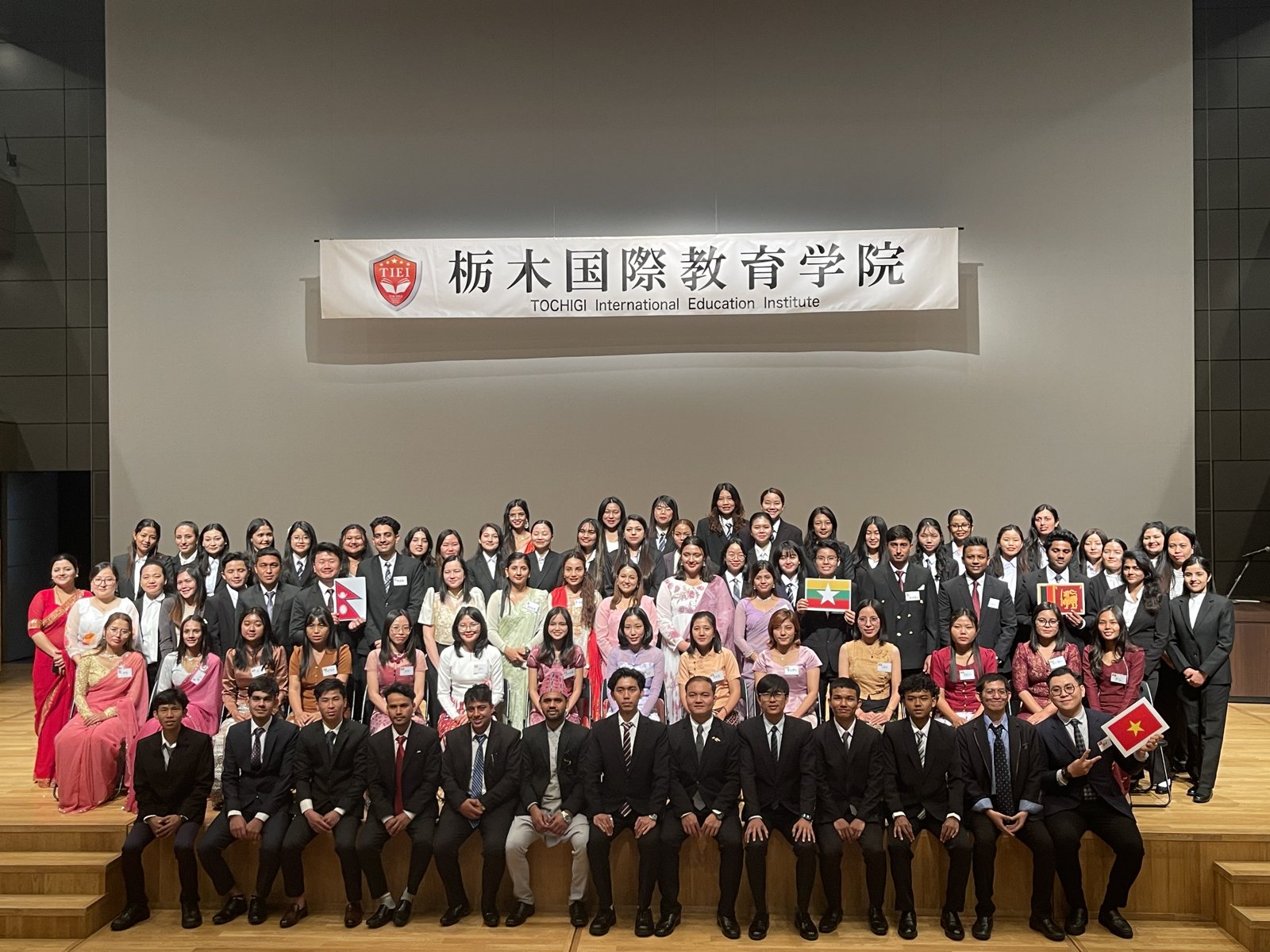
A school that specializes in hotel and ryokan employment, where admission requires that the purpose of studying abroad be "employment in accommodation or similar". Within the 1-year course it includes hotel front desk system classes, preparation for the Specified Skilled Worker (accommodation) exam, and internships at hotels and ryokan across the country on the premise of being hired. It is in the center of Utsunomiya, 3 minutes on foot from Tobu-Utsunomiya Station, with a capacity of 110, and most students are from Nepal, Myanmar and the Philippines. All students live in the dormitory (¥33,000 per month), and discipline is strict enough that graduation requires an attendance rate of 97% or more. The school has applied for a plan to split into a Service course (aiming at work on the floor, JLPT N3 target) and a Front Desk course (for university graduates aiming at front desk work, JLPT N2 target).
Published data and school website
Tuition
If you saw a lower amount elsewhere, it may not include the admission fee and application fee
Median 1-year tuition in other areas — Kyoto ¥911,000(7 schools) · Kanagawa ¥880,000(8 schools) · Okinawa ¥858,000(6 schools) · Tokyo ¥840,600(56 schools) · Fukuoka ¥835,000(12 schools) · Hyogo ¥825,500(7 schools) · Osaka ¥814,000(27 schools) · Shizuoka ¥790,000(9 schools) · Chiba ¥745,333(10 schools) · Aichi ¥740,667(5 schools)
Admission & dates
- Apr intake
- 1-year course · Application July of the previous year to the end of October
- Oct intake
- 1-year course · Application February to early May
- Japanese level
- Applicants who can prove at least 150 hours of Japanese study and have passed a Japanese test at A1 level or higher for the Service course, or B1 level or higher for the Front Desk course
Pre-arrival education: for the Service course, Level 1–5 beginner assignments and an online level check 2 months before arrival. For the Front Desk course, shadowing assignments and 2 level checks, one within 1 month and one 2 months before arrival
Deadline and capacity rules
Service course 78 students, Front Desk course 32 students, study period 1 year, entry in April and October. The courses are currently under application and planned, and the content may change
School website · 2026-07-14 updated
Classes
- Morning
- 09:00-12:45 Morning class: 9:00–12:45 (website). School Rules, Article 8: period 1 from 9:30 to period 4 ending 12:45, each unit hour is 45 minutes
- Afternoon
- 13:45-17:00 4 periods of 45 minutes
- Class size
- Max 20 students
Materials · Subjects · Timetable · Details
- Subject
- General Japanese · Kanji · Japanese society and hospitality · Kanji is taught only in the Front Desk course. Japanese Affairs and Hospitality teaches Japanese culture for working life and the honorific language and hospitality skills of the service industry
Class start and end times 4 periods a day (period 1: 09:00–09:45)
| Morning | Afternoon | |
|---|---|---|
| Period 1 | 09:30-10:15 | 13:45-14:30 |
| Period 2 | 10:20-11:05 | 14:35-15:20 |
| Period 3 | 11:10-11:55 | 15:25-16:10 |
| Period 4 | 12:00-12:45 | 16:15-17:00 |
Service course: weekly class hours, etc. (hours per week)20 per week in total. One class period is 45 minutes.
| Beginner, weeks 1–6 | Pre-intermediate, weeks 7–20 | Intermediate, weeks 21–40 | |
|---|---|---|---|
| Comprehensive Japanese | 20 | 19 | 16 |
| Japanese Affairs and Hospitality | — | 1 | 4 |
| Total | 20 | 20 | 20 |
Front Desk course: weekly class hours, etc. (hours per week)20 per week in total. One class period is 45 minutes.
| Intermediate, weeks 1–10 | Upper-intermediate, weeks 11–40 | |
|---|---|---|
| Comprehensive Japanese | 13.3 | 14.6 |
| Kanji | 2 | 2 |
| Japanese Affairs and Hospitality | 4.7 | 3.4 |
| Total | 20 | 20 |
Targets: Service course B1 (JLPT N3), Front Desk course B2 (N2). Reached when all 5 language activities score 60 or higher. Graduation requires an attendance rate of 97% or more per term and sitting all end-of-term exams
School website · 2026-07-14 updated
Documents
- Admission application formSchool's prescribed form
- RésuméSchool's prescribed form
- Certificate of graduation or diploma from the last school attendedOriginal
- Academic transcript covering the entire period of enrollment at the last school attended
- Copy of the family register or ID (showing the place of birth)
- 6 photos (4 cm × 3 cm, taken within the last 3 months)
- Certificate of Japanese study history and a certificate of Japanese ability
Financial supporter's documents · only if applicable · 6 application requirements
Submitted by the person paying the tuition (financial sponsor)
- Bank deposit balance certificate in the remitter's nameOriginal
- Copy of the bankbook or transaction statement that supports the remitter's name
- Financial sponsorship statementSchool's prescribed form
- Documents proving the relationship between the applicant and the remitterOriginal, or copy with certification as a true copy, of the family register or birth certificate
- Documents that can prove the remitter's annual income
- Tax payment certificate
- Copy of the family register or ID (showing the place of birth)
- Written pledgeSchool's prescribed form
Only if applicable
- Copy of passport (If you have a passport)
- Employment certificate (if you have work experience)
- Bank balance certificate in the applicant's own name (original), and documents that can prove the applicant's annual income (if the applicant has sufficient work history) (If paying with your own funds (if you have sufficient work history))
- Statement of financial support, tax assessment certificate stating total income (issued by the city or ward office), bank balance certificate in the financial supporter's name, documents proving the relationship with the applicant, documents proving occupation, certificate of residence (listing all household members), and documents proving identity (Sponsor residing in Japan)
Application requirements
Documents for when the applicant's parents or other relatives send money from the home country. 1 copy of each document. People who have completed (or are expected to complete) 12 or more years of school education or an equivalent course. Aged 18 or over. People whose purpose in studying in Japan and learning Japanese is "employment in accommodation, etc." People who have a reliable guarantor. For the Front course, you must be a university graduate with a degree (also required: 150 hours or more of Japanese study and a pass in a Japanese exam at B1 equivalent or above)
School website · 2026-07-14 updated
Admission process
- Request an admission consultation — For enrollment procedures, please consult us first.
- Inquiry and application — First, please inquire about applying for admission by e-mail or phone. We will explain the application method and other details.
- Submit enrolment documents — Send the documents required for the admission application.
- Document screening and interview — After receiving the documents, the school conducts document screening and an interview, and decides on admission on that basis.
- Entry procedures — The application documents are submitted to the Tokyo Regional Immigration Services Bureau to apply for issuance.
- Decision on issuance or non-issuance of the COE — After screening by the Tokyo Regional Immigration Services Bureau, it is decided whether the Certificate of Eligibility is issued.
- Tuition payment — Once it is issued, please pay the tuition. After payment is confirmed, the admission letter and the Certificate of Eligibility are sent.
- Visa issuance — Apply for a visa in your home country. After obtaining the visa, prepare for entry, for example by arranging a flight ticket.
- Enter Japan and enrol — We will pick you up at the airport. You start your life as a student in a fully equipped dormitory.
- Placement test
- The course is decided at an interview, based on an overall judgment of the evaluation of pre-arrival education, Japanese level at enrollment, level check test, educational background and desired career path. Choosing multiple courses or changing courses is not possible
School website · 2026-07-14 updated
Reviews
If you study here or used to, tell others what the classes, teachers and daily life were like. It helps anyone deciding on this school.
Write the first reviewUniversity prep
- Education to become a working adult — Assignments are given every day, and students are trained as in a working adult's life, with strict submission of work and deadlines. The goal is the level of a full-time employee. Class attendance rate of 97% or more, and strict observance of times and deadlines
- Focused on job hunting — Students learn how to write a résumé, interview practice, self-analysis and self-promotion, and adapting to Japanese ways of working. Employers are introduced during class, with interviews and consultations with the person in charge
- Hotel system class — Students learn how to handle reservations, check-in and check-out, and how to serve guests at the front desk. TIEI is the only Japanese language school that teaches a hotel system class
- Education on the hotel and tourism industry — Classes on specialized knowledge of the tourism industry, hotel terminology, and preparation for the Specified Skilled Worker (accommodation) exam
- Hotel and ryokan tours — Tours of guest rooms, various restaurants, banquet halls and the front desk, and also of actual room cleaning, back-of-house areas and the inside of kitchens
- Internship — Students can go on internships at hotels and ryokan across the country on the premise of being hired. Students receive job offers from their internship hosts at a high rate
- Job hunting starts — Job hunting starts in September for April entry and in March for October entry (annual schedule)
School website · 2026-07-13 updated
Daily-life support
- Airport pickup — We will pick you up at the airport.
- Part-time job introductions — Part-time job support is available. Up to 28 hours a week (up to 8 hours a day during long breaks). Tell the school where you work part-time
- Free bicycle loan — Free bicycle loan (with insurance)
- Health checkup — A health checkup is held once a year (School Rules, Article 26). Self-evaluation: all eligible students are enrolled in National Health Insurance
- Orientation on study and daily life — Orientation on daily life is held (self-evaluation 5.2.3)
- Daily-life support — 3 daily-life support staff. Self-evaluation: the school has staff who can respond in students' native languages
School website · 2026-07-13 updated
Students
80 students enrolled (2025) · Capacity 110 National median: 180 students
Based on the 80 students enrolled in 2025.
Public data from the Association for the Promotion of Japanese Language Education (Nisshinkyo) · verified 2026-09-20
School life
For 1 year
- Apr
- Entrance ceremony · Orientation · Social gathering · New student interviews
- May
- Field class · New student interviews · JLPT prep
- Jun
- Summer festival · JLPT prep
- Jul
- Taking the JLPT
- Aug
- Summer vacation
- Sep
- Job hunting starts
- Oct
- Halloween
- Nov
- Barbecue · JLPT prep
- Dec
- Winter vacation · Health checkup · JLPT prep
- Jan
- Japanese culture experience
- Feb
- Event · Setsubun
- Mar
- Hinamatsuri · Growth presentation · Graduation ceremony
For October entry: entrance ceremony, exchange party and Halloween in October, JLPT in December, job hunting starts in March, growth presentation and graduation ceremony in September. There are 4 terms: spring, summer, autumn and winter
- Communicating with local residents, people at part-time workplaces and Japanese-language volunteers is one of the important parts of the curriculum
- Students take part in volunteer cleaning activities such as picking up litter in the town.
- On December 23, 2024, the 11th sports day was held at the Brex Arena Utsunomiya Gymnasium: tug-of-war, bandana grab, obstacle race and relay
- There is an exchange party between senior students and new students.
- Alumni reunion: 1st in July 2025, 2nd on Thursday, July 2, 2026
2027–2028 annual schedule
- Golden Week
- Apr 29–May 5, 2026
- End-of-spring-term break
- late Jun–early Jul
- Summer vacation
- mid-Aug
- End-of-autumn-term break
- late Sep–early Oct
- Year-end and New Year holidays
- late Dec–early Jan
- End-of-winter-term break
- late Mar–early Apr
School website · 2026-07-14 updated
Access
- Transit
- Tobu-Utsunomiya Station on foot 3 min
- Nearby
- It is in the center of Utsunomiya City. A station, department stores and more are right near the school building, making it a good location.
- Dormitory
- Available¥30,000–33,000 per month · Everyone lives in a dormitory. Central Heights and Royal Heights dormitories: ¥198,000 for up to 6 months after enrollment (6 months paid in advance in one sum), then ¥33,000 per month from the 7th month · Based on school website
School website · 2026-07-14 updated
Dorm — At enrollment: support fee ¥33,000, futon fee ¥11,000, dormitory entry fee ¥66,000. Together with ¥198,000 for up to 6 months after enrollment, the total is ¥308,000. From the 7th month, ¥33,000 per month
School website · 2026-07-13 updated
SALLAE has organized the school website and published data in English.
The update date is the day that material was last revised.
Photos are materials published by the school.
This information is compiled from official sources and is not updated daily. Please confirm with the official contact before signing or applying.