Toho International Gakuin
Toho International Gakuin
- Tuition
- On the cheaper side for Tokyo ›
- To station
- 3 min on foot · Kasai Station
- Admission
- 4 times a year · Jan, Apr, Jul, Oct ›
Compare side by side with other schools →
Tuition and conditions may change depending on the intake. If you contact us, we will check with the school and give you accurate details.
Nearby schools comparedBy distance · no ads or paid placement
- Toho International GakuinThis schoolTuition/yr¥670,000Progression86%IntakesJan · Apr · Jul · Oct
- Toyo Language Academy1.6km›Tuition/yr¥816,000Progression—IntakesJan · Apr · Jul · Oct
- Mizuno Foreign Language Institute3.9km›Tuition/yr¥640,000Progression—IntakesJan · Apr · Jul · Oct
- Tokyo YMCA Japanese Language Institute5.3km›Tuition/yr¥730,000Progression—IntakesApr · Oct
— means SALLAE has not yet found the data.
About the school
A school that focuses on progression to further study: 5 of its 6 student-visa courses are progression courses, and of the 101 students who completed in FY2023, 84 went on to university or similar. It opened in 1994 in Kasai, Tokyo, with a capacity of 460. Its two buildings, Building 1 and Building 2, are 3 minutes on foot from Kasai Station on the Tokyo Metro Tozai Line, and each class's homeroom teacher holds interviews using a "progression notebook" and individually coaches students through application documents and interviews. School-managed student dormitories are 0–15 minutes on foot from the school, and staff who speak Chinese, English, Vietnamese and other languages handle daily-life consultations.
Published data and school website
Tuition
If you saw a lower amount elsewhere, it may not include the admission fee and application fee
Median 1-year tuition in other areas — Kyoto ¥911,000(7 schools) · Kanagawa ¥880,000(8 schools) · Okinawa ¥858,000(6 schools) · Tokyo ¥840,600(56 schools) · Fukuoka ¥835,000(12 schools) · Hyogo ¥825,500(7 schools) · Osaka ¥814,000(27 schools) · Shizuoka ¥790,000(9 schools) · Chiba ¥745,333(10 schools) · Aichi ¥740,667(5 schools)
Admission & dates
- Apr intake
- 2-year course · Application August to October
- Jul intake
- 1 year 9 months course · Application December of the previous year – February
- Oct intake
- 1 year 6 months course · Application Feb–Apr
- Jan intake
- 1 year 3 months course · Application June–August of the previous year
- Japanese level
- JLPT N5 or higher (N3 or higher is required for January-intake students).
At least 200 hours of Japanese study or N5 or higher. The 2024 Chinese version says at least 150 hours. January-intake students need N3 or higher.
Deadline and capacity rules
Application requirements: completion of 12 or more years of school education (including those expected to graduate by the end of the relevant fiscal year), an educational background equivalent to high school graduation or higher, and a clear purpose for studying abroad and funds. As a rule, within 5 years of graduating from the last school. January intake 20 students, April intake 150 students.
School website · Confirmed 2026-09-26
Classes
- Morning
- 09:00-12:30
- Afternoon
- 13:15-16:45
- Class assignment
- Level-based 6 stages
Materials · Subjects · Timetable · Details
- Materials
- Beginner uses Minna no Nihongo, Intermediate I uses its intermediate I counterpart, Intermediate II and Advanced I use the "Theme-based ... Nihongo" series, and Advanced II and the preparation classes use the institute's original materials.
- Subject
- Comprehensive Japanese · Graduate school exam preparation · University exam preparation (humanities) · University exam preparation (sciences) · Vocational college exam preparation · General Japanese covers exam preparation, conversation, writing, and culture and current affairs. Graduate school covers research plans and interviews, humanities covers humanities general subjects and short essays, and sciences cover mathematics and short essays.
Class period times Monday to Friday (5 days a week). 4 periods a day, with period 1 from 9:00 to 9:45.
| Morning | Afternoon | |
|---|---|---|
| Period 1 | 09:00-09:45 | 13:15-14:00 |
| Period 2 | 09:50-10:35 | 14:05-14:50 |
| Period 3 | 10:55-11:40 | 15:10-15:55 |
| Period 4 | 11:45-12:30 | 16:00-16:45 |
Japanese is taught in Japanese. Beginner classes focus on oral lessons, with 4 kanji a day. From intermediate, N3 and N2 are covered, and at advanced N1 and EJU preparation. Mock exams are held 3 times per half-year.
Goals for each level · 6 levels
- Beginner I
- 3 months Level to pass N5. Study time: 200 hours.
- Beginner II
- 3 months Level to pass N4. Study time: 200 hours.
- Intermediate I
- 3 months Level to pass N3. Study time: 200 hours.
- Intermediate II
- 3 months Level to pass N2. Study time: 200 hours.
- Advanced I
- 9 months Level to pass N1. Study time: 600 hours (including exam preparation).
- Advanced II
- 3 monthsAdvanced II is 3 months and 200 hours, with the institute's original materials.
School website · Confirmed 2026-09-26
Documents to prepare — student visa course
- Application form (designated form), handwritten by the applicant, or typed on a PC and signed
- Résumé (designated form), handwritten by the applicant, or typed on a PC
- Statement of reasons for study (designated form), handwritten by the applicant, or typed on a PC and signed
- Diploma, original
- Academic transcript: transcript for the period of enrollment at the last school attended
- A study certificate stating Japanese study history, or a copy of a test certificate showing Japanese ability of N5 level or higher
- Copy of passport: the identity page and the pages with Japan entry and exit stamps
- Photos, 3×4 cm, 6 copies: front view, no hat, upper body, taken within the last 3 months
Sponsor documents · Only if applicable · 7 application requirements
Submitted by the person paying the tuition (financial sponsor)
- Statement of financial support (designated form), handwritten by the financial supporter, or typed on a PC and signed
- Bank balance certificate in the name of the financial sponsorIf the name is different, a separate explanatory statement is required
- Certificate of employment: company employees: certificate of employment; business owners: one issued by a public agency
- Income certificate: details of annual income for the past 3 years
- Tax payment certificate: one stating the tax paid and the amount of income, for the past 3 years
- Proof of relationship: documents proving the relationship between the student and the financial supporter
- Statement of financial support (designated form), handwritten by the financial supporter, or typed on a PC and signed
- Bank balance certificate in the name of the financial sponsorIf the name is different, a separate explanatory statement is required
- Company employee: certificate of employment □ Company owner: certified copy of the corporate registry □ Self-employed: copy of the tax return
- Tax payment certificate: one stating the tax paid and the amount of income, for the past 3 years
- Proof of relationship: documents proving the relationship between the student and the financial supporter
- Certificate of residence: for all household members
Only if applicable
- Certificate of expected graduation (current enrollment) (If you are expected to graduate)
- Certificate of employment (employed persons only)
- Plan after graduating from a Japanese language school (free format, if more than 5 years have passed since graduation)
Application requirements
Certificates must have been issued within 3 months counting from the date of application to the Immigration Services Agency. Documents that need translation must come with a Japanese translation. The institute can also translate them, in which case a separate translation fee of ¥10,800 is charged in addition to the application fee. Unify copies to A4 size, and write in the margin the date of the copy, the signature of the person who made the copy, and their relationship to the applicant Do not use correction fluid for corrections; strike through with a double line and then stamp a correction seal. Except for the diploma, documents submitted to the Immigration Services Agency are never returned. Please understand. If any false statement or forged document is found among the submitted documents, the applicant is immediately excluded from selection, and reapplication is not accepted. * This may differ depending on the applicant's nationality and individual conditions.
No documents specifically for Korean applicants are published — the school says they differ by nationality and conditions, so applicants are told to ask the office · A plan for "more than 5 years since graduation" appears only in the 2024 Chinese-language admission guidelines. SALLAE is confirming this with the school.
For short-term courses, submit Application form (for short-term students) · 4 photos (4 cm tall × 3 cm wide, taken within the last 6 months) · Copy of passport (working holiday participants also need the page with the Designated Activities visa) only.
School website · Confirmed 2026-09-26
Admission process
- Request an admission consultation — The office handles Japanese, Chinese, English, Vietnamese and Indonesian. Inquiries by e-mail, phone and online.
- Submit the application form and application documents to the institute's office, and pay the application fee — Submit the application form and application documents to the office. The application fee is not refunded even if the application is withdrawn, the applicant is not admitted, or the Certificate of Eligibility is not issued (2018 admission guidelines).
- Document screening by the institute — Document screening by the institute (screening by application documents, exams, interviews, etc.)
- The institute applies to the Tokyo Regional Immigration Services Bureau of the Ministry of Justice for issuance of the Certificate of Eligibility — The institute applies to the Tokyo Regional Immigration Services Bureau of the Ministry of Justice for issuance of the Certificate of Eligibility
- The Immigration Services Agency announces the screening result — The institute notifies the applicant of the screening result
- The applicant pays 1 year of tuition and other fees at enrollment — Transfer to the bank account designated by the institute. The remitter bears the fee. Write the student's name and the number of the Certificate of Eligibility in the remarks column. Dormitory fees are paid at the same time.
- Receive the admission permit and Certificate of Eligibility — After payment is confirmed, the institute sends the "admission letter", the "Certificate of Eligibility" and other enrollment documents to the applicant
- Apply for a student visa — The applicant goes to a Japanese embassy or consulate abroad to apply for and receive a "Student visa"
- Arrive in Japan. Classes begin — Present your passport and admission letter at enrollment procedures
- Placement test
- Classes are decided by the result of the placement test. The FY2026 schedule includes a class test for new students.
School website · Confirmed 2026-09-26
Short-term study
- Visa
- Temporary visitor or Working holiday(not a student visa)
- Duration
- 4 weeks – 3 months
- Open now?
- Rolling admissions, so availability varies from time to time — SALLAE will confirm with the school
Course without a student visa
- Short-term course (1–3 months) — Short-term courses of 3 months or less for visas other than the student visa. Start in January, April, July and October; the deadline is 1 month before entry; capacity 15 each; 9:00–12:30 in the morning or 13:15–16:45 in the afternoon.
- Summer short course, winter short course — There are summer and winter short courses; in the FY2026 schedule the summer short course is Aug 10–24.
- Working holiday short course — The working holiday short course is one of the short-term programs, for holders of working holiday and similar visas.
- JLPT preparation course — One of the short-term courses. A JLPT final preparation course with a special curriculum is offered in November.
- Residents of Japan (3 months) — Business Japanese, everyday conversation and JLPT classes, and private lessons (in the classroom or online). Each class is planned to run with 3 or more students (flyer for the course starting April 1, 2022).
★Short-term courses are not listed in the published data — it counts only student-visa courses.
School website · Confirmed 2026-09-26
Graduate outcomes
| FY2023 | Admitted |
|---|---|
| Employment | 6 students |
| Graduates | 101 students |
All schools accepted to so far
+26 more schools
See 76 more schools
Prepared June 19, 2024. Completers 101; meeting the standard 98 (97.0%). Progression: 2-year 36, 1 year 9 months 27, 1 year 6 months 17, 1 year 3 months 4. · Change of status of residence: 1.9-year progression course 2, 1.6-year progression course 4. · School website · Updated 2024-06-19
Reviews
If you study here or used to, tell others what the classes, teachers and daily life were like. It helps anyone deciding on this school.
Write the first reviewUniversity prep
- Progression and career guidance — With the homeroom teacher system, the homeroom teacher gives individual career guidance in addition to regular classes. Students carry a "progression notebook" and have regular interviews.
- Guidance on application documents and interviews — Once the target schools are decided, the school helps gather application documents, guides students in filling in application forms, and gives individual interview practice and guidance.
- The latest materials on progression are available for students to read — In the self-study room, students can browse brochures and materials of graduate schools, universities and vocational colleges, and files and notices of progression news in classrooms and around the school building.
- Progression briefing and progression fair — Teachers accompany students to progression fairs. A progression briefing with invited graduates is held every year.
- Prep for external exams such as JLPT and EJU — Preparation is done in regular classes from the intermediate level. For the JLPT, a final preparation course with a special curriculum is offered in November.
- Career support — For students who want to find a job, the school teaches how to find employers, entry sheets and résumés, company visits and interviews. It supports preparation for progression and employment through seminars and individual counseling.
- Designated-school recommendations: 15 schools — Meikai University (Faculty of Foreign Languages, Department of Japanese; Faculty of Economics, Department of Economics; Faculty of Real Estate Sciences, Department of Real Estate Sciences) · Shumei University (Faculty of Comprehensive Management, Faculty of English Information Management, Faculty of Tourism Business) · Ryutsu Keizai University (Faculty of Distribution and Information, Faculty of Sociology, Faculty of Law) · Keiai University (Faculty of Economics, Faculty of International Studies) · Aikoku Gakuen University (Faculty of Human Culture) · Josai International University (Faculty of Business Administration and Information Science, Faculty of International Humanities, Faculty of Media Studies, Faculty of Comprehensive Welfare, Faculty of Environmental and Social Studies, Faculty of Tourism) · Hollywood Beauty College · Japan Electronics College · Meisei Information Business College · Aoyama Drafting College · Tokyo Design College · Hokkaido Adachi Gakuen · OCT Osaka College of Technology · Nippon Engineering College · Tokyo Animation College · Students with an attendance rate of 98% or more and excellent class attitude can use the designated-school recommendation system. The list is divided into universities and vocational colleges.
School website · Confirmed 2026-09-26
Daily-life support
- Daily-life support — Multilingual staff who speak Japanese, Chinese, English, Vietnamese and other languages advise on all kinds of daily-life problems, such as illness and injury.
- Airport pickup — The FY2026 annual schedule includes welcoming new students at the airport (April 7–8, June 25–26, September 28–29).
- Staff accompany you for procedures after entry. — School staff accompany students if needed to help with residence registration, National Health Insurance, opening a bank account and buying a mobile phone.
- New student orientation — Entrance ceremonies and new student orientations are held in April, July, October and January.
- Part-time job referrals — The school provides part-time job information and helps with writing résumés and mock interviews. The Japanese ability needed differs by type of job.
- Homeroom teacher consultation — So that international students can focus on their studies with peace of mind and consult about career and daily-life problems, the institute has a homeroom teacher system.
- Insurance — National Health Insurance is compulsory, about ¥12,000 for the first year. International student insurance covers traffic accidents and injuries and the 30% of medical costs not covered by National Health Insurance (illnesses existing before enrollment may be excluded).
School website · Confirmed 2026-09-26
Scholarship
- Learning incentive for privately financed international students (JASSO)
- Monthly ¥30,000 × 1 yearStudents who excel in attendance, grades and character have a chance to receive it through a recommendation from the Japanese language school.
- JASSO Reservation Program for the Scholarship for Privately Financed International Students
- Monthly ¥48,000 × 1 yearHigh scorers on the EJU are selected. Paid for 1 year after entering a university or vocational college.
- LSH Asia Scholarship Foundation (NPO) scholarship (Lee Soo-hyun Scholarship)
- Monthly ¥20,000 × 5 months(for students from Asia)
- Kyoritsu Maintenance Co., Ltd. Scholarship
- Monthly ¥60,000 × 1 yearFor students from Asia. A recommendation is requested from the Kyoritsu International Exchange Scholarship Foundation.
- Toho International College perfect attendance award
- Students with 100% attendance receive a perfect attendance award at the graduation ceremony.
School website · Confirmed 2026-09-26
Students
304 students enrolled (2018) · Capacity 460 National median: 180 students
Based on the 304 students enrolled in 2018 — Old materials.
Public data from the Association for the Promotion of Japanese Language Education (Nisshinkyo) · verified 2026-09-20
School life
For 1 year
- 4
- Airport pick-up for new students · Class placement test for new students · April intake entrance ceremony and new-student orientation · Classes begin
- 5
- Progression information session · Spring sports day
- 6
- EJU (1st session) · Bus trip · 9-day JLPT preparation · Welcome for new students · Test for new students
- 7
- July intake entrance ceremony and new-student orientation · JLPT (1st session) · Tanabata · Japanese-language exchange party (July 12).
- 8
- Summer short course
- 9
- Airport pickup · New student test · Day bus trip (field trip)
- 10
- Entrance ceremony and orientation for October-intake new students
- 11
- EJU (Examination for Japanese University Admission), 2nd · JLPT final preparation course
- 12
- JLPT (2nd session) · Christmas party · Winter break
- 1
- Classes begin · January intake entrance ceremony and new-student orientation
- 2
- Setsubun · Japanese culture experience (tea ceremony, koto, etc.) · Sumo viewing (for those who wish)
- 3
- Tokyo tour for graduates · Hinamatsuri (Girls' Day) · Graduation ceremony · Tokyo tour · End-of-year exams · Spring break
Dates are based on the FY2026 annual schedule (prepared December 17, 2025) and may change at the school's discretion · Events without a date are annual events listed on the course information page.
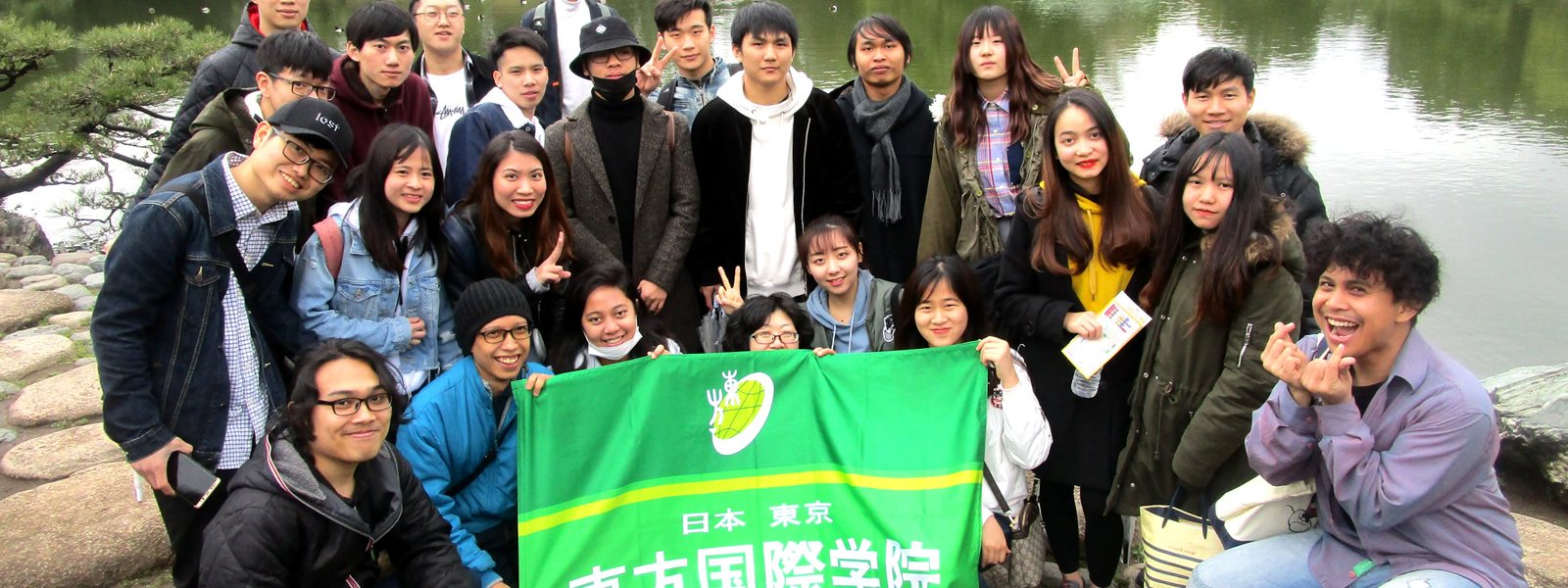
- Every year there are extracurricular activities such as a day bus trip and a sports day.
- Traditional events include seasonal events such as Tanabata, Setsubun and Hinamatsuri, and Japanese culture experiences such as tea ceremony and koto.
- Exchange with local residents
On campus
- Building 1, Toho Building, 5-15-2 Higashi-Kasai, Edogawa-ku, Tokyo 134-0084
- 11 classrooms, library, self-study room, office, teachers' room, infirmary and more
- Building 2, 5-11-14 Higashi-Kasai, Edogawa-ku, Tokyo 134-0084 (Toho Building 2)
- 11 classrooms, library, office, teachers' room, infirmary and more — The new Building 2 was completed in October 2017. Every classroom is fully equipped with a laptop, a large monitor and a DVD player.
2026–2027 academic calendar
- Saturdays, Sundays and public holidays
- · These are days without classes in the 2026 annual schedule.
- Summer break
- Aug 10–24 · The summer short course runs Aug 10–24.
- Winter break
- Dec 16–Jan 5
- Spring break
- Mar 20–April, before classes start · Classes began on April 14, 2026.
- Holiday
- Jun 19
School website · 2025-12-17 updated
Access
⚠ The monthly dormitory fee differs depending on the source. Please confirm with the school. Association for the Promotion of Japanese Language Education published materials: yes, ¥25,000 (per month) · School website: the dormitory fee (per month) is ¥35,000 per person in a double room and ¥60,000 in a single room. It is not stated which year the published amounts are from.
- Transit
- Tokyo Metro Tozai Line Kasai Station, 3 min walkNorth exit
- Nearby
- About 17 minutes by subway to Tokyo Station, and about 30 minutes to Ueno, Asakusa and Akihabara. About 55 minutes from Narita (¥1,600) and about 35 minutes from Haneda (¥1,100).
- Dormitory
- AvailableYes, ¥25,000 (per month) · 6 school-managed dormitories. Monthly fee: ¥35,000 per person in a double room, ¥60,000 in a single room. 0–15 minutes on foot to the school. · Based on school website
School website · Confirmed 2026-09-26
Student dormitory — Dormitory entry fee ¥60,000 (non-refundable), refundable deposit ¥10,000. 3 months paid in advance (double room ¥175,000, single room ¥250,000), ¥105,000 on renewal.
School website · Confirmed 2026-09-26
SALLAE has organized the school website and published data in English.
The update date is the day that material was last revised.
Photos are materials published by the school.
This information is compiled from official sources and is not updated daily. Please confirm with the official contact before signing or applying.