Tokyo International Foreign Language Institute
Tokyo International Foreign Language Institute
- Tuition
- On the cheaper side for Tokyo ›
- Age requirement
- Age 30 or under ›
- AM & PM classes
- Decided by the school ›
Compare side by side with other schools →
Tuition and conditions may change depending on the intake. If you contact us, we will check with the school and give you accurate details.
Nearby schools comparedBy distance · no ads or paid placement
- Tokyo International Foreign Language InstituteThis schoolTuition/yr¥782,000Progression—IntakesApr · Oct
- Nitto International Institute, Hachioji Campus1.3km›Tuition/yr¥910,000Progression—IntakesJan · Apr · Jul · Oct
- Tokyo International Exchange Academy1.8km›Tuition/yr¥888,000Installments OKProgression76%IntakesJan · Apr · Jul · Oct
- Hosanna Japanese Language Institute Tokyo Campus7.4km›Tuition/yr¥792,000Progression93%IntakesApr · Oct
— means SALLAE has not yet found the data.
About the school
The admission guidelines say the school is mainly for people who want to go on to Japanese universities or vocational colleges. It has university-prep courses (2 years and 1 year 6 months) and nursing-care courses (1 year and 1 year 6 months) that focus on Japanese for care settings for students aiming to enter nursing-care vocational colleges. It is an 8-minute walk from JR Hachioji Station; April intake students attend morning classes and October intake students attend afternoon classes. It is run by the same company as a sister school in Kurashiki, Okayama, and as of the April 2026 inspection report 198 students were enrolled against a capacity of 220.
Published data and school website
Tuition
If you saw a lower amount elsewhere, it may not include the admission fee and application fee
Median 1-year tuition in other areas — Kyoto ¥911,000(7 schools) · Kanagawa ¥880,000(8 schools) · Okinawa ¥858,000(6 schools) · Tokyo ¥840,600(56 schools) · Fukuoka ¥835,000(12 schools) · Hyogo ¥825,500(7 schools) · Osaka ¥814,000(27 schools) · Shizuoka ¥790,000(9 schools) · Chiba ¥745,333(10 schools) · Aichi ¥740,667(5 schools)
Admission & dates
- Apr intake
- 2-year course · Application Sep 1–Oct 15 of the year before enrollment · Classes 2-year university-prep course: 1,600 class hours
- Apr intake
- 1-year course · Application Sep 1–Oct 15 of the year before enrollment · Classes 1-year nursing-care course: 800 class hours
- Oct intake
- 1 year 6 months course · Application Mar 1–Apr 15 of the year of enrollment · Classes 1-year 6-month university-prep and nursing-care courses: 1,200 class hours
- Japanese level
- JLPT N5 level or above
2-year university-prep course: N5; 1-year 6-month university-prep course: N4; 1-year and 1-year 6-month nursing-care courses: N3; at least 150 hours of Japanese study; N5-equivalent or higher on J-TEST, NAT-TEST or TOP-J; take the test early so you can submit the certificate when you apply
Deadline and capacity rules
University-prep course = go on to university or vocational college; nursing-care course = go on to a nursing-care vocational college; at least 12 years of schooling, age 18–30, less than 5 years since graduating from the last school attended; consult the school if you want to study for less than 1 year; capacity 220, enrolled 198
School website · 2025-04-16 updated
Classes
- Morning
- 08:50-12:20 Part 1 (morning), 4 periods (8:50–12:20) / 2-year progression course and 1-year nursing care course (April intake) / 1 class period = 45 minutes
- Afternoon
- 13:00-16:30 Part 2 (afternoon), 4 periods (13:00–16:30) / 1 year 6 month progression course and 1 year 6 month nursing care course (October intake) / 1 class period = 45 minutes
- AM/PM placement
- Part 1 (morning): 2-year university-prep and 1-year nursing-care courses (April intake); Part 2 (afternoon): 1-year 6-month university-prep and 1-year 6-month nursing-care courses (October intake)
- Class assignment
- Level-based 5 stages
- Elective classes
- Special EJU preparation classes are also offered: special preparation classes for the Examination for Japanese University Admission for International Students, such as science and mathematics, for students who want to go on to university. · In addition to regular Japanese classes, special preparation classes for the Examination for Japanese University Admission for International Students, such as science and mathematics, are offered to students who want to go on to university.
Materials · Subjects · Timetable · Details
- Materials
- Minna no Nihongo Beginner I and II series; Japanese Intermediate J301 and J501; Japanese for Advanced Learners, 3rd edition; Nursing care: Let's Learn Through Conversation! Japanese for Nursing Care and Japanese for Nursing Care Learned from Situations
Class hours by subject
| Subject | 2 years | 1 year 6 months | 1 year |
|---|---|---|---|
| Beginner | 200 hours | 100 hours | 0 hours |
| Lower intermediate | 300 hr | 300 hr | 300 hr |
| Intermediate | 400 hours | 400 hours | 400 hours |
| Upper intermediate | 400 hours | 400 hours | 100 hours |
| Advanced | 300 hr | 0 hours | 0 hours |
1st term Apr 1–Sep 30, 2nd term Oct 1–Mar 31 / Minimum guaranteed goal at graduation N2, target N1 / 1 class period = 45 minutes
What each level aims for · 5 levels
- Beginner A
- Hiragana and katakana check / 100 basic kanji / about 900 vocabulary words / 80 sentence patterns / greetings and basic conversation / a composition of about 300 characters about oneself
- Beginner B
- 300 basic kanji and 100 intermediate kanji / about 1,200 vocabulary words / 100 sentence patterns / conversation on familiar topics / finding information in guidance texts of about 400 characters / a composition of about 400 characters
- Intermediate A
- 500 intermediate kanji / about 2,400 vocabulary words / about 200 sentence patterns / language ability to accomplish tasks in everyday conversation / understanding the outline of explanatory texts, commentaries and essays of about 250–500 characters
- Intermediate B
- 400 advanced kanji / about 2,500 vocabulary words / about 230 sentence patterns / newspaper, news and academic Japanese / discussions and logical compositions of about 600–700 characters / EJU preparation
- Advanced
- 400 advanced kanji / about 1,000 vocabulary words / about 90 sentence patterns / discussion, composition and presentations in texts of about 700–1,000 characters / main points and gist of editorials and critical essays / EJU preparation (Japanese)
School website · 2025-04-16 updated
Documents
- Application form (school's designated format, handwritten by the applicant; always write the name in the Roman alphabet (pinyin for China) above the name)
- Pages with the photo, the validity period and records of past visits to Japan
- Graduation certificate from your last school (original)
- Transcript from last school attended
- Proof of Japanese study: the original JLPT result notice or the original J-TEST or similar certificate, plus a certificate of Japanese study history. At the time of application, 150 hours or more of Japanese study and proof of N5 level are required.
- Statement of reasons for study (school's designated format): write it in your native language.
- Photos: 4 cm tall × 3 cm wide, taken within 3 months, front view, no hat, plain background, clear; submit 6. Attach 1 of the 6 to the application form
Financial supporter's documents · only if applicable · 8 application requirements
Submitted by the person paying the tuition (financial sponsor)
- Financial sponsorship form (school's designated format): choose the applicable tuition category (1 year, 1.5 years or 2 years) and check the box; in the payment method field, write that funds are transferred to or handed to the applicant's own account
- Documents proving the relationship: for parents, siblings, relatives, etc., a certificate issued by a public agencyFamily register copy, notarized document, birth certificate, etc.) / For others, documents proving the relationship in detail (business records, photos showing the relationship, letters, etc.
- Bank balance certificate: in the financial sponsor's name; balance of about ¥1,500,000 per person or more for the 1.5-year course, about ¥2,000,000 per person or more for the 2-year course
- Documents showing how the deposit balance was accumulated (copy of passbook covering at least the past year, proof of sale of assets, etc.). Must be issued within the last 3 months
- Translator information: the translator's name and contact details, with the translator's signature
Only if applicable
- Certificate of enrollment (stating either the enrollment period of the course or the expected completion month) (If you are currently enrolled)
- Employment certificate (stating the start date of employment, period of employment, job duties and salary at the time of application; written on company letterhead printed with the workplace's address, telephone and fax numbers) (if employed at the time of application)
- Certificate of the leave-of-absence period from school (If you come to Japan while on leave)
- Original bachelor's degree certificate, etc. (If you have an original degree certificate in addition to the diploma)
Application requirements
All certificates must be dated within 3 months of the date the application is accepted by the Immigration Bureau. Attach a Japanese translation to every document written in a language other than Japanese (including English). The translation must include the translator's name and contact details. If a certificate does not use the Western calendar, convert all dates to it. Certificates issued by schools or companies must show the issuing organization's name, address, telephone number, fax number, issuer's name and title, and signature. Leave no gaps in work or education history; include periods of exam preparation, military service, etc. When several people pay the expenses, a married couple living together should pledge jointly on one financial-support statement; otherwise, each sponsor pledges separately. Reference: living costs of at least ¥40,000 (JPY) a month are needed. The Immigration Bureau or this school may ask for additional documents / If any document or its contents prove to be false, admission eligibility is cancelled immediately
Proof of relationship is described only as a certificate issued by a public authority; document names for each country are not given. SALLAE is confirming this with the school.
School website · 2023-04-15 updated
Admission process
- Request Korean-language consultation — Admissions inquiries: E-mail t.appli@tokyo-ila.jp / Business days: Monday–Friday, 8:30–17:30
- Primary screening — Primary screening: on a date designated by the school, an interview by school teachers on site or online, document screening and a written exam. The primary screening fee is free.
- Prepare application documents — Preparing application documents A: Sep 1–Oct 15 B: Mar 1–Apr 15. Obtain the required documents (certificates, etc.). Applicants who pass the primary screening should apply for a passport.
- Submit documents (PDF) and second screening — Submit scanned application documents (PDF) to the school and transfer the application screening fee (¥22,000) to the designated account at the same time. The fee is not refundable even if you fail the second screening.
- Submit original documents — Send the original application documents. A: late Oct–early Nov B: late Apr–early May. Applications with incomplete documents cannot be accepted. The original of the "Important Matters Confirmation for Applicants" does not need to be sent; the applicant keeps it
- Second screening results — Secondary screening results A: mid-Nov B: mid-May. Results are notified to the recommending school and recommender in the home country. For unsuccessful applicants, original documents such as the diploma are returned.
- Application for the Certificate of Eligibility — Application for the Certificate of Eligibility A: early–mid Dec B: early–mid Jun. The school applies for successful applicants to the Tokyo Regional Immigration Services Bureau of the Ministry of Justice.
- Issuance of the Certificate of Eligibility — Issuance of the Certificate of Eligibility A: scheduled for late Feb B: scheduled for late Aug (may be delayed). If it is not issued, only the original documents such as the diploma are returned, together with a statement of the reason for non-issuance.
- Payment of admission fee, tuition and other fees — The invoice is sent immediately after the Certificate of Eligibility result is notified. A: late Feb–early Mar (payment deadline: Mar 15) B: late Aug–early Sep (payment deadline: Sep 15). The first payment includes bank fees.
- Sending the original Certificate of Eligibility and admission permit — After payment of tuition and dormitory fees is confirmed, the original Certificate of Eligibility and the admission permit are sent to the recommending school and recommender.
- Obtaining a visa — Applicants submit the required documents (passport, Certificate of Eligibility and admission permit) to the Japanese embassy or consulate abroad and complete the visa procedure. If the visa is not issued, contact the school promptly.
- Arrive in Japan and enrol — Arrival and enrollment A: mid–late Mar B: mid–late Sep / Notify the departure date, airline and flight number at least 10 days before arrival / Arrive on a weekday if possible / If you will be late, get permission so that you arrive in time for the entrance ceremony
School website · 2025-04-16 updated
Reviews
If you study here or used to, tell others what the classes, teachers and daily life were like. It helps anyone deciding on this school.
Write the first reviewUniversity prep
- Career interview — The school interviews each student about their desired path and supports them carefully toward it. It stays close to students and avoids focusing only on "exit guidance" for enrollment or employment.
- Career preference survey
- Attending school fairs
- Interview practice and individual guidance
- Applications and various procedures
- Specified Skilled Worker path — Come to Japan as an international student, pass the exam, then work (6 months at Tokyo International Language Academy, working part-time at a facility during that time); the registered support organization after employment is Lapis Co., Ltd.
School website · 2023-04-07 updated
Daily-life support
- Airport pickup — The school first meets students at the airport and takes them to the dormitory. Transport costs from the airport to the destination are paid by the student.
- City hall procedures and opening a bank account — With help on city hall procedures, opening a bank account, introductions to part-time jobs and a guidance session on life in Japan, students can start their study life in Japan with peace of mind.
- Japanese life guidance — Part-time job introductions and life-in-Japan guidance
- Part-time job introductions — With permission to engage in activity outside the status of residence, up to 28 hours a week (up to 40 hours a week during long breaks) / Part-time jobs are available mainly at food factories and nursing care facilities
- Life consultation — Staff also listen to concerns such as trouble at a part-time job, difficulty falling asleep at night or broken dormitory equipment, and work with the student to find a solution.
- Student insurance — All students are enrolled in student insurance (the cost is included in "miscellaneous fees"); incidents and accidents outside student life are not covered.
- Health checkup — Health checkups are held once a year, as separately specified.
School website · 2025-04-16 updated
Scholarship
- Nursing-care scholarship (from care facilities)
- Nursing-care facilities lend or give scholarships to students who plan to work as care workers in the future, covering tuition at the Japanese language school and care-worker training school, living costs and so on. In principle, the student works at that facility afterward. For costs, please refer to the attached materials.
School website · 2023-04-15 updated
Students
91 enrolled (2024) · Capacity 100 National median: 180 students
Based on 91 enrolled students in 2024.
Public data from the Association for the Promotion of Japanese Language Education (Nisshinkyo) · verified 2026-09-20
School life
- Events are held every month so students learn not only the language but also Japanese culture.
- Cherry blossom viewing, calligraphy, flower arranging, tea ceremony, yukata events and autumn leaf viewing
- Annual events: first shrine visit of the year, mochi-making, Setsubun, Tanabata and Christmas
- Off-campus study trips
On campus
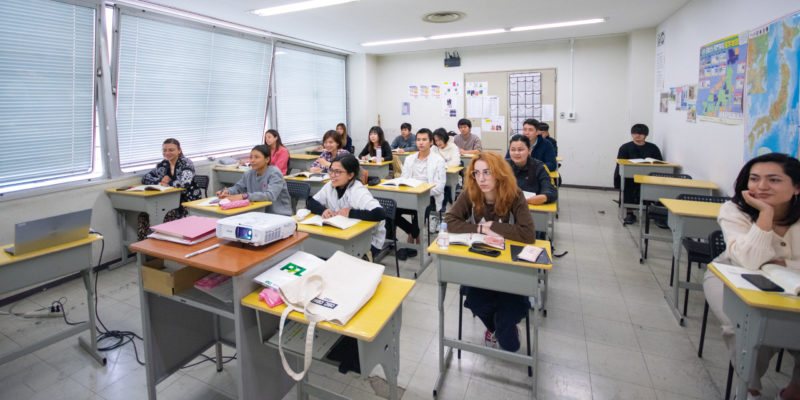
- Classroom — Classrooms for daily lessons, assigned by class. Each room has a TV and projector, so video materials can be used.
- Staff room — Teachers prepare lessons, make materials and grade work here. Student consultations, tuition payment and various procedures are also handled here.
- Library room — A library with about 1,000 books across many genres, including history, culture, economics and literature (more added over time). It can also be used as a study room for preparation and review.
- Infirmary — If a student suddenly feels unwell, there is an infirmary where they can lie down and rest. Staff also advise on which hospital to go to.
2025–2026 academic calendar · Older data
- Saturdays and Sundays
- Weekly
- Days stipulated by the Act on National Holidays
- Days stipulated by the Act on National Holidays
- Summer vacation
- Summer break (from the 2nd Monday of August to the 4th Friday of August)
- Winter break
- Winter break (Dec 24 to Jan 6)
- Spring break
- Spring break (Mar 23 to Apr 6)
- Autumn break
- Autumn break (Sep 24 to Sep 30)
School website · 2023-04-07 updated
Access
- Transit
- Hachioji Station on foot 8 min
- Nearby
- About 40 minutes by train to central Tokyo. The campus is in a quiet residential area, with a pedestrian shopping street, restaurants, convenience stores and supermarkets nearby, and many nursing-care facilities in the city.
- Dormitory
- Available¥25,000 per month · 2 students per room / Dormitory entrance fee ¥100,000 + 6 months of dormitory fees ¥210,000 / Several dormitories within walking distance of the nearest station · Based on the school website
School website · 2025-04-16 updated
Dorm — Free to choose whether to live in the dorm; 2 students per room, and you cannot choose your room or roommate; contracts run 6 months, and notice to leave must be given at least 1 month before the term ends; utilities and similar costs are paid by the resident; no meals provided; dorm entry fee ¥100,000 + 6 months of dorm fees ¥210,000 = ¥310,000 total
School website · 2025-04-16 updated
SALLAE has organized the school website and published data in English.
The update date is the day that material was last revised.
Photos are materials published by the school.
This information is compiled from official sources and is not updated daily. Please confirm with the official contact before signing or applying.