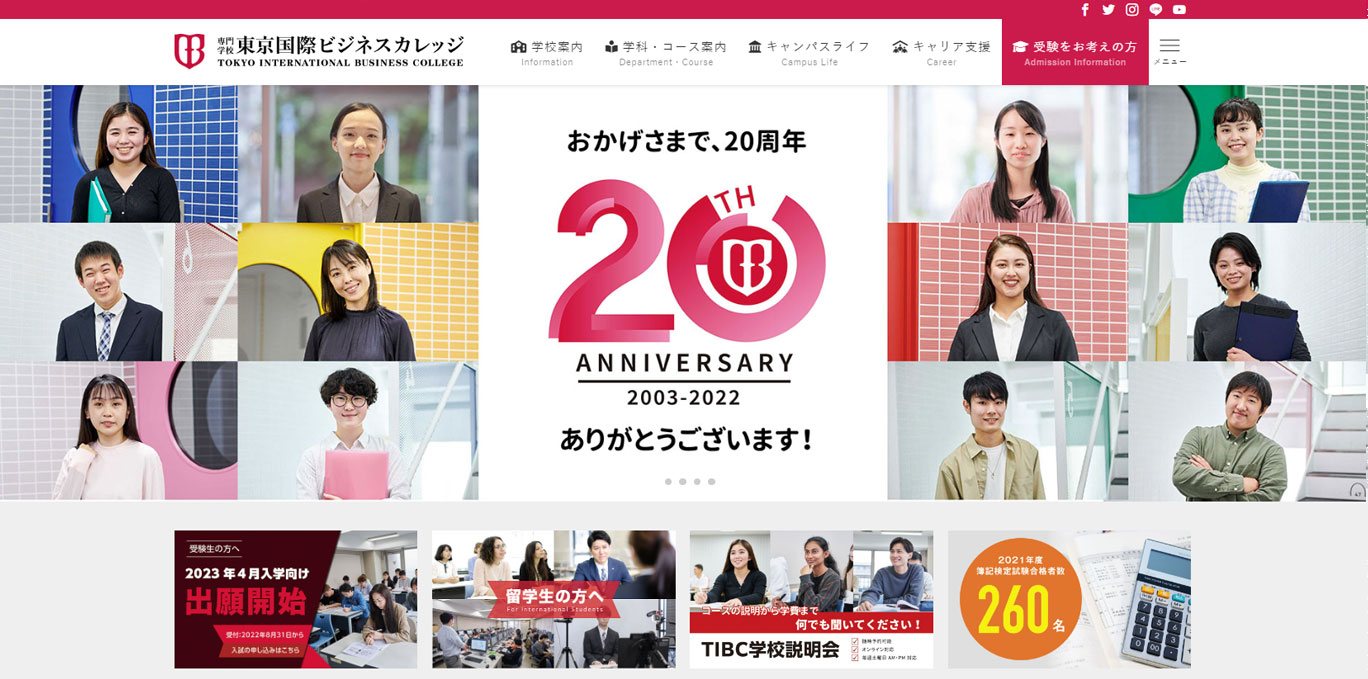
Tokyo International Business College (vocational school)
Tokyo International Business College (vocational school)
- To station
- 1-minute walk · Asakusabashi Station
- AM & PM classes
- Decided by the school ›
- Admission
- Twice a year · April and October ›
Compare side by side with other schools →
Tuition and conditions may change depending on the intake. If you contact us, we will check with the school and give you accurate details.
Nearby schools comparedBy distance · no ads or paid placement
- Tokyo International Business College (vocational school)This schoolTuition/yr¥845,000Progression88%IntakesApr · Oct
- Waseda Culture Hall0.1km›Tuition/yr¥930,000Progression—IntakesApr · Jul · Oct
- JSL Japan Academy, Tokyo Campus0.4km›Tuition/yr¥830,000Progression—IntakesApr
- Tamagawa International Institute0.4km›Tuition/yr¥841,000Progression90%IntakesJan · Apr · Jul · Oct
— means SALLAE has not yet found the data.
About the school
The school is divided into a university-prep course (2 years) and a general course (1 year 6 months) for those aiming to work, and in the second year it provides EJU and research plan preparation, or business manners and interview preparation, separately. Of the 66 students who completed in fiscal 2025, 50 went on to universities and vocational colleges, and 7 changed their status of residence for employment and similar reasons. Because the Japanese department is inside a business vocational college, students can audit vocational classes during free periods and join free qualification preparation seminars (bookkeeping, MOS, TOEIC, etc.). The school is a 1-minute walk from Exit A6 of Asakusabashi Station on the Toei Asakusa Line, and teaches its capacity of 200 students in morning and afternoon classes.
Published data and school website
Tuition
⚠ The course length and total cost for the October intake differ depending on the source. Please confirm with the school. School website: Second year, half year: tuition ¥300,000 + materials ¥47,500 = ¥347,500 total (October intake) · Association for the Promotion of Japanese Language Education published data: Japanese department, general course, 2 years (October intake): ¥1,570,000 total (including the ¥30,000 application fee). For the 2-year course with April intake, the published total equals the school's table amount plus the ¥30,000 application fee. Only the October intake differs in course length — please confirm with the school.
If you saw a lower amount elsewhere, it may not include the admission fee and application fee
Median 1-year tuition in other areas — Kyoto ¥911,000(7 schools) · Kanagawa ¥880,000(8 schools) · Okinawa ¥858,000(6 schools) · Tokyo ¥840,600(56 schools) · Fukuoka ¥835,000(12 schools) · Hyogo ¥825,500(7 schools) · Osaka ¥814,000(27 schools) · Shizuoka ¥790,000(9 schools) · Chiba ¥745,333(10 schools) · Aichi ¥740,667(5 schools)
Total by intake
| Intake · length | Full course |
|---|---|
| October intake · 1 year 6 months | ¥1,192,500 |
| April intake · 2 years | ¥1,540,000 |
Cost details · course tables · notes · 5 items
- One-time fees
- ¥845,000Tuition ¥600,000 · Admission fee ¥100,000 · Materials ¥45,000 · Facility maintenance fee ¥100,000
According to the school guide, fees are paid in one lump sum at enrollment. SALLAE will check with the school whether you can pay in installments.
| Intake · course | Extra 2nd-year costs | All |
|---|---|---|
| October · 1 year 6 months | ¥347,500 | ¥1,192,500 |
| April · 2 years | ¥695,000 | ¥1,540,000 |
Costs added in year 2. The application fee and admission fee are not charged again. Year 2: tuition ¥600,000, materials ¥95,000 (April intake) / For half a year: tuition ¥300,000, materials ¥47,500 (October intake)
These are the amounts in the April 2025 admission guidelines for the vocational college's Japanese department. The current admissions information page and the school brochure (2025) show the same amounts, and no newer admission guidelines are published.
After the Certificate of Eligibility is issued, please pay the admission fee, tuition, facility maintenance fee, materials fee and other expenses in one lump sum before entering Japan.
Payment deadline for the October intake: Aug 10; for the April intake: Feb 10
The school's table has no application fee. The Association for the Promotion of Japanese Language Education's published data separately includes an application fee of ¥30,000.
The table does not indicate whether amounts include or exclude tax.
School website · 2024-08-20 updated
Whether it is refundable
- If, after the Certificate of Eligibility is issued, the student does not apply for an entry visa at the Japanese embassy or consulate in their home country and does not come to Japan
- Expenses paid to the school are refunded except for the ¥100,000 admission fee. Return of the admission permit and the Certificate of Eligibility is required.
- If the Japanese embassy or consulate does not issue a visa
- Expenses are refunded except for the ¥100,000 admission fee. Return of the admission permit and confirmation that the entry visa was not issued are required.
- If, after the Certificate of Eligibility is issued, the student obtains an entry visa at the Japanese embassy or consulate in their home country but withdraws before coming to Japan
- Expenses are refunded except for the ¥100,000 admission fee. Confirmation that the entry visa is unused and has expired, and return of the admission permit, are required.
- Leaving school midway after arriving in Japan and enrolling
- As a rule, none of the payments is refunded
See refund policy in detail · 1 more line
- When you receive a refund
- Bank transfer fees are paid by the student.
Admission & dates
- Apr intake
- 2-year course · Application Send by e-mail from Sep 1, 2024 (Mon) to noon (Japan time) on Sep 30, 2024 (Mon) · Classes 1,712 (1 class period = 45 minutes)
- Oct intake
- 1 year 6 months course · Application Send by e-mail from Apr 10, 2024 (Wed) to noon (Japan time) on May 15, 2024 (Wed) · Classes 1,342 (1 class period = 45 minutes)
- Japanese level
- JLPT N5 level or above
Those who have studied Japanese for 180 hours or more
Deadline and capacity rules
Applicants who have completed 12 or more years of school education abroad. Capacity: 200 students
School website · Confirmed 2026-09-26
Classes
- Morning
- 08:45-12:10
- Afternoon
- 13:00-16:25
- AM/PM placement
- You cannot choose morning or afternoon classes; they are decided by the placement test on the first day at the school.
- Class assignment
- Level-based 3 stages
- Elective classes
- Qualification prep seminars · Starting with seminars (free electives) for qualifications the school recommends, you can also join JLPT, EJU and TOEIC preparation seminars · TOEIC/TOEFL seminar · EJU juku · You can audit classes of the specialized courses · Qualification preparation seminars are free (textbooks and exam fees are paid by the student). They can be taken at times when there are no classes.
Materials · Subjects · Timetable · Details
- Subject
- Japanese (JLPT N2 and N1) · Research plan guidance · EJU preparation · Interview preparation · Business manners · Japanese culture · University-prep: Japanese (N2 and N1), research plan guidance, EJU and interview preparation. General: Japanese (N3 and N2), business manners, Japanese culture, interview preparation
TIBC class days and hours: 218 days and 872 hours per year. Two sessions, morning and afternoon, with classes divided by Japanese ability, 5 days a week.
What each level aims for · 3 levels
- Beginner (JLPT N5–N4)
- Everyday conversation, basic grammar, hiragana and katakana, 300 kanji
- Intermediate (JLPT N3–N2)
- Situational conversation, intermediate grammar, vocabulary building, 1,200 kanji
- Advanced level N1 (B2/C1)
- Advanced conversation, speeches and compositions, career guidance, 2,000 kanji
School website · 2024-09-09 updated
Documents
- Photo3 cm × 4 cm) 6 photos. Color, no hat, plain background, front view, within 3 months (digital camera photos and photocopies not accepted
- Résumé p. 1 (school's designated form). For education and work history, write addresses down to the unit number (room number)
- Résumé p. 2 (school's designated form). Only the reason for study needs a Japanese translation
- Original diploma (most recent), translation attached
- Application form (school's designated form), with photo
- Copy of the applicant's household register. The copy of the original must be at actual size (no reduction or enlargement) and clear
- Academic transcript from the school you graduated from, translation attached. Must include the school's address, telephone number, the signature of the person who made the certificate and a seal
- Japanese study certificate, translation attached. Must include the school's address, telephone number, the signature of the person who made the certificate and a seal
- Submit copies of JLPT, J-TEST certificate, NAT-TEST pass certificate, college entrance exam scores or equivalent documents
Sponsor documents · Only if applicable · 5 application requirements
Submitted by the person paying the tuition (financial sponsor)
- Financial sponsorship form (school's designated form), first-year tuition ¥845,000, translation attached
- Notarized certificate of family relationship
- Deposit balance certificateFixed-term deposit period of 3 months or more
- Employment certificateCompany letterhead
- Income certificateSponsor
- Tax certificate (tax paid on annual income for the last 3 years), with translation
- Copy of passbook, fixed deposit certificate, etc.
- Copies of other proof of funds
- Copy of the sponsor's household registerAlso copy the cover of the household register
Only if applicable
- Certificate of expected graduation (If you are expected to graduate)
- The applicant's certificate of enrollment or certificate of employment (Submit only if you are enrolled in school or employed at the time of application.)
- Copy of passport (If you have a passport)
- Business license (copies of the original and the duplicate) ((In the case that the sponsor is doing business on his/her own))
Application requirements
All documents within 3 months of the date of submission to Immigration. No ghostwriting; handwritten by the person. Include the address and telephone number of the school or workplace (and fax number for companies), the signature of the certificate's issuer and a seal. Tax certificate is required for sole proprietorships. Please consult us about translations
Application criteria by nationality are not shown. The document list uses Chinese document names such as household register and notarized proof of family relationship. SALLAE is checking with the school. SALLAE is confirming this with the school.
School website · 2024-04-06 updated
Admission process
- Request an admission consultation — Please contact info@tibc.jp directly. Support is available in Japanese, English, Chinese and Korean.
- Send résumé — Applications received after the deadline or with incomplete documents will not be accepted. Submitted documents will not be returned.
- Document screening — The principal consults the selection committee about the applicants and decides which candidates go on to the interview; results are notified to each person by e-mail or similar.
- Interview and exam — Overall evaluation of the document review, a written test (Japanese proficiency test) and an interview in Japanese. Motivation to study is emphasized. Interviews are in September 2024.
- Visa application preparation — An interview is held in September 2024 and visa application preparation starts in October. All documents within 3 months of the date of submission to Immigration
- Tuition payment — After the Certificate of Eligibility is issued, please pay the admission fee, tuition, facility maintenance fee, materials fee and other expenses in one lump sum before entering Japan.
- Visa, arrival and enrollment — You cannot choose morning or afternoon classes; they are decided by the placement test on the first day at the school.
- Placement test
- You cannot choose morning or afternoon classes; they are decided by the placement test on the first day at the school.
School website · Confirmed 2026-09-26
Graduate outcomes
| FY2025 | Admitted |
|---|---|
| Employment | 7 students |
| Graduates | 66 students |
Course completers: 66; total meeting the criteria: 57; share meeting the criteria: 86.3% (prepared June 30, 2026) · Those permitted to change status of residence: University-prep course Part 1: 1; General course Part 2: 1; General course Part 1: 3; University-prep course Part 2: 2 · School website · 2026-06-30 updated
Reviews
If you study here or used to, tell others what the classes, teachers and daily life were like. It helps anyone deciding on this school.
Write the first reviewUniversity prep
- Second-year preparation by path — In the Japanese department, the first year is for improving Japanese skills, and in the second year the school offers preparation courses suited to each student's career goal.
- Progression guidance — Drawing on know-how built up in university entrance guidance, experienced staff support students aiming for higher goals in further study.
- Career Support Center — The Career Support Center offers personal job-hunting consultations that classes cannot cover,
- Internship program — Internships are available at hotels and in the food and beverage industry connected to TIBC, to gain work experience.
- Auditing vocational classes and progression — Depending on how fast you learn Japanese, you can skip the Japanese department's course and move on to the vocational program, or transfer into the second year of the vocational program using credits already earned.
Schedule to admission
- Year 1
- In the Japanese department, the first year is about improving Japanese skills. Preparation for exams such as the JLPT and EJU is built into the curriculum. · Support in deciding on a target university or graduate school and choosing a school
- Next year
- For students who want to continue their studies, support also includes EJU preparation for university entry and writing a research plan. · For students who want to work, thorough guidance from how to wear a suit to business manners and interview coaching. The general course offers guidance from self-analysis to résumés and interviews.
School website · 2024-09-09 updated
Daily-life support
- Homeroom teacher — Homeroom teachers support each student. The school values close, face-to-face relationships with students and watches over and supports their growth.
- Japanese mentor — Mentors support students from Europe and North America. They help with new-life procedures such as airport pickup, explaining dormitory rules and the surrounding area when moving in, and address registration at the ward office.
- Health checkup — A health checkup is held as early as possible after enrollment and every year after that
- Commuting and other costs — Student discounts apply to commuting fares.
- Part-time work — Under Immigration Services Bureau rules, students may work part-time up to 28 hours per week.
Monthly living costs · School information
| Item | 1 month |
|---|---|
| Commuting costs | ¥5,000 |
| Food costs | ¥28,000 |
| Housing costs | ¥39,000 |
| Utilities | ¥7,000 |
| Medical expenses | ¥3,000 |
| Hobbies and entertainment | ¥7,000 |
| Miscellaneous expenses | ¥7,000 |
| Total | ¥96,000 |
Reference monthly living expenses in the Kanto region: ¥96,000 total (JASSO fiscal 2017 Survey on the Living Conditions of Privately-Financed International Students, summary)
School website · 2024-04-06 updated
Scholarship
- TIBC Global Scholarship
- ¥300,000 Once¥150,000 tuition waiver (6 months), ¥300,000 tuition waiver for 1 year. A letter of recommendation from a Japanese language institution or its teacher is required.
- Soshi Internship
- Those with English teaching experience or qualifications receive a full tuition waiver (¥600,000 for 1 year, ¥300,000 for 6 months); others receive a waiver of ¥450,000 for 1 year or ¥225,000 for 6 months. A letter of recommendation is required.
- JASSO (Japan Student Services Organization) scholarship
- Students with excellent grades and conduct can receive a Japan Student Services Organization (JASSO) scholarship.
School website · 2024-08-20 updated
School life
For 1 year
- 4
- Entrance ceremony · Evacuation drill
- 5
- Asakusabashi Maronnier Festival
- 7
- Hawaii short-term training · School festival
- 8
- Summer break internship activities · Lantern floating volunteer activity
- 9
- Business suit seminar · Special business lecture
- 10
- Halloween · Neighborhood association sports day volunteering
- 11
- First-term perfect attendance award party
- 12
- Christmas party
- 1
- On-campus company briefing
- 2
- Ski and snowboard camp · Short-term study program in Europe (France)
- 3
- Asakusa community volunteer activity · Graduation ceremony
This is the one-year schedule for the whole vocational college as listed in the Japanese department brochure (2025 edition). Events differ by course and may change from year to year.
- Cultural events are planned regularly. Past events include distant trips such as climbing Mt. Fuji and training trips to Kyoto and Nara, as well as kimono dressing and wind chime making.
- Tokyo Skytree, Senso-ji, Nikko Toshogu, Kinkaku-ji, a barbecue event, Japanese culture experiences, kabuki viewing, wind chime making
- Japanese department events: first shrine visit of the year at Meiji Jingu, kite flying and mochi pounding (January 2024), Tokyo Bay cruise (February 2024, the last event of that year), Seibuen Amusement Park (June 2024)
- Five students chosen in a school selection took part in the Soshi Gakuen Group Japanese speech contest and won a special prize in the upper-intermediate division (February 2025).
On campus
- Building 1 (main building), 1st floor
- Administration office — The administrative office handles many matters across the whole school, from helping students to school information sessions and entrance exams.
- Building 2
- New campus — Building 2 is a new campus completed in December 2019. It is a 2-minute walk from Building 1.
Academic calendar
School website · 2024-09-09 updated
Access
- Transit
- Toei Asakusa Line Asakusabashi Station on foot 1 min Exit A6
JR Sobu Line Asakusabashi Station on foot 3 minEast exit - Nearby
- 1 stop by train to Akihabara, 2 stops to Asakusa and 4 stops to Tokyo Skytree. Asakusabashi is 10 minutes by train from Tokyo Station.
- Dormitory
- Available¥30,000–¥45,000 per month · The 2024 recruitment page says the facility was not available at the time because it was under renovation · Based on the school website
School website · 2023-06-30 updated
Dorm — The school reportedly gives full support to students who cannot commute from home in finding housing · Many students from Europe and North America live in the student dormitory, and the school guide says that Japanese students may share a room with international students from overseas · Participants in the 2025 Soshi Internship were required to live in the school dormitory while enrolled.
School website · 2024-04-06 updated
SALLAE has organized the school website and published data in English.
The update date is the day that material was last revised.
Photos are materials published by the school.
This information is compiled from official sources and is not updated daily. Please confirm with the official contact before signing or applying.