Tokyo International Exchange Institute
Tokyo International Exchange Institute
- Course
- Employment course available ›
- To station
- 3-minute walk · Nishi-Hachioji Station
- AM & PM classes
- Decided by the school ›
Compare side by side with other schools →
Tuition and conditions may change depending on the intake. If you contact us, we will check with the school and give you accurate details.
Nearby schools comparedBy distance · no ads or paid placement
- Tokyo International Exchange InstituteThis schoolTuition/yr¥888,000Installments OKProgression76%IntakesJan · Apr · Jul · Oct
- Nitto International Institute, Hachioji Campus0.5km›Tuition/yr¥910,000Progression—IntakesJan · Apr · Jul · Oct
- Tokyo International Foreign Language Academy1.8km›Tuition/yr¥782,000Progression—IntakesApr · Oct
- Hosanna Japanese Language Institute Tokyo Campus7.9km›Tuition/yr¥792,000Progression93%IntakesApr · Oct
— means SALLAE has not yet found the data.
About the school
This is a school focused on further study that accepts only people who want to go on to vocational colleges and universities in Japan. According to the June 2026 school report, 137 of the 173 students who completed went on to universities and similar schools, and recent destinations published include Tokyo University of the Arts, Tokyo Metropolitan University graduate school, Waseda University, Yokohama National University and Nippon Engineering College Hachioji. It has a capacity of 480, is located in Hachioji, Tokyo, a 3-minute walk from the north exit of Nishi-Hachioji Station on the JR Chuo Line, opened in 2001, and has 4 school-run dormitories 5–15 minutes away on foot. The school regulations also include a 2-year employment course, and the business class supports job-hunting preparation such as interview practice.
Published data and school website
Tuition
⚠ Total costs by course vary by source — please check with the school. Published by the Ministry of Education, Culture, Sports, Science and Technology (MEXT). Published data: 1 year 3 months ¥980,000 · 1 year 6 months ¥1,162,000 · 1 year 9 months ¥1,339,000 · 2 years ¥1,522,000 (including application fee and admission fee) · School website: first-year total ¥858,000 + CoE application fee ¥30,000. Second-year amounts are ¥798,000 / ¥600,650 / ¥403,300 / ¥198,550. By the school's table, every course costs about ¥100,000–¥160,000 more than the published total. The published data may reflect earlier prices.
⚠ Withdrawal before enrollment for reasons other than the visa differs depending on the source. Please confirm with the school. If the applicant declines before enrollment, the amount is refunded except for the entrance examination fee, admission fee, administrative fee and remittance fee. · Tuition once paid is not returned for any reason. Only if the embassy does not issue the visa: refund of everything except the screening fee, translation fee and admission fee. Because the two sources differ, please confirm with the school before applying.
If you saw a lower amount elsewhere, it may not include the admission fee and application fee
Median 1-year tuition in other areas — Kyoto ¥911,000(7 schools) · Kanagawa ¥880,000(8 schools) · Okinawa ¥858,000(6 schools) · Tokyo ¥840,600(56 schools) · Fukuoka ¥835,000(12 schools) · Hyogo ¥825,500(7 schools) · Osaka ¥814,000(27 schools) · Shizuoka ¥790,000(9 schools) · Chiba ¥745,333(10 schools) · Aichi ¥740,667(5 schools)
Total by intake
| Intake · length | Full course |
|---|---|
| January intake · 1 year 3 months | ¥1,086,550 |
| October intake · 1 year 6 months | ¥1,291,300 |
| July intake · 1 year 9 months | ¥1,488,650 |
| April intake · 2 years | ¥1,686,000 |
Cost details, tables by course and notes · 4 items
- One-time fees
- ¥888,000Tuition ¥715,000 · Entrance screening fee ¥30,000 · Admission fee ¥60,000 · Materials ¥26,000 · Facility fee ¥40,000 · International student insurance ¥10,000 · Health management fee ¥7,000
According to the school guide, fees are paid in one lump sum at enrollment. Installments are available.
| Intake · course | Extra 2nd-year costs | All |
|---|---|---|
| January · 1 year 3 months | ¥198,550 | ¥1,086,550 |
| October · 1 year 6 months | ¥403,300 | ¥1,291,300 |
| Jul · 1 year 9 months | ¥600,650 | ¥1,488,650 |
| April · 2 years | ¥798,000 | ¥1,686,000 |
Costs added in year 2. The application fee and admission fee are not charged again. Year-2 payment dates: 2-year course Feb 25 of the next year, 1 year 9 months May 25 of the next year, 1 year 6 months Aug 25 of the next year, 1 year 3 months Nov 25 of the next year
The ¥30,000 CoE application fee is due by the day before the immigration application date. Pay first-year tuition within 2 weeks from the day after the CoE is issued.
Tuition is in principle paid annually. With prior permission, it can be paid in 2 installments per year (first payment ¥497,500). The installment fee is ¥50,000 for April, ¥40,000 for July, ¥30,000 for October and ¥20,000 for January.
Materials for elective subjects are extra (about ¥2,000–¥2,500). If Japan's consumption tax rises, the difference is also collected from enrolled students.
Students take the JLPT once (free) during enrollment.
School website · 2026-09-09 updated
Whether it is refundable
- If you decline enrolment before enrolling
- If the applicant declines before enrollment, the amount is refunded except for the entrance examination fee, admission fee, administrative fee and remittance fee.
- If the Japanese embassy or consulate does not issue a visa
- Only if the embassy does not issue the visa: refund of everything except the screening fee, translation fee and admission fee.
- First year
- Student fees already paid for the first year are, in principle, not refunded.
- From year 2
- From year 2, part of the tuition may be refunded.
Admission & dates
- Apr intake
- 2-year course · Application mid-Aug–late Oct · Classes 1,600 class hours (45 min each)
- Jul intake
- 1 year 9 months course · Application mid-Dec–late Feb · Classes 1400 hr
- Oct intake
- 1 year 6 months course · Application mid-Mar – late May · Classes 1200 hr
- Jan intake
- 1 year 3 months course · Application mid-Jul – late Aug · Classes 1000 hr
- Japanese level
- 2-year and 1-year 9-month courses: a pass certificate at about A1 of the reference framework (JLPT N5) or above, or 150 hours or more of Japanese study
1-year 6-month course: about N4 or above, or 300 hours or more. 1-year 3-month course: about N3 or above, or 450 hours or more. At the interview: about N5 for April and July intakes, N4 for October, N3 for January.
Deadline and capacity rules
High school graduate (or expected graduate) or above, and the person paying tuition and living costs must be able to submit documents showing how the funds were built up. No age limit. Applications close when capacity is reached.
School website · 2026-09-16 updated
Classes
- Morning
- 08:55-12:05 Period 1 8:55–9:40, Period 2 9:40–10:25, Period 3 10:35–11:20, Period 4 11:20–12:05
- Afternoon
- 12:50-16:00
- AM/PM placement
- Your class is decided by the result of the placement test taken at entry.
- Class size
- Max 20 students
- Class assignment
- Level-based 4 stages
Materials · Subjects · Timetable · Details
- Materials
- Materials used include Minna no Nihongo Beginner 1 and 2, Intermediate 1 and 2, Kanji Master, Sōmatome grammar and Power Drill reading.
- Subject
- Comprehensive Japanese · Characters · Composition · Presentation · Culture and general knowledge · Exam preparation · Comprehensive Japanese (conversation, reading, listening), characters, composition, presentations, culture and general education. Exam preparation from B1; electives from B2.
Sample timetable (morning class) A1 (Beginner I) 4 class hours a day (class hour = 45 minutes)
| Mon | Tue | Wed | Thu | Fri | |
|---|---|---|---|---|---|
| Morning 8:55–9:40 / Afternoon 12:50–13:35 | Characters (kanji) | Composition and presentation | Characters (kanji) | Composition and presentation | Characters (kanji) |
| Morning 9:40–10:25 / Afternoon 13:35–14:20 | Comprehensive Japanese | Comprehensive Japanese | Comprehensive Japanese | Comprehensive Japanese | Comprehensive Japanese |
| Morning 10:35–11:20 / Afternoon 14:30–15:15 | Comprehensive Japanese | Comprehensive Japanese | Comprehensive Japanese | Comprehensive Japanese | Comprehensive Japanese |
| Morning 11:20–12:05 / Afternoon 15:15–16:00 | Comprehensive Japanese | Comprehensive Japanese | Comprehensive Japanese | Comprehensive Japanese | Comprehensive Japanese |
A2 (Beginner II) 4 class hours a day (class hour = 45 minutes)
| Mon | Tue | Wed | Thu | Fri | |
|---|---|---|---|---|---|
| Morning 8:55–9:40 / Afternoon 12:50–13:35 | Characters (kanji) | Comprehensive Japanese | Characters (kanji) | Composition and presentation | Characters (kanji) |
| Morning 9:40–10:25 / Afternoon 13:35–14:20 | Comprehensive Japanese | Comprehensive Japanese | Comprehensive Japanese | Comprehensive Japanese | Comprehensive Japanese |
| Morning 10:35–11:20 / Afternoon 14:30–15:15 | Comprehensive Japanese | Comprehensive Japanese | Comprehensive Japanese | Comprehensive Japanese | Comprehensive Japanese |
| Morning 11:20–12:05 / Afternoon 15:15–16:00 | Comprehensive Japanese | Comprehensive Japanese | Comprehensive Japanese | Comprehensive Japanese | Comprehensive Japanese |
B1 (Intermediate I) 4 class hours a day (class hour = 45 minutes)
| Mon | Tue | Wed | Thu | Fri | |
|---|---|---|---|---|---|
| Morning 8:55–9:40 / Afternoon 12:50–13:35 | Characters (kanji) | Exam preparation | Characters (kanji) | Composition and presentation | Characters (kanji) |
| Morning 9:40–10:25 / Afternoon 13:35–14:20 | Exam preparation | Exam preparation | Exam preparation | Composition and presentation | Exam preparation |
| Morning 10:35–11:20 / Afternoon 14:30–15:15 | Comprehensive Japanese | Comprehensive Japanese | Comprehensive Japanese | Comprehensive Japanese | Comprehensive Japanese |
| Morning 11:20–12:05 / Afternoon 15:15–16:00 | Comprehensive Japanese | Comprehensive Japanese | Comprehensive Japanese | Comprehensive Japanese | Comprehensive Japanese |
B2 (Intermediate II) 4 class hours a day (class hour = 45 minutes)
| Mon | Tue | Wed | Thu | Fri | |
|---|---|---|---|---|---|
| Morning 8:55–9:40 / Afternoon 12:50–13:35 | Characters (kanji) | Exam preparation | Characters (kanji) | Composition and presentation | Characters (kanji) |
| Morning 9:40–10:25 / Afternoon 13:35–14:20 | Exam preparation | Exam preparation | Exam preparation | Composition and presentation | Exam preparation |
| Morning 10:35–11:20 / Afternoon 14:30–15:15 | Comprehensive Japanese | Comprehensive Japanese | Comprehensive Japanese | Comprehensive Japanese | Comprehensive Japanese |
| Morning 11:20–12:05 / Afternoon 15:15–16:00 | Comprehensive Japanese | Comprehensive Japanese | Comprehensive Japanese | Comprehensive Japanese | Comprehensive Japanese |
Class hours by subject
| Subject | 2 years | 1 year 9 months | 1 year 6 months | 1 year 3 months |
|---|---|---|---|---|
| Comprehensive Japanese | 640 hr | 560 hr | 480 hr | 400 hours |
| Listening comprehension | 160 hours | 140 hours | 120 hours | 100 hours |
| Composition | 160 hours | 140 hours | 120 hours | 100 hours |
| Conversation practice | 640 hr | 560 hr | 480 hr | 400 hours |
| Comprehensive Japanese | 800 hours | — | — | — |
| JLPT preparation | 240 hours | — | — | — |
| Business Japanese | 400 hours | — | — | — |
| Japanese society and culture | 160 hours | — | — | — |
One class period is 45 minutes. Evaluation of study is decided by combining exam results, attendance and class attitude, on a 4-level scale.
What each level covers · 4 stages
- A1 (Beginner I), about JLPT N5
- Understand basic Japanese spoken slowly and clearly in familiar daily situations, and be able to have simple exchanges such as self-introductions and give short presentations.
- A2 (Beginner II), about JLPT N4
- Understand content about daily life and familiar social life, and be able to hold exchanges and give simple explanations that include experiences, plans and reasons.
- B1 (Intermediate), about JLPT N3–N2
- Understand everyday and social topics spoken at normal speed, and be able to present ideas and experiences logically with reasons and concrete examples.
- B2 (Upper-intermediate), about JLPT N2–N1
- Understand a variety of texts, including social and abstract topics, and be able to hold logical exchanges and give presentations that make your position and grounds clear.
School website · 2026-09-03 updated
Documents
- Admission application formSchool's prescribed form
- RésuméSchool's prescribed form
- 8 ID photos4 cm tall × 3 cm wide, within 3 months, front view, plain background, no hat. Digital camera photos not accepted
- DiplomaOriginal of the highest educational certificate. Copies not accepted. For those still in high school, a certificate of expected graduation
- Academic transcript from the highest level of educationFor the entire period of enrollment
- Certificate of Japanese study historyProof of JLPT N5 or above, or proof of 150 or more hours of study
- Copy of passportIf you have entered Japan before, copies of the entry and exit pages are also required
- Copy of household registerFor a Chinese household register: cover, spread pages, head-of-household page and applicant page
Sponsor's documents · Only for those who apply · 13 application requirements
Submitted by the person paying the tuition (financial sponsor)
- Financial sponsorship statementSchool's prescribed form
- List of the financial sponsor's family membersSchool's prescribed form
- Applicant's ID and translation
- Certificate of family relationship
- Bank balance certificateEquivalent to ¥3,000,000 or more; local currency is fine
- Certificate of employment showing 3 or more years of service
- Income certificate and tax certificate for the most recent year
- Documents showing the bank balance and how the funds were accumulatedCopy of bank passbook for 3 years, proof of real estate sale, etc.
- Residence certificate (jūminhyō)
- Document proving the relationship with the applicant
- Certificate of employment: for company owners, the original corporate registry; for the self-employed, a copy of the tax return
- Resident tax or income tax assessment certificates for 3 years showing total annual income
- Bank balance certificateEquivalent to ¥3,000,000 or more), documents showing how the bank balance was built up (copy of bank passbook for 3 years, proof of real estate sale, etc.
Only if applicable
- Certificate of expected graduation (If currently in high school)
- Copy of entry and exit pages (If you have entered Japan before)
- Proof of Japanese study history is not required only for junior college or university graduates (Junior college or university graduates)
Application requirements
When a relative living in a country other than the home country pays the expenses, the same documents as for parents and relatives in the home country are submitted (except the family list). It may be possible depending on the applicant's educational and work background. Please feel free to contact the school. Application documents that have passed 3 months or more from their issue date by the time of submission to the Tokyo Regional Immigration Services Bureau cannot be accepted. For documents in languages other than Japanese, attach a typed Japanese translation. If you cannot submit one, an extra ¥15,000 applies (translation from Chinese and English only). Except for the original diploma and the JLPT and Japanese NAT-TEST pass certificates, submitted documents are never returned. Copies of household registers, passbooks and the like are valid only if they are clear first-generation copies of the original. Write the copier's name, relationship to the applicant and the copy date in the margin. All items in submitted documents must match other related materials. If they do not match, attach a separate explanatory statement. Each certificate needs the issue date, issuing organization, issuer's title and name (signature), and the organization's address, telephone and fax numbers. If missing, attach an explanatory statement. Corrections with correction fluid or the like are not allowed on any document. The financial sponsorship form must be signed and sealed by the sponsor in their own hand. Describe in detail how the sponsor came to take responsibility, and state living costs of around ¥100,000 per month. If the amount deposited is equal to or more than the monthly salary shown on the income certificate, a separate individual explanatory statement is required. If the sponsor's company or the applicant's graduating school appears in a brochure, website or telephone directory, submit a copy. In the reason-for-study field, state the purpose and necessity of coming to Japan, the financial guarantee, plans after arriving, family consent and compliance with the law. Always write the name of the school and department you wish to enter.
Copy of the family register: for a Chinese hukou booklet, the cover, the opening pages, the household head's page and the applicant's page. SALLAE is confirming this with the school.
School website · 2026-09-16 updated
Admission process
- Request an admission consultation — You can contact the school through the website inquiry form, e-mail or LINE.
- Submit the application form — Applicants send the application form (the school's designated form) to the school's application e-mail address
- Interview — Interview by the admissions staff. If English is not the applicant's native language, English ability is also assessed. School staff check the Japanese level.
- Document screening — Certificate of Eligibility (CoE) application fee: ¥30,000 (please pay by the day before the date of the immigration application)
- Notice of acceptance and application for status of residence on the applicant's behalf to the Immigration Services Agency of Japan — If the applicant passes the screening by Tokyo International Exchange College, a notice of acceptance is issued and the school applies for the status of residence on the applicant's behalf to the Immigration Services Agency of Japan.
- CoE issued — Pay first-year tuition within 2 weeks from the day after the CoE is issued. After payment is confirmed, the CoE, admission permit and admission guide are sent.
- Before entering Japan — Complete the assignment in your home country and bring the original. Apply for a visa at the local embassy or consulate, and book your flight after it is issued.
- Entry into Japan — Enter Japan by the day before the designated entrance date. Airport pickup at Narita (paid) is available on request. At city hall: resident registration, health insurance enrollment, pension exemption procedures, etc.
- Enrollment procedures — Placement test (assignment submitted beforehand). Orientation, enrollment procedures, police safety seminar and a city hall briefing on garbage disposal. Dormitory residents also have a dormitory briefing.
- Classes start
- Placement test
- School staff check your Japanese level at the interview, and your class is decided by the result of the placement test at entry.
School website · 2026-09-16 updated
Short-term study
- Open now?
- Rolling admissions, so availability varies from time to time — SALLAE will confirm with the school
Course without a student visa
- Private lessons — One-on-one lessons for holders of Japanese visas. Admission fee ¥10,000 (at enrollment only), Japanese lesson 50 minutes ¥5,000, special lesson 50 minutes ¥7,000.
- On-site lessons — For companies and personal groups, among others. Timing and hours: by arrangement. Tuition: by arrangement.
★Short-term courses are not listed in the published data — it counts only student-visa courses.
School website · 2026-09-09 updated
Graduate outcomes
| FY2025 | Admitted |
|---|---|
| Employment | 7 students |
| Graduates | 173 students |
Passing an exam
| Exam | Pass |
|---|---|
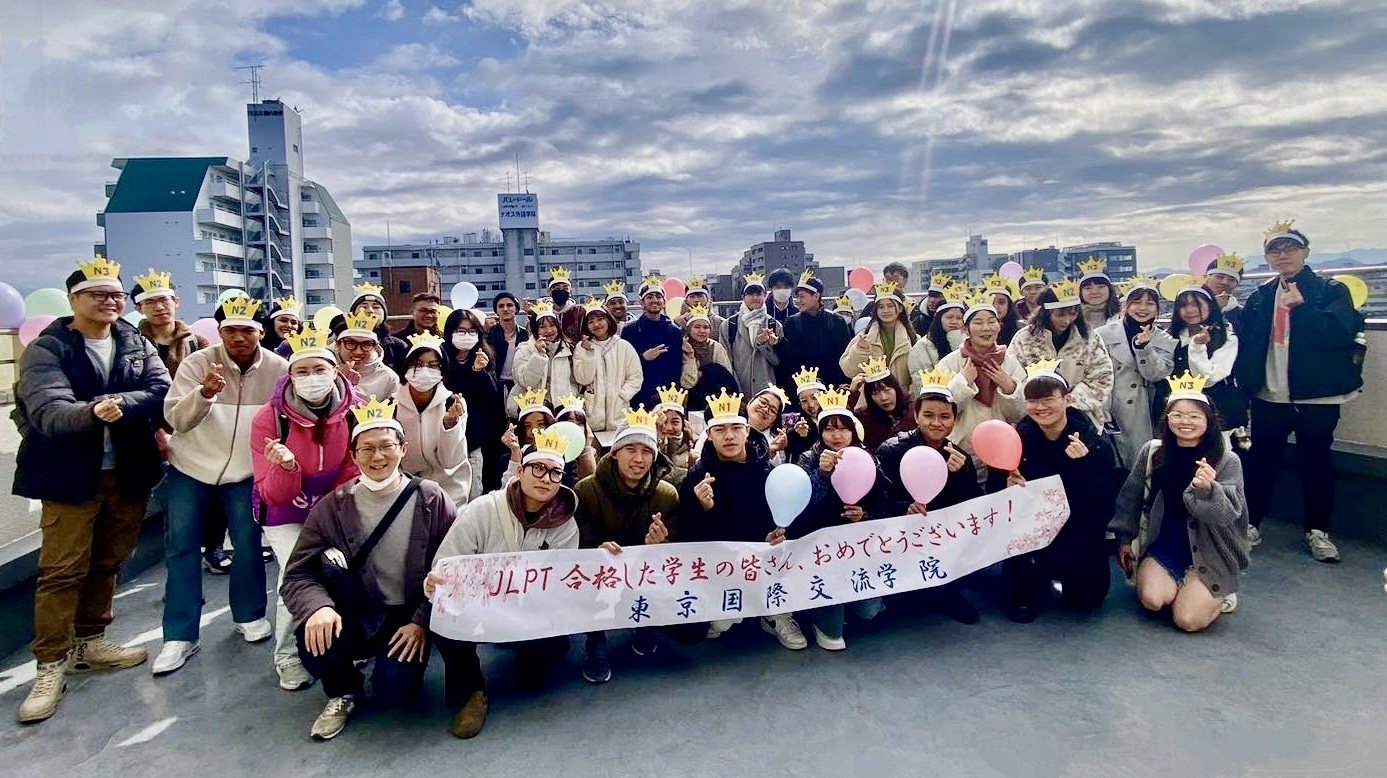
| JLPT N1 2026 | 6 students |
| JLPT N2 2026 | 23 students |
| JLPT N3 2026 | 32 students |
| JLPT N4 2026 | 22 students |
JLPT passers in July 2026: N1: 6, N2: 23, N3: 32, N4: 22, total 83.
All schools accepted to so far
+33 more schools
Prepared June 23, 2026. Completers 173, total meeting the standard 180, of whom 10 withdrew, share meeting the standard 98.4%. · Persons permitted a change of status of residence: 2-year progression course 3, 1 year 9 month progression course 1, 2-year employment course 3 · School website · Updated 2026-06-23
Reviews
If you study here or used to, tell others what the classes, teachers and daily life were like. It helps anyone deciding on this school.
Write the first reviewUniversity prep
- Regular meetings with homeroom teacher — From entry, homeroom teachers hold regular individual meetings to keep track of students' study and living situations and to support further study.
- University prep — Yes, you meet with a teacher and look for schools to apply to together. Teachers also support application preparation carefully.
- Career guidance and career interviews — In April of the second year there are career guidance sessions and career interviews.
- Opportunities to experience vocational college classes and information sessions by universities and other schools — There are opportunities to experience vocational college classes, and information sessions by universities and other schools are also held.
- Many designated-school recommendation slots — The school is a designated school for many vocational colleges and universities, and some offer benefits such as free application fees.
- Prep for external exams such as JLPT and EJU — Students take the JLPT once (free) during enrollment. EJU integrated subject and mathematics classes are offered only to students who want them.
- Business class — The business class supports interview practice and job hunting. Students attend briefings by an organization that supports international students' job hunting.
School website · 2026-09-03 updated
Daily-life support
- The school is set up to support students in their own language. — Yes, there are teachers who speak English, Chinese, Burmese, Nepali, Vietnamese and Hindi.
- Airport pickup — Airport pickup at Narita (paid) is available on request.
- Procedures after arriving in Japan — On request, the school helps with city hall and bank procedures (only for students living in Hachioji).
- Orientation — Orientation, enrollment procedures, a police safety seminar and a city hall briefing on garbage disposal are held. Dormitory residents also have a dormitory briefing.
- Guidance to the nearest hospital or clinic — When you are sick, the school can direct you to a hospital near the school. In an emergency, staff may accompany you, and flu vaccinations may be offered to those who want them.
- Arrange student insurance — If you become ill or injured after coming to Japan in a way covered by the international student insurance, the money you paid to the hospital is reimbursed later by the insurance.
- Health checkup — Health checkups are held once a year, as separately specified.
- Status of residence renewal — Visa renewal during enrollment is applied for through the school. When moving on to further study, students apply by themselves, and the school helps check the required documents and contents.
- Part-time work — The school does not arrange part-time jobs but provides job listings. Job postings are displayed on the first floor of the office.
- Life consultation — Yes, you can consult not only about studies but also about any problem in daily life.
- Monthly living costs (per the school) — Living costs are about ¥100,000–¥150,000 per month, covering housing, food, utilities, transportation, health insurance and so on.
You may not be able to find a part-time job right after enrolling, so please bring living expenses for 2–3 months.
School website · 2026-09-09 updated
Scholarship
- Perfect attendance award (2-year course)
- ¥20,000 OnceAwarded to students with, in principle, no absences, tardiness or early departures. Absences not caused by the student, such as natural disasters, transport disruptions or infectious diseases, do not affect this if the principal approves.
- Perfect attendance award (1-year 9-month course)
- ¥15,000 Once
- Perfect attendance award (1-year 6-month and 1-year 3-month courses)
- ¥10,000 Once
- JLPT N1 passers
- ¥10,000 Once¥10,000 is awarded to students who pass JLPT N1 while enrolled. The award is given upon submission of documents proving the pass.
- JASSO Study Incentive Grant
- There is a chance to receive a scholarship from the Japan Student Services Organization (JASSO).
- Newspaper delivery scholarship students
- Newspaper delivery scholarship students follow their separate contract with the newspaper scholarship association. Motorbikes are permitted only for newspaper delivery scholarship students.
School website · 2026-09-03 updated
Students
468 enrolled (2025) · Capacity 480 National median: 180 students
Based on 468 enrolled students in 2025.
Public data from the Association for the Promotion of Japanese Language Education (Nisshinkyo) · verified 2026-09-20
School life
For 1 year
- Apr
- Cherry blossom viewing · April intake. Orientation and enrollment procedures at entry, plus regular individual meetings with the homeroom teacher. · Year 2: career guidance and career interviews
- May
- Golden Week
- Jun
- JLPT study group · EJU
- Jul
- July intake enrollment. At enrollment there are orientation and enrollment procedures, and regular individual meetings with the class teacher. · Tanabata · Summer break · Fireworks festival · JLPT
- Aug
- Summer break · Trial class
- Sep
- Nishi-Hachi summer festival · Evacuation drill · Autumn break
- Oct
- Autumn break · October intake enrollment. At enrollment there are orientation and enrollment procedures, and regular individual meetings with the class teacher.
- Nov
- Mt. Takao hike · JLPT study group · EJU
- Dec
- JLPT · Winter break · Year 1: cultural exchange event · Year 2: research presentation
- Feb
- Graduation exam
- Mar
- Spring break · March: graduation ceremony, graduation trip
This summarizes the annual events the school lists separately for Year 1 and Year 2; "Year 2:" applies to second-year students only. · In the 2026 academic year schedule, classes start on April 13, October 1 is Tokyo Citizens' Day and the school's founding anniversary, and March is the term-end exams.
- Many cherry trees bloom along the river near the school, and cherry blossom viewing is held as a spring event.
- Students take part in local festivals such as the Hachioji fireworks festival and the Nishi-Hachi summer festival. They can also wear yukata and try carrying a portable shrine (mikoshi).
- A hike up Mt. Takao is an outdoor activity for experiencing nature. On clear days, Mt. Fuji can be seen from the summit.
- July: Tanabata / December: year-end party / March: graduation ceremony
- A trial class was held at the school on August 28, 2025.
- Yes, students can take part in outside speech contests. School teachers provide support.
- The school takes part in community activities in cooperation with Hachioji City Hall and the Hachioji Chamber of Commerce and Industry, and encourages volunteering as a Hachioji "helper" international student.
- There is no cafeteria in the school. There is no bicycle parking, so students use nearby paid bicycle parking. There is no smoking area in the school.
On campus
- Library room — Besides books on Japanese language and culture, students can browse and borrow novels, illustrated guides and manga, and can also study on their own outside class hours.
2026–2027 academic calendar
- Saturdays and Sundays
- Weekly
- National holidays
- Holidays set by the Act on National Holidays
- Spring break
- 2026-03-14 ~ 2026-04-12
- Summer break
- 2026-07-29 ~ 2026-08-16
- Autumn closure
- 2026-10-14 ~ 2026-10-21
- Winter break
- 2026-12-23 ~ 2027-01-06
- School anniversary
- Oct 1
School website · 2026-09-09 updated
Access
- Transit
- JR Chuo Line Nishi-Hachioji Station, 3 min walkNorth exit
- Nearby
- After the ticket gates, head toward the north exit. Go straight along the rotary, keeping the police box on your left. When you reach Koshu Kaido, turn right. The entrance is on the first floor of the building.
- Dormitory
- Available · Dorms are Hikari, Momiji, Taishi and SAKURA TERRACE. Dorm fees are ¥440,000–¥625,000 per year. About 5–15 minutes on foot from the school. · Based on school website
School website · 2026-06-16 updated
Student dorm — Hikari, Momiji and Taishi dorms: 6 months ¥260,000, 9 months ¥350,000, 1 year ¥440,000. SAKURA TERRACE: ¥385,000, ¥505,000 and ¥625,000 respectively
School website · 2026-09-09 updated
SALLAE has organized the school website and published data in English.
The update date is the day that material was last revised.
Photos are materials published by the school.
This information is compiled from official sources and is not updated daily. Please confirm with the official contact before signing or applying.