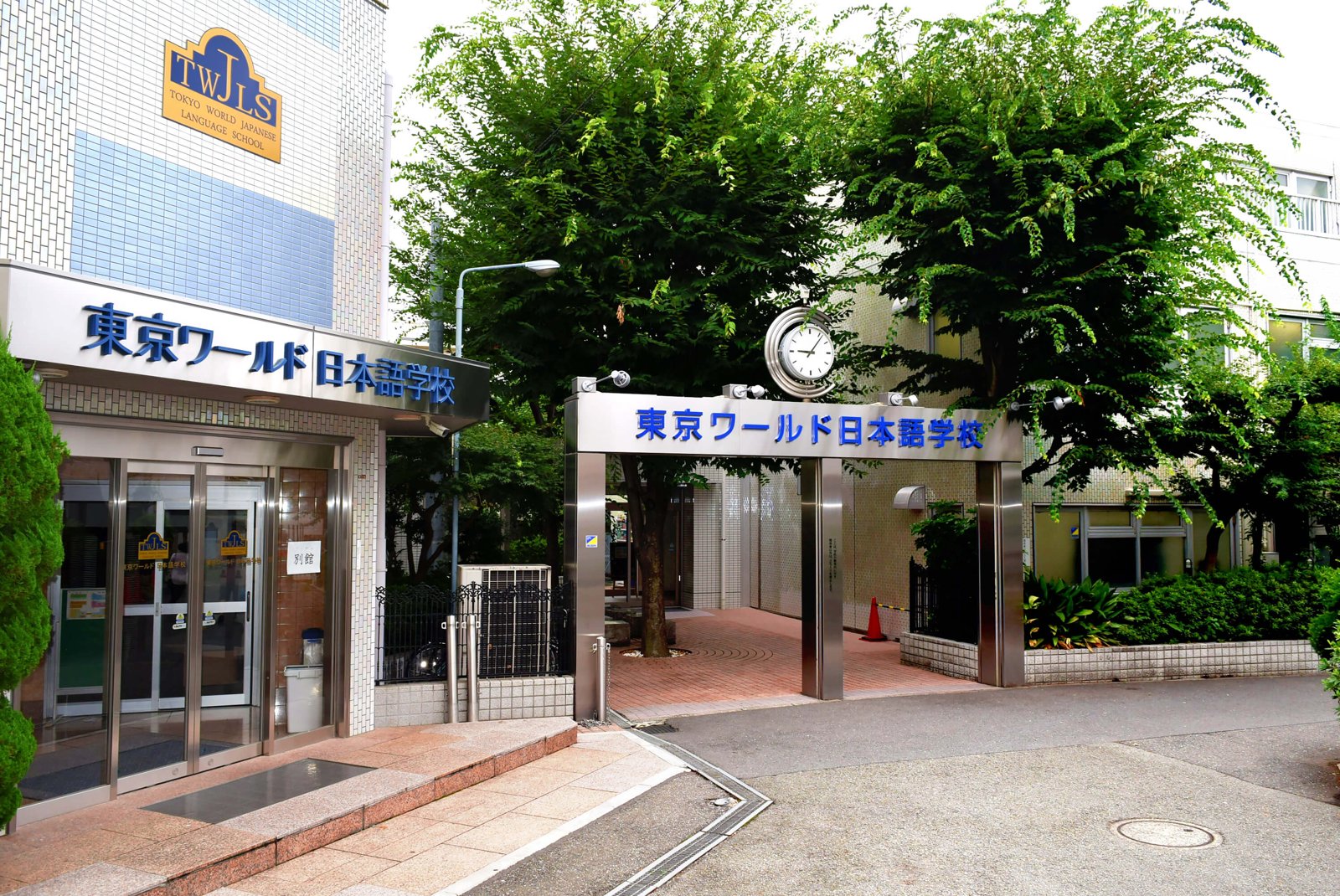
Tokyo World Japanese Language School
Tokyo World Japanese Language School
- To station
- 3 min walk · Shin-Okubo Station
- University referrals
- Applications accepted with a recommendation letter at 30+ schools ›
- Admission
- 4 times a year · choose your intake month ›
Compare side by side with other schools →
Tuition and conditions may change depending on the intake. If you contact us, we will check with the school and give you accurate details.
Nearby schools comparedBy distance · no ads or paid placement
- Tokyo World Japanese Language SchoolThis schoolTuition/yr¥877,000Installments OKProgression—IntakesJan · Apr · Jul · Oct
- Shinjuku Heiwa Japanese Language School0.1km›Tuition/yr¥826,000Progression70%IntakesJan · Apr · Jul · Oct
- ECC Japanese Language Institute Shinjuku Campus0.2km›Tuition/yr¥826,000Progression—IntakesApr · Oct
- Elite Vision Japanese Language School0.2km›Tuition/yr¥868,000Progression—IntakesApr · Jul · Oct
— means SALLAE has not yet found the data.
About the school
A large Japanese language school with a capacity of 1,752 students, operating in Shin-Okubo since 1989. It is a 3-minute walk from Shin-Okubo Station on the Yamanote Line, and in 2023 alone 94 students went on to graduate school and 288 to university. Tuition includes event fees and textbook costs, and installment payment is available. The website supports Korean.
Published data and school website
Tuition
⚠ Installment payment varies by source — please confirm with the school. Installments allowed per the MEXT published materials · The 1st payment starts from ¥481,000 (application fee, admission fee + half a year of tuition and facility fee) · The published materials allow payment every half year, but the school website's table gives the payment at enrollment as ¥877,000 for the full year — please confirm when you consult
If you saw a lower amount elsewhere, it may not include the admission fee and application fee
Median 1-year tuition in other areas — Kyoto ¥911,000(7 schools) · Kanagawa ¥880,000(8 schools) · Okinawa ¥858,000(6 schools) · Tokyo ¥840,600(56 schools) · Fukuoka ¥835,000(12 schools) · Hyogo ¥825,500(7 schools) · Osaka ¥814,000(27 schools) · Shizuoka ¥790,000(9 schools) · Chiba ¥745,333(10 schools) · Aichi ¥740,667(5 schools)
Total by intake
| Intake · length | Full course |
|---|---|
| January intake · 1 year 3 months | ¥1,075,000 |
| October intake · 1 year 6 months | ¥1,273,000 |
| July intake · 1 year 9 months | ¥1,471,000 |
| April intake · 2 years | ¥1,669,000 |
Cost details · course tables · notes · 3 items
- Per term
- ¥198,000 3 months · Based on tuition
- One-time fees
- ¥877,000Tuition ¥750,000 · Application fee ¥20,000 · Admission fee ¥65,000 · Facility fee ¥42,000
According to the school guide, fees are paid in one lump sum at enrollment. Installments are available.
| Intake · course | Extra 2nd-year costs | All |
|---|---|---|
| January · 1 year 3 months | ¥198,000 | ¥1,075,000 |
| October · 1 year 6 months | ¥396,000 | ¥1,273,000 |
| Jul · 1 year 9 months | ¥594,000 | ¥1,471,000 |
| April · 2 years | ¥792,000 | ¥1,669,000 |
Costs added in year 2. The application fee and admission fee are not charged again. Year-2 payment: 1 year 3 month course ¥198,000 / 1 year 6 months ¥396,000 / 1 year 9 months ¥594,000 / 2 years ¥792,000
* The above costs include school event fees and textbook costs.
Short-term course 2 months ¥145,000 / business class: first 3 months ¥232,500, second 3 months ¥222,500
EJU preparation special classes: English ¥10,800, Mathematics I ¥21,600, Integrated subjects ¥21,600 (each 3 months)
Short-term 3 months is charged separately: ¥207,500 (admission fee ¥10,000 · tuition ¥187,500 · facility fee ¥10,000).
School website · 2026-01-07 updated
Whether it is refundable
- If the Certificate of Eligibility is not issued
- Only the application fee (¥20,000) is charged
- If the Japanese embassy refuses to issue a visa
- Fees paid, except the application fee and admission fee, are refunded / the application requires documents confirming the visa refusal (such as the passport)
- If the student declines enrollment for personal reasons before entering Japan
- Fees paid, except the application fee and admission fee, are refunded / the CoE and letter of admission must be returned and a written notice of withdrawal submitted
- Cancellation after enrolment: withdrawal midway
- As a rule, none of the payments is refunded
See refund policy in detail · 1 more line
- When you receive a refund
- Bank transfer fees are borne by the payer
Admission & dates
⚠ The application differs by source. Please confirm with the school. April term: Sep–Nov of the previous year / October term: Apr–Jun (course guide and application for admission) · April intake: Sep–Oct of the previous year / October intake: Apr–May (student visa and application timing and deadlines) The school's own pages differ — please confirm with the school before you apply
- Jan intake
- 1 year 3 months course · Application July to September of the previous year
- Apr intake
- 2-year course · Application Sep–Nov of the previous year
- Jul intake
- 1 year 9 months course · Application Jan–Mar
- Oct intake
- 1 year 6 months course · Application Apr–Jun
- Japanese level
- N4–N5 equivalent or above
At application, a certificate of 150 or more hours of Japanese study, or JLPT N4–N5 or above / applicants who wish to go on to a Japanese university or similar institution must have completed 12 or more years of school education
Deadline and capacity rules
Courses cannot be changed after enrollment / the application deadline varies depending on nationality and the number of applicants
School website · Updated 2026-08-21
Classes
- Morning
- 9:00 ~ 12:30 4 periods of 45 minutes
- Afternoon
- 13:30 ~ 17:00 4 periods of 45 minutes
- AM/PM placement
- General course: choose either morning classes or afternoon classes
- Class assignment
- Level-based 6 stages
- Elective classes
- Business Japanese · Japanese culture (kimono dressing, flower arranging, tea ceremony experience, etc.) · Video and anime Japanese · JLPT prep · EJU prep · Elective classes are held one day a week for students in intermediate and higher classes
Materials · Subjects · Timetable · Details
- Materials
- Minna no Nihongo Beginner I and II / Manabou! Nihongo Pre-intermediate, Intermediate, Upper-intermediate and Advanced
- Subject
- Role-play conversation practice · Characters and kanji · Grammar · Reading · Listening · Long compositions (pre-intermediate) / Short essay writing (upper-intermediate) / Techniques for getting full marks on compositions (university prep course) · Beginner I, Beginner II, Pre-intermediate and Intermediate are 3 months each; Upper-intermediate and Advanced are 6 months each
General course: morning classes and afternoon classes 4 periods of 45 minutes
| Morning | Afternoon | |
|---|---|---|
| Period 1 | 9:00~9:45 | 13:30~14:15 |
| Period 2 | 9:55~10:40 | 14:25~15:10 |
| Period 3 | 10:50~11:35 | 15:20~16:05 |
| Period 4 | 11:45~12:30 | 16:15~17:00 |
Class hours by subject
| Subject | 2 years | 1 year 9 months | 1 year 6 months | 1 year 3 months | 1 year |
|---|---|---|---|---|---|
| Beginner | 400 hours | 300 hr | 200 hours | 200 hours | — |
| Lower intermediate | 200 hours | 200 hours | 220 hr | 200 hours | 200 hours |
| Intermediate | 220 hr | 220 hr | 220 hr | 200 hours | 200 hours |
| Upper intermediate | 360 hours | 360 hours | 360 hours | 280 hr | 280 hr |
| Advanced | 420 hours | 320 hours | 200 hours | 120 hours | 120 hours |
| Total | 1,600 hours | 1,400 hr | 1,200 hours | 1,000 hr | 800 hours |
Goal at completion: N1 / 1 class hour = 45 minutes / EJU preparation special classes: Monday English 17:00–19:00, Wednesday and Friday Mathematics I, Tuesday and Thursday Integrated Subjects 13:30–15:30
Goals for each level · 6 levels
- Beginner I
- 3 monthsCan respond in simple Japanese in daily life / reading and writing hiragana, katakana and basic kanji, about 300 vocabulary words
- Beginner II
- 3 monthsCan explain things in detail and convey feelings precisely / learns honorific language and can communicate with expressions suited to the other person
- Lower intermediate
- 3 monthsCan converse naturally on familiar topics using learned vocabulary, listen for needed information and state opinions / about 600 vocabulary words, understanding of intermediate grammar and sentence structures
- Intermediate
- 3 monthsCan understand abstract expressions on topics in their specialty or strong areas / can carry on conversations with native speakers without nervousness
- Upper intermediate
- 6 monthsUnderstands texts on various themes smoothly / about 2,000 vocabulary words (newspapers and magazines), comprehension of texts, writing short essays
- Advanced
- 6 monthsCan communicate about abstract and specialized matters on the theme of the current state and problems of Japanese society / vocabulary that works at university and graduate school
School website · 2025-05-21 updated
Documents to prepare — student visa course
- Copy of passportIf you have been to Japan before, also the entry record pages
- Admission application formSchool-designated form
- Diploma from the last school attended
- Certificate of enrollment if currently a student; certificate of employment if working
- Certificate of Japanese proficiency
- 5 photosTaken within 3 months · 3 cm wide × 4 cm tall
Financial supporter's documents · only if applicable · 3 application requirements
Submitted by the person paying the tuition (financial sponsor)
- Financial sponsorship statementSchool-designated form
- Documents proving the relationship between the sponsor and the applicantCertified copy of family register, etc.
- Deposit balance certificateIssued by a bank
- Account deposit and withdrawal statement or copy of passbook
- Documents proving the sponsor's occupationCertificate of employment, etc.
- Document proving the income of the person bearing the expenses
Only if applicable
- If the person bearing the expenses lives in Japan: copy of resident record (all household members), original income and tax certificates (Sponsor residing in Japan)
Application requirements
Applicants who wish to go on to a Japanese university or similar institution must have completed 12 or more years of school education. Applicants must be able to prove the Japanese ability each course requires at the time of application (those who have obtained a Japanese proficiency test result equivalent to N4–N5 or above). Applicants who have a relative, in their home country or in Japan, with sufficient assets to cover the costs of study and living during their stay in Japan
* Required documents may differ depending on nationality. Please contact us for details. SALLAE is confirming this with the school.
For the short course, submit only: application form · 2 photos · copy of passport
School website · Updated 2026-08-21
Admission process
- Request an admission consultation — Consult in Korean and prepare the documents together
- Submit the application form, required documents and the ¥20,000 application fee, then go through document screening and an interview
- Application to the Immigration Services Agency — Application to the Immigration Services Agency: for April intake, late November of the previous year; for October intake, mid-June
- Certificate of Eligibility (CoE) issued and enrollment costs paid — Application fee, admission fee, tuition and facility fee (amount due at enrollment: ¥877,000)
- Visa application at the embassy or consulate abroad / arrival in Japan — April intake: arrival in late March
- Placement test
- Document screening and interview (online available) / classes are formed every term based on the placement test at enrollment and end-of-term exam results
School website · 2025-11-28 updated
Short-term study
- Visa
- Temporary visitor or Working holiday(not a student visa)
- Duration
- 8 weeks to 3 months
- Open now?
- Rolling admissions, so availability varies from time to time — SALLAE will confirm with the school
Course without a student visa
- Business course — Duration 6 months · JLPT N2 or above, or 2 or more years of Japanese language major · April and October term intakes · first 3 months ¥232,500 / second 3 months ¥222,500 · current students pay additional tuition
- Special short-term course — Intensive short-term special course / the course is not held if applicants do not reach the minimum number / contact us for tuition
- Auditing student — For Japanese nationals or those who already hold a status of residence · 3-month units · start months January, April, July and October · tuition ¥135,000 for 3 months (materials separate)
- EJU preparation special classes — English ¥10,800 · Mathematics I ¥21,600 · Integrated subjects ¥21,600 (each 3 months) · classes are held irregularly / for intermediate-level students
★Short-term courses are not listed in the published data — it counts only student-visa courses.
School website · 2025-03-24 updated
Graduate outcomes
| FY2024 | Admitted |
|---|---|
| Graduate school | 40 students |
| University | 146 students |
| Vocational school | 368 students |
| Employment | 67 students |
| Graduates | 663 students |
See 15 more schools
+37 more schools
2023: graduate school 94, university 288, junior college 3, vocational school 316 / 2022: graduate school 71, university 211, junior college 2, vocational school 109 · FY2024: 663 completers / 649 meeting the standard (94.6%) / total of 551 who went on to universities, etc. · School website · Updated 2025-08-19
Reviews
If you study here or used to, tell others what the classes, teachers and daily life were like. It helps anyone deciding on this school.
Write the first reviewUniversity prep
- University progression course — Preparation for the Examination for Japanese University Admission (EJU), which is needed for university applications / kanji, listening, grammar, reading, writing
- Graduate school progression course — Information searching, short essays, research plans, contacting academic supervisors, interview preparation, JLPT N1 preparation
- Many designated-school recommendation slots — Students with an attendance rate of 90% or higher who work hard every day are encouraged to apply through designated-school recommendation / it lightens the burden of taking exams
- Meetings with homeroom teacher — A survey of progression wishes is conducted from enrollment / each term the homeroom teacher interviews students, and it is updated every 3 months as needed
- Annual progression guidance plan — A schedule is set so that all students regularly receive guidance such as individual interviews
- 33 designated schools — Shibaura Institute of Technology · Toyo University · Teikyo University · Musashino University · Takushoku University · Otsuma Women's University · Yamanashi Gakuin University · Shumei University · Bunka Gakuen University · Ryutsu Keizai University · Seibu Bunri University · Nippon Keizai University · Chiba Institute of Science · Niigata Technical Junior College · Osaka University of Tourism · Shobi University · Sanno University · Shiseikan University · Tokyo Polytechnic University · Kyoto University of Foreign Studies · Daiichi Institute of Technology · Kansai University of International Studies · Kaetsu University · Professional University of Information and Management for Innovation · Tokyo Rissho Junior College · Tama University · Tokyo University of Information Sciences · Shonan University of Medical Sciences · Komazawa Women's University · Nippon International Academy University · Josai International University · Josai University · Ferris University · Schools eligible for designated-school recommendation (FY2024 record) / attendance rate of 90% or higher / changes every year / 63 vocational schools (45 in Tokyo)
School website · 2025-08-20 updated
Daily-life support
- Native-language support staff — Native speakers of several languages (Chinese, Korean, Vietnamese, Nepali) are on staff / English and Indonesian are also supported
- Orientation — At enrollment, domestic laws, daily-life rules and school-life rules are explained in the student's native language and the like, and explained again in the first class of every term
- Finding housing — Introduction to student dormitories / individual consultations for students looking for housing
- Part-time work — The school does not itself actively refer students to part-time jobs, but works with employers to resolve any trouble / the workplaces of all students are checked every month
- Health checkup — Health checkups are held at the school so that all students can take one each year
- Disaster and crime prevention — Disaster-prevention seminars every 3 months with the fire department / crime-prevention talks held regularly at the school with the police
- Student support on holidays and during long breaks — Staff who can respond by phone and similar means are assigned on a rotating basis on holidays and during long breaks / during full closures, social media and email are the contact points
- Consultation system for traffic accidents and the like — For traffic accidents, the administrative office is the contact point and connects students to medical and legal consultation as needed
School website · 2025-06-30 updated
Scholarship
- Study incentive allowance
- Monthly ¥30,000 × 1 yearJapan Student Services Organization (JASSO) scholarship: excellent grades and attendance, remittances from the home country averaging ¥90,000 a month or less, annual income under ¥5 million, going on to a university or vocational school the following year / screening is held for those who wish to apply
- Perfect attendance scholarship
- ¥10,000 OnceNo late arrivals, early departures or absences (no limit on the number of recipients) / ¥3,000 for 3 months, ¥10,000 for 1 year
School website · 2026-01-07 updated
Students
1,340 students enrolled (2026) · Capacity 1,752 students National median: 180 students
Based on the 1,340 students enrolled in 2026.
Public data from the Association for the Promotion of Japanese Language Education (Nisshinkyo) · verified 2026-09-20
School life
For 1 year
- Apr
- April term entrance ceremony · New-student orientation · Classes begin
- May
- Study trip
- Jun
- Exchange party · EJU · Regular tests · Summer break
- Jul
- July term entrance ceremony · New-student orientation · JLPT · Classes begin
- Aug
- Obon holiday
- Sep
- Sports day · Regular tests · Autumn break
- Oct
- October term entrance ceremony · New-student orientation · Classes begin
- Nov
- EJU
- Dec
- JLPT · Regular tests · Winter break
- Jan
- Entrance ceremony · New-student orientation · Classes begin
- Feb
- Speech contest · Social gathering
- Mar
- Regular tests · Graduation ceremony and party · Spring break
2026 study trip (Tokyo DisneySea) / during the long break after term-end exams, international students may work up to 8 hours a day (40 hours a week)
- International students may work part-time up to 28 hours a week / during the school's long breaks, up to 8 hours a day (submit the certificate issued by the school to the workplace)
- Around Okubo, many jobs pay ¥1,200/hr or more / Tokyo's minimum wage is ¥1,226 (as of October 2025)
- Main building (1-13-24 Hyakunincho, Shinjuku-ku), Annex 2 (1-22-12 Hyakunincho) and Annex 3 (1-8-15 Kitashinjuku)
- Students take part every month in a community cleanup co-hosted by the ward, police and fire department. Volunteers are recruited, about 150 a year / they also join the neighborhood association's annual events
On campus
- All classrooms
- Interactive whiteboards, laptops and LAN wiring in every classroom — The same setup was installed in all classrooms during FY2024
- On campus
- Self-study room
- Some buildings
- Wheelchair-accessible elevators and multipurpose restrooms — Step-free barrier-free design
2026–2027 academic calendar
- Spring break
- Mar 19 (Thu) – Apr 9 (Thu), 2026
- Summer vacation
- Jun 23 (Tue) – Jul 6 (Mon), 2026
- Autumn break
- Sep 26 (Sat) – Oct 8 (Thu), 2026
- Winter break
- Dec 19, 2026–Jan 6, 2027
School website · 2026-09-17 updated
Access
- Transit
- JR Yamanote Line Shin-Okubo Station, 3 min walk
JR Sobu Line Okubo Station, 3 min walkSouth Exit
Seibu Shinjuku Line Seibu-Shinjuku Station, 5 min walk - Nearby
- Annexes 2 and 3 are a 2-minute walk from Okubo Station on the JR Sobu Line / around Okubo there are restaurants and food shops from many countries, and you can eat from about ¥500
- Dormitory
- AvailableSchool-run women's dormitory (2-person room · 3 months ¥144,000) + partner dormitories (men and women) · Student dormitory (women only): two students per room; air conditioner, refrigerator, washing machine, microwave and rice cooker; ¥144,000 for 3 months; utilities included (electricity is paid separately by the resident); 8-minute walk to the school · Based on school website
School website · 2025-07-31 updated
Dormitory — 7-minute walk from Okubo Station / options such as airport pickup / Kyoritsu International Exchange Scholarship Foundation: estimated rent ¥74,300/month, initial cost ¥152,300, meals included (breakfast and dinner)
School website · 2025-08-20 updated
Japanese language institution certified by MEXT Certification No. 20252130072 · certified Apr 30, 2026 →
SALLAE has organized the school website and published data in English.
The update date is the day that material was last revised.
Photos are materials published by the school.
This information is compiled from official sources and is not updated daily. Please confirm with the official contact before signing or applying.