Toyama International Gakuin
Toyama International Gakuin
- Course
- Further-study course only ›
- Tuition
- On the cheaper side nationwide ›
- Age requirement
- Age 25 or under ›
Compare side by side with other schools →
Tuition and conditions may change depending on the intake. If you contact us, we will check with the school and give you accurate details.
Nearby schools comparedBy distance · no ads or paid placement
- Toyama International GakuinThis schoolTuition/yr¥694,000Progression—IntakesApr · Oct
- Alice Gakuen (vocational school)53.6km›Tuition/yr¥710,000Progression75%IntakesApr · Oct
- Nagano Business Foreign Language College (vocational school)98.6km›Tuition/yr¥834,000Progression—IntakesApr · Oct
- Karuizawa International Japanese Language School122.5km›Tuition/yr¥830,000Progression—IntakesApr · Oct
— means SALLAE has not yet found the data.
About the school
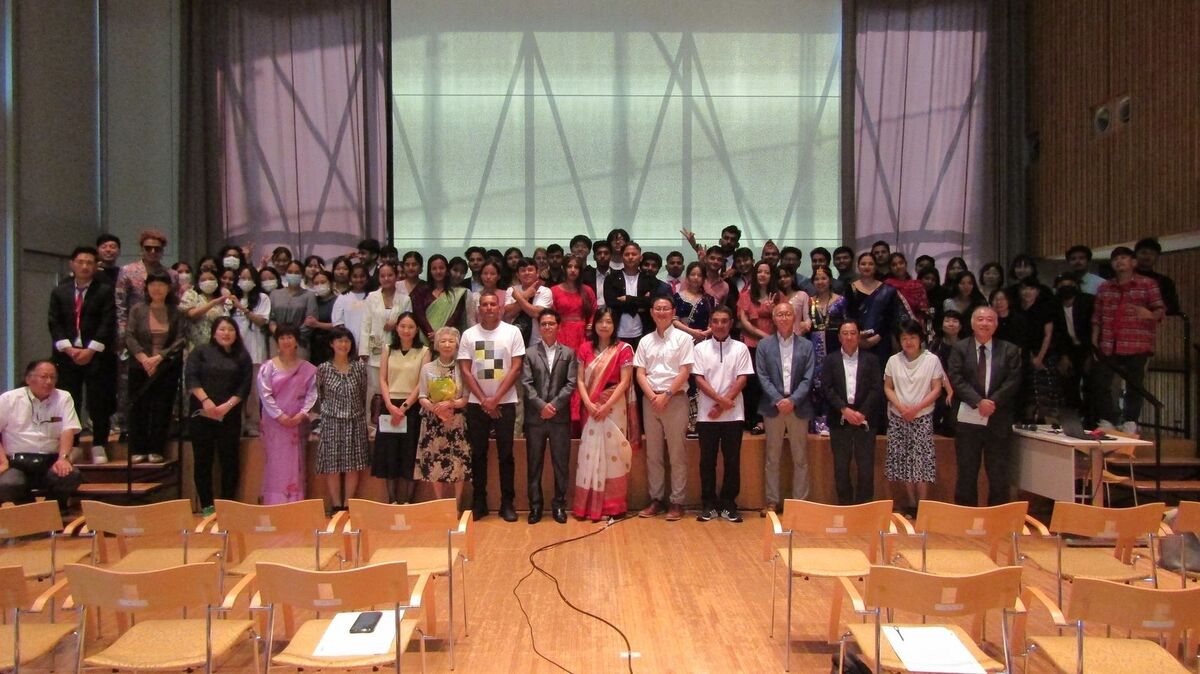
A progression-focused school with only one progression course, accepting only students who have a clear field to study after graduation. Of the 38 students who graduated in March 2026, 37 went on to further study; the named destinations were vocational schools 23 (many in tourism, hotel and business) and universities 2. It was the first Japanese language school in Hokuriku, founded in 1993, and is now run by an NPO, with three classrooms on the 2nd and 3rd floors of a building 15 minutes on foot from Toyama Station. Year 1 (beginner) classes are in the afternoon and Year 2 (upper-intermediate) classes in the morning. The school has no dormitory, but introduces private apartments on request.
Published data and school website
Tuition
If you saw a lower amount elsewhere, it may not include the admission fee and application fee
Median 1-year tuition in other areas — Kyoto ¥911,000(7 schools) · Kanagawa ¥880,000(8 schools) · Okinawa ¥858,000(6 schools) · Tokyo ¥840,600(56 schools) · Fukuoka ¥835,000(12 schools) · Hyogo ¥825,500(7 schools) · Osaka ¥814,000(27 schools) · Shizuoka ¥790,000(9 schools) · Chiba ¥745,333(10 schools) · Aichi ¥740,667(5 schools)
Total by intake
| Intake · length | Full course |
|---|---|
| 1 year 6 months | ¥995,000 |
| 2 years | ¥1,296,000 |
Cost details · Course tables · Notes
- Per term
- ¥150,500 3 months
- One-time fees
- ¥92,000Application fee · Admission fee
| Duration | Total |
|---|---|
| 1 year 6 months | ¥995,000 |
| 1 year 9 months | ¥1,145,500 |
| 2 years | ¥1,296,000 |
★"Per term" and "One-time at start" were calculated by SALLAE from each course's total. The courses this school actually offers are 1 year 6 months onward — all amounts in the table are values calculated by SALLAE.
Calculated by SALLAE · verified 2026-09-16
Admission & dates
- Apr intake
- 2-year course · Application April intake: application Sep 1 – Oct 31, 2nd exam in early November. · Classes 1760 hr
- Oct intake
- 1 year 6 months course · Application October intake: application Mar 1 – Apr 30, 2nd exam in early May. · Classes 1320 hr
- Japanese level
- JLPT N5 level or above
A pass certificate of N5 / A1 or above from an official Japanese exam (JLPT, NAT-TEST, etc.). Ability to study up to N4 / A2 level by enrollment.
Deadline and capacity rules
Japanese language progression course only. Capacity: about 56 for the 2-year course (April) and about 24 for the 1 year 6 months course (October). High school graduation or above, within 3 years of graduating from the last school attended, age 25 or under.
School website · 2025-02-18 updated
Classes
- Morning
- 09:00-12:30 Year 2 (upper-intermediate) 9:00–12:30
- Afternoon
- 13:00-16:30 Year 1 (beginner) 13:00–16:30
- AM/PM placement
- Year 1 (beginner) 13:00–16:30, Year 2 (upper-intermediate) 9:00–12:30. The class for auditing students is decided by the academy's test.
- Class size
- Max 15 students
- Class assignment
- Level-based 5 stages
Materials · Subjects · Timetable · Details
- Materials
- Beginner: Minna no Nihongo, Daichi, Dekiru Nihongo; pre-intermediate and intermediate: Chukyu e Ikou, Chukyu o Manabou, Nihongo Chukyu J301, J501 and others.
The application guidelines set the goal at JLPT N1 level for the 2-year course and N2 level for the 1 year 6 months course · the school brochure states classes are 828 periods a year (45 minutes each), and 414 periods for the first half year of the first year for the October intake · morning and afternoon times follow the auditing guide, and classes run Monday to Friday · the top page says classes are small, with 10 students per class (the school brochure gives a class capacity of 15) · proficiency tests are held twice a year, and presentations are assessed as well as the four skills · classes include tasks that use Japanese in real situations, such as making library cards and shopping · students who want supplementary lessons in subjects such as mathematics and English for progression may be charged separately (application guidelines).
What each level aims for · 5 levels
- First half of beginner
- 3 monthsGoal N5, 100 kanji, 800 vocabulary words. Can read simple notices and short sentences and understand everyday conversation. 3 months, 60 hours.
- Second half of beginner
- 3 monthsGoal N4, 300 kanji, 1,500 vocabulary words. Can read texts about daily life and understand slow everyday conversation. 3 months, 60 hours.
- Lower intermediate
- 2 monthsGoal N3, 350 kanji, 3,000 vocabulary words. Can read everyday sentences and understand everyday conversation at natural speed. 2 months, 40 hours.
- Intermediate
- Goal N2, 1,000 kanji, 6,000 vocabulary words. Can read general texts and understand coherent talks on general topics.
- Advanced
- Goal N1, 2,000 kanji, 10,000 vocabulary words. Can read newspapers and editorials and understand news and lectures.
School website · Confirmed 2026-09-26
Documents
- Admission application formAttach the photo to the designated form
- RésuméAttach the photo to the designated form
- 6 photos identical to photos (1) and (2), 3 cm × 4 cm, taken within 3 months; write name and nationality on the back
- Certificate of your last education: submit the original diploma or a graduation certificate
- High school transcript
- Certificate of passing an official Japanese exam
Financial supporter's documents · only if applicable · 6 application requirements
Submitted by the person paying the tuition (financial sponsor)
- Self-funded: bank balance certificate (in Japanese yen or US dollars, at least the amount equivalent to tuition and living costs for the study period), scholarship award certificate, certificate of employment and income, and documents for the past 3 years.
- Remittance from abroad: statement of expense support (designated form, handwritten), documents proving the relationship (family, employment, business, etc.), bank balance certificate, income certificate and documents for the past 3 years.
- Supported by a related person in Japan: statement of expense support (designated form, handwritten), tax certificate (showing annual income), residence record (listing all family members) and documents proving the relationship (an exchange of letters or photos are also acceptable).
Only if applicable
- Certificate of enrolment or certificate of expected graduation [copy] (If you are currently enrolled)
- Employment certificate (employed applicants only)
- Copy of passport (identity page) (If you have a passport)
Application requirements
Application documents must have been issued within 3 months. Write handwritten documents clearly and carefully, and follow every instruction to write by hand yourself. Documents in a language other than Japanese need a Japanese translation. A mistranslation can lead to visa denial, so provide an accurate translation, not an automatic one. Applications with incomplete entries cannot be accepted. If a problem is found in the submitted documents, admission may be cancelled even after enrollment procedures. Accepted documents (except originals such as diplomas) and paid application fees are not returned. Do I need a guarantor in Japan or a deposit? Neither is required.
School website · 2025-02-18 updated
Admission process
- Request an admission consultation — If you are interested, please contact us by phone or email.
- Inquiry → the school first selects who may apply — From among those who inquire or apply, the school selects based on whether they will actually apply for a visa and whether they meet the application requirements.
- Submit application documents and pay the application fee — Bring the application documents and the ¥20,000 application fee. If you cannot bring them, transfer the fee in advance and mail a copy of the remittance receipt with the application documents.
- The first round is document screening; the second round is an interview and written exam. — The second round is an interview and written exam, which may not be held in some cases. The second-round exam date is early November for the April intake and early May for the October intake.
- Notification of selection results — The Korean-language application guidelines state the end of December for the April intake and the end of June for the October intake.
- Application to the Immigration Services Agency for the Certificate of Eligibility — Application to the Immigration Services Agency for the Certificate of Eligibility
- Issuance of the Certificate of Eligibility — The Certificate of Eligibility (CoE) is issued in early March for the April intake and early September for the October intake.
- Tuition payment — After receiving notice that the Certificate of Eligibility (CoE) has been issued, pay the tuition and other fees promptly. This completes the enrollment procedures.
- Receive the Certificate of Eligibility and admission permit — After the tuition is paid, the school sends the Certificate of Eligibility (CoE) to the student.
- Apply for and obtain a visa at the Japanese embassy or consulate abroad. — Visa application (passport, Certificate of Eligibility (CoE), letter of admission). Visas are issued in late March for the April intake and late September for the October intake.
- Arrive in Japan and enrol — Enrollment is April 1 for the April intake and October 1 for the October intake.
- Application form
- Korean version is available
School website · 2025-02-18 updated
Short-term study
- Visa
- Working holiday(not a student visa)
- Admission
- RollingNo fixed intake months
- Open now?
- Rolling admissions, so availability varies from time to time — SALLAE will confirm with the school
Course without a student visa
- Class course — Mon–Fri; Year 1 13:00–16:30, Year 2 9:00–12:30. 4 weeks ¥58,600, 12 weeks ¥168,416, 24 weeks ¥329,450 (tax included); admission fee ¥22,000
- Private course — 90 minutes per session (45 minutes × 2). 12 sessions ¥79,200, 36 sessions ¥229,680, 72 sessions ¥455,400 (consumption tax included); admission fee ¥22,000.
- Short-term study — There are no particular rules. We will accommodate your needs. Tuition follows the class course.
- 6-month introductory course — Mon, Wed, Fri 17:30–19:10, capacity 15 (held with 2 or more students). ¥227,700–303,600 per person (tax included); admission fee ¥22,000 plus copy fee ¥11,000 (tax excluded)
- Teacher dispatch — Weekdays 9:00–17:00. Admission fee ¥20,000 plus consumption tax (per company, once); tuition ¥3,000 per 45 minutes for 1 student plus consumption tax, ¥300 per additional student plus consumption tax; transportation cost is round-trip distance × ¥20.
- Summer 9-day intensive class — Opened in August 2025 for beginners (Chinese-language notice).
★Short-term courses are not listed in the published data — it counts only student-visa courses.
School website · Confirmed 2026-09-26
Progression
| FY2025 | Admitted |
|---|---|
| Graduates | 38 students |
Passing an exam
| Exam | Pass |
|---|---|
| JLPT N2 2025 | 6 students |
| JLPT N3 2025 | 11 students |
| JLPT N4 2025 | 18 students |
| PJC Bridge B- 2025 | 2 students |
| JLPT N2 2024 | 2 students |
| JLPT N3 2024 | 4 students |
| JLPT N4 2024 | 2 students |
| JLPT N1 2023 | 1 student |
| JLPT N2 2023 | 2 students |
| JLPT N3 2023 | 19 students |
| JLPT N4 2023 | 13 students |
These are the numbers of students who passed, counted at the time international students graduate · years are fiscal years (FY2025 = graduation in March 2026) · separately, for auditing and private-lesson students: N4 2 in FY2025, N2 1 and N3 2 in FY2024, N2 1 in FY2023.
See 6 more schools
All schools accepted to so far
Based on the "Graduate Status" PDF (June 17, 2026): of the 38 students who graduated in March 2026, 37 went on to further study and 1 is on Designated Activities · named destinations are 2 universities and 23 vocational schools, and the rest are listed only as "other" · 1 auditing/private-lesson student went on to Anabuki Technical College · past graduate numbers: March 2025, 8 (all progressed); March 2024, 41 (all progressed; 1 university, 40 vocational schools); March 2023, 3 (2 progressed, 1 employed); March 2022, 2; March 2021, 22 (20 progressed, 2 employed) · cumulative destinations are based on the history PDF, the FAQ (including the English version) and the greeting message, and the history also lists Toyama College of Dentistry and Pharmacy. · School website · updated 2026-06-17
Reviews
If you study here or used to, tell others what the classes, teachers and daily life were like. It helps anyone deciding on this school.
Write the first reviewUniversity prep
- Progression preparation seminar — For students who wish to go on to Japanese universities or vocational schools, a progression preparation seminar is held.
- Online school information sessions — The school asks the schools that students wish to enter to hold online school information sessions.
- Career guidance for each school year and progression briefings by vocational schools — Besides career guidance for each school year, the school asks vocational schools to hold progression briefings from an early stage and guides students to attend them. Progression information is shared within the school, and joint exam-taking has become possible.
- Career counseling — The school provides progression and employment guidance in line with students' wishes and supports career choices through individual counseling. It also provides information on scholarship programs and support for obtaining qualifications.
School website · 2025-04-07 updated
Daily-life support
- Entry orientation — An orientation is held on arrival. Through exchange between senior and junior students, new students learn about the streets of Toyama City, where to shop, and how to ride trains and buses.
- Guidance on student life in Japan — Laws and rules needed for daily life are explained in guidance sessions and the like. Guidance is given to students about 5 times a year.
- Native-language support — Support is available in English, Chinese, Nepali, Burmese, Vietnamese and other languages
- Help desk — A teacher in charge of student life guidance is the contact point, and full-time staff are always present in the office, so students can consult them at any time.
- Insurance — Right after arriving in Japan, join National Health Insurance at the city office. It costs about ¥1,500 a month. Students also join international student insurance at the school (the premium is included in tuition).
- Health management and interpreting — The school guides students on regular health checkups and vaccinations, and provides interpreters who can handle the languages of enrolled students.
- Disaster prevention and traffic safety — Traffic safety guidance in May and a disaster drill in July are part of the curriculum.
- Part-time work guidance — Up to 28 hours a week (up to 8 hours a day during long breaks) is allowed.
- Temporary return to home country — During spring, summer and winter breaks, it is allowed in special cases such as illness or family circumstances.
- Prayer — For students from Islamic countries, the school arranges a place and time for prayer through consultation.
School website · 2025-04-07 updated
Students
47 enrolled (2025) · Capacity 60 National median: 180 students
Based on 47 students enrolled in 2025.
Public data from the Association for the Promotion of Japanese Language Education (Nisshinkyo) · verified 2026-09-20
School life
For 1 year
- 4
- Entrance ceremony · Cherry blossom viewing · New-student welcome party
- 5
- Traffic safety guidance
- 6
- Examination for Japanese University Admission for International Students (EJU, 2nd year)
- 7
- JLPT · Tanabata · Disaster drill
- 8
- Excursion · Summer break
- 10
- Entrance ceremony · New-student welcome party
- 11
- Examination for Japanese University Admission for International Students (EJU, 2nd year)
- 12
- JLPT · Winter break
- 1
- University etc. entrance exams (Year 2)
- 2
- University etc. entrance exams (Year 2)
- 3
- Study presentation · Graduation ceremony · Spring break
To the annual schedule in the Korean and English FAQs (no year shown), we added the May traffic safety guidance and July disaster drill from the 2024 self-inspection.
- Exchange activities with elementary, junior high and high school students and university students, introducing foreign cultures and sharing cooking
- Students take part in volunteer work such as local festivals, beach cleanups, bamboo grove clearing and food bank distribution.
- Growing foreign vegetables with local people in a multicultural community garden
- Students take part in Earth Day Toyama and international exchange events and perform on stage. They also work as volunteer interpreters at disaster-prevention and local events.
- The school holds disaster-prevention workshops, and by becoming disaster supporters, international students give multilingual support to foreign residents who do not understand Japanese.
- Students take part in and cooperate with the police "Easy Japanese" training
On campus
- Building
- Oda Building — A student bicycle parking area is on the 1st floor. The building is shared with other companies' parking, kitchenettes and rooms.
- 2F
- "Sora" classroom and "Umi" classroom — 30.57m²·25.19m²
- 2F
- Staff room
- 3F
- "Hoshi" classroom — 30.57m²
- 3F
- Library and infirmary (available) — The library and infirmary share a single room of 25.19 m².
- Classroom
- An environment where classes can be run effectively using audiovisual materials and ICT tools — Audiovisual materials and ICT tools are used, and online learning tools have been introduced.
- On campus
- Self-study room — There is no self-study room available outside class hours. The school introduces public study spaces and the like.
- Building
- Barrier-free — Because of the building's structure, it is difficult to implement barrier-free measures.
Academic calendar
- Summer vacation
- Aug, about 3 weeks · Based on the English FAQ.
- Winter break
- Dec 27, 2025 – Jan 12, 2026 · Based on the progression class (Chinese-language notice) · In FY2024 it was Dec 21 – Jan 5, and the English FAQ says about 2 weeks.
- Spring break
- Mar
School website · Confirmed 2026-09-26
Access
- Transit
- By Hokuriku Shinkansen or conventional line to Toyama Station; Toyama Station, 15 min walk
- Nearby
- Follow the streetcar line toward "Daigaku-mae" → turn right at the "Toyama Prefectural Government Park" traffic light → the "Oda Building" is on the right about 300 m ahead
- Dormitory
- None · SALLAE helps you look for housing nearby · Per the school website
School website · Confirmed 2026-09-26
Dormitory — There is no dormitory; private apartments are introduced. Room rent is about ¥20,000–35,000 a month, and a deposit (2–3 months' rent) and an agent fee (1 month's rent) are usual.
School website · Confirmed 2026-09-26
SALLAE has organized the school website and published data in English.
The update date is the day that material was last revised.
Photos are materials published by the school.
This information is compiled from official sources and is not updated daily. Please confirm with the official contact before signing or applying.